When someone collapses and starts making irregular gasping sounds, most bystanders assume the person is breathing and wait for help. That assumption can be fatal. Those gasps have a name: agonal breathing. Recognizing agonal breathing as a sign of cardiac arrest, not normal respiration, is one of the most critical skills any bystander can have.
Every year, more than 350,000 people in the United States experience out-of-hospital cardiac arrest, according to the American Heart Association. Studies show that agonal respirations occur in roughly 40% to 60% of cardiac arrest cases within the first few minutes. When bystanders recognize these gasps and begin CPR immediately, survival rates can increase significantly.
This guide explains what agonal breathing is, what causes it, how to identify it, and exactly what to do when you witness it. Whether you manage an AED program for your organization or simply want to be prepared for a cardiac emergency, understanding agonal breathing could help you save a life.
What Is Agonal Breathing?
Agonal breathing, also called agonal respirations or gasping breathing, refers to abnormal, involuntary gasps that occur when the brain is deprived of oxygen. These gasps are not true breathing. They are a brainstem reflex triggered when oxygen levels in the brain drop to dangerously low levels.
The term “agonal” comes from the Greek word agonia, meaning struggle. Agonal breaths represent the body’s final, reflexive attempt to draw in air when normal respiratory function has failed.
It is important to understand that agonal breathing does not provide adequate oxygen to sustain life. A person displaying agonal respirations is in immediate danger and requires emergency intervention. Agonal breathing is most commonly associated with sudden cardiac arrest, but it can also occur during stroke, near-drowning, suffocation, drug overdose, and other events that cut off blood flow to the brain.
What Does Agonal Breathing Sound Like?
Agonal breathing does not look or sound like normal breathing, but its varied presentation is exactly what makes it dangerous. Bystanders frequently misidentify agonal respirations as signs that a person is still breathing adequately.
Common descriptions of agonal breathing include:
- Gasping or gulping for air with long pauses between breaths
- Snoring or snorting sounds, sometimes mistaken for sleep
- Gurgling or choking noises, often caused by fluid in the airway
- Moaning or groaning, which can sound distressing but is involuntary
- Labored, shallow breaths that barely move the chest
Unlike normal breathing, which occurs at a rate of 12 to 20 breaths per minute with a steady rhythm, agonal breaths are slow, irregular, and infrequent. Rescuers typically report observing fewer than 10 to 12 gasps per minute. The chest may barely rise, and the person will be unresponsive and unconscious.
The key distinction is straightforward: normal breathing is steady, rhythmic, and effective. Agonal breathing is slow, irregular, and desperate. If you find yourself questioning whether someone is breathing normally, treat the situation as an emergency.
Why Agonal Breathing Happens During Cardiac Arrest
The most common cause of agonal breathing is sudden cardiac arrest. Understanding the connection between the two helps explain why immediate action is so critical.
During cardiac arrest, the heart’s electrical system malfunctions. The heart stops pumping blood effectively, often due to an abnormal rhythm called ventricular fibrillation. Without a functioning heartbeat, blood stops flowing to the brain and other vital organs.
Within seconds of losing blood flow, the brain begins to shut down. The lower brainstem, which controls involuntary functions like breathing, sends out distress signals in a last-ditch effort to restore oxygen intake. These signals produce the gasping, irregular breaths we call agonal respirations.
Here is why this matters: agonal breathing is actually a positive sign during cardiac arrest. Research published in medical journals has shown that cardiac arrest patients who exhibit agonal breathing have higher survival rates than those who do not gasp at all. One study found that 27% of patients with agonal breathing survived to hospital discharge, compared to only 9% of those without it.
Agonal breathing indicates that the brainstem is still functioning and that the brain has not yet suffered irreversible damage. This creates a critical window of opportunity. If CPR and defibrillation are started during this window, the chances of survival improve dramatically.
Other Causes of Agonal Breathing
While cardiac arrest is the most common trigger, agonal breathing can also result from:
- Ischemic stroke, when a blood clot blocks an artery supplying the brain
- Severe heart attack, which can progress to cardiac arrest
- Near-drowning or suffocation, which deprives the brain of oxygen
- Drug overdose, particularly opioids, which suppress the respiratory center
- Carbon monoxide poisoning
- Severe trauma affecting the brain or spinal cord
- Choking that completely obstructs the airway
In each case, the underlying mechanism is the same: the brain is not receiving the oxygen it needs, and the brainstem responds with agonal gasps.
How to Recognize Agonal Breathing vs. Normal Breathing
One of the most dangerous aspects of agonal breathing is that it can fool bystanders into inaction. Studies of 911 calls have found that bystanders and even dispatchers sometimes mistake agonal respirations for normal breathing, leading to critical delays in CPR.
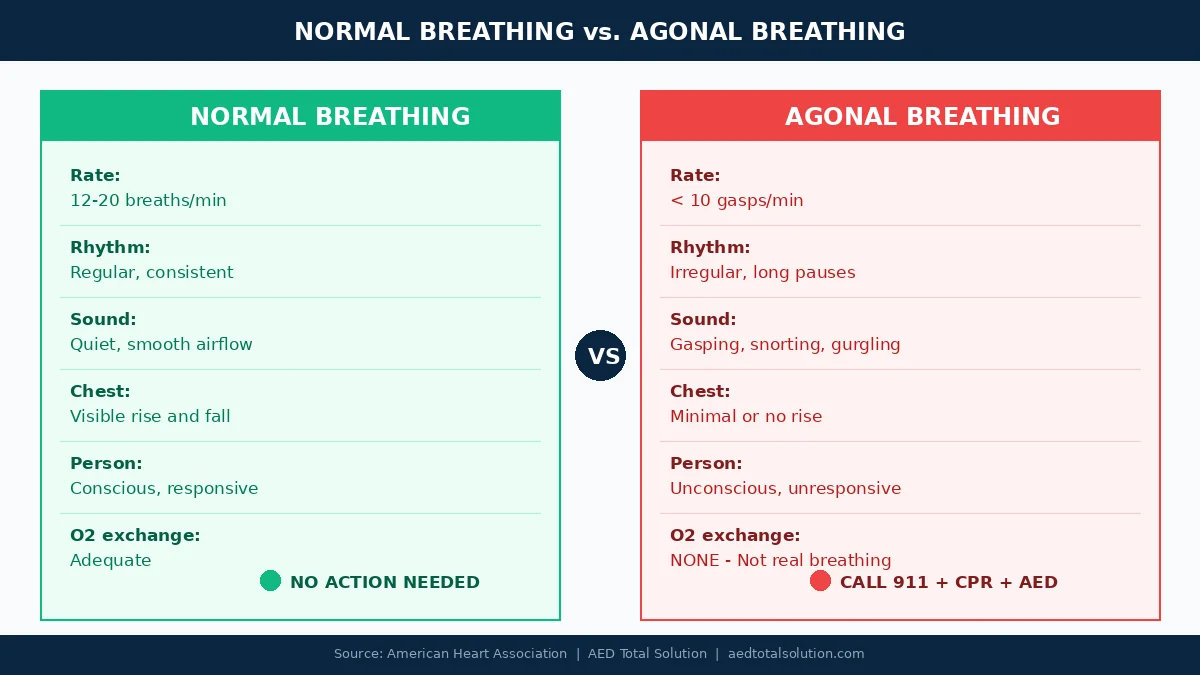
Here is a side-by-side comparison to help you tell the difference:
| Characteristic | Normal Breathing | Agonal Breathing |
|---|---|---|
| Rate | 12-20 breaths per minute | Fewer than 10 gasps per minute |
| Rhythm | Regular and consistent | Irregular with long pauses |
| Sound | Quiet, smooth airflow | Gasping, snorting, gurgling, moaning |
| Chest movement | Visible, steady rise and fall | Minimal or absent chest rise |
| Consciousness | Person is awake or arousable | Person is unresponsive |
| Effectiveness | Adequate oxygen exchange | No effective oxygen exchange |
The golden rule: If someone has collapsed, is unresponsive, and is not breathing normally, or you are unsure, treat it as cardiac arrest. Begin CPR immediately.
What to Do When You See Agonal Breathing
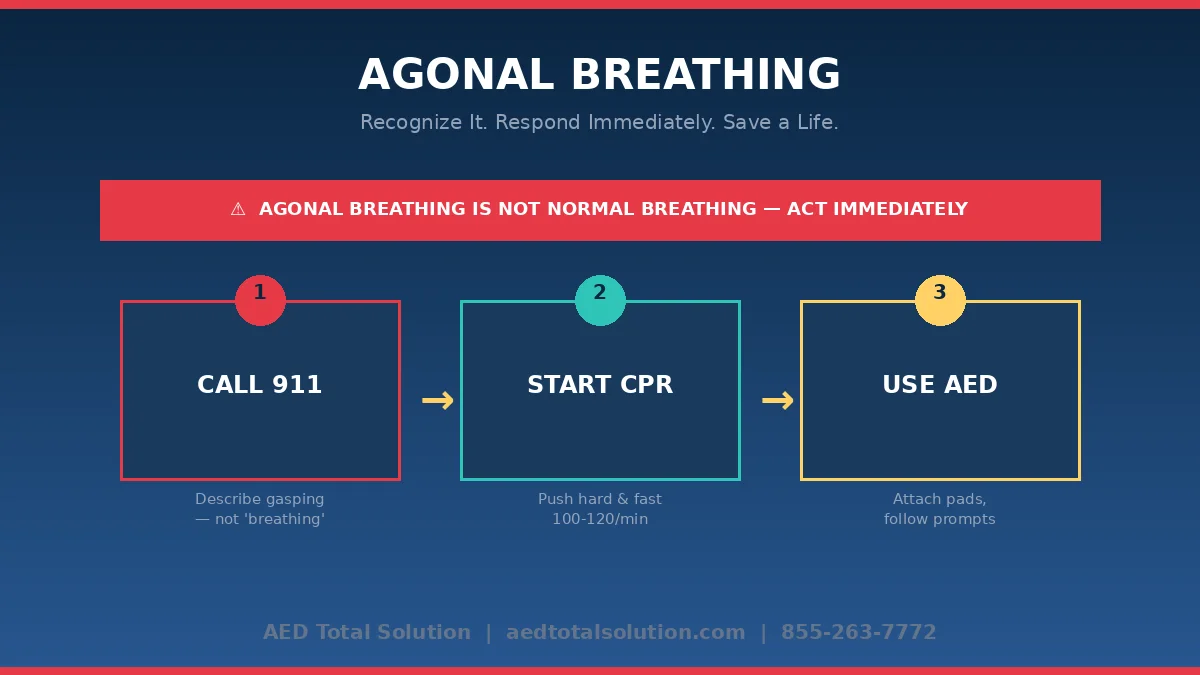
If you encounter someone who is unresponsive and displaying signs of agonal breathing, follow these three steps immediately. In emergency medicine, this is known as the Call-Push-Shock protocol:
Step 1: Call 911
Call emergency services immediately or instruct someone nearby to make the call. When speaking to the dispatcher, describe the breathing as “gasping” or “abnormal breathing,” not just “they’re breathing.” This distinction helps dispatchers correctly identify cardiac arrest and provide appropriate instructions.
Step 2: Start CPR Immediately
Do not wait for the agonal breathing to stop. Begin hands-only CPR:
- Place the heel of one hand on the center of the person’s chest (on the breastbone)
- Place your other hand on top, interlocking your fingers
- Push hard and fast, compressing the chest at least 2 inches deep
- Maintain a rate of 100 to 120 compressions per minute (the tempo of “Stayin’ Alive” by the Bee Gees)
- Allow the chest to fully recoil between compressions
- Do not stop compressions unless an AED is ready to analyze or emergency responders take over
CPR manually circulates blood to the brain and vital organs, buying critical time until defibrillation can restore a normal heart rhythm.
Step 3: Use an AED as Soon as One Is Available
An automated external defibrillator (AED) is the definitive treatment for the most common cause of cardiac arrest: ventricular fibrillation. Agonal breathing is strongly associated with shockable heart rhythms, which means an AED can often correct the problem.
To use an AED:
- Turn on the device and follow the voice prompts
- Attach the adhesive electrode pads to the person’s bare chest as shown in the diagrams on the pads
- Allow the AED to analyze the heart rhythm (ensure no one is touching the person)
- If a shock is advised, press the shock button when prompted
- Resume CPR immediately after the shock is delivered
AEDs are designed for use by anyone, even without formal training. The device analyzes the heart rhythm automatically and will only deliver a shock if one is needed. You cannot accidentally harm someone with an AED. Learn more about how AEDs work in our complete guide to defibrillators.
How AEDs Save Lives When Agonal Breathing Is Present
The presence of agonal breathing during cardiac arrest is actually an encouraging sign for rescuers. Here is why:
Agonal breathing indicates a shockable rhythm. Research has demonstrated that cardiac arrest patients with agonal respirations are more likely to have ventricular fibrillation or pulseless ventricular tachycardia, the two heart rhythms that respond to defibrillation. An AED delivers a controlled electrical shock that can reset the heart’s electrical system and restore a normal pumping rhythm.
Time is the critical factor. For every minute that passes without defibrillation, the chance of survival decreases by approximately 7% to 10%. When agonal breathing is present, the brain is still alive but running out of time. Immediate CPR combined with rapid AED use provides the best chance of a positive outcome.
Survival data supports early intervention. According to the American Heart Association, when bystanders provide CPR and use an AED before emergency services arrive, cardiac arrest survival rates can improve from less than 10% to over 40%. The combination of recognizing agonal breathing, starting CPR, and applying an AED creates the strongest chain of survival.
This is why having an AED accessible in your workplace, school, gym, or public space is not just a good idea; it is a critical component of emergency preparedness. Organizations that maintain compliant AED programs ensure that when a cardiac arrest happens, the tools to save a life are within reach. For organizations without defibrillators, our AED rental program provides an affordable way to get started.
Common Misconceptions About Agonal Breathing
Misunderstanding agonal breathing leads to preventable deaths. Here are the most dangerous myths and the facts that correct them:
Misconception 1: “They’re breathing, so they don’t need CPR.”
Fact: Agonal breathing is NOT normal breathing. It does not deliver adequate oxygen to the brain or body. A person with agonal respirations needs CPR immediately, just as if they were not breathing at all.
Misconception 2: “Agonal breathing means the person is recovering.”
Fact: Agonal breathing is a sign of severe physiological distress, not recovery. It indicates the brain is being deprived of oxygen. Without CPR and defibrillation, the person will progress to complete respiratory and cardiac failure.
Misconception 3: “I might hurt them if I start CPR while they’re gasping.”
Fact: You cannot make the situation worse by starting CPR on someone who is unresponsive and breathing abnormally. The risk of doing nothing far outweighs the risk of performing chest compressions. CPR is the only thing keeping blood flowing to the brain during cardiac arrest.
Misconception 4: “Agonal breathing is the same as the death rattle.”
Fact: While both involve abnormal breathing sounds, they are different. The death rattle typically occurs in the final hours of life due to terminal illness, where fluid accumulates in the throat. Agonal breathing is a sudden event, usually associated with a treatable cardiac emergency. When agonal breathing occurs in a person who suddenly collapses, immediate emergency response is required.
Misconception 5: “Only medical professionals can help.”
Fact: Bystander CPR and AED use are consistently shown to be among the most powerful predictors of cardiac arrest survival. You do not need medical training to perform hands-only CPR or operate an AED. These devices provide step-by-step voice instructions and are designed for untrained users.
How Long Does Agonal Breathing Last?
Agonal breathing can last anywhere from a few seconds to several minutes after cardiac arrest occurs. In some cases, it may continue for longer, depending on the cause and the individual’s physiology.
Regardless of duration, every second of agonal breathing represents a window of opportunity. The sooner CPR and defibrillation begin, the better the outcome. Do not wait for agonal breathing to stop before taking action. Do not try to time the gasps or count breaths. If someone is unresponsive and not breathing normally, act immediately.
Is Your Organization Prepared for a Cardiac Emergency?
Agonal breathing is one of the first visible signs of cardiac arrest, and recognizing it triggers the chain of survival. But recognition alone is not enough. Your organization needs the right equipment, training, and program management to respond effectively.
At AED Total Solution, we provide full-service AED program management that ensures your AEDs are compliant, maintained, and ready to save a life at a moment’s notice. Our services include:
- AED selection, placement guidance, and registration
- Routine inspections and readiness verification
- Battery and pad replacement tracking
- Remote monitoring with automated alerts
- Audit-ready compliance documentation
- CPR and AED training programs for your team
Whether you are building a new AED program or upgrading an existing one, we make compliance simple and readiness guaranteed.
Contact AED Total Solution at 855-263-7772 or visit aedtotalsolution.com to learn how we can help your organization prepare for cardiac emergencies.
Frequently Asked Questions About Agonal Breathing
What is agonal breathing?
Agonal breathing refers to abnormal, involuntary gasping breaths that occur when the brain is deprived of oxygen. It is commonly seen during sudden cardiac arrest and is not effective breathing. Agonal respirations are a sign that the person needs immediate CPR and defibrillation.
What does agonal breathing sound like?
Agonal breathing can sound like gasping, snorting, gurgling, choking, or moaning. The breaths are slow, irregular, and infrequent, with long pauses between gasps. They do not follow a normal breathing rhythm and should not be mistaken for adequate respiration.
What causes agonal breathing?
The most common cause is sudden cardiac arrest, which stops blood flow to the brain. Other causes include stroke, severe heart attack, near-drowning, drug overdose (especially opioids), carbon monoxide poisoning, and severe trauma.
Should I perform CPR if someone is breathing agonally?
Yes, absolutely. Agonal breathing is not effective breathing. If someone is unresponsive and displaying gasping or abnormal breathing, you should call 911, begin chest compressions immediately, and use an AED as soon as one is available.
How long does agonal breathing last?
Agonal breathing can last from a few seconds to several minutes. In some cases, it may persist longer. Regardless of duration, it is a medical emergency that requires immediate CPR and defibrillation.
Is agonal breathing the same as the death rattle?
No. The death rattle is a breathing pattern typically heard in the final hours of a terminal illness. Agonal breathing occurs suddenly, usually during a treatable emergency like cardiac arrest. When a seemingly healthy person collapses and starts gasping, this is agonal breathing and demands immediate emergency response.
Does agonal breathing mean the person will survive?
Agonal breathing indicates the brainstem is still active, which is a more favorable sign than no breathing at all. Studies show that cardiac arrest patients with agonal breathing have higher survival rates when they receive prompt CPR and defibrillation. However, survival depends on how quickly bystanders respond.
Written by Prabakar Mahalingam, Managing Partner at AED Total Solution. Prabakar is a nationally recognized provider of safety training, products, and proprietary compliance software dedicated to addressing Sudden Cardiac Arrest (SCA).