

Key Takeaways
- AED registration connects your device to the emergency response network. When you register your AED, 911 dispatchers can direct callers and bystanders to the nearest available defibrillator during a sudden cardiac arrest, dramatically improving survival odds.
- Many states legally require AED registration. While there is no single federal mandate, states like New York, California, New Hampshire, and many others have laws that require AED owners to register their devices with local EMS agencies or state health departments.
- Registration supports maintenance, legal protection, and compliance. A registered AED helps you stay current on battery and pad expiration dates, strengthens your Good Samaritan legal protections, and ensures your AED program passes regulatory audits.
What Is AED Registration?
AED registration is the process of recording the location, make, model, and serial number of your Automated External Defibrillator (AED) with a local, state, or national registry. The purpose is straightforward: to make sure that emergency responders, 911 dispatchers, and even nearby bystanders know exactly where your AED is located so it can be accessed quickly during a sudden cardiac arrest (SCA) emergency.
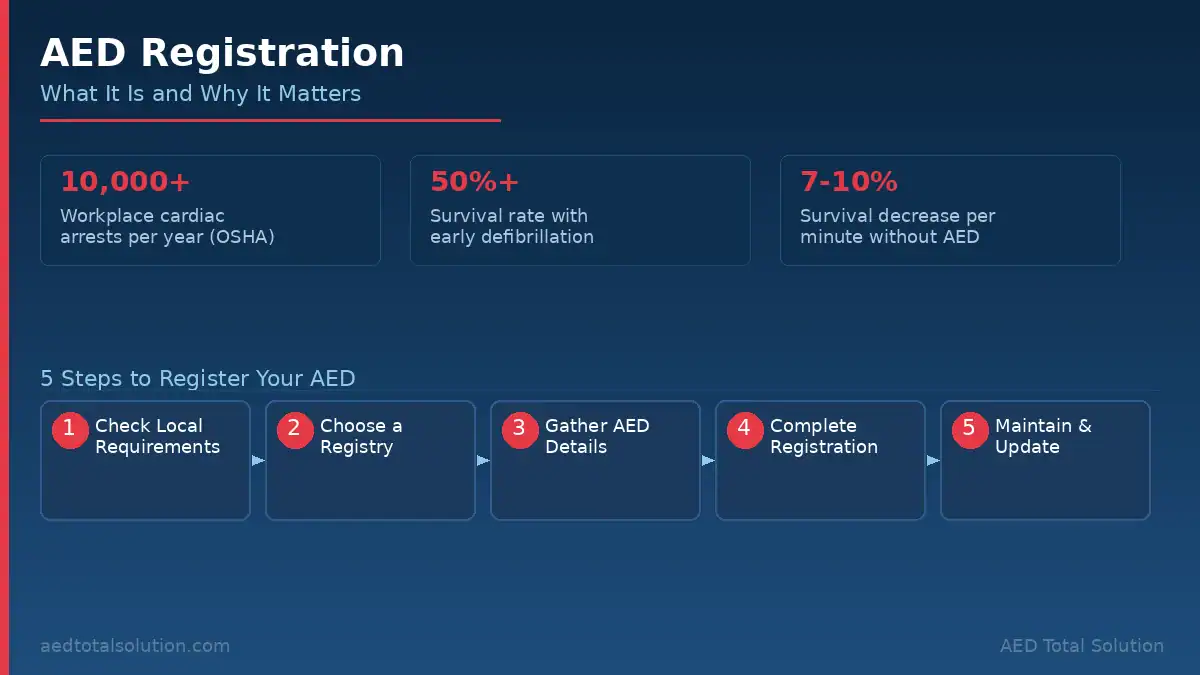
When someone experiences SCA, every second counts. The American Heart Association reports that survival rates decrease by 7 to 10 percent for each minute without defibrillation. An AED that no one can find in an emergency is an AED that cannot save a life. Registration bridges that gap by putting your device on the map, literally.
Registration typically involves providing the following information:
- AED make, model, and serial number
- Exact physical location (building, floor, room, wall mount position)
- Contact information for the person responsible for the device
- Maintenance supervisor details
- Staff training certifications (optional in many registries)
The process usually takes less than 10 minutes and can be completed through platforms like the National Emergency AED Registry (NEAR) via the PulsePoint app, your state health department, or your local fire/EMS agency.
Why AED Registration Matters
Purchasing an AED is a critical first step in workplace and public safety. But without registration, your device remains invisible to the emergency response system. Here is why AED registration matters for every organization that owns a defibrillator.
Faster Emergency Response Times
When a 911 call comes in for a suspected cardiac arrest, dispatchers need to act fast. If your AED is registered, the dispatcher can immediately see that a defibrillator is available at or near the caller’s location. They can then direct the caller, a bystander, or an employee to retrieve the device while paramedics are en route.
According to the Occupational Safety and Health Administration (OSHA), approximately 10,000 cardiac arrests occur in U.S. workplaces each year. Studies show that early defibrillation, delivered within three to five minutes, can produce survival rates above 50 percent, compared to just 5 to 7 percent when victims must wait for EMS arrival alone. AED registration is what connects your device to that critical chain of survival.

Integration With Emergency Apps and Mapping Systems
Modern AED registries integrate with mobile applications like PulsePoint, which alert trained bystanders to nearby cardiac arrest events and show them where the closest registered AED is located. When your AED is registered, it becomes part of this public lifesaving network. Unregistered devices remain invisible to these systems, limiting their potential to save lives beyond your immediate staff.
Legal Protection and Compliance
AED registration is directly linked to the legal protections available to organizations and individuals who use a defibrillator in an emergency. Most state Good Samaritan laws, which shield you from liability when you render emergency aid in good faith, require that your AED program meets certain standards. Registration is frequently one of those standards.
If your AED is unregistered and it is used during an emergency, or if an emergency occurs and your device is not accessible, your organization may face legal exposure. A registered, well-maintained AED program demonstrates due diligence and responsible stewardship.
Simplified Maintenance and Recall Tracking
Many AED registries provide automated reminders for critical maintenance tasks, including:
- Electrode pad expiration dates
- Battery replacement schedules
- Manufacturer product recalls
- Software update notifications
Between 1996 and 2005, over 21 percent of AEDs were subject to recalls. A registered device ensures you receive timely notification if your specific AED model is affected, preventing a scenario where your device fails during the moment it is needed most.
Federal AED Registration Requirements
There is no single federal law that mandates AED registration for all businesses. However, several federal frameworks shape how AEDs are regulated and managed.
FDA Regulation of AEDs
The U.S. Food and Drug Administration (FDA) classifies AEDs as Class III medical devices. This means that their manufacture, distribution, and marketing are subject to strict federal oversight. While the FDA does not require end-user registration, it does require that AED manufacturers maintain tracking systems for device recalls and safety notifications. Registering your AED with the manufacturer ensures you receive these critical updates.
The Cardiac Arrest Survival Act (CASA)
Signed into law in 2000, the Cardiac Arrest Survival Act established guidelines for placing AEDs in federal buildings and provided Good Samaritan protections for individuals who use an AED in an emergency. CASA also encouraged coordination between AED placement and local emergency medical systems, reinforcing the importance of registration as a link between device owners and first responders.
OSHA Guidelines
OSHA does not have specific standards requiring AEDs in the workplace. However, OSHA strongly recommends AEDs as part of a comprehensive workplace safety and first-aid program, particularly in higher-risk industries such as construction, manufacturing, healthcare, and fitness facilities. OSHA’s guidelines specifically state that AEDs should be registered with the manufacturer to receive updates and recalls, and that employers should coordinate their AED program with local EMS.

State AED Registration Laws
While the federal government provides the overarching framework, the most specific and enforceable AED registration requirements come from state and local governments. This creates a patchwork of regulations that can be challenging for organizations, especially those operating across multiple states.
States That Require AED Registration
Many states have enacted laws that require AED owners to register their devices with local EMS, the state health department, or both. Examples include:
- New Hampshire: State law (RSA 153-A:33) requires AED owners to register their devices with the Department of Safety within 30 days of acquisition.
- New York: Requires AED registration with local EMS agencies and mandates AEDs in certain public buildings, schools, and fitness centers.
- California: Requires businesses with AEDs to notify local EMS, maintain the device per manufacturer standards, and ensure trained personnel are available.
- New Jersey: Janet’s Law requires all school districts to have registered AEDs on site.
- Florida: Requires AED registration in certain facilities and mandates compliance with maintenance and training standards.
- Illinois: Requires AEDs in schools and fitness facilities, with registration and maintenance obligations.
Common Requirements Across States
While the specifics vary, most state AED laws include several common elements:
- Registration of the AED with local emergency medical services
- Written notification to local EMS of the AED’s location
- A physician’s prescription or medical direction for the AED program
- Regular inspection and maintenance per manufacturer guidelines
- Trained personnel designated to use the AED
- Post-event data review by a prescribing physician
Because these requirements change over time as legislation is updated, it is essential for organizations to review their state’s current AED laws regularly, especially those operating in multiple states.
How to Register Your AED
Registering your AED is a straightforward process. Here is a step-by-step guide to get your device on the map and fully integrated into the emergency response system.
Step 1: Check Your Local and State Requirements
Before registering, find out whether your state or local jurisdiction requires AED registration. Contact your local fire department, EMS agency, or state health department. Many states publish their AED requirements online.
Step 2: Choose a Registry
There are several options for AED registration:
- National Emergency AED Registry (NEAR): Administered by the PulsePoint Foundation, this is the largest national registry with over 200,000 alertable AEDs. You can register for free at nationalaedregistry.com or through the PulsePoint AED app.
- State and Local Registries: Some states and cities maintain their own AED registries. Check whether your jurisdiction has a specific registry you should use.
- Manufacturer Registration: Register your AED directly with the manufacturer (such as Philips, ZOLL, Physio-Control, or HeartSine) to receive recall notices, software updates, and maintenance reminders.
Step 3: Gather Your AED Information
Have the following details ready:
- AED make, model, and serial number
- Exact installation location (building address, floor, room, wall position)
- Contact person responsible for the AED
- Electrode pad and battery expiration dates
- Any associated medical direction or physician oversight details
Step 4: Complete the Registration
Submit your information through the chosen registry platform. Most online registrations take fewer than 10 minutes per device.
Step 5: Maintain and Update Your Registration
AED registration is not a one-time task. You should update your registry entry whenever:
- The AED is relocated
- Electrode pads or batteries are replaced
- The contact person changes
- The device is decommissioned or replaced
Consequences of Not Registering Your AED
Failing to register your AED can have serious consequences:
- Reduced emergency response effectiveness: Without registration, 911 dispatchers and emergency apps cannot direct people to your device.
- Legal liability: An unregistered AED may not qualify for Good Samaritan protections in your state, exposing your organization to lawsuits.
- Missed maintenance alerts: Without registry reminders, batteries and pads may expire unnoticed, rendering the device non-functional.
- Regulatory penalties: In states that require registration, non-compliance can result in fines and regulatory action.
- Failed audits: For organizations subject to safety audits, an unregistered AED can flag a compliance deficiency.
How AED Total Solution Simplifies AED Registration and Compliance
Managing AED registration and ongoing compliance can be complex, especially for organizations with multiple devices across multiple locations. This is where a full-service AED program management partner makes all the difference.
At AED Total Solution, we handle every aspect of AED program management, including registration. Our white-glove service covers:
- Device Registration: We register your AEDs with the appropriate local, state, and national registries on your behalf.
- Remote Readiness Monitoring: Our automated monitoring system tracks your AED status, sending alerts for pad and battery expirations, upcoming inspections, and compliance milestones.
- Audit-Ready Documentation: We maintain complete compliance records so your organization is always prepared for regulatory review.
- Multi-Location Support: For organizations managing AEDs across multiple sites, our centralized dashboard provides visibility and control across every device.
- Medical Oversight: We coordinate physician oversight and medical direction as required by state regulations.
Whether you are a small business with a single AED or an enterprise managing devices across dozens of locations, our program ensures your AEDs are registered, maintained, compliant, and always ready to save a life.
Contact AED Total Solution to learn how our managed AED program can simplify registration and keep your organization compliant.
Frequently Asked Questions About AED Registration
Is AED registration required by federal law?
No, there is no single federal law requiring AED registration for all organizations. However, many states have their own registration requirements, and federal guidelines from OSHA and the FDA strongly recommend registration as part of a compliant AED program.
How long does AED registration take?
Most online AED registration platforms, such as the PulsePoint-powered NEAR registry, take less than 10 minutes per device. You will need your AED’s make, model, serial number, and exact location.
Does AED registration cost anything?
Registration with the National Emergency AED Registry (NEAR) and PulsePoint is free. Some state registries and manufacturer registrations are also free. AED program management services, which often include registration as part of a broader compliance package, are available through providers like AED Total Solution.
What happens if I do not register my AED?
An unregistered AED remains invisible to 911 dispatchers and emergency response apps. Depending on your state, you may also face fines, loss of Good Samaritan protections, and failed compliance audits.
Do I need to register my AED with the manufacturer?
Yes. In addition to registering with local or state EMS, you should register your AED directly with the manufacturer. This ensures you receive product recall notifications, software updates, and maintenance reminders.