How to Use an AED: A Step-by-Step Overview
An automated external defibrillator (AED) is a portable device that analyzes a person’s heart rhythm and delivers an electrical shock to restore a normal heartbeat during sudden cardiac arrest. AEDs are designed so that anyone can use them, even without medical training.
Sudden cardiac arrest kills more than 356,000 Americans outside of hospitals every year. When an AED is used within the first 3 to 5 minutes, survival rates can improve dramatically. For current benchmarks, see our 2026 update on AED survival rates compared with CPR alone. Knowing how to use an AED could save the life of a co-worker, family member, or stranger.
This guide walks you through every step of using an AED, from recognizing cardiac arrest to delivering a shock and continuing care until emergency medical services arrive.
Before You Use the AED: Assess the Scene
Before touching the AED or the patient, take 5 to 10 seconds to assess the situation. This is the first link in the Chain of Survival.
Step 1: Check for safety
- Make sure the area is safe for you and the victim (no water, electrical hazards, or traffic)
- If the person is in water, move them to a dry surface before using the AED
- If there are flammable gases or oxygen present, move the person away before delivering a shock
Step 2: Check responsiveness
- Tap the person firmly on the shoulders and shout, “Are you okay?”
- If they do not respond, do not move, and are not breathing normally, treat this as a cardiac emergency
Step 3: Call 911 and get the AED
- Call 911 immediately (or direct a bystander to call)
- Send someone to get the nearest AED
- If you are alone, call 911 on speakerphone and retrieve the AED yourself
- Begin CPR immediately while waiting for the AED
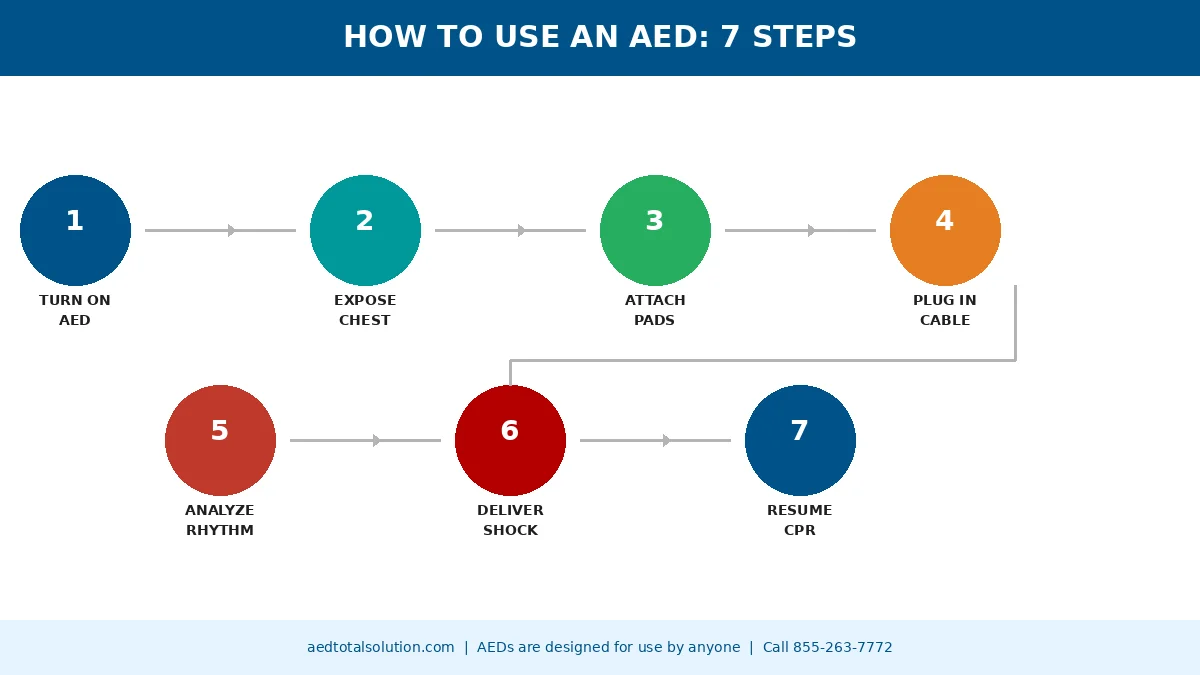
How to Use an AED: 7 Steps
Once you have the AED, follow these steps. Every AED provides voice prompts and visual instructions to guide you, but understanding the process in advance will help you act with confidence.
Step 1: Turn on the AED
Open the AED case and press the power button (some models turn on automatically when you open the lid). The device will begin providing voice instructions immediately.
Step 2: Expose the chest
Remove or cut away clothing to expose the person’s bare chest. The AED pads must make direct contact with the skin. If the chest is wet, dry it quickly with a towel. If there is excessive chest hair that might prevent pad adhesion, use the razor included in most AED kits to shave the area.
Step 3: Attach the AED pads
AED pads have diagrams showing exactly where to place them:
- Right pad: Upper right chest, below the collarbone
- Left pad: Lower left side of the chest, below the armpit
For detailed placement guidance including special situations, read our complete AED pad placement guide.
Special considerations:
- Children under 8 or under 55 pounds: Use pediatric pads if available. If only adult pads are available, use them (an AED with adult pads is better than no AED at all)
- Implanted pacemaker or defibrillator: If you see a lump under the skin on the chest, place the AED pad at least 1 inch away from the device
- Medication patches: Remove any medication patches from the chest and wipe the area clean before applying AED pads
Step 4: Plug in the connector (if needed)
Some AED models require you to plug the pad cable into the main unit. Others come pre-connected. Follow the voice prompts.
Step 5: Let the AED analyze the heart rhythm
The AED will instruct everyone to “stand clear” while it analyzes the heart rhythm. Make sure no one is touching the patient during analysis. The device determines whether the heart is in a shockable rhythm such as ventricular fibrillation or ventricular tachycardia.
Step 6: Deliver the shock (if advised)
If the AED detects a shockable rhythm, it will charge and prompt you to press the shock button. Before pressing:
- Loudly announce “Everyone clear!” and visually confirm no one is touching the patient
- Press the shock button firmly
- The patient’s body may jerk briefly; this is normal
If the AED says “no shock advised,” this means the heart is not in a shockable rhythm. This does not mean the person is okay. Continue CPR immediately. Learn more about what happens when the AED says no shock advised.
Step 7: Resume CPR
Immediately after the shock (or after a “no shock advised” message), resume CPR. Push hard and fast at 100 to 120 compressions per minute in the center of the chest. The AED will re-analyze the rhythm after approximately 2 minutes and prompt you again.
Continue this cycle of CPR and AED analysis until:
- The person starts breathing normally or moving
- EMS professionals arrive and take over
- You are too exhausted to continue (switch with another trained bystander if possible)
Common AED Mistakes to Avoid
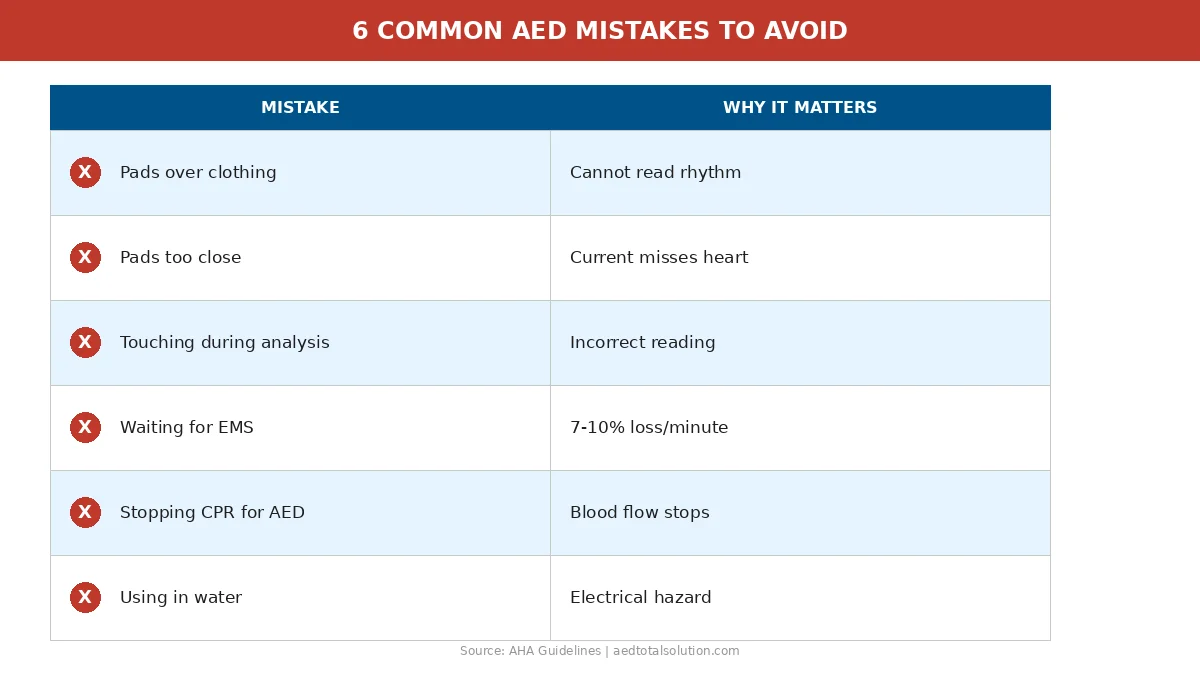
Even though AEDs are designed for simplicity, these common mistakes can reduce their effectiveness:
| Mistake | Why It Matters | How to Avoid It |
|---|---|---|
| Placing pads over clothing | Pads cannot read the heart rhythm through fabric | Always expose the bare chest before applying pads |
| Placing pads too close together | The electrical current may not cross the heart effectively | Follow the pad diagrams exactly; one upper right, one lower left |
| Touching the patient during analysis | Movement can interfere with rhythm analysis, causing incorrect readings | Announce “stand clear” and ensure no one touches the patient |
| Delaying use to wait for EMS | Every minute without defibrillation reduces survival by 7-10% | Use the AED as soon as it arrives; do not wait for paramedics |
| Stopping CPR to set up the AED | Blood flow stops when compressions stop | Have one person do CPR while another sets up the AED |
| Using an AED in water or on a wet surface | Water conducts electricity and can cause harm | Move the patient to a dry area and dry the chest before applying pads |
Can Anyone Use an AED?
Yes. AEDs are specifically designed for use by laypeople with no medical background. The device makes all medical decisions; it analyzes the heart rhythm and only allows a shock to be delivered when a shockable rhythm is detected. You cannot accidentally shock someone who does not need it.
All 50 U.S. states have Good Samaritan laws that provide legal protection for bystanders who use an AED in good faith during a cardiac emergency. You do not need AED certification to use one, although formal AED training is recommended because it builds confidence and improves response time.
After Using an AED: What to Do Next
Once EMS arrives, provide them with the following information:
- When the cardiac arrest occurred (approximate time)
- How many shocks the AED delivered
- How long CPR was performed
- Any medications or medical conditions you are aware of
Most AEDs store event data that paramedics can download for the hospital team. Do not turn off the AED or remove the pads until instructed by EMS.
For a detailed overview of post-AED steps, read our guide on what to do after an AED shock.
Where to Find AEDs
AEDs are typically located in high-traffic public areas. Look for AED signs (a heart with a lightning bolt) in:
- Office buildings and lobbies
- Airports and train stations
- Shopping malls and retail stores
- Schools, gyms, and community centers
- Sports venues and arenas
- Hotels and convention centers
- Government and municipal buildings
If your workplace does not yet have an AED, or if your existing devices need program management support, AED Total Solution provides full-service AED program management including device placement, signage compliance, automated inspections, and staff training coordination. For organizations that need a defibrillator without the upfront cost, our AED rental program provides FDA-approved devices starting at $45 per month with full compliance support included.
Frequently Asked Questions About Using an AED
How long does it take to use an AED?
From opening the case to delivering the first shock, most AEDs can be ready in under 60 seconds. The faster you apply the pads and follow the prompts, the better the patient’s chances of survival.
What if the AED says “no shock advised”?
This means the heart is not in a shockable rhythm. Continue CPR immediately. The AED will continue to monitor the rhythm and re-analyze every 2 minutes. A “no shock advised” message does not mean you should stop providing care.
Can you use an AED on a child?
Yes. Use pediatric pads if available for children under 8 years old or under 55 pounds. If pediatric pads are not available, use adult pads. Never withhold defibrillation because of the patient’s age.
Can an AED hurt someone who does not need a shock?
No. AEDs are designed with safeguards that prevent a shock from being delivered unless a shockable rhythm is detected. You cannot accidentally shock someone whose heart is beating normally.
Do I need to be certified to use an AED?
No certification is required. AEDs are designed for bystander use and provide voice-guided instructions. However, formal AED training is recommended because it improves your confidence, speed, and effectiveness during a real emergency.
What maintenance does an AED need?
AEDs require regular checks to ensure batteries are charged, pads have not expired, and the device passes its self-test. Professional AED program management automates these inspections and sends reminders so your devices are always rescue-ready. To put it all together, learn how to build a complete AED emergency response plan for your organization.
About the Author: Prabakar Mahalingam is the Managing Partner of AED Total Solution and a nationally recognized provider of safety training, products, and proprietary compliance software dedicated to addressing Sudden Cardiac Arrest (SCA).
Make sure your team knows how to use an AED before an emergency happens. Contact AED Total Solution for comprehensive AED program management, staff training coordination, and compliance support. Call 855-263-7772 for a free consultation.