By Prabakar Mahalingam, Managing Partner, AED Total Solution
Ventricular fibrillation is the most common cause of sudden cardiac death in the United States, claiming over 350,000 lives each year. Often called V-Fib or VFib, this life-threatening heart rhythm disrupts the heart’s ability to pump blood and can cause death within minutes without intervention. The single most effective field treatment is defibrillation with an automated external defibrillator (AED).
This guide explains what ventricular fibrillation is, what causes it, how to recognize it, and why immediate access to an AED is the difference between life and death.
What Is Ventricular Fibrillation?
Ventricular fibrillation is a type of cardiac arrhythmia where the heart’s lower chambers (ventricles) quiver rapidly and chaotically instead of contracting in a coordinated rhythm. During V-Fib, the heart cannot pump blood to the brain, lungs, or other organs. Without treatment, the person loses consciousness within seconds and can suffer irreversible brain damage within four to six minutes.
In a normal heartbeat, electrical signals travel from the sinoatrial (SA) node in the upper chambers through the atrioventricular (AV) node to the ventricles, triggering a coordinated contraction that pumps blood throughout the body. During ventricular fibrillation, these electrical signals become rapid, disorganized, and erratic. The ventricles quiver at rates exceeding 300 beats per minute instead of contracting effectively.
The result is immediate cardiac arrest. The heart is still electrically active, which is why an AED can detect and treat this rhythm, but it produces no meaningful blood flow. This is what makes V-Fib a shockable rhythm: the heart’s electrical activity can be reset by a controlled electrical shock from a defibrillator.
V-Fib vs. Cardiac Arrest vs. Heart Attack
These terms are often confused, but they describe different events:
- Ventricular fibrillation is a specific abnormal heart rhythm (arrhythmia) that causes the heart to stop pumping effectively.
- Cardiac arrest is the broader term for when the heart stops functioning. V-Fib is the most common cause of sudden cardiac arrest, but not the only one.
- Heart attack occurs when blood flow to part of the heart muscle is blocked, usually by a clot. A heart attack can trigger ventricular fibrillation, but they are not the same thing.
Understanding the difference matters for response. A heart attack victim may be conscious and talking. A person in ventricular fibrillation is unconscious, not breathing normally, and needs immediate CPR and defibrillation. Learn more about sudden cardiac arrest vs heart attack.
What Causes Ventricular Fibrillation?
V-Fib can result from structural heart problems, electrical abnormalities, or external triggers. The most common causes include:
Heart-Related Causes
- Prior heart attack (myocardial infarction): Scar tissue from a previous heart attack can disrupt electrical pathways. A heart attack in progress can also trigger V-Fib.
- Coronary artery disease: Reduced blood flow to the heart muscle weakens electrical stability.
- Cardiomyopathy: Diseases that enlarge or thicken the heart muscle, particularly hypertrophic cardiomyopathy in younger individuals.
- Heart valve disease: Conditions like aortic stenosis or mitral valve prolapse.
- Congenital heart defects: Structural problems present from birth.
Electrical Causes
- Long QT syndrome: A genetic condition that affects the heart’s electrical recharging process.
- Brugada syndrome: An inherited condition that causes abnormal electrical activity in the ventricles.
- Wolff-Parkinson-White (WPW) syndrome: An extra electrical pathway in the heart that can trigger rapid rhythms.
External Triggers
- Electrocution or lightning strike
- Severe electrolyte imbalances (particularly potassium and magnesium)
- Drug toxicity (including certain medications and recreational drugs)
- Commotio cordis: A blunt impact to the chest during a critical phase of the heartbeat, most often seen in young athletes hit by a baseball or hockey puck.
- Severe trauma or blood loss
In some cases, ventricular fibrillation occurs without any identifiable cause. This is called idiopathic V-Fib and accounts for approximately 5% to 10% of sudden cardiac arrest cases.
Recognizing Ventricular Fibrillation
A bystander cannot see ventricular fibrillation on an ECG monitor, but you can recognize the signs of the cardiac arrest it causes:
- Sudden collapse without warning
- Loss of consciousness within seconds
- No pulse when checked at the neck (carotid artery) or wrist
- No normal breathing. The person may exhibit agonal breathing, which looks like occasional gasping or gurgling. This is not effective breathing and should not delay CPR.
- Skin may appear pale, blue, or gray, especially around the lips and fingertips
What V-Fib Looks Like on an ECG
On an electrocardiogram (ECG or EKG), ventricular fibrillation appears as a chaotic, irregular waveform with no identifiable P waves, QRS complexes, or T waves. The tracing looks like a rapid, disorganized oscillation, sometimes described as a “bag of worms” pattern. This V-Fib rhythm is distinctly different from the organized, repeating pattern of a normal sinus rhythm.
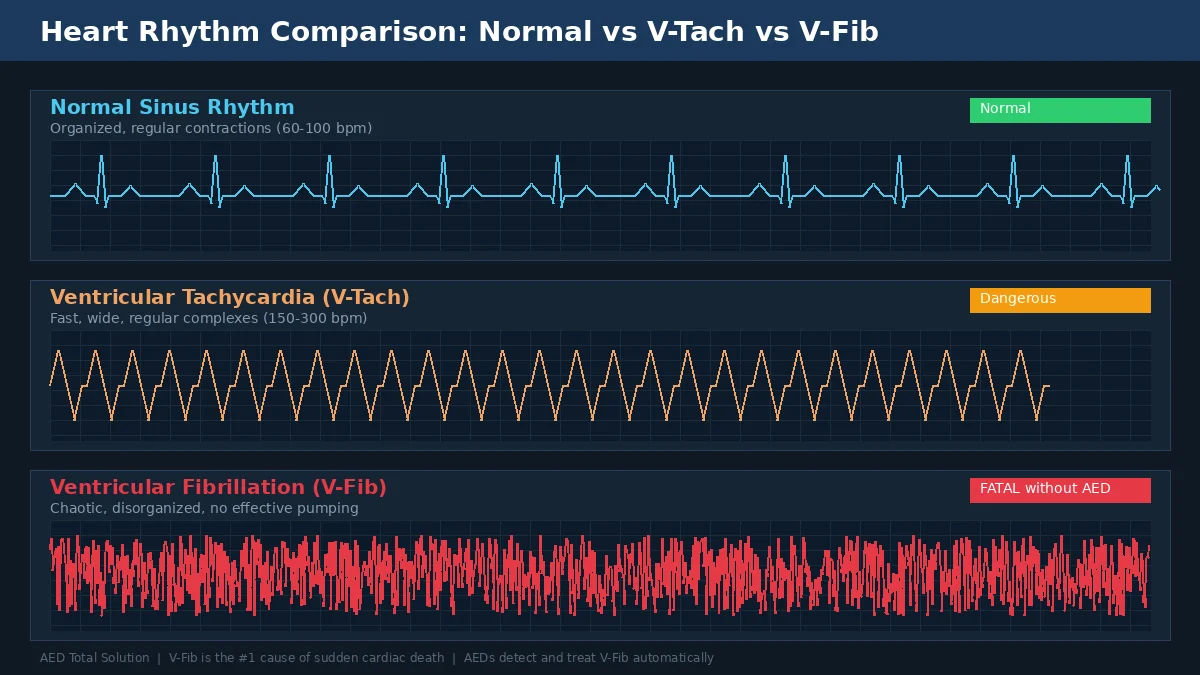
When an AED is attached to a patient in ventricular fibrillation, its algorithm analyzes this chaotic electrical pattern and determines that a shock is advised. The AED’s internal software is specifically designed to identify V-Fib and pulseless ventricular tachycardia (pVT) as shockable rhythms.
VFib vs. VTach: Understanding the Difference
Ventricular fibrillation and ventricular tachycardia (V-Tach or VTach) are both dangerous ventricular arrhythmias, but they differ in important ways:
| Feature | Ventricular Fibrillation (V-Fib) | Ventricular Tachycardia (V-Tach) |
|---|---|---|
| Heart rhythm | Completely chaotic, no organized pattern | Fast but organized, regular pattern |
| Heart rate | 300+ disorganized beats per minute | 150-300 beats per minute, regular |
| Blood pumping | None; heart quivers without pumping | May pump some blood (with pulse) or none (pulseless) |
| ECG appearance | Chaotic, irregular waveform | Wide, regular QRS complexes |
| Consciousness | Always unconscious | May be conscious (with pulse) or unconscious (pulseless) |
| AED treatment | Always shockable | Shockable only when pulseless |
V-Tach can deteriorate into V-Fib if left untreated. Pulseless V-Tach is treated the same as V-Fib: immediate CPR and defibrillation.
AFib vs. VFib
Atrial fibrillation (AFib) and ventricular fibrillation (VFib) both involve chaotic electrical activity, but they affect different parts of the heart:
- AFib affects the upper chambers (atria). It is a chronic, manageable condition. People with AFib are typically conscious and may experience palpitations, fatigue, or shortness of breath. AFib is not immediately life-threatening.
- VFib affects the lower chambers (ventricles). It causes immediate cardiac arrest and is fatal without emergency treatment.
AFib does not require an AED. VFib requires an AED as soon as possible.
How AEDs Detect and Treat Ventricular Fibrillation
An automated external defibrillator is a portable device that analyzes heart rhythms and delivers a controlled electrical shock to restore normal rhythm. AEDs are the only effective field treatment for ventricular fibrillation. Browse our AED devices to find the right model for your organization.
How an AED Works Against V-Fib
- Rhythm analysis. When electrode pads are placed on the patient’s chest, the AED reads the heart’s electrical activity. Its algorithm identifies the chaotic waveform pattern characteristic of V-Fib.
- Shock advised. The AED determines the rhythm is shockable and either automatically delivers a shock (fully automatic models) or prompts the rescuer to press the shock button (semi-automatic models).
- Defibrillation. The electrical shock momentarily stops all electrical activity in the heart, allowing the heart’s natural pacemaker (the SA node) to re-establish a coordinated rhythm.
- Post-shock CPR. Immediately after the shock, CPR must continue. The heart often needs several minutes of supported circulation before it can pump effectively on its own.
Why Every Minute Matters
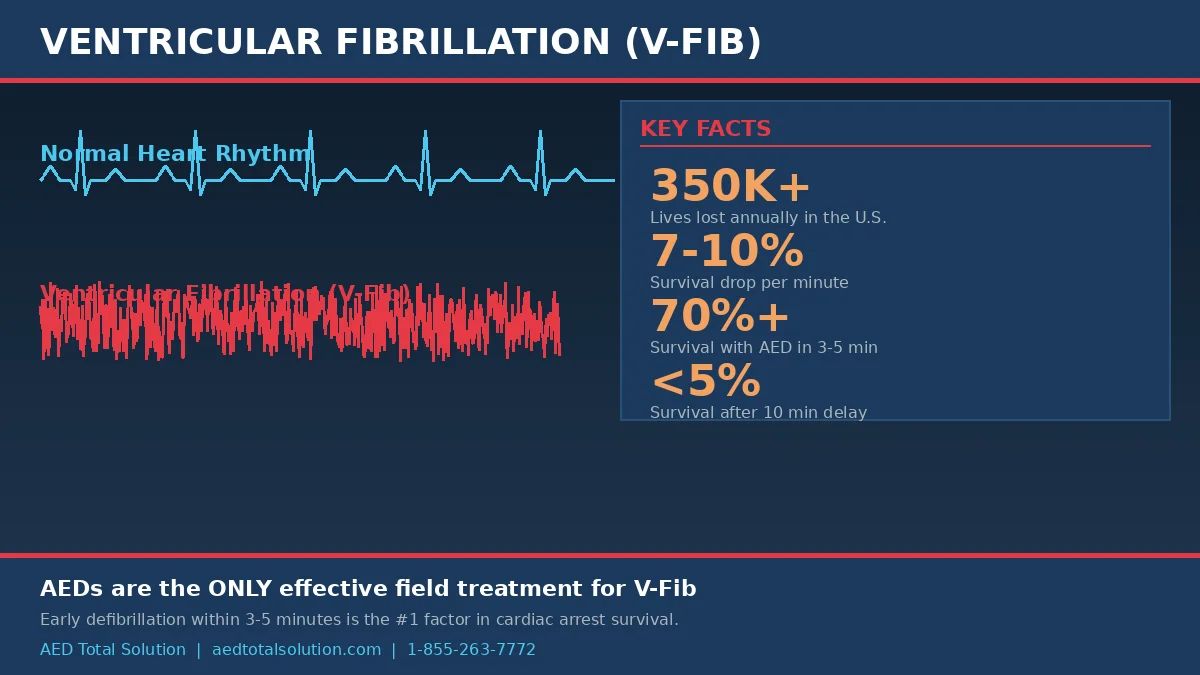
For every minute that passes without defibrillation, the chance of surviving ventricular fibrillation drops by 7% to 10%. After 10 minutes without a shock, survival rates fall below 5%.
This timeline is why cardiac arrest survival rates are directly tied to AED availability. When an AED is used within the first three to five minutes of cardiac arrest, survival rates can exceed 70%. This is why rapid defibrillation is the third link in the chain of survival. The average emergency medical services (EMS) response time in the United States is 7 to 14 minutes, which is why relying solely on paramedics is not enough.
How to Respond to Suspected Ventricular Fibrillation
If you witness someone suddenly collapse, become unresponsive, and stop breathing normally, follow these steps:
Step 1: Call 911
Call emergency services immediately or direct someone nearby to call. Every second counts.
Step 2: Start CPR
Begin chest compressions at a rate of 100 to 120 per minute, pressing at least two inches deep on the center of the chest. Effective CPR maintains blood flow to the brain and vital organs until defibrillation can occur. Read our CPR and AED guide for detailed instructions.
Step 3: Use an AED as Soon as Available
Send someone to retrieve the nearest AED. When it arrives:
- Power on the AED and follow the voice prompts.
- Expose the patient’s chest and apply the electrode pads as shown on the diagrams.
- Ensure no one is touching the patient during rhythm analysis.
- If the AED advises a shock, press the shock button (semi-automatic) or stand clear (fully automatic).
- Resume CPR immediately after the shock for two minutes, then allow the AED to re-analyze.
For a complete walkthrough, see our guide on how to use an AED.
Step 4: Continue Until EMS Arrives
Continue cycles of CPR and AED use until emergency medical personnel take over or the person shows signs of life (movement, normal breathing).
Who Is at Risk for Ventricular Fibrillation?
Certain populations face higher risk, which is why targeted AED placement matters:
- People with a history of heart disease or prior heart attack. The majority of V-Fib cases occur in adults over 45 with known coronary artery disease.
- Young athletes. Conditions like hypertrophic cardiomyopathy and commotio cordis make student athletes vulnerable. Schools and sports facilities should have AEDs accessible within a three-minute walk of all athletic venues.
- Individuals with inherited heart conditions. Long QT syndrome, Brugada syndrome, and other genetic conditions can trigger V-Fib in seemingly healthy individuals, sometimes with no prior symptoms.
- People taking certain medications. Some antiarrhythmic drugs, antibiotics, and psychiatric medications can prolong the QT interval and increase V-Fib risk.
- Workers in high-risk environments. Electricians, utility workers, and construction personnel face electrocution risks that can trigger V-Fib.
Medical Treatment After V-Fib
Surviving a ventricular fibrillation episode requires immediate hospital care and long-term management:
Acute Treatment
- Advanced cardiac life support (ACLS): Paramedics and emergency physicians use medications (epinephrine, amiodarone) alongside continued defibrillation.
- Cardiac catheterization: If a heart attack triggered the V-Fib, doctors may perform angioplasty and stenting to restore blood flow.
- Targeted temperature management: Cooling the body to reduce brain injury after cardiac arrest.
Long-Term Prevention
- Implantable cardioverter-defibrillator (ICD): A device surgically implanted in the chest that continuously monitors heart rhythm and delivers shocks if V-Fib recurs. Learn about life after ICD implantation.
- Medications: Beta-blockers, antiarrhythmics, and other drugs to stabilize heart rhythm.
- Catheter ablation: A procedure that destroys the heart tissue causing abnormal electrical signals.
- Lifestyle modifications: Managing blood pressure, cholesterol, diabetes, and weight.
Why Workplace and School AED Programs Are Essential
Ventricular fibrillation can strike anyone, anywhere. Approximately 80% of out-of-hospital cardiac arrests occur in homes, workplaces, schools, and public spaces, not in hospitals. Having AEDs readily available in these locations directly addresses the survival gap.
The Case for AED Programs
- Time advantage. An on-site AED can deliver a shock within one to three minutes. Waiting for EMS extends response to seven minutes or more.
- Ease of use. Modern AEDs are designed for untrained bystanders. Voice prompts guide every step, and the device will not allow a shock on a non-shockable rhythm.
- Legal protection. Good Samaritan laws in all 50 states protect bystanders who use AEDs in good faith during emergencies.
- Regulatory compliance. Many states require AEDs in schools, gyms, government buildings, and other public facilities. Non-compliance creates liability.
Building a Compliant AED Program
Purchasing an AED is only the first step. A compliant program includes:
- Regular inspections to verify device readiness (battery, pads, status indicators)
- Staff training in CPR and AED use, with refresher courses
- Medical oversight from a licensed physician
- State registration where required
- Documented maintenance records for liability protection
Managing these requirements across multiple locations becomes complex. AED Total Solution provides comprehensive AED program management that handles inspections, supply replacement, compliance tracking, and physician oversight, so your devices are always ready when ventricular fibrillation strikes.
Frequently Asked Questions About Ventricular Fibrillation
What is the survival rate for ventricular fibrillation?
With immediate CPR and AED defibrillation within three to five minutes, survival rates from V-Fib can exceed 70%. Without intervention, the survival rate drops to less than 5% after 10 minutes.
Can an AED treat ventricular fibrillation?
Yes. An AED is the only effective field treatment for ventricular fibrillation. The device analyzes the heart rhythm, identifies V-Fib as a shockable rhythm, and delivers an electrical shock to restore normal heart function.
What is the difference between VFib and VTach?
VFib is a completely chaotic heart rhythm with no organized contractions. VTach is a fast but organized rhythm. Both can be life-threatening, but pulseless VTach and VFib are treated the same way: CPR and AED defibrillation.
Can you survive ventricular fibrillation?
Yes, if treatment occurs quickly. The key factors are immediate CPR, rapid access to an AED, and timely arrival of advanced medical care. Every minute without defibrillation reduces the chance of survival by 7% to 10%.
Is ventricular fibrillation the same as cardiac arrest?
Ventricular fibrillation is the most common cause of sudden cardiac arrest, but not all cardiac arrest is caused by V-Fib. Other causes include pulseless electrical activity (PEA) and asystole, which are not treatable with an AED.
Who is most at risk for ventricular fibrillation?
People with coronary artery disease, prior heart attacks, cardiomyopathy, or inherited electrical conditions (Long QT syndrome, Brugada syndrome) are at highest risk. Young athletes are also at risk from hypertrophic cardiomyopathy and commotio cordis.
Protect Your People with AED Readiness
Ventricular fibrillation can happen without warning to anyone, at any age. The only proven way to restore a normal heart rhythm in the field is immediate defibrillation with an AED. Having the right equipment, trained responders, and a compliant AED program in place means your organization is prepared to save lives when every second counts.
AED Total Solution provides full-service AED program management with automated compliance tracking, physician oversight, AED training, and supply management. Whether you manage one location or hundreds, we ensure your AEDs are always inspection-ready and your team is always prepared. Need an AED without the upfront cost? Our AED rental program starts at just $45/month with full compliance management included.
Ready to build or upgrade your AED program? Contact us today or call 1-855-263-7772 to speak with an AED program specialist.