By Prabakar Mahalingam, Managing Partner — AED Total Solution. Prabakar is a nationally recognized provider of safety training, products, and proprietary compliance software dedicated to addressing Sudden Cardiac Arrest (SCA). He leads comprehensive AED programs throughout North America. For a detailed comparison of all key factors, see our complete AED buyer’s guide.
Key Takeaways: Over 350,000 out-of-hospital cardiac arrests occur annually in the United States, and immediate access to an AED can double or even triple survival rates, according to the American Heart Association. A portable AED machine that travels with your team, fits in a small case, and deploys in seconds could be the difference between a successful rescue and a preventable tragedy. Understanding the difference between cardiac arrest and a heart attack helps you respond correctly when seconds count. This guide compares the top-rated portable defibrillator models for 2026, with verified specifications, pricing, and recommendations for every environment.
What Makes an AED “Portable”?
Every automated external defibrillator is designed to be moved, but not every AED qualifies as truly portable. A portable AED is lightweight enough to carry in a backpack or shoulder bag, compact enough to store in a vehicle or on a shelf, and rugged enough to withstand transport between locations.
For an AED machine to earn the portable label, it should meet these practical benchmarks:
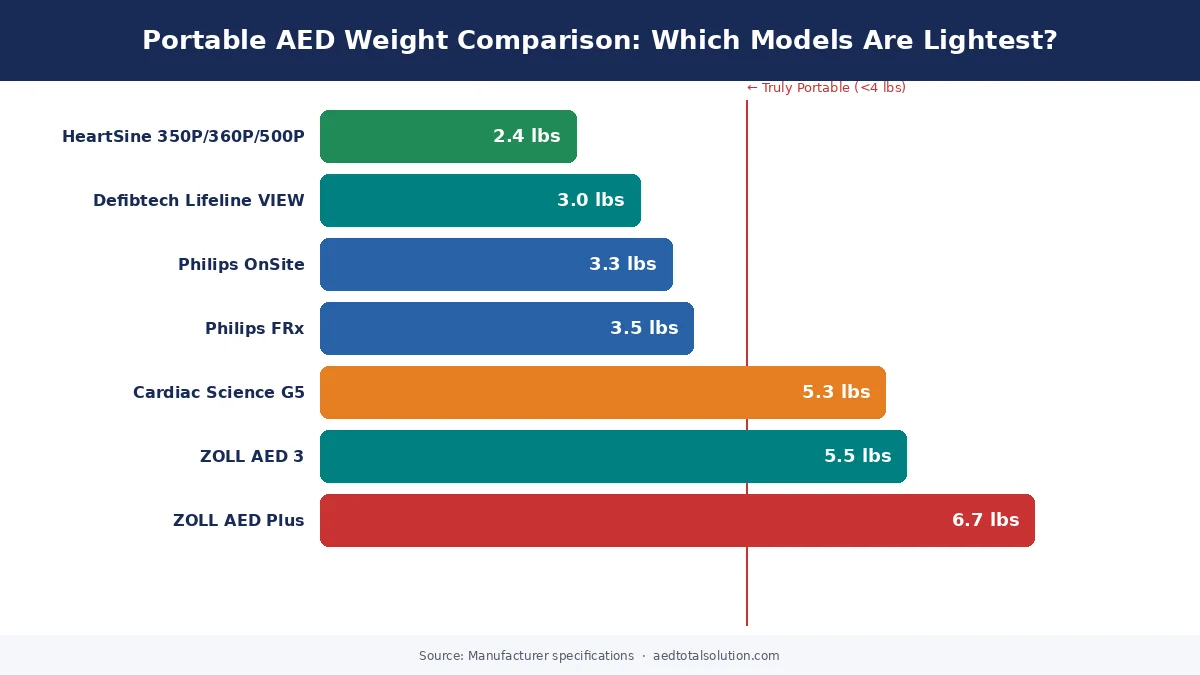
- Weight under 4 pounds (without carrying case)
- IP55 or higher dust and water resistance for outdoor or transit use
- Long standby battery life (4+ years) to remain ready without frequent maintenance
- Carrying case included or available for grab-and-go deployment
Portability matters most for organizations that need AEDs beyond a fixed wall-mount location. Think mobile medical teams, event coordinators, school athletic trainers, construction sites, and outdoor recreation programs. If your AED needs to travel, the models below are built for it.
Top Portable AED Models for 2026: Head-to-Head Comparison
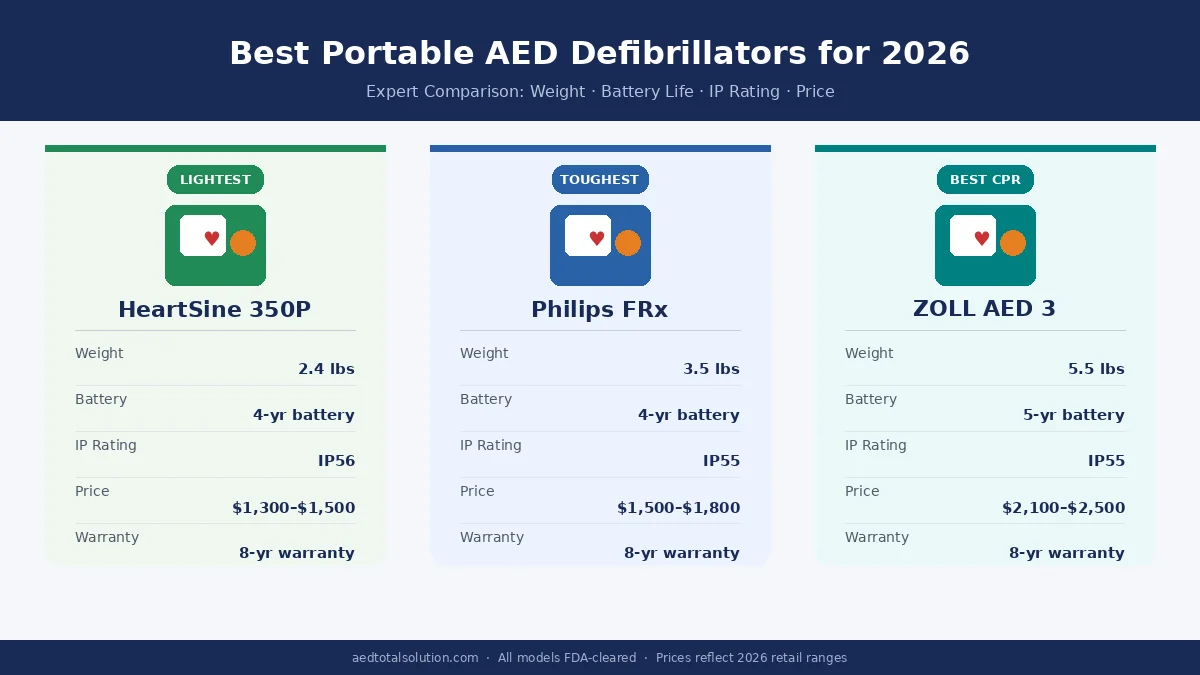
We evaluated current FDA-cleared portable defibrillator models based on weight, durability, battery longevity, CPR guidance features, warranty coverage, and total cost of ownership. Here is how the leading models compare:
| Model | Weight | Battery Life | IP Rating | Warranty | Price Range |
|---|---|---|---|---|---|
| HeartSine Samaritan PAD 350P | 2.4 lbs | 4 years | IP56 | 8 years | $1,300–$1,500 |
| HeartSine Samaritan PAD 360P | 2.4 lbs | 4 years | IP56 | 8 years | $1,400–$1,600 |
| HeartSine Samaritan PAD 500P | 2.4 lbs | 4 years | IP56 | 8 years | $1,600–$1,900 |
| Philips HeartStart FRx | 3.5 lbs | 4 years | IP55 | 8 years | $1,500–$1,800 |
| Philips HeartStart OnSite | 3.3 lbs | 4 years | IP21 | 8 years | $1,400–$1,600 |
| ZOLL AED 3 | 5.5 lbs | 5 years | IP55 | 8 years | $2,100–$2,500 |
| ZOLL AED Plus | 6.7 lbs | 5 years | IP55 | 7 years | $1,900–$2,200 |
| Defibtech Lifeline VIEW | 3.0 lbs | 4 years | IP54 | 8 years | $1,600–$2,000 |
| Cardiac Science Powerheart G5 | 5.3 lbs | 4 years | IP55 | 8 years | $2,000–$2,300 |
All models listed are FDA-cleared for public access use. Prices reflect typical 2026 retail ranges and may vary by package configuration.
In-Depth Reviews: Best Portable AED Picks for 2026
HeartSine Samaritan PAD 350P — Best Overall Portable AED
At just 2.4 pounds, the HeartSine Samaritan PAD 350P is the lightest full-featured portable defibrillator available. Its IP56 rating means it handles dust, rain, and splashing water without issue, making it a strong choice for outdoor events, construction sites, and travel kits.
The 350P uses a combined Pad-Pak that integrates the battery and electrode pads into a single replaceable cartridge. This simplifies maintenance significantly because you only track one expiration date instead of two. The 8-year warranty is the longest standard warranty in the industry.
Best for: Mobile teams, outdoor events, and organizations that need a lightweight AED they can carry anywhere.
Philips HeartStart FRx — Best for Rugged Environments
The Philips HeartStart FRx is built for demanding conditions. It carries an IP55 rating and has passed a 500-pound crush test, which means it can survive being dropped, stepped on, or stored in industrial environments. At 3.5 pounds, it remains easy to transport.
The FRx uses Philips SMART Pads II, which work for both adult and pediatric patients when paired with the optional Infant/Child Key. This eliminates the need to carry separate pediatric pads, which is a practical advantage for schools comparing AED options and family-oriented settings.
Best for: Schools, manufacturing facilities, warehouses, and any location where the AED may face physical abuse.
ZOLL AED 3 — Best CPR Feedback Technology
The ZOLL AED 3 stands apart with its Real CPR Help technology. A sensor in the electrode pad measures compression depth and rate in real time, providing audio and visual coaching to the rescuer. This feature has been validated in clinical studies to improve CPR quality during actual rescues.
At 5.5 pounds, the ZOLL AED 3 is heavier than the HeartSine or Philips models, which makes it less ideal for backpack carry but still manageable for vehicle storage and facility deployment. Its touchscreen display and WiFi connectivity allow remote monitoring and program management.
Best for: Organizations that prioritize CPR quality coaching and want connected device management.
Defibtech Lifeline VIEW — Best Visual Display
The Defibtech Lifeline VIEW features a full-color video screen that displays step-by-step rescue instructions alongside voice prompts. For first-time rescuers who may freeze under pressure, having visual instructions on-screen can provide the confidence needed to act.
Weighing just 3.0 pounds, the VIEW strikes a strong balance between portability and usability. Its IP54 rating is adequate for indoor and light outdoor use, though it is not as weather-resistant as the HeartSine or ZOLL models.
Best for: Offices, public buildings, and locations where untrained bystanders are the most likely first responders.
Cardiac Science Powerheart G5 — Best for Multilingual Environments
The Cardiac Science Powerheart G5 offers Rescue Ready technology with automatic daily, weekly, and monthly self-tests that verify the device is operational. It supports multiple languages and can switch between them with a single button press, which is valuable for diverse workplaces.
At 5.3 pounds, the G5 is on the heavier end for portable use. However, its Intellisense CPR feedback and dual-language capability make it a solid choice for multicultural organizations and facilities serving diverse communities.
Best for: Multilingual workplaces, community centers, and organizations that need built-in self-testing.
Best Portable AED by Use Case
Choosing the right portable AED depends on where and how you plan to use it. Here are targeted recommendations:
Best for Offices and Corporate Environments
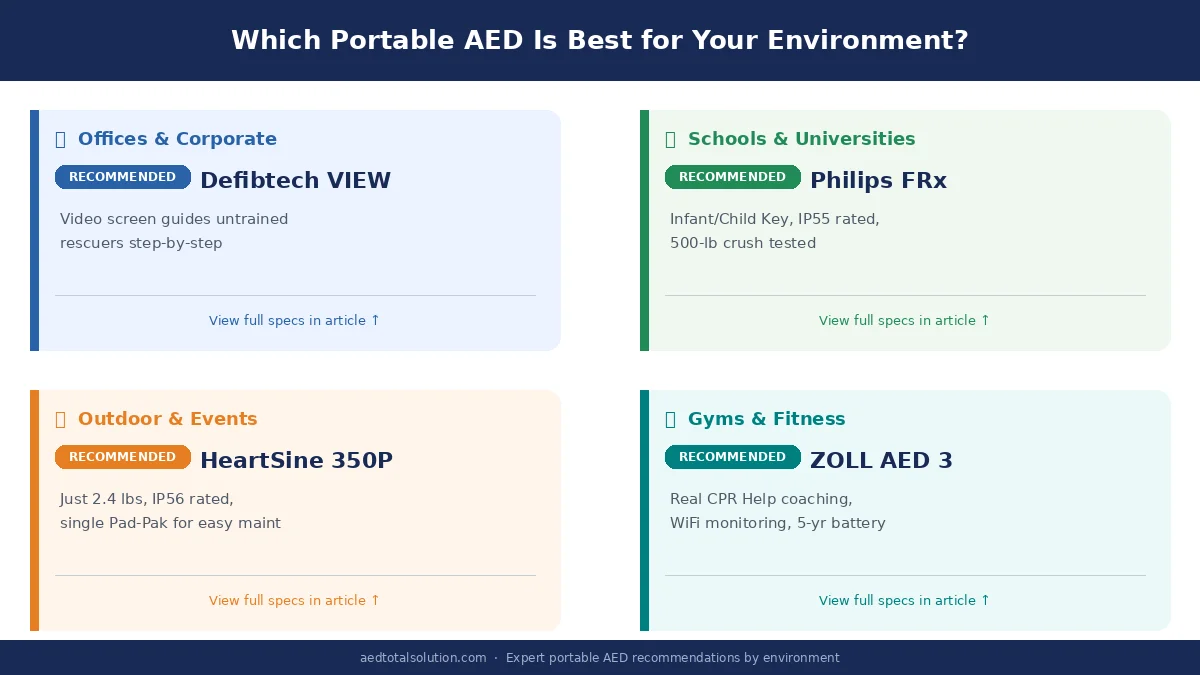
Defibtech Lifeline VIEW or Philips HeartStart OnSite. Indoor settings with climate control and untrained responders benefit from intuitive visual displays and voice guidance. The OnSite at 3.3 pounds is easy to mount and move between floors.
Best for Schools and Universities
Philips HeartStart FRx. The Infant/Child Key makes it versatile across age groups, the IP55 rating handles gym and outdoor athletic use, and the rugged build survives school environments.
Best for Outdoor Events and Construction Sites
HeartSine Samaritan PAD 350P. The lightest option at 2.4 pounds with the highest weather resistance (IP56). Easy to carry in an event medical bag or job-site first aid kit.
Best for Fitness Centers and Gyms
ZOLL AED 3. Real-time CPR coaching is critical in environments where cardiac events are statistically more likely during physical exertion. WiFi monitoring keeps the device ready.
Key Features to Evaluate Before Buying a Portable AED
When comparing portable AED machines, focus on these decision factors:
Semi-Automatic vs. Fully Automatic. Semi-automatic models require the rescuer to press a button to deliver the shock. Fully automatic models (like the HeartSine 360P) deliver the shock without user intervention once pads are placed. Fully automatic AEDs may be better for untrained environments.
CPR Feedback. Real-time compression coaching (depth and rate) improves rescuer performance. The ZOLL AED 3 and Cardiac Science G5 offer the most advanced CPR feedback among portable models.
Pediatric Capability. If your facility serves children, choose a model with a simple pediatric mode. The Philips FRx Infant/Child Key and HeartSine Pediatric Pad-Pak are the most streamlined options.
Connectivity and Monitoring. WiFi-enabled AEDs like the ZOLL AED 3 can report readiness status to a central dashboard. This is especially valuable for organizations managing multiple AED locations.
Total Cost of Ownership. The purchase price is just the beginning. Factor in electrode pad replacements (every 2–5 years), battery replacements (every 4–5 years), carrying cases, wall cabinets, and signage. Read our complete AED cost breakdown to understand long-term expenses.
Portable AED Pricing Overview
New portable AED machines typically range from $1,100 to $2,500 depending on features, brand, and package inclusions. Here is a general pricing framework:
- Budget-friendly (under $1,500): Defibtech Lifeline DCF-100, HeartSine Samaritan PAD 350P
- Mid-range ($1,500–$2,000): Philips HeartStart FRx, Philips HeartStart OnSite, Defibtech Lifeline VIEW, HeartSine 500P
- Premium ($2,000–$2,500): ZOLL AED 3, ZOLL AED Plus, Cardiac Science Powerheart G5
Organizations that need temporary coverage for events, construction projects, or seasonal operations should consider AED rental programs as a cost-effective alternative to purchasing.
Maintenance and Compliance for Portable AEDs
A portable AED is only useful if it works when you need it. Ongoing maintenance is not optional. It is a regulatory and safety requirement.
Monthly Visual Inspections. Check the readiness indicator light, verify pad and battery expiration dates, and confirm the device is clean and undamaged. Our AED inspection guide walks through this process step by step.
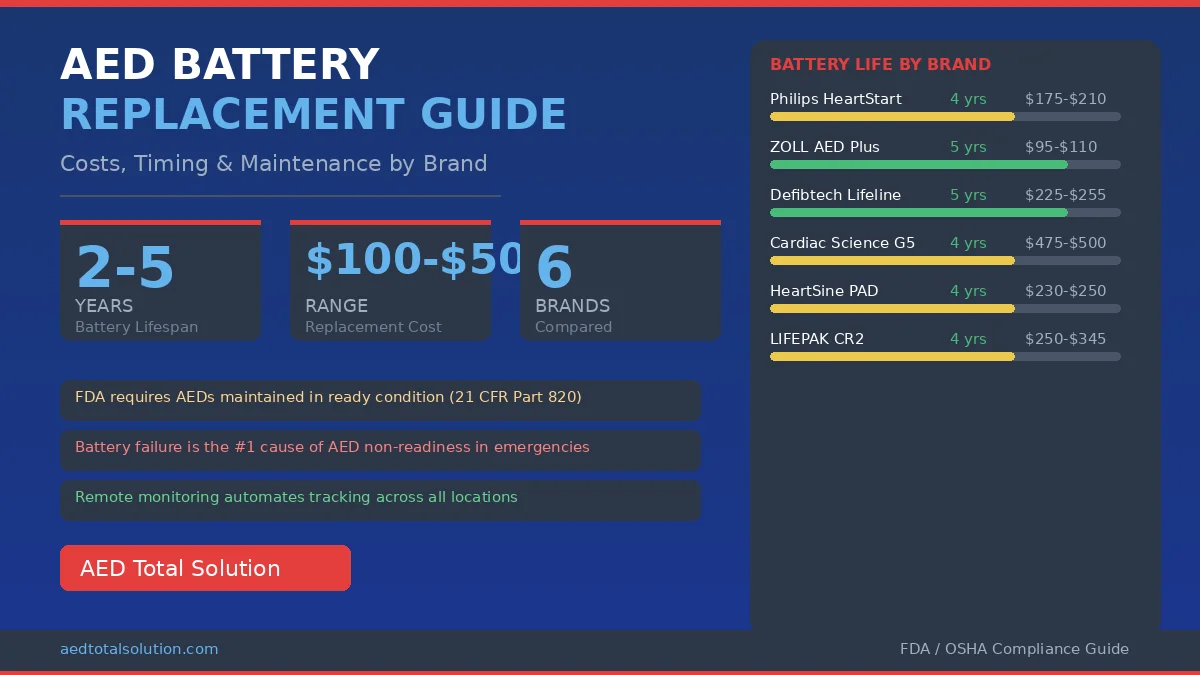
Pad and Battery Replacement. Most electrode pads expire every 2 years. Batteries last 4–5 years depending on the model. Track these dates carefully to avoid having an expired device during an emergency.
AHA Guidelines Compliance. The American Heart Association recommends that AED programs include regular maintenance checks, staff training, integration with EMS notification systems, and medical direction oversight. These align with the chain of survival framework. Following the AHA’s guidelines for AED programs is not just best practice; it is the standard that OSHA references in workplace safety guidance.
Program Management. For organizations with multiple portable AEDs across locations, manual tracking becomes unreliable. A managed AED compliance program handles inspections, replacement tracking, documentation, and audit-ready reporting through a single provider.
How to Choose the Right Portable AED for Your Organization
Selecting the right portable AED machine comes down to three questions:
- Where will it be used? Indoor-only environments have different needs than outdoor, industrial, or mobile settings. Match the IP rating and weight to your reality.
- Who will use it? Trained staff can handle semi-automatic models. Untrained bystanders benefit from fully automatic or video-guided AEDs.
- How many devices do you need? Single-device programs can manage maintenance manually. Multi-location programs should invest in centralized compliance management.
If you are evaluating portable AEDs for your organization and want expert guidance on device selection, compliance, or program setup, explore our AED solutions or contact our team to discuss your needs.
Knowing how to use an AED is just as important as having the right device. Pair every AED purchase with staff training to maximize your emergency preparedness.
Frequently Asked Questions
What is the lightest portable AED available?
The HeartSine Samaritan PAD 350P weighs just 2.4 pounds, making it the lightest FDA-cleared portable AED on the market. It is ideal for travel kits, outdoor events, and mobile teams.
Do I need a prescription to buy a portable AED?
No federal prescription is required to purchase an AED in the United States. However, some states require physician oversight or registration of AED programs. Check your state’s specific requirements.
How often should a portable AED be inspected?
The American Heart Association recommends monthly visual inspections to verify readiness indicators, pad expiration dates, and battery status. More detailed inspections should be conducted quarterly or per your organization’s AED program policy.
Can a portable AED be used on children?
Yes. Most portable AED models offer pediatric capability through reduced-energy pads or a pediatric key/switch. The Philips HeartStart FRx uses an Infant/Child Key, while HeartSine models use a dedicated Pediatric Pad-Pak.
How long do portable AED batteries last?
Battery standby life varies by model, typically ranging from 4 to 5 years. ZOLL models generally offer 5-year battery life, while Philips and HeartSine models provide 4-year battery life. Always replace batteries before their expiration date.