

Every year, over 350,000 people in the United States experience sudden cardiac arrest (SCA) outside of a hospital. When SCA strikes, survival depends on rapid defibrillation. Studies show that using an AED within the first 3 to 5 minutes can increase survival rates to 50-70%. For businesses, having the right AED is not just a compliance checkbox. It is a critical investment in workplace safety.
But with dozens of AED models on the market, choosing the right one for your business can feel overwhelming. This guide walks you through the key factors to consider, compares top AED brands, and helps you make a confident, informed decision.
Why Your Business Needs an AED
Sudden cardiac arrest can happen to anyone, anywhere, at any time. It affects people of all ages and fitness levels, and the majority of incidents occur in workplaces, schools, and public spaces.
While OSHA does not currently mandate AEDs in most workplaces, many states have laws requiring them in specific settings such as schools, gyms, and government buildings. Beyond legal requirements, having an AED demonstrates a commitment to employee safety and can reduce your organization’s liability exposure.
Key reasons to invest in an AED:
- Rapid response saves lives. Emergency medical services (EMS) take an average of 7 to 14 minutes to arrive. Brain damage can begin in just 4 to 6 minutes without defibrillation.
- Anyone can use an AED. Modern AEDs are designed for use by untrained bystanders with clear voice prompts and visual instructions.
- Legal protection. Good Samaritan laws in all 50 states protect individuals who use an AED in good faith during an emergency.
- Compliance requirements. Many states and industries require AEDs in certain facilities. Staying compliant protects your organization from penalties and lawsuits. Having a documented AED emergency response plan further strengthens your preparedness.
Key Factors to Consider When Choosing an AED
Selecting the right AED requires evaluating several factors based on your specific workplace environment, staff capabilities, and compliance obligations.
1. Semi-Automatic vs. Fully Automatic
AEDs come in two main configurations:
- Semi-automatic AEDs analyze the heart rhythm and advise the user to press a button to deliver a shock. This gives the rescuer control over when the shock is delivered.
- Fully automatic AEDs analyze the rhythm and deliver the shock automatically after a brief countdown. No button press is required.
Best for your business: Fully automatic AEDs are ideal for environments where responders may have minimal training, such as offices, retail stores, and public lobbies. Semi-automatic models work well in settings with trained staff, such as healthcare facilities and fitness centers.
2. Ease of Use
In a cardiac emergency, stress levels are high and every second counts. The best AED for your business is one that anyone can operate confidently, even without prior training.
Look for these features:
- Clear, step-by-step voice prompts
- Visual diagrams showing pad placement
- Minimal buttons and simple interfaces
- Pre-connected electrode pads for faster setup
- Real-time CPR feedback (compression rate and depth coaching)
3. Pad and Battery Life
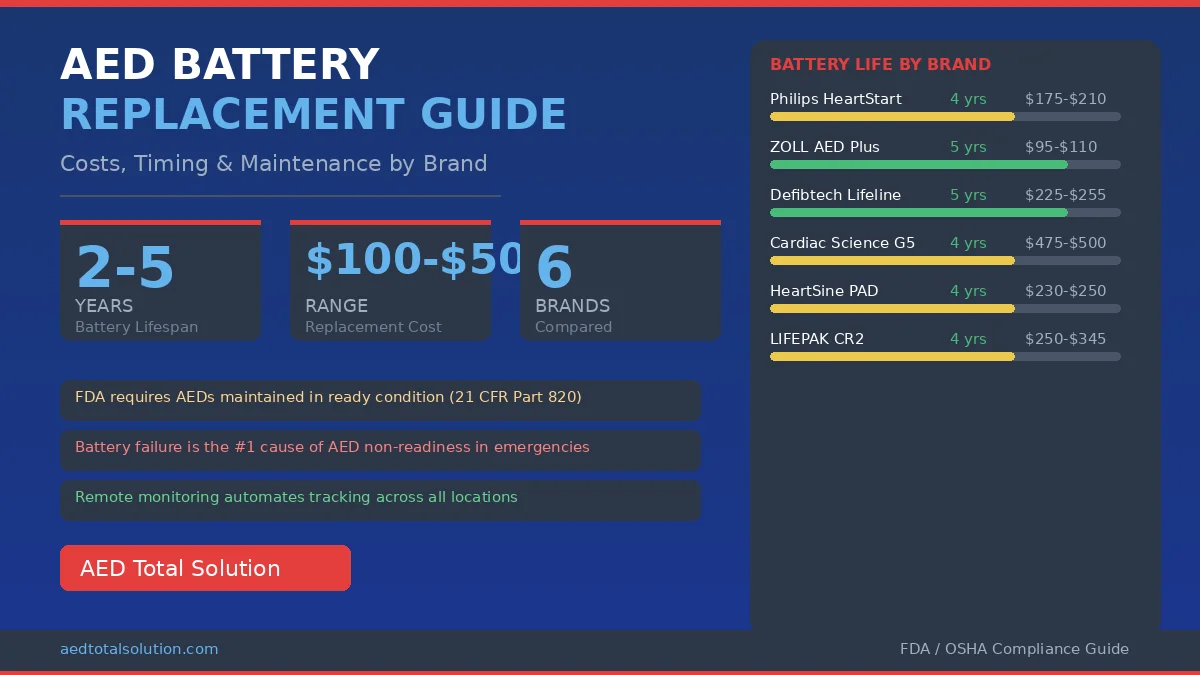
AED pads and batteries have expiration dates and must be replaced periodically. Longer-lasting consumables reduce ongoing maintenance costs and the risk of having an AED that is not ready when needed.
| Component | Typical Lifespan | Best-in-Class |
|---|---|---|
| Electrode pads | 2-3 years | Up to 5 years (ZOLL CPR-D-Padz) |
| Batteries | 4-5 years | Up to 5 years |
Pro tip: Choose an AED with integrated pad-battery designs or long-life consumables to minimize replacement frequency. ZOLL AED Plus, for example, offers pads and batteries that last up to 5 years.
4. Durability and Environment
Consider where the AED will be placed and the conditions it will face:
- Indoor office environments require standard durability. Most AEDs meet this need.
- Outdoor or industrial settings (construction sites, warehouses, pools) need AEDs with higher IP ratings for dust and water resistance. Look for IP55 or higher.
- Extreme temperatures matter for AEDs stored in vehicles, outdoor cabinets, or unheated buildings. Check the operating temperature range.
5. Pediatric Capability
If your business serves children (schools, daycare centers, family entertainment venues), you need an AED that can treat pediatric patients.
Options include:
- Separate pediatric pads that reduce energy output for children under 8 or weighing less than 55 pounds
- AEDs with a pediatric mode switch that adjusts energy levels automatically
Most modern AEDs support pediatric use with the right pads or settings.
6. Self-Testing and Readiness Indicators
An AED is only useful if it works when you need it. Look for models with:
- Daily, weekly, and monthly self-tests that check battery, pads, and internal circuits
- Visual status indicators (green light means ready, red means attention needed)
- Audible alerts when maintenance is required
- Remote monitoring capability for organizations managing multiple devices
7. Total Cost of Ownership
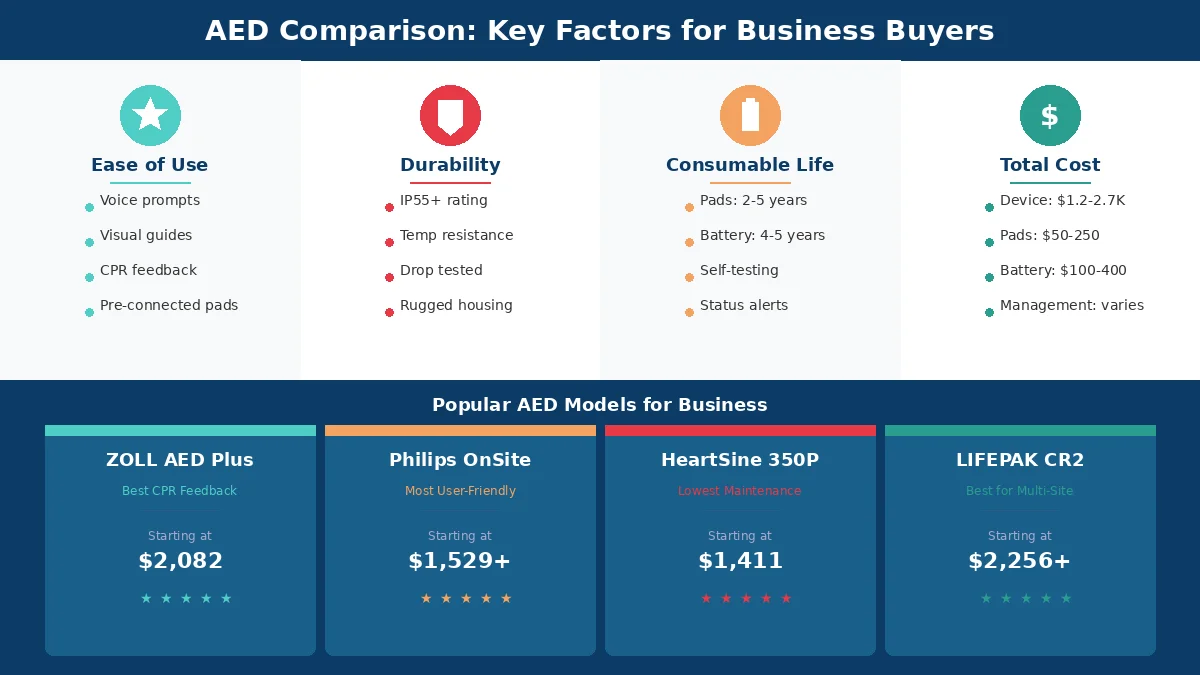
The purchase price of an AED is just the starting point. Factor in the total cost of ownership over a 5 to 10 year period:
- Initial device cost: $1,200 to $2,700 depending on the model
- Replacement pads: $50 to $250 per set, every 2 to 5 years
- Replacement batteries: $100 to $400, every 4 to 5 years
- Accessories: AED cabinets ($125-$175), carry cases, signage
- AED program management: Inspection tracking, compliance documentation, medical oversight
Important: The cheapest AED upfront may cost more over time if it requires frequent pad and battery replacements. Evaluate the 5-year total cost, not just the sticker price.
8. Warranty and Support
A strong warranty protects your investment. Most AED manufacturers offer warranties ranging from 5 to 10 years on the device. Consider:
- Length of the manufacturer warranty
- What the warranty covers (device only, or pads and batteries too)
- Customer support availability
- Trade-in or upgrade programs
Comparing Top AED Brands for Business
Here is an overview of the most popular AED models for business use, based on features, reliability, and total cost of ownership.
ZOLL AED Plus
- Type: Semi-automatic and fully automatic options
- Key feature: Real-time CPR feedback with depth and rate coaching
- Pad/battery life: Up to 5 years
- Durability: IP55 rated, suitable for demanding environments
- Warranty: 7 years
- Best for: Organizations that want CPR coaching and long consumable life
Philips HeartStart OnSite
- Type: Semi-automatic
- Key feature: Intuitive design with simple pull-handle activation
- Pad/battery life: 2 years (pads), 4 years (battery)
- Warranty: 8 years
- Best for: Small offices and businesses seeking an affordable, reliable option
Philips HeartStart FRx
- Type: Semi-automatic
- Key feature: Rugged design with a pediatric key for child patients
- Pad/battery life: 2 years (pads), 4 years (battery)
- Durability: IP55 rated
- Warranty: 8 years
- Best for: Schools, outdoor venues, and environments requiring durability
Physio-Control LIFEPAK CR2
- Type: Semi-automatic and fully automatic options
- Key feature: ClearVoice technology adjusts prompts based on ambient noise, Wi-Fi connectivity for device management
- Pad/battery life: 2 years (pads), 4 years (battery)
- Warranty: 8 years
- Best for: Large organizations and multi-location deployments
HeartSine Samaritan PAD
- Type: Semi-automatic (350P, 360P) and fully automatic (450P)
- Key feature: Lightweight, integrated pad-battery cartridge (Pad-Pak) simplifies maintenance
- Pad/battery life: 4 years (combined Pad-Pak)
- Warranty: 8 years
- Best for: Budget-conscious organizations that want minimal maintenance
Cardiac Science Powerheart G5
- Type: Semi-automatic and fully automatic options
- Key feature: Dual-language support, STAR biphasic technology, RescueCoach real-time CPR assistance
- Pad/battery life: 2 years (pads), 4 years (battery)
- Warranty: 8 years
- Best for: Diverse workplaces with multilingual staff
Defibtech Lifeline AED
- Type: Semi-automatic and fully automatic options
- Key feature: High-contrast LCD screen with video instructions, simple two-button interface
- Pad/battery life: 2 years (pads), 4 years (battery)
- Warranty: 8 years
- Best for: Organizations that value visual guidance during emergencies
How Many AEDs Does Your Business Need?
The American Heart Association recommends placing AEDs so that one can be retrieved and applied within 3 minutes of a cardiac arrest. As a general rule:
- One AED per floor in multi-story buildings
- One AED for every 50,000 square feet of floor space
- Additional AEDs in high-traffic areas, fitness facilities, cafeterias, and outdoor spaces
- Portable or AED rental options AEDs for temporary events, construction sites, or off-site activities
For multi-location organizations, a centralized AED management platform can track devices, monitor readiness, and ensure compliance across all sites.
AED Program Management: Beyond the Purchase
Buying an AED is the first step. Keeping it compliant, maintained, and ready to save a life requires ongoing program management.
An effective AED program includes:
- Medical direction and oversight from a licensed physician
- Registration with local EMS and state authorities as required
- Regular inspections (monthly visual checks, documented)
- Pad and battery tracking with proactive replacement before expiration
- Staff training on AED use and CPR
- Compliance documentation for audits and legal protection
- Post-event support after an AED is used in an emergency
Managing all of these tasks internally can be time-consuming and error-prone, especially for organizations with multiple locations. That is where a managed AED program can help.
AED Total Solution provides full-service AED program management that covers every aspect of compliance and readiness. From device selection and placement guidance to remote monitoring, inspection tracking, and audit-ready documentation, our white-glove approach ensures your AEDs are always ready when seconds matter most.
Frequently Asked Questions
What is the best AED for a small business?
For most small businesses, the Philips HeartStart OnSite or HeartSine Samaritan PAD 350P offer a strong balance of affordability, ease of use, and reliability. If you want real-time CPR feedback, the ZOLL AED Plus is an excellent choice with longer consumable life.
Are AEDs required in the workplace?
OSHA recommends but does not mandate AEDs in most workplaces. However, many states require AEDs in specific settings such as schools, fitness centers, and government buildings. Check your state’s AED laws for specific requirements.
How much does an AED cost?
AED prices typically range from $1,200 to $2,700 depending on the model and features. When evaluating cost, consider the total cost of ownership including replacement pads, batteries, accessories, and program management over the device’s lifespan. See our complete AED cost pricing guide for detailed 2026 pricing.
Do AEDs require maintenance?
Yes. AEDs require regular inspections, pad and battery replacements, and software updates. Most manufacturers recommend monthly visual inspections and replacing consumables before their expiration dates. Learn more in our AED maintenance guide.
Can anyone use an AED without training?
Yes. AEDs are designed for use by untrained bystanders. They provide clear voice instructions and will only deliver a shock if a shockable rhythm is detected. However, AED training is recommended and can increase confidence and response speed. Read our AED training guide for more information.
What is AED program management?
AED program management is a comprehensive service that handles all aspects of maintaining an AED program, including medical oversight, compliance tracking, inspections, consumable replacement, staff training, and documentation. AED Total Solution offers managed AED programs for businesses of all sizes.
Choose Confidently With Expert Guidance
Selecting the right AED for your business does not have to be complicated. Focus on the factors that matter most for your environment: ease of use, durability, consumable lifespan, total cost of ownership, and ongoing support.
If you need help choosing the right AED or building a compliant AED program for your organization, the team at AED Total Solution is here to help. We work with businesses, schools, and organizations across the United States to simplify AED compliance and ensure emergency readiness.
Browse our AED selection or call (855) 263-7772 to speak with an AED program expert today.