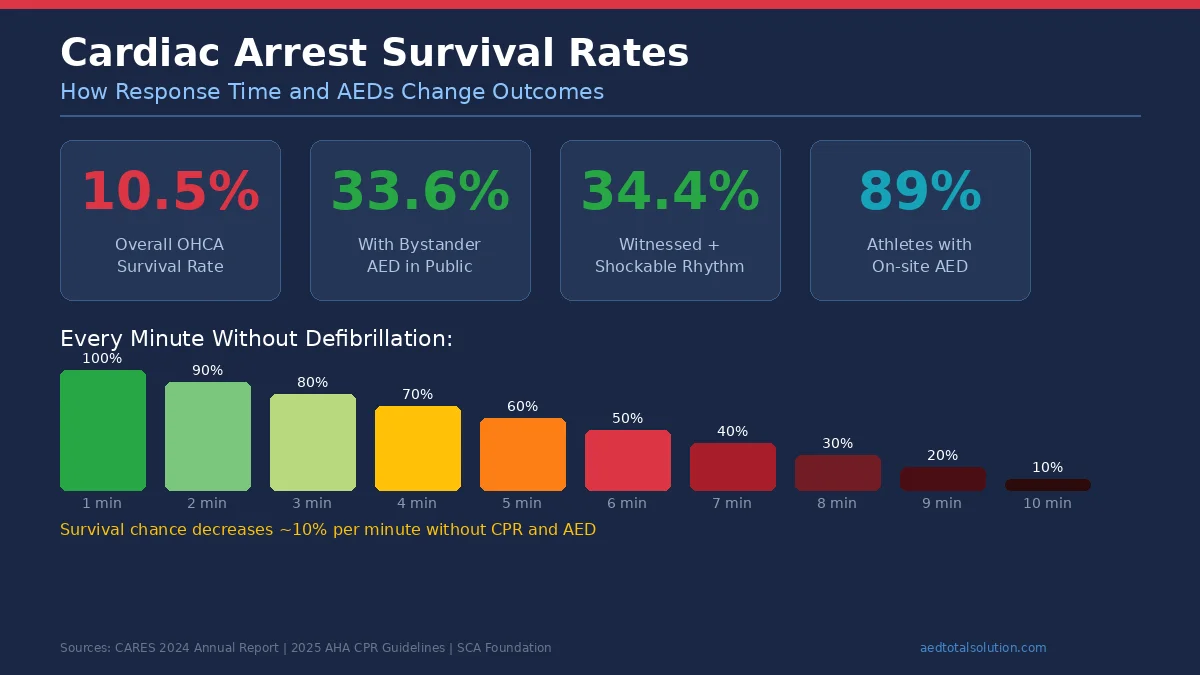
Sudden cardiac arrest remains one of the leading causes of death in the United States. According to the 2024 CARES Annual Report, an estimated 263,711 EMS-treated, non-traumatic out-of-hospital cardiac arrests occurred across the country in 2024 alone. The overall cardiac arrest survival rate stands at just 10.5% for those who make it to hospital discharge.
Those numbers are sobering, but they do not tell the whole story. Survival is not fixed. It changes dramatically based on how quickly someone receives CPR, how soon an automated external defibrillator (AED) delivers a shock, and whether the people nearby know what to do. This article breaks down the latest cardiac arrest survival data, explains the science behind time-to-defibrillation, and shows why having an AED program in your organization is one of the most impactful safety investments you can make.
What Is Cardiac Arrest and Why Is It So Deadly?
Cardiac arrest occurs when the heart’s electrical system malfunctions, causing the heart to stop beating effectively. The most common cause is an arrhythmia called ventricular fibrillation (V-fib), where the heart quivers chaotically instead of pumping blood. Without blood flow to the brain and vital organs, a person loses consciousness within seconds and faces irreversible damage within minutes.
Unlike a heart attack, which is a blockage that restricts blood flow to the heart muscle, cardiac arrest is an electrical failure that shuts down the heart entirely. For details, see our guide on sudden cardiac arrest vs heart attack. A heart attack victim is typically conscious and experiencing chest pain. A cardiac arrest victim collapses, stops breathing, and has no pulse. For a deeper look at these differences, see our guide on sudden cardiac arrest vs heart attack.
Common Causes of Cardiac Arrest
Understanding cardiac arrest causes helps organizations assess risk and prepare accordingly:
- Ventricular fibrillation (V-fib): The most common trigger, responsible for the majority of sudden cardiac arrests
- Prior heart conditions: Coronary artery disease, prior heart attack, cardiomyopathy, and heart valve disease
- Congenital heart defects: Structural abnormalities present from birth that affect electrical conduction
- Inherited arrhythmia syndromes: Long QT syndrome and other genetic conditions
- External triggers: Electrocution, severe trauma, drug overdose, drowning, and extreme physical exertion
- Heart attack escalation: A severe heart attack can damage the heart’s electrical system and trigger cardiac arrest
The American Heart Association (AHA) reports that approximately 84% of adult sudden cardiac arrests are linked to underlying heart conditions, but many victims have no prior symptoms or diagnosis.
Cardiac Arrest Survival Rate: What the Data Shows
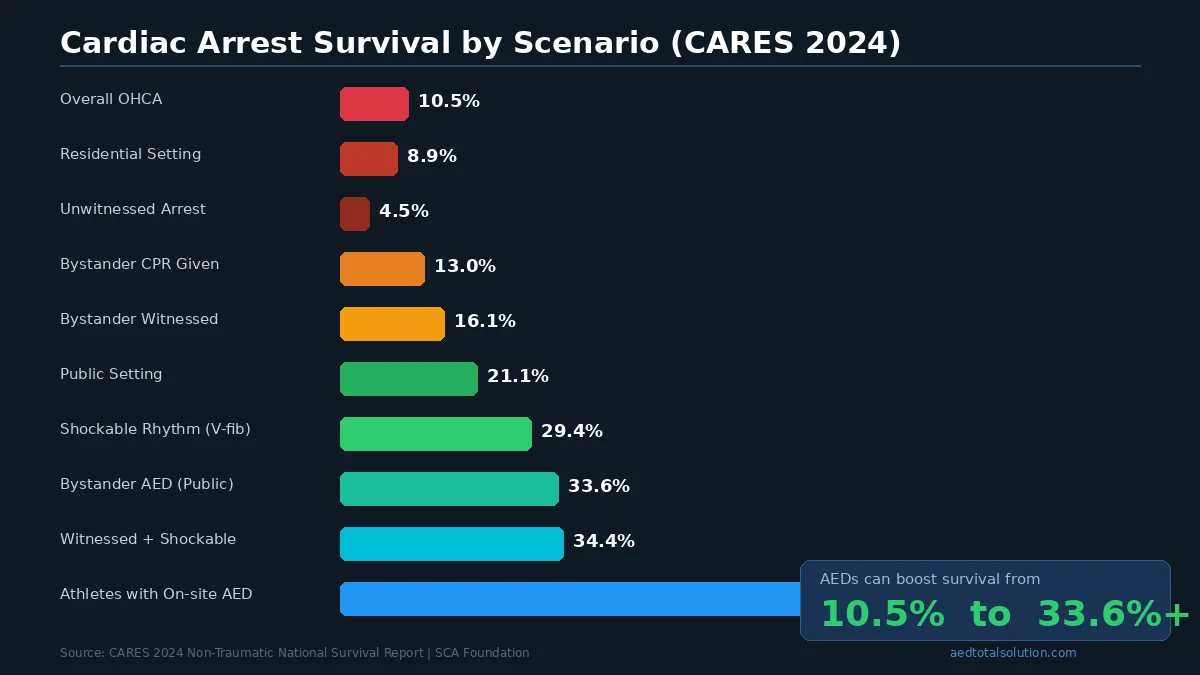
The most comprehensive source for U.S. cardiac arrest outcomes is the Cardiac Arrest Registry to Enhance Survival (CARES), which collects data from EMS agencies nationwide. The 2024 report reveals:
| Metric | Survival Rate |
|---|---|
| Overall survival to hospital discharge | 10.5% |
| Favorable neurological outcome (CPC 1 or 2) | 8.2% |
| Survival in public settings | 21.1% |
| Survival in residential settings | 8.9% |
| Bystander-witnessed arrests | 16.1% |
| Unwitnessed arrests | 4.5% |
| Shockable rhythm (V-fib/V-tach) | 29.4% |
| Witnessed + shockable rhythm | 34.4% |
Sources: CARES 2024 Annual Report; 2025 AHA Guidelines for CPR and ECC
Several patterns stand out in this data:
- Location matters. Cardiac arrests in public settings have more than double the survival rate of those at home (21.1% vs 8.9%). Public locations are more likely to have bystanders, AEDs, and shorter response times.
- Witnesses save lives. When someone sees the arrest happen, survival jumps to 16.1%, compared to just 4.5% for unwitnessed events. Witnessing the collapse enables faster 911 calls and faster CPR initiation.
- Rhythm type is critical. Patients with a shockable rhythm (V-fib or pulseless V-tach) have a 29.4% survival rate, nearly five times higher than those with non-shockable rhythms (6.4%). Shockable rhythms are exactly what AEDs are designed to treat.
- The best-case scenario. When the arrest is witnessed and the rhythm is shockable, survival reaches 34.4% and can climb much higher with rapid AED use.
How AEDs Change the Survival Equation
An automated external defibrillator is a portable device that analyzes heart rhythm and delivers an electrical shock to restore normal cardiac activity. AEDs are specifically designed to treat ventricular fibrillation, the chaotic rhythm responsible for most sudden cardiac arrests.
The data on AED effectiveness is compelling. According to the 2024 CARES data, when bystanders applied an AED in public settings (excluding nursing home and healthcare facility events), the survival rate was 33.6%, more than triple the overall 10.5% average.
For young athletes, the results are even more striking. Research cited by the Sudden Cardiac Arrest Foundation found that when a certified athletic trainer was on-site and an AED was available, 89% of young athletes who experienced cardiac arrest survived. One of the most common causes of sudden cardiac arrest in young athletes is commotio cordis, a condition triggered by a blow to the chest during sports.
Why Every Minute Counts: Time-to-Defibrillation Data
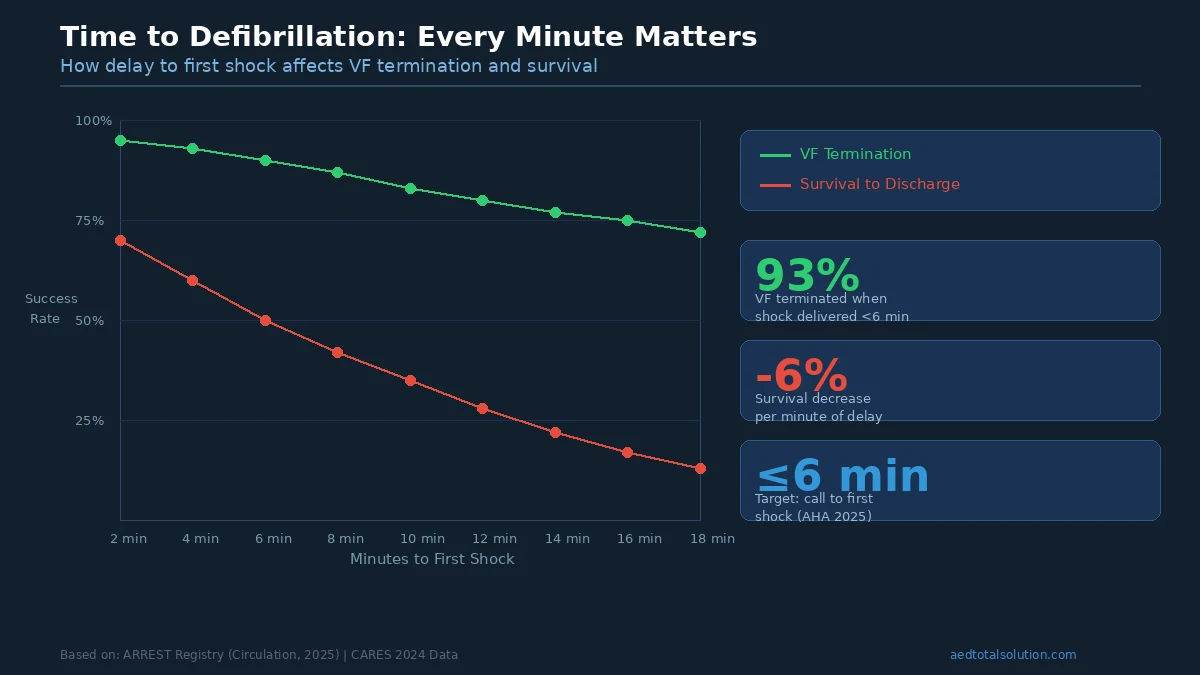
The relationship between time-to-shock and survival is one of the most well-documented findings in emergency medicine. A 2025 study published in Circulation using the ARREST registry analyzed 3,723 patients with witnessed out-of-hospital cardiac arrest and ventricular fibrillation. The results showed:
- When the first shock was delivered within 6 minutes, 93% of shocks successfully terminated ventricular fibrillation
- When the delay exceeded 16 minutes, only 75% of shocks terminated V-fib
- Every additional minute of delay was associated with a 6% lower probability of surviving to discharge
- Shorter delays to the first shock also correlated with higher rates of return to organized heart rhythm
A separate study on in-hospital cardiac arrests found that patients defibrillated within 4 minutes had a 36.4% mortality rate, compared to 50% for those defibrillated after 4 minutes and 90.9% for those who never received defibrillation.
The takeaway is clear: the window for effective defibrillation is narrow, measured in minutes, not hours. The American Red Cross summarizes it simply: survival chances decrease by approximately 10% for every minute that CPR and AED use is delayed.
The Chain of Survival
The AHA’s Chain of Survival framework outlines the critical steps that maximize cardiac arrest survival:
- Early recognition and calling 911. Identify the arrest immediately and activate emergency services.
- Early CPR. Begin high-quality chest compressions to maintain blood flow to the brain and heart. Learn the 7 essential CPR steps.
- Early defibrillation. Use an AED as soon as one is available. The device provides voice prompts and is designed for use by anyone, even without medical training. Review our step-by-step AED guide for details.
- Early advanced care. EMS provides medications, advanced airway management, and transport to the hospital.
- Post-arrest care and recovery. Hospital-based interventions including targeted temperature management and cardiac monitoring.
Each link in this chain builds on the one before it. CPR alone (without an AED) produces a survival rate of roughly 9%. For details, see our guide on CPR and AED use. Add an AED within the first few minutes, and survival can exceed 30%. When all links in the chain function quickly and effectively, the odds improve dramatically.
Public Access Defibrillation: The Evidence
Public access defibrillation (PAD) programs place AEDs in public locations and train community members to use them. The evidence supporting these programs is substantial.
Federal Workplace Results
A study of the Federal Occupational Health (FOH) public access defibrillation program in U.S. federal buildings found a 25% overall survival rate after cardiac arrest when AEDs were part of the response. For patients who were witnessed to collapse and presented with a shockable rhythm, survival rose to 39%.
OSHA reports that waiting for EMS personnel without an on-site AED results in only 5-7% survival. With immediate defibrillation from an on-site AED, studies have shown up to 60% survival one year after sudden cardiac arrest.
CARES 2024: Bystander AED Impact
The 2024 CARES data shows that only 12.6% of patients who had a cardiac arrest in a public location had an AED applied by a bystander. This represents a massive untapped opportunity. Despite the clear evidence that AEDs save lives, most available devices go unused during emergencies because people either do not know where the AED is or are not confident using it.
Among patients who did receive bystander AED application in public (excluding nursing home events), the survival rate was 33.6%, more than three times the national average.
Legislation Drives Improvement
A 2024 study published in JAMA Network Open examined the impact of bystander CPR legislation in Shenzhen, China. After implementing legislation requiring CPR and AED training, rates of bystander CPR increased from 4.1% to 18.7%, and AED use increased from 4.1% to 5.3%. Survival to hospital discharge improved significantly in the post-legislation period, demonstrating that policy-level investments in AED access and training produce measurable results.
Workplace Cardiac Arrest: A Preventable Crisis
The workplace represents one of the most controllable environments for improving cardiac arrest outcomes, and the data supports aggressive preparedness.
The Scale of the Problem
According to OSHA and the AHA, approximately 10,000 cardiac arrests occur in workplaces every year in the United States. Cardiac arrest accounts for 13% of all workplace fatalities, making it one of the leading causes of occupational death.
The AHA reports that only 50% of workers can locate an AED at their workplace. In the hospitality industry, that number drops to just 34%.
Why Workplaces Have Better Outcomes
Despite these gaps, workplace cardiac arrests consistently show better survival outcomes than residential events. The CARES data confirms this: survival in public settings (which includes many workplaces) is 21.1%, compared to 8.9% at home.
Workplaces benefit from several built-in advantages:
- Witnesses are almost always present. Coworkers can recognize an emergency within seconds.
- AEDs are more likely to be on-site. Particularly in offices, manufacturing facilities, and government buildings.
- Response times are shorter. An AED stored on the same floor can be retrieved in under two minutes.
- Trained responders may be available. Companies with safety programs often have CPR/AED-trained employees.
Organizations that invest in a comprehensive AED program with proper device maintenance, staff training, and strategic AED placement can push survival rates even higher.
Who Is at Risk for Sudden Cardiac Arrest?
Sudden cardiac arrest can strike anyone at any age, but certain factors increase risk:
- Age: Risk increases significantly after 45 for men and 55 for women
- Gender: Men account for 63.2% of OHCA cases (CARES 2024)
- Prior heart conditions: Coronary artery disease, heart failure, previous heart attack, or arrhythmia history
- Family history: A family history of sudden cardiac death or inherited arrhythmia syndromes
- Lifestyle factors: Smoking, excessive alcohol use, drug use, physical inactivity, and obesity
- Chronic conditions: Diabetes, high blood pressure, and high cholesterol
Organizations with higher-risk populations, such as fitness centers, manufacturing facilities, schools, and offices with employees over 40, should be especially proactive about AED readiness. For individuals at highest risk, implantable cardioverter-defibrillators (ICDs) can significantly improve survival rates. Our guide on AEDs for schools covers specific requirements for educational settings.
What Organizations Can Do to Improve Survival Rates
Based on the evidence, organizations can take concrete steps to ensure they are prepared for a cardiac emergency:
1. Deploy AEDs Strategically
OSHA recommends that AEDs be placed to ensure a response within 3-5 minutes of a cardiac arrest. This means:
- One AED per floor in multi-story buildings
- AEDs near high-traffic areas, fitness facilities, and cafeterias
- AEDs near confined spaces and areas with electrical hazards
- Clear signage so every employee knows the nearest AED location
Browse our AED shop for FDA-approved devices from leading manufacturers. For short-term needs like events or construction sites, our AED rental program provides flexible coverage.
2. Implement a Managed AED Program
Simply purchasing an AED is not enough. AEDs require ongoing maintenance: battery monitoring, electrode pad replacement, firmware updates, and regular inspections. An AED with an expired battery or depleted pads will not function when it is needed most.
AED Total Solution provides full-service, white-glove AED program management that covers:
- Device selection and placement guidance tailored to your facility
- AED registration and compliance documentation
- Routine inspections and readiness verification
- Battery and pad lifecycle tracking with proactive replacement
- Remote readiness monitoring through a centralized compliance dashboard
- Audit-ready reporting for regulatory reviews
- Scalable multi-location support
3. Train Employees in CPR and AED Use
The CARES data shows that bystander CPR was performed in only 41.7% of OHCA cases. Every percentage point increase in bystander CPR rates translates directly to lives saved. Ensure your employees understand how to use an AED and learn CPR basics, including proper AED pad placement.
4. Build and Document Your Emergency Response Plan
An effective cardiac emergency response plan includes:
- Designated trained responders on every shift
- Clear procedures for calling 911 and retrieving the AED
- Regular drills to ensure everyone knows their role
- Post-event debriefing and documentation
- Compliance with OSHA guidance and state-specific AED laws
5. Consider AED Certification
Understanding the regulatory landscape around AEDs is important for compliance and liability protection. Our guide on AED certification meaning explains what certifications mean and how they affect your organization.
Frequently Asked Questions
What is the survival rate for cardiac arrest?
The overall survival rate for out-of-hospital cardiac arrest in the United States is approximately 10.5%, according to the 2024 CARES Annual Report. However, when bystanders perform CPR and use an AED promptly in public settings, survival rates can exceed 33%. For witnessed cardiac arrests with a shockable rhythm, survival reaches 34.4%.
How much does an AED improve survival chances?
AEDs dramatically improve survival. The overall OHCA survival rate is 10.5%, but when a bystander applies an AED in a public setting, survival jumps to 33.6% (CARES 2024 data, excluding nursing home events). In athletic settings with on-site AEDs and trained responders, survival rates as high as 89% have been documented.
How quickly does an AED need to be used?
Every minute counts. Research shows that survival chances decrease by approximately 7-10% for every minute without defibrillation. A 2025 study found that when the first shock was delivered within 6 minutes, 93% of shocks successfully terminated ventricular fibrillation. The AHA and OSHA recommend AEDs be accessible within 3-5 minutes in workplace settings.
What is the survival rate for heart attacks compared to cardiac arrest?
Heart attacks and cardiac arrests have very different survival profiles. Most heart attack patients survive when they receive prompt medical treatment, as the heart is still beating. Cardiac arrest, where the heart stops entirely, has a much lower survival rate of 10.5% overall. However, a heart attack can trigger cardiac arrest, so rapid response to heart attack symptoms is critical.
Does OSHA require AEDs in the workplace?
OSHA does not currently mandate AEDs in all workplaces, but OSHA strongly recommends that employers include AED programs as part of their emergency action plans. OSHA estimates that 160 of the estimated 400 sudden cardiac deaths in the workplace each year could be prevented with on-site AEDs. Many states also have their own AED requirements for specific settings.
Can anyone use an AED, or do you need training?
Anyone can use an AED. Modern AEDs are designed with voice prompts and visual instructions that guide untrained users through every step. The device automatically analyzes the heart rhythm and will only deliver a shock if it detects a shockable rhythm. While formal training is recommended and improves confidence, Good Samaritan laws in most states protect bystanders who use an AED in good faith during an emergency.
This article is for informational and educational purposes only and is not a substitute for professional medical advice, diagnosis, or treatment. If you or someone near you is experiencing symptoms of cardiac arrest, call 911 immediately. Written by Prabakar Mahalingam, Managing Partner at AED Total Solution and a nationally recognized provider of safety training, products, and proprietary compliance software dedicated to addressing Sudden Cardiac Arrest (SCA).