

Commotio cordis is a life-threatening cardiac event triggered by a sudden blow to the chest, most often during sports. It can cause the heart to stop beating in otherwise healthy individuals, particularly young athletes. Understanding what commotio cordis is, how it happens, and why having an AED nearby can mean the difference between life and death is critical for coaches, parents, athletic trainers, and facility managers.
In this guide, we break down the causes, symptoms, risk factors, and prevention strategies for commotio cordis, including why rapid defibrillation with an automated external defibrillator (AED) is the single most important factor in survival.
What Is Commotio Cordis?
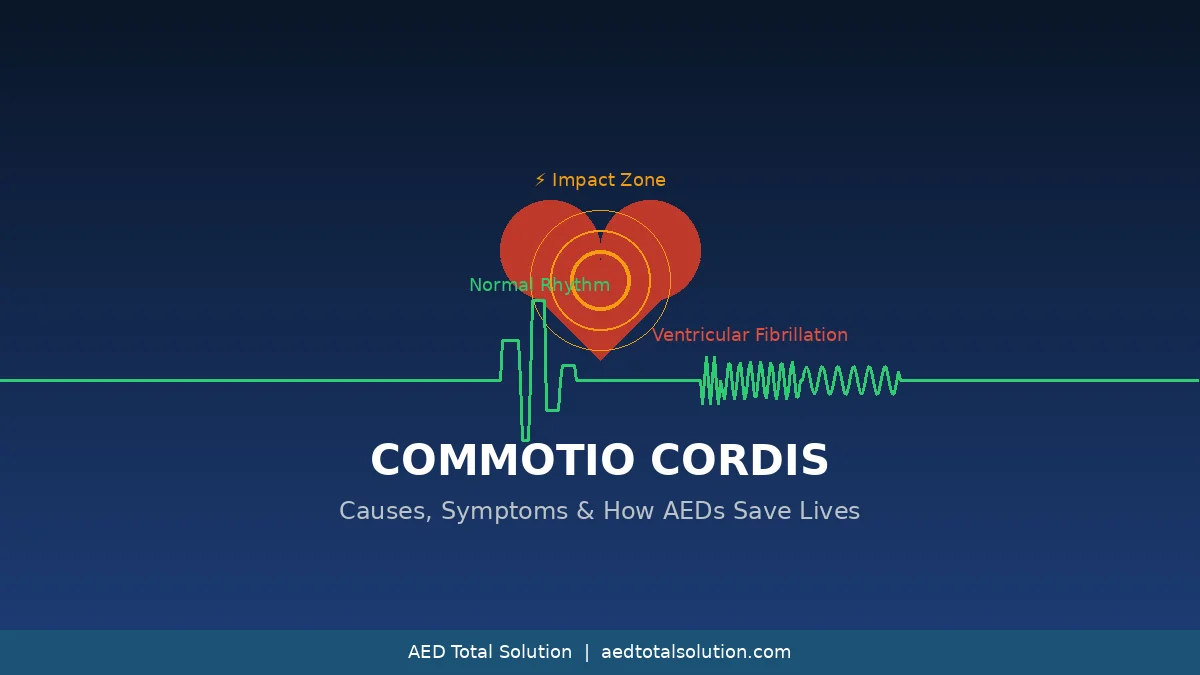
Commotio cordis (Latin for “agitation of the heart”) is a rare but potentially fatal condition in which a blunt impact to the chest directly over the heart causes sudden cardiac arrest. Unlike other cardiac emergencies that stem from underlying heart disease, commotio cordis occurs in structurally normal hearts.
The condition was first described in medical literature in the 18th century, but gained widespread public attention after NFL safety Damar Hamlin collapsed on the field in January 2023. His survival, thanks to immediate CPR and defibrillation by on-field medical staff, highlighted the critical importance of having trained responders and AEDs at every athletic event.
According to the National Commotio Cordis Registry maintained by the Minneapolis Heart Institute Foundation, approximately 10 to 20 cases are reported in the United States each year, though the actual number may be higher due to underreporting.
How Does Commotio Cordis Happen?
Commotio cordis occurs when a blunt object strikes the chest at a precise moment during the cardiac cycle. For the impact to trigger cardiac arrest, several conditions must align:
- Timing: The blow must land during a narrow 20-to-40-millisecond window just before the peak of the T-wave in the cardiac cycle. This is the period when the heart is electrically vulnerable to disruption.
- Location: The impact must occur directly over the heart, typically the left side of the chest over the precordium.
- Force: The impact must be hard enough to disturb the heart’s electrical rhythm but does not need to cause structural damage to the chest wall, ribs, or heart muscle.
- Object: Projectiles that are hard and small enough to concentrate force on a small area (like a baseball, lacrosse ball, or hockey puck) are the most common triggers.
When all these factors coincide, the impact can induce ventricular fibrillation, a chaotic, ineffective heart rhythm that prevents the heart from pumping blood. Without immediate intervention, ventricular fibrillation leads to sudden cardiac arrest and, if untreated, death within minutes.
Who Is Most at Risk?
Commotio cordis predominantly affects young males between the ages of 8 and 18, though it has been documented in adults as well. Several factors contribute to this age group’s vulnerability:
- Thinner chest walls: Children and adolescents have less muscle and fat protecting their hearts compared to adults.
- Sports participation: Young athletes are more likely to be involved in activities where chest impacts are common.
- Lack of protective equipment: Many youth sports do not require or enforce the use of chest protectors.
Sports With the Highest Risk
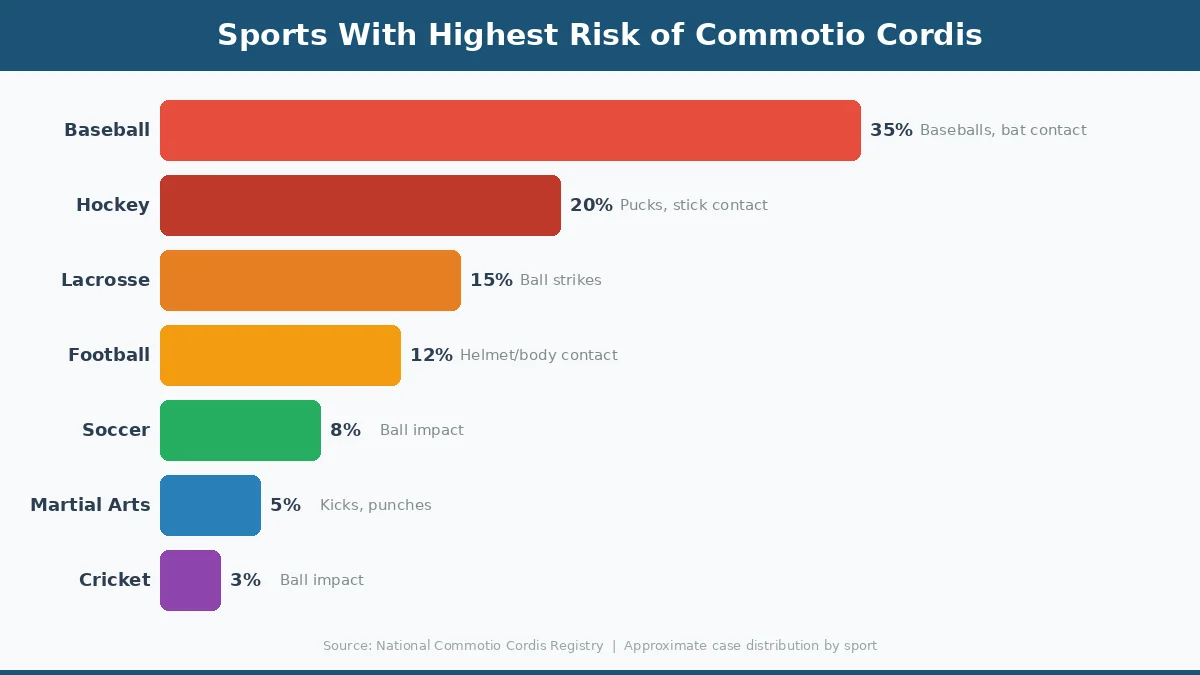
The following sports are most commonly associated with commotio cordis cases:
| Sport | Common Projectile or Cause |
|---|---|
| Baseball/Softball | Ball impact to the chest |
| Hockey (ice and field) | Puck or ball strike |
| Lacrosse | Ball strike |
| Football | Helmet or body contact |
| Soccer | Ball impact to the chest |
| Martial arts/Boxing | Kick or punch to the chest |
| Cricket | Ball impact |
Baseball accounts for the largest share of reported commotio cordis cases in the United States, largely because the size and hardness of a baseball are well-suited to triggering the condition when it strikes the chest.
Symptoms of Commotio Cordis
Commotio cordis can be difficult to recognize immediately because the initial impact may not appear severe. Unlike a major collision or visible injury, the chest blow that triggers commotio cordis can seem relatively minor to bystanders.
Watch for these warning signs immediately after a chest impact:
- Sudden collapse within seconds of the blow
- Loss of consciousness
- No pulse or detectable heartbeat
- Abnormal or no breathing (the person may exhibit agonal breathing, which are gasping, irregular breaths that should not be mistaken for normal breathing)
- No response to verbal or physical stimulation
If someone collapses after being struck in the chest during a sporting event, assume commotio cordis until proven otherwise. Every second counts.
How Is Commotio Cordis Treated?
The treatment for commotio cordis follows the same emergency protocol as any sudden cardiac arrest. The key difference is that victims of commotio cordis are typically young and otherwise healthy, which means survival rates are significantly higher when bystanders act quickly.
Step 1: Call 911 Immediately
Alert emergency medical services as soon as someone collapses after a chest impact.
Step 2: Begin CPR
Start high-quality chest compressions immediately. Push hard and fast (at least 2 inches deep at 100 to 120 compressions per minute). Do not stop to check for a pulse. Every minute without CPR reduces the chance of survival by 7% to 10%.
For a detailed guide, see our article on how to use an AED.
Step 3: Use an AED as Quickly as Possible
An automated external defibrillator (AED) is the definitive treatment for ventricular fibrillation caused by commotio cordis. The AED analyzes the heart rhythm and delivers a shock to restore normal electrical activity.
Time to defibrillation is the single most important factor in survival. According to research published in the journal Circulation, survival rates from commotio cordis have improved from less than 15% to over 60% in recent years, largely due to increased AED availability at sporting events and faster bystander response times.
Step 4: Continue CPR Until Help Arrives
After the AED delivers a shock, continue CPR as directed by the device. Do not remove the AED pads. Emergency responders will take over when they arrive.
Why AEDs Are Critical for Commotio Cordis Survival
The relationship between AED access and commotio cordis survival is direct and measurable:
- Defibrillation within 3 minutes: Survival rates above 70%
- Defibrillation within 5 minutes: Survival rates around 50%
- Defibrillation after 10 minutes: Survival rates drop below 10%
This is why every sports facility, school gymnasium, athletic field, and community recreation center should have an AED on-site and accessible within a two-minute walk of any playing area.
AED Total Solution provides comprehensive AED program management for schools, sports organizations, and recreational facilities, including device selection, installation, training coordination, compliance tracking, and ongoing maintenance. Our remote readiness monitoring ensures your AEDs are always rescue-ready when seconds count.
How to Prevent Commotio Cordis
While commotio cordis cannot be completely eliminated from contact sports, several measures can reduce the risk and improve outcomes:
1. Place AEDs at Every Sports Venue
Every location where athletes compete or practice should have at least one accessible AED. Many states now require AEDs at schools and athletic facilities. Check your state’s AED requirements to ensure compliance.
2. Train Coaches and Staff in CPR and AED Use
Coaches, athletic trainers, referees, and facility staff should be CPR and AED certified. In many commotio cordis cases, the first person on the scene is a coach or teammate, not a medical professional.
3. Develop an Emergency Action Plan
Every sports organization should have a written cardiac emergency action plan that includes:
- Location of the nearest AED
- Designated individuals trained to use it
- Steps for activating 911
- Directions for EMS to reach the field or court
4. Consider Chest Protectors
While research on the effectiveness of commercially available chest protectors has produced mixed results, some newer designs show promise in reducing the risk of commotio cordis. The challenge is that chest protectors must be worn correctly and consistently to offer any protection.
5. Use Age-Appropriate Equipment
Softer baseballs (safety baseballs) can reduce the risk for younger players, particularly those under age 12.
Commotio Cordis vs. Sudden Cardiac Arrest: What Is the Difference?
Commotio cordis is a specific type of sudden cardiac arrest triggered by blunt chest trauma. The key distinction is the cause:
| Feature | Commotio Cordis | Sudden Cardiac Arrest (Other Causes) |
|---|---|---|
| Cause | Blunt chest impact | Heart disease, arrhythmia, genetic conditions |
| Typical victim | Young, healthy athlete | Can affect anyone, more common in older adults |
| Heart structure | Normal (no underlying disease) | Often abnormal |
| Trigger | External physical trauma | Electrical malfunction, blockage, or structural issue |
| Treatment | CPR + AED (same protocol) | CPR + AED (same protocol) |
| Prevention | Chest protectors, AED access | Screening, medication, lifestyle changes |
Both conditions require the same emergency response: call 911, start CPR, and use an AED immediately. Learn more about the differences between cardiac arrest and heart attack.
Frequently Asked Questions About Commotio Cordis
What does commotio cordis mean?
Commotio cordis is a Latin term meaning “agitation of the heart.” It refers to sudden cardiac arrest caused by a blunt impact to the chest, typically during sports. The condition affects structurally normal hearts and is not the result of underlying heart disease.
How rare is commotio cordis?
Commotio cordis is considered rare, with approximately 10 to 20 confirmed cases reported annually in the United States. However, experts believe the actual incidence may be higher because some cases are misdiagnosed or unreported. It is the second leading cause of sudden cardiac death in young athletes, after hypertrophic cardiomyopathy.
Can you survive commotio cordis?
Yes, survival is possible with rapid intervention. When CPR is started immediately and an AED delivers a shock within 3 to 5 minutes, survival rates exceed 50% and can reach 70% or higher. The key factor is how quickly defibrillation occurs after collapse.
What sports have the highest risk of commotio cordis?
Baseball has the highest reported incidence of commotio cordis in the United States, followed by hockey, lacrosse, football, and soccer. Any sport involving projectiles or body contact carries some level of risk.
Do chest protectors prevent commotio cordis?
Current commercially available chest protectors have not been conclusively proven to prevent commotio cordis in all cases. Some newer designs show improved impact absorption, but no chest protector can guarantee complete protection. AED access and CPR training remain the most effective safety measures.
Is an AED effective for commotio cordis?
Yes. An AED is the most effective treatment for the ventricular fibrillation caused by commotio cordis. Rapid defibrillation is the single most important factor in survival. This is why every sports facility should have an AED on-site and personnel trained to use it.
Protect Your Athletes With AED Total Solution
Commotio cordis is rare, but when it strikes, every second matters. Having a properly maintained AED within reach and trained personnel ready to act can be the difference between life and death for a young athlete.
AED Total Solution offers complete AED program management designed specifically for schools, sports organizations, and recreational facilities. From device selection and AED rentals for events to ongoing compliance monitoring and staff training coordination, we handle every aspect of your AED program so you can focus on what matters most: keeping athletes safe.
Ready to protect your athletes? Call us at (855) 263-7772 or contact us online for a free AED program consultation.