AED compliance is not a federal checkbox. It is a patchwork of state laws, each with its own rules for placement, registration, training, and maintenance. If your organization has locations in more than one state, a program that passes inspection in Virginia could put you at risk in Maryland or New York.
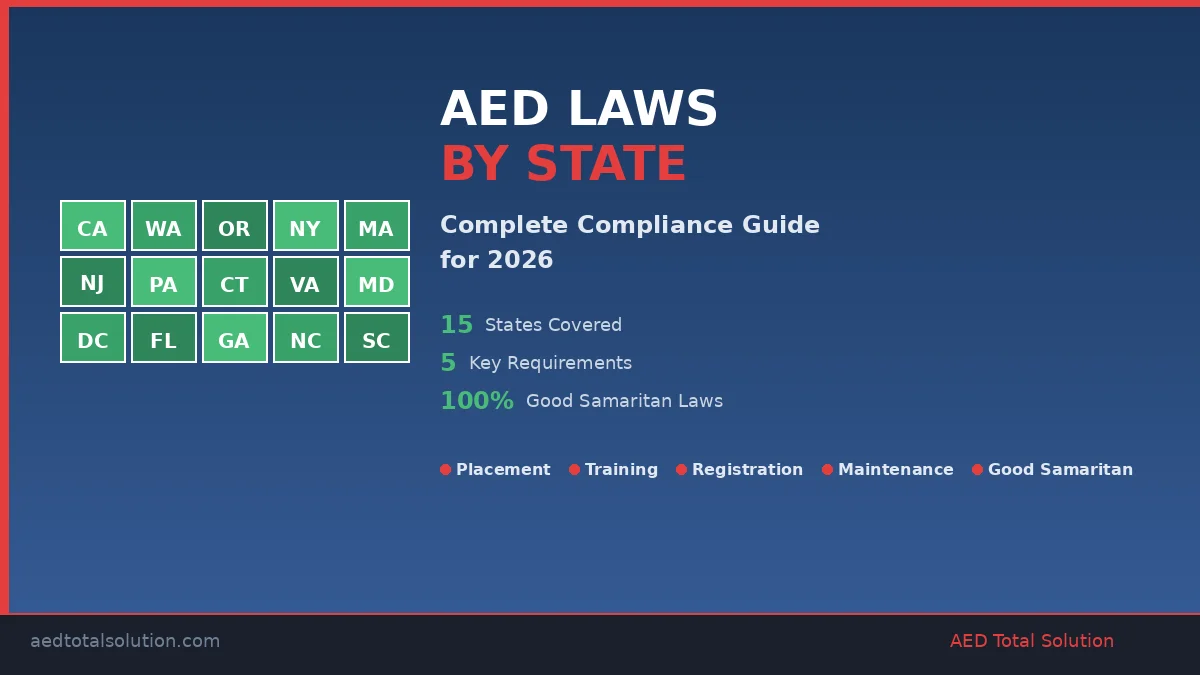
That gap between what you think is required and what your state actually mandates is where liability lives. This guide breaks down the AED rules and regulations for all 15 states where multi-location organizations most commonly operate, so you can build a program that is compliant everywhere, not just where your headquarters happens to be.
Key Takeaways
- AED laws are set at the state level, not federally. There is no single national AED mandate. Each state creates its own requirements for placement, training, registration, and maintenance. What is compliant in one state may fall short in another.
- Good Samaritan protections vary significantly. Every state offers some form of liability protection for AED users, but the scope differs. Some states require strict compliance with training and registration rules to maintain immunity.
- Multi-state organizations face the greatest compliance risk. If you manage AEDs across different jurisdictions, you must track and meet the specific requirements of each state individually. A one-size-fits-all policy creates gaps.
How AED Laws Work in the United States
Before examining individual state requirements, it helps to understand how the regulatory framework is structured. AED compliance in the United States operates on two levels: federal guidelines that set the baseline and state laws that define the specific obligations.
Federal Guidelines: The Foundation
At the federal level, two agencies set the groundwork:
- The FDA regulates AEDs as medical devices, governing their manufacture, sale, and labeling. The FDA’s 2004 reclassification of AEDs made them available for public access without a prescription.
- OSHA does not specifically mandate AEDs in the workplace but includes them in best-practice guidance for workplace first-aid programs. OSHA’s recommendations for AEDs encourage employers to incorporate defibrillators as part of a comprehensive emergency action plan.
The Federal Cardiac Arrest Survival Act (42 U.S.C. 238q) provides limited Good Samaritan protections at the federal level, but it explicitly defers to state law for most operational requirements.
State Laws: Where the Requirements Live
Every state has enacted some form of AED legislation. These laws typically address five areas:
- Placement mandates (where AEDs must be located)
- Training requirements (who must be trained and to what standard)
- Registration (whether devices must be registered with local EMS or state agencies)
- Maintenance (inspection schedules, manufacturer guideline compliance)
- Good Samaritan protections (liability immunity for AED users)
The complexity is in the details. Some states, like New Jersey and Maryland, have prescriptive programs with mandatory registration, physician oversight, and specific placement requirements. Others, like Virginia, take a lighter regulatory approach and focus primarily on liability protections.
State-by-State AED Requirements: Your 15-State Breakdown
Below is a detailed breakdown of AED compliance requirements for each of the 15 states where multi-location organizations are most active.
California
Key Statute: California Health & Safety Code Section 1797.196; California Civil Code Section 1714.21
California has some of the most detailed AED requirements in the country.
Placement Mandates:
- Health clubs, fitness centers, and public swimming pools
- Buildings with high occupancy (300+ for assembly use, 200+ for other uses) in new construction or major renovations
- Schools with interscholastic athletic programs
- Certain commuter rail services (since July 2020)
Training and Registration:
- AED registration is required with the local EMS agency
- Instructions for use must be displayed in 14-point font next to the device
- Building owners must annually notify tenants of AED locations and available training
- High school health education curricula should include compression-only CPR training
Maintenance:
- AEDs must be maintained per manufacturer specifications
- Testing required at least twice per year and after each use
Good Samaritan Protection:
- California Civil Code 1714.21 provides immunity for good-faith, uncompensated emergency AED use
- Does not protect against gross negligence
For a detailed breakdown, see our complete guide to AED requirements in California.
New York
Key Statute: New York Public Health Law Section 3000-b
New York has one of the most comprehensive AED regulatory frameworks in the nation, requiring medical oversight, staff training, and placement in multiple facility types.
Placement Mandates:
- Health clubs with 500 or more members (at least one AED on premises)
- All schools (AEDs and trained staff must be available during events and athletic competitions)
- Beaches and pools with lifeguards
- State government buildings
- Dental offices
- Places of public assembly with high occupancy
Training and Registration:
- AED providers must inform the regional emergency medical services council of device locations
- Anticipated users must be trained in CPR and AED operation
- Trained personnel must be present during all staffed hours at health clubs
Medical Oversight:
- Required. AED providers must establish a collaborative agreement with an emergency physician or licensed hospital
Maintenance:
- Providers are responsible for maintaining and testing devices per manufacturer guidelines
Good Samaritan Protection:
- Covers the AED user, prescribing physician, AED trainer, provider, and operator
- AED use is treated as first aid under the state’s Good Samaritan statute
For more details, read our guide to AED requirements in New York.
New Jersey
Key Statutes: N.J.S.A. 2A:62A-23 through 2A:62A-32; N.J.S.A. 18A:40-41a (Janet’s Law)
New Jersey has one of the strictest AED regulatory frameworks in the country, with mandatory placement in schools, health clubs, nursing homes, and public aquatic facilities.
Placement Mandates:
- All public and nonpublic K-12 schools (Janet’s Law, 2014) with AEDs available at athletic events and practices
- Health clubs with 100 or more members
- Nursing homes and assisted living facilities
- Trampoline parks
- Public swimming pools and bathing beaches (500+ swimmer capacity)
Training and Registration:
- Anyone acquiring an AED must ensure users hold current CPR/AED certification from ARC, AHA, or an equivalent program recognized by the Department of Health
- AEDs must be registered with the appropriate local EMS provider
- High school students must receive CPR/AED instruction before graduation
Medical Oversight:
- A licensed physician must be involved in protocol review for AED programs
- Purchasers must demonstrate a compliance protocol before acquisition
Good Samaritan Protection:
- N.J.S.A. 2A:62A-27 provides immunity for good-faith AED use, acquisition, training, and supervision
- Protection is contingent on compliance with statutory requirements for training, maintenance, and oversight
- Does not protect against gross negligence or willful misconduct
Pennsylvania
Key Statute: 42 Pa.C.S. Section 8331.2
Pennsylvania provides a solid liability protection framework and encourages AED placement across public venues.
Placement Mandates:
- Schools are encouraged or required (varies by district)
- Public buildings and recreation facilities
- Health clubs and fitness centers
Good Samaritan Protection:
- Section 8331.2 provides civil immunity for individuals who use an AED in good faith to render emergency care
- Protection extends to the person providing CPR/AED training and the prescribing physician
Training:
- Expected AED users should complete AHA or ARC-recognized CPR/AED training
For a full breakdown, see our guide to AED requirements in Pennsylvania.
Florida
Key Statutes: Florida Statutes Section 401.2915; Section 768.1325 (Cardiac Arrest Survival Act)
Florida takes an incentive-based approach rather than broad mandates. AEDs are required in specific settings but encouraged across most businesses.
Placement Mandates:
- Public high schools affiliated with the Florida High School Athletic Association (trained staff/volunteers required)
- Dental offices
- Certain assisted living facilities
- State buildings (per Florida Statutes Section 768.1326)
- Law enforcement vehicles may carry AEDs
Training and Registration:
- AED users are encouraged to obtain CPR/AED training
- AED owners are encouraged to notify local EMS of device location
- Students in grades 6 and above are encouraged to receive CPR/First Aid training every two years
Good Samaritan Protection:
- The “Cardiac Arrest Survival Act” (Section 768.1325) provides broad immunity for any person who uses an AED in a perceived medical emergency
- Protects acquirers, providers, and users
- Does not protect against gross negligence or willful misconduct
Note: Businesses are encouraged but not required to have AEDs. Intentional tampering with an AED or falsifying AED records is a first-degree misdemeanor.
Massachusetts
Key Statute: M.G.L. Chapter 93, Section 78A
Massachusetts focuses AED requirements primarily on health and fitness facilities.
Placement Mandates:
- Health clubs and fitness centers must have operational AEDs on premises
Training:
- Staff at health clubs should be trained in AED and CPR use
- Schools are encouraged to include CPR/AED instruction
Good Samaritan Protection:
- General Good Samaritan protections cover AED users acting in good faith
- Immunity does not extend to willful or wanton misconduct
Washington
Key Statutes: RCW 70.54.310; RCW 4.24.300
Washington requires a structured AED program for any entity that acquires a defibrillator, with one of the more comprehensive Good Samaritan frameworks.
Placement Mandates:
- Dental offices offering sedation or general anesthesia (WAC 246-817-722)
- Schools: every high school district must offer CPR instruction as a graduation requirement
Program Requirements (for AED acquirers):
- Expected users must receive DOH-approved training in AED use and CPR
- A licensed physician must provide medical direction upon AED acquisition
- The local EMS organization must be notified of the AED’s location
- AEDs must be maintained and tested per manufacturer guidelines
- After emergency use, 911 must be called and follow-up data provided
Good Samaritan Protection:
- RCW 70.54.310 provides immunity for AED users and all persons providing services under the statute
- RCW 4.24.300 provides broader Good Samaritan protection for rescuers, purchasers, property owners, physicians, and trainers
- Immunity does not apply to gross negligence or willful/wanton misconduct
Oregon
Key Statutes: SB 556 (2009); SB 1033 (2010); SB 1548 (2014)
Oregon has progressively strengthened its AED requirements, particularly for large public settings and schools.
Placement Mandates:
- All public and private schools (SB 1033, 2010)
- Community colleges and schools of higher education (SB 1006, 2010)
- Health clubs and fitness centers
- Buildings with 50,000+ square feet and 25+ people congregating per day (SB 556, 2009)
Training:
- A sufficient number of employees must be trained so at least one trained person is present during business hours
- AED locations must be clearly marked
Maintenance:
- Per manufacturer guidelines; batteries and electrodes must be current
- AED must be stored for quick retrieval during business hours
Good Samaritan Protection:
- SB 1548 (2014) provides broad immunity, covering use, attempted use, and nonuse of an AED
- Immunity extends to the person who used or attempted to use the AED, those present when it was used, trainers, physicians, and property owners
Connecticut
Key Statutes: Connecticut General Statutes Section 52-557b; Section 10-212d
Connecticut mandates AED placement in schools and specific recreational settings, with strong Good Samaritan protections.
Placement Mandates:
- All schools (since July 2010), subject to available federal, state, or private funding
- Athletic departments of higher education institutions
- Golf courses (at least one AED on premises)
- Health clubs
Training:
- School personnel should be trained in AED operation and CPR
- Higher education institutions must develop emergency action plans for athletics
Good Samaritan Protection:
- CPR-trained individuals, AED owners, program sites, and AED users receive liability protection
- May not cover CPR/AED trainers or medical directors of AED programs
- Does not protect against gross, willful, or wanton negligence
- A health club that fails to use an available AED may face liability (since October 2022)
Virginia
Key Statute: Code of Virginia Section 8.01-225
Virginia takes a relatively light-touch approach to AED regulation, with no specific administrative program requirements but strong liability protections and targeted mandates.
Placement Mandates:
- Health clubs (operational AED required)
- Dental offices administering deep sedation or general anesthesia
Training:
- Since the 2016-2017 school year, incoming 9th-grade students must complete training in emergency first aid, CPR, and AED use, including hands-on practice
Good Samaritan Protection:
- One of the broader frameworks: covers Good Samaritan rescuers, AED purchasers, property owners/managers, school board personnel, AED trainers, and supervising physicians
- Compensation (including salaries of people providing care) does not disqualify immunity
- Does not apply to willful or wanton misconduct
Maryland
Key Statutes: Maryland Education Code Section 13-517; Maryland Code of Regulations
Maryland has one of the most comprehensive AED programs in the country, with expanding mandates and a formal registration system.
Placement Mandates:
- Middle and high schools (registered AEDs and trained personnel at athletic events)
- Public swimming pools (AED and trained personnel required)
- Dental offices
- Grocery stores and restaurants (starting 2024, one of the few states with this requirement)
Training and Registration:
- Facilities must be certified by the EMS Board to have an AED
- EMS must be notified after each AED use
- Ninth-grade students must receive CPR/AED training
- Trained personnel must be present at all school athletic events
Medical Oversight:
- An in-state licensed physician or a regional AED committee must provide medical oversight
Maintenance:
- Must adhere to manufacturer guidelines and FDA standards
- Documentation of inspections, maintenance, and use is mandatory
Good Samaritan Protection:
- Contingent on compliance with EMS Board requirements
- Registered facilities and their members receive immunity
- Does not protect against grossly negligent conduct
Georgia
Key Statutes: Georgia Code Section 31-11-53.1; Section 51-1-29.3; Section 20-2-149.1
Georgia combines targeted school mandates with comprehensive Good Samaritan protections.
Placement Mandates:
- Every public high school with an interscholastic sports program must have a functional AED accessible at all times (“Cory Joseph Law”)
- Facilities performing conscious or deep sedation or general anesthesia
- Students in grades 9-12 must receive CPR and AED training
Training and Registration:
- AED acquirers must ensure users are trained in CPR and AED use
- The local EMS must be notified of the device’s location and type
Medical Oversight:
- A licensed physician must provide medical oversight of the AED program
Good Samaritan Protection:
- Georgia Code 51-1-29.3 provides immunity for AED users, owners/operators, medical directors, and CPR/AED instructors
- Does not apply to willful or wanton misconduct or persons acting within the scope of a licensed profession
District of Columbia
Key Requirements:
The District of Columbia has a structured AED program with multiple requirements:
- Physician oversight: Required
- Registration: Required with local authorities
- Training: Required for designated AED users
Good Samaritan Protection:
- D.C. provides liability protection for good-faith AED use during emergencies
North Carolina
Key Considerations:
North Carolina encourages AED placement through liability protections rather than broad mandates.
- Good Samaritan protection covers individuals who use an AED in good faith during an emergency
- Schools with athletic programs are encouraged to maintain AEDs
- AED acquirers should ensure proper training and maintenance
- The state follows a voluntary compliance model for most businesses
South Carolina
Key Considerations:
South Carolina requires physician involvement in AED programs but has relatively limited placement mandates.
- Physician requirement: Yes, a prescribing physician must be involved
- Registration: Not required
- Training: Not specifically mandated by state law, though best practice
- Good Samaritan protection: Available for good-faith emergency AED use
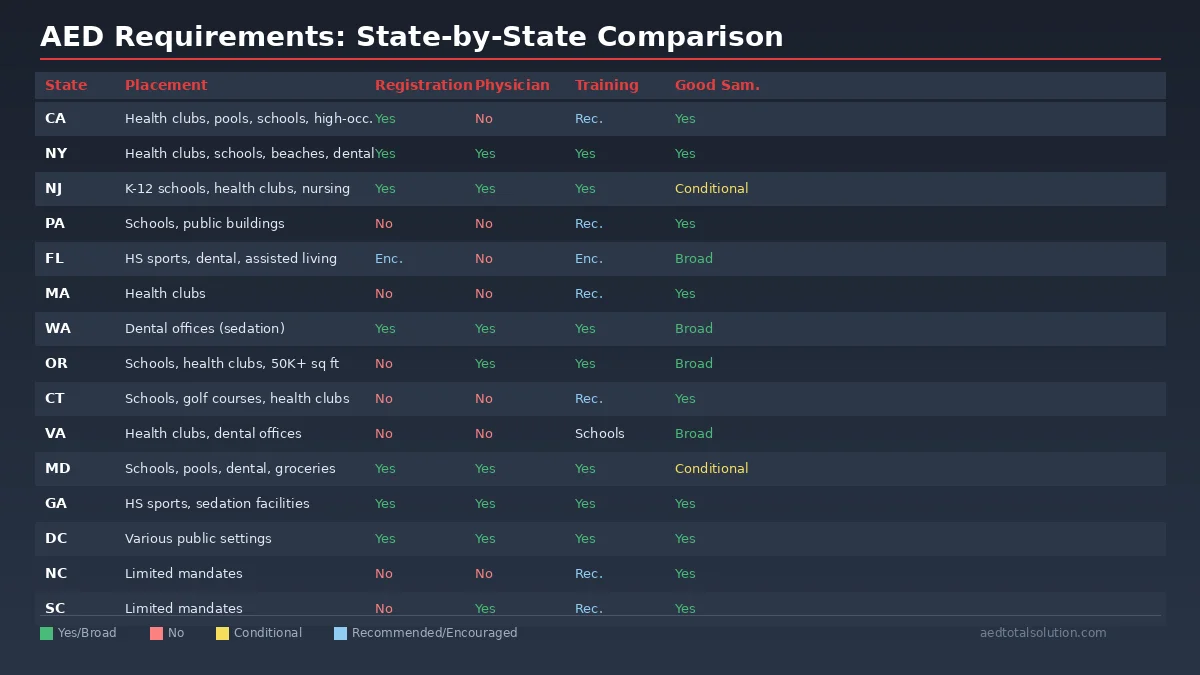
Comparison: AED Requirements Across All 15 States
Here is a quick reference comparing the key compliance obligations across every state covered in this guide.
| State | Placement Mandates | Registration Required | Physician Oversight | Training Required | Good Samaritan |
|---|---|---|---|---|---|
| California | Health clubs, pools, high-occupancy buildings, schools | Yes | No | Recommended | Yes |
| New York | Health clubs (500+), schools, beaches, state buildings, dental offices | Yes (regional council) | Yes | Yes | Yes |
| New Jersey | K-12 schools, health clubs (100+), nursing homes, pools, beaches | Yes (EMS) | Yes | Yes (certified) | Yes (conditional) |
| Pennsylvania | Schools, public buildings | No | No | Recommended | Yes |
| Florida | High schools (FHSAA), dental offices, assisted living, state buildings | Encouraged | No | Encouraged | Yes (broad) |
| Massachusetts | Health clubs | No | No | Recommended | Yes |
| Washington | Dental offices (sedation) | Yes (EMS) | Yes | Yes (DOH-approved) | Yes (broad) |
| Oregon | Schools, colleges, health clubs, buildings 50K+ sq ft | No | Yes (prescription) | Yes | Yes (broad) |
| Connecticut | Schools, golf courses, health clubs | No | No | Recommended | Yes |
| Virginia | Health clubs, dental offices | No | No | Schools (9th grade) | Yes (broad) |
| Maryland | Schools, pools, dental offices, grocery stores, restaurants | Yes (EMS Board) | Yes | Yes | Yes (conditional) |
| Georgia | High schools (sports), sedation facilities | Yes (EMS) | Yes | Yes | Yes |
| DC | Various public settings | Yes | Yes | Yes | Yes |
| North Carolina | Limited mandates | No | No | Recommended | Yes |
| South Carolina | Limited mandates | No | Yes | Recommended | Yes |
Good Samaritan Laws: What Actually Protects You
Every state in the country has some form of Good Samaritan law that provides liability protection to people who use an AED during an emergency. However, the scope and conditions of that protection differ meaningfully from state to state.
Universal Principles
Across all 50 states, Good Samaritan AED laws share several common elements:
- Good faith requirement. The person using the AED must act in good faith, genuinely attempting to help
- No gross negligence. Protection is universally voided by gross negligence, willful misconduct, or wanton behavior
- Emergency context. The AED must be used in an actual or perceived emergency situation
Key Differences to Watch
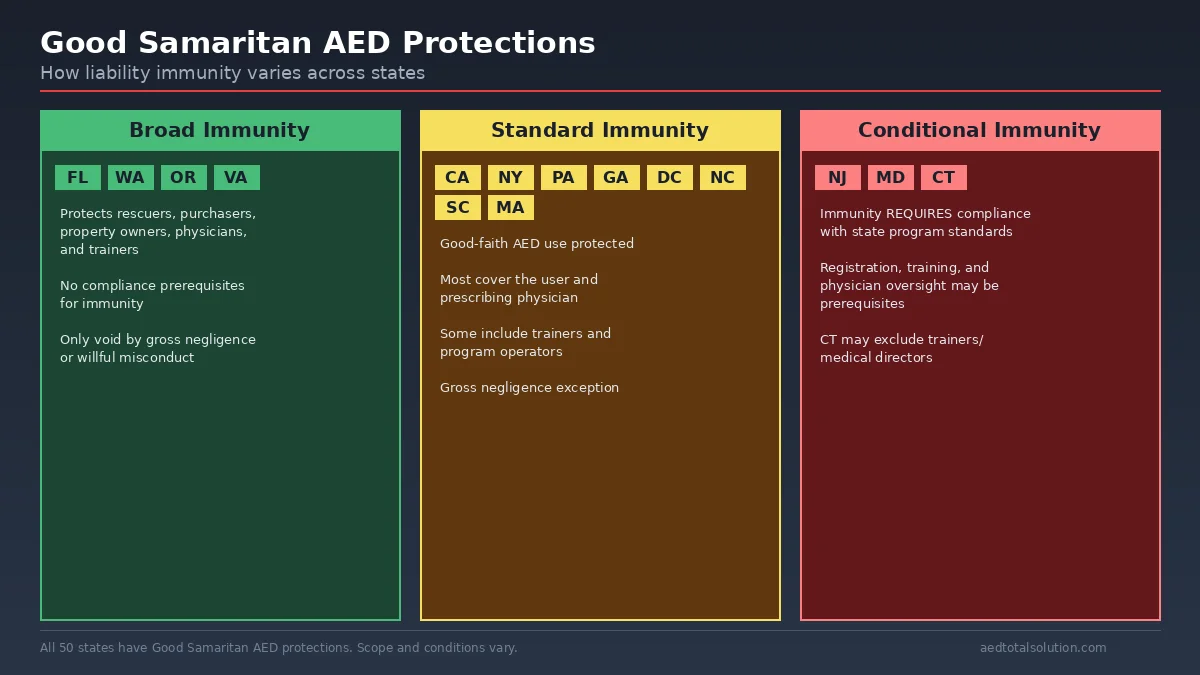
Where states diverge is in the conditions and scope of that protection:
- Conditional immunity (NJ, MD): In New Jersey and Maryland, Good Samaritan protection for AED program owners is contingent on compliance with specific administrative requirements like registration, training, and physician oversight. If your program is not registered in Maryland, you may lose immunity.
- Broad immunity (FL, WA, OR, VA): States like Florida, Washington, Oregon, and Virginia offer broad protections that extend to rescuers, purchasers, property owners, physicians, and trainers, without requiring strict compliance with administrative standards.
- Trainer/director exclusions (CT): Connecticut’s Good Samaritan law may not cover CPR/AED trainers or medical directors of AED programs, an important distinction for organizations providing in-house training.
Why This Matters for Multi-State Organizations
If your organization operates in both New Jersey and Virginia, the same AED program could enjoy full protection in Virginia while being exposed to liability in New Jersey if your registration or physician oversight lapsed. Understanding these distinctions is essential for risk management.
Penalties and Consequences for Non-Compliance
While criminal penalties for AED non-compliance are rare, the consequences of falling out of compliance are real:
- Loss of Good Samaritan protection. In states with conditional immunity (New Jersey, Maryland), a lapsed registration or expired training certification can strip your organization of liability protection.
- Civil liability exposure. If an AED fails during an emergency due to improper maintenance, or if trained personnel are not available when required, the organization may face negligence claims.
- Fines. New Jersey health clubs that fail to meet AED requirements can face penalties from state or local authorities. Repeated violations could lead to business license suspension.
- Criminal penalties (rare). Florida Statutes Section 401.2915 makes intentional AED tampering or falsifying AED records a first-degree misdemeanor.
How to Stay Compliant Across Multiple States
Managing AED compliance for a single location is manageable. Managing it across 5, 10, or 50 locations in different states requires a system. Here is what a compliant multi-location AED program looks like:
1. Map Each Location to Its State Requirements
Do not assume uniformity. Build a compliance matrix that maps every location to its state’s specific obligations for placement, training, registration, maintenance, and medical oversight.
2. Centralize Tracking and Documentation
Use a centralized management system to track:
- Device locations, serial numbers, and models
- Pad and battery expiration dates
- Inspection schedules and results
- Training certifications and renewal dates
- Registration status with local EMS
3. Establish a Maintenance Protocol
Every state that addresses maintenance requires adherence to manufacturer guidelines. At minimum:
- Conduct visual inspections monthly
- Test devices per manufacturer recommendations
- Replace pads and batteries before expiration
- Document every inspection and maintenance action
4. Keep Training Current
Train designated responders in CPR/AED use through AHA, ARC, or state-recognized programs. Track certification expiration dates and schedule renewals proactively, not reactively.
5. Work with a Compliance Partner
The most reliable way to maintain multi-state compliance is to partner with a managed AED program provider. AED Total Solution provides end-to-end program management that includes remote readiness monitoring, compliance tracking, maintenance scheduling, and audit-ready documentation across every jurisdiction where you operate.
Frequently Asked Questions
Are AEDs required by federal law?
No. There is no federal mandate requiring AEDs in private workplaces. The FDA regulates AED devices, and OSHA recommends them as part of workplace first-aid programs, but specific placement and maintenance requirements are determined by state law.
Which state has the strictest AED requirements?
New Jersey and Maryland have the most prescriptive AED regulatory frameworks, with mandatory placement in schools, health clubs, and other facilities, plus required registration, physician oversight, training, and conditional Good Samaritan protections tied to compliance.
Do Good Samaritan laws protect my organization or just the person using the AED?
It depends on the state. Some states (like Virginia and Washington) extend protection broadly to purchasers, property owners, trainers, and physicians. Others (like Connecticut) may exclude trainers or medical directors. In conditional-immunity states (New Jersey, Maryland), your organization must meet all statutory requirements to maintain protection.
What happens if my AED is not registered in a state that requires it?
In conditional-immunity states, an unregistered AED program could lose Good Samaritan protection. This means your organization could be exposed to civil liability in the event of an AED-related incident. Additionally, some states may impose fines for non-registration.
How often should AEDs be inspected?
California requires testing at least twice per year and after each use. Most other states defer to manufacturer guidelines, which typically recommend monthly visual checks and periodic comprehensive testing. For a complete breakdown, read our AED inspection policy guide.
Can anyone use an AED, or do you need training?
Modern AEDs are designed for use by anyone, with voice prompts that guide the user step-by-step. However, some states (like New Jersey and Washington) require that designated responders complete certified training before using an AED. All 50 states provide Good Samaritan protection for untrained bystanders who use an AED in good faith during an emergency.
Take the Guesswork Out of Multi-State AED Compliance
Tracking the requirements of 15 different state laws across dozens of locations is not a task for spreadsheets and calendar reminders. One missed registration renewal or expired pad can create a compliance gap that exposes your organization to liability.
AED Total Solution manages the entire compliance lifecycle for organizations operating across multiple states. From device procurement and registration to ongoing monitoring, inspections, training coordination, and audit-ready documentation, we ensure every device at every location meets the specific requirements of its state.
Ready to simplify your multi-state AED compliance? Contact AED Total Solution for a consultation on managed AED program services.
Written by Prabakar Mahalingam, Managing Partner at AED Total Solution. Prabakar is a nationally recognized provider of safety training, products, and proprietary compliance software dedicated to addressing Sudden Cardiac Arrest (SCA). With extensive experience managing AED programs across multiple states and industries, he helps organizations build compliance frameworks that meet the unique requirements of each jurisdiction.
Disclaimer: This guide is intended for educational purposes and does not constitute legal advice. AED laws are subject to change. We recommend consulting with legal counsel or your state’s EMS agency for the most current requirements applicable to your organization.