

An AED sitting on a wall with a dead battery is worse than no AED at all. It creates a false sense of security that can cost someone their life. Regular AED inspections are the system that keeps your devices rescue-ready, your organization compliant, and your people protected. This guide covers everything you need to build and maintain a bulletproof AED inspection program, from daily visual checks to annual professional assessments, with a complete checklist you can put to work today.
What Is an AED Inspection?
An AED inspection is a systematic check of your automated external defibrillator to verify it will function correctly during a sudden cardiac arrest emergency. The process confirms that the device’s status indicator shows “ready,” the battery holds adequate charge, electrode pads have not expired, and the unit is physically undamaged and accessible.
Most modern AEDs perform automated daily or weekly internal self-tests, but these electronic checks cannot catch every problem. A visual inspection by a trained person remains the standard recommended by OSHA and device manufacturers. Self-tests will not tell you if the cabinet has been tampered with, if someone moved the device, or if accessories like rescue masks and razors need replacement.
Think of an AED inspection the way you think about checking a fire extinguisher. The device may sit unused for years, but the moment you need it, it must work perfectly. According to research published in the Journal of the American Heart Association, approximately 23% of AED failures stem from expired batteries, expired pads, or inadequate maintenance. A consistent inspection routine eliminates these preventable failures.
Get certified in CPR

CPR & AED Training
3-hour in-person training with a 2-year nationally recognized certification.
CPR, AED & First Aid Certification
Instructor-led on-site. Practice on real manikins and AED trainers.
Why AED Inspections Matter
When someone experiences sudden cardiac arrest, survival rates drop 7-10% for every minute without defibrillation. An AED used within the first few minutes can push survival rates as high as 74%. But that potential disappears entirely if the device fails because nobody checked the battery or replaced expired electrode pads.
Beyond the immediate life-safety stakes, AED inspections serve three critical functions for your organization:
Legal and Liability Protection
Most states tie Good Samaritan liability protections to proper AED maintenance. If your organization deploys an AED but fails to inspect it according to manufacturer guidelines, you may forfeit legal protection in the event of an incident. Illinois, for example, imposes fines of $1,500 to $2,000 or more for non-compliant AED programs.
Regulatory Compliance
AEDs are FDA-regulated Class III medical devices. While federal OSHA standards do not mandate AED deployment, OSHA Publication 3185 strongly encourages workplaces that choose to deploy AEDs to maintain a written inspection program. Many states go further with specific mandates.
Organizational Readiness
Documented inspections create an audit trail that proves your organization takes emergency preparedness seriously. This matters for insurance carriers, accreditation bodies, and internal risk management. When a cardiac emergency occurs, you want records showing every device was checked on schedule.
How Often Should AEDs Be Inspected?
AED inspection frequency follows a tiered schedule. Each tier catches different types of issues, and all three are necessary for a complete program.
Daily Visual Checks (30 Seconds)
A daily check takes less than 30 seconds and catches the most common readiness problems. Walk past each AED location and confirm:
- The device is present in its designated location
- The status indicator light shows green or “ready”
- The cabinet or case has not been opened or tampered with
- No visible damage to the exterior
Daily checks are especially important in high-traffic locations like gyms, schools, and office lobbies where devices may be moved or disturbed.
Monthly Documented Inspections (5-10 Minutes)
Monthly inspections are the industry standard recommended by the FDA and most AED manufacturers. This is the core of your AED maintenance checklist and the minimum frequency required for compliance in most jurisdictions.
A monthly inspection should verify:
- Status indicator: Green light or “ready” symbol is displayed
- Battery expiration date: Confirm battery is not expired and note the replacement date
- Electrode pad expiration: Check both adult and pediatric pads (if applicable) for expiration dates
- Physical condition: Inspect for cracks, corrosion, loose connections, or water damage
- Accessories: Verify the rescue kit includes gloves, a razor, a CPR barrier mask, and scissors
- Signage: Confirm the AED location sign is visible and unobstructed
- Documentation: Record the inspection date, inspector name, and any issues found on your AED inspection log
Quarterly to Semi-Annual Reviews
Some states and manufacturers require more frequent documented checks. California, for example, mandates biannual device testing and 90-day inspection cycles. Certain AED brands like Cardiac Science recommend quarterly inspections. Always check your specific model’s user manual for the manufacturer’s recommended schedule.
Annual Professional Assessments
Once a year, conduct a comprehensive review of your entire AED program:
- Verify all devices have current physician prescriptions (required in most states)
- Review and update your written AED policy
- Confirm trained responder CPR/AED certifications are current
- Check for any manufacturer recalls or required software updates
- Evaluate whether AED placement still matches building use and foot traffic patterns
- Update your inventory with serial numbers, purchase dates, and warranty status
- Review all inspection records from the past 12 months for gaps
The Complete AED Inspection Checklist
Use this checklist for your monthly documented inspections. Print it out or integrate it into your AED management software for digital tracking.
Step 1: Check the Status Indicator
Without opening the device, look at the visual status indicator on the front panel. Every AED manufacturer uses a slightly different system, but the principle is the same: green means ready, red or no light means a problem. If the indicator shows anything other than “ready,” do not attempt to fix it yourself. Contact the manufacturer or your AED program manager immediately.
Step 2: Verify Battery Life
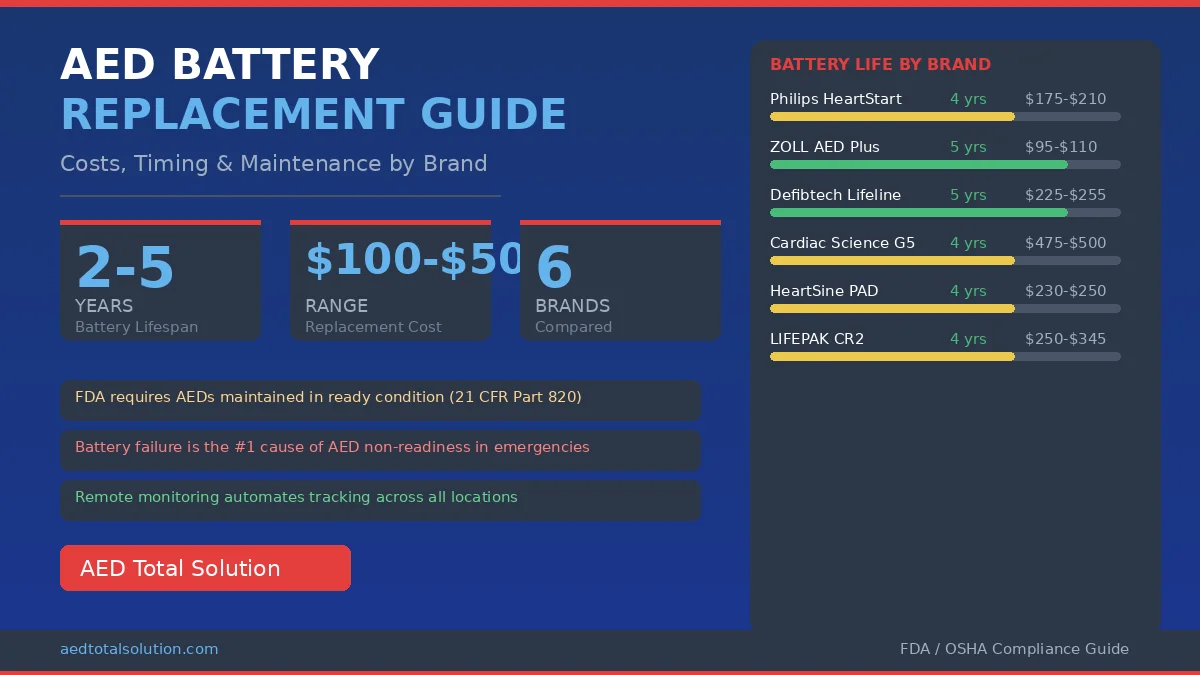
Locate the battery expiration date, which is typically printed on the battery itself or visible through a window on the device. Most AED batteries last 2-5 years depending on the manufacturer. Replace any battery that will expire within 30 days. Common battery lifespans by brand:
- Philips HeartStart: 4-year standby life
- ZOLL AED Plus: 5-year standby life
- Physio-Control LIFEPAK: 2-4 year standby life
- Defibtech Lifeline: 4-7 year standby life
- Cardiac Science Powerheart: 4-year standby life
- HeartSine Samaritan: 4-year standby life
Step 3: Check Electrode Pads
Electrode pads are sealed in foil packaging to keep the conductive gel moist. Once that seal is compromised or the pads expire, they may not adhere properly to the patient’s skin or deliver an adequate shock. Check the expiration date printed on the pad packaging. If pads expire within 30 days, order replacements now. Also confirm that pediatric pads are available if your location serves children.
Step 4: Inspect the Device Exterior
Look for physical damage: cracks in the housing, frayed cables, corroded connectors, or signs of water exposure. Open the carrying case and check that all components are present and properly seated. Verify the device has not been dropped or struck.
Step 5: Verify Accessories and Supplies
A complete AED response kit should include:
- CPR barrier mask or pocket mask
- Nitrile gloves (at least two pairs)
- Disposable razor (to shave chest hair if needed for pad adhesion)
- Trauma scissors (to cut away clothing)
- Absorbent towel (to dry the patient’s chest)
- Biohazard bag
Step 6: Document Everything
Record the inspection results with the date, the inspector’s name, and the serial number of each device checked. Note any corrective actions taken. This documentation creates the audit trail that proves compliance during regulatory reviews, insurance audits, or legal proceedings.
AED Inspection Requirements by State
AED regulations vary significantly across the United States. While no federal law mandates AED deployment in private workplaces, most states have enacted their own requirements. Understanding your state’s model helps you build an inspection schedule that meets or exceeds the legal minimum.
Comprehensive Regulation States (California Model)
States like California impose detailed requirements including:
- Mandatory AED placement in health clubs, schools, and certain public buildings
- Biannual device testing and 90-day inspection cycles
- Good Samaritan immunity tied directly to documented compliance
- Required physician oversight for all AED programs
Medical Oversight States (Texas Model)
States like Texas require:
- Explicit physician oversight for every AED program
- Monthly inspection requirements with documented checklists
- Facility-specific mandates for dental offices, nursing homes, and similar settings
- Post-event physician review within specified timeframes
Collaborative Agreement States (New York Model)
States like New York require:
- Filing with Regional EMS Councils
- Quarterly reporting to the state health department
- AED mandates for facilities with capacity over 1,000 people
- Collaborative agreements between facilities and local EMS agencies
Voluntary Compliance States (Florida Model)
States like Florida offer:
- Unconditional Good Samaritan protection for compliant AED programs
- Facility-specific recommendations without universal mandates
- Reduced liability exposure for organizations that follow best practices voluntarily
Regardless of your state’s requirements, following manufacturer inspection schedules and documenting every check is the baseline for any responsible AED program. When in doubt, default to monthly documented inspections.
RECOMMENDED
HeartSine Samaritan 350P AED Package
Compact, fully-automatic AED designed for first-time responders. Pads, battery, carry case and wall sign included.
How to Build an AED Inspection Policy
An AED inspection policy is your organization’s written plan that defines who inspects the devices, what they check, how often they check, and how results are recorded. Without a formal policy, maintenance falls through the cracks. Batteries die, pads expire, and nobody notices until an emergency exposes the gap.
Key Elements of an Effective Policy
- Designated AED coordinator: Assign one person (with a backup) who owns the inspection program. This person is accountable for scheduling checks, ordering supplies, and maintaining records.
- Inspection schedule: Define your daily, monthly, and annual inspection cadence in writing. Tie it to your organization’s calendar so it does not drift.
- Standardized checklist: Use the same checklist for every inspection so nothing gets missed. Include the specific items listed in the checklist section above.
- Documentation system: Choose between paper logs (stored with the device) and digital tracking through AED management software. Digital systems offer automated reminders and centralized reporting.
- Escalation procedures: Define what happens when an inspection reveals a problem. Who gets notified? Where does the replacement supply come from? How quickly must the issue be resolved?
- Training requirements: Document which staff members need CPR/AED certification, track their certification expiration dates, and schedule recertification training in advance.
- Post-event protocol: After any AED deployment, the device must be serviced: data downloaded, electrode pads replaced, battery assessed, and a physician review completed (required in most states).
AED Inspection Software: Moving Beyond Paper Logs
Spreadsheets and paper logs work for a single AED, but they break down quickly when you manage multiple devices across multiple locations. AED inspection software provides a digital command center for your entire program, giving you real-time visibility into every device’s status from one dashboard.
What Good AED Inspection Software Does
- Automated inspection reminders: The system sends email or push notifications when inspections are due, so nothing gets missed because someone forgot
- Mobile inspection logging: Inspectors can complete checks using a smartphone app with barcode scanning, eliminating manual data entry errors
- Expiration tracking: Automatic alerts when batteries or electrode pads approach their expiration dates, typically at 60-day and 30-day intervals
- Compliance reporting: Generate inspection history reports for auditors, insurance carriers, or regulatory agencies with a few clicks
- Multi-site management: Track devices across dozens or hundreds of locations from a single dashboard
- Training certification tracking: Monitor which staff members hold current CPR/AED certifications and when they need renewal
Software vs. Full-Service Program Management
Basic inspection software handles scheduling and record-keeping, but it still leaves your team responsible for ordering supplies, coordinating physician oversight, managing device recalls, and handling post-event procedures. A full-service AED program management solution handles all of this for you.
AED Total Solution provides a complete managed service that goes beyond software. The platform includes a web portal and mobile app for real-time AED monitoring, automated inspection reminders, battery and pad expiration alerts, CPR certification tracking, physician-provided medical oversight, and post-event coordination. The Standard Plus plan adds automatic no-cost replacement of expiring pads and batteries, so your team never needs to track down or order supplies.
Common AED Inspection Mistakes
After managing AED programs for thousands of organizations across all 50 states, these are the mistakes we see most often:
- Relying solely on self-tests: The AED’s internal self-test checks circuitry, but it cannot verify pad seal integrity, accessory completeness, or physical accessibility. Manual inspections remain essential.
- Skipping documentation: Performing inspections without recording them offers zero legal protection. If it is not documented, it did not happen from a compliance standpoint.
- Ignoring accessory kits: The AED itself may be ready, but a missing CPR mask or razor can delay response during an actual emergency.
- Setting it and forgetting it: AED programs require ongoing attention. Staff turnover means new coordinators need training. Building renovations may change optimal device placement. Annual reviews catch these changes.
- Waiting until expiration day: Order replacement batteries and pads at least 30 days before expiration. Supply chain delays are real, and a device with expired components is a non-functional device.
- Not tracking trained responders: Having an AED without trained staff nearby reduces its effectiveness significantly. Track certifications and schedule renewals proactively.
Manufacturer-Specific Inspection Guidelines
While the core inspection steps apply to all AEDs, each manufacturer has specific requirements. Here is a quick reference for the most common brands:
| Brand | Recommended Inspection Frequency | Battery Life (Standby) | Pad Shelf Life | Self-Test Frequency |
|---|---|---|---|---|
| Philips HeartStart | Monthly | 4 years | 2 years | Daily |
| ZOLL AED Plus | Monthly | 5 years | 2-5 years | Daily |
| Physio-Control LIFEPAK | Monthly | 2-4 years | 2 years | Daily/Weekly |
| Defibtech Lifeline | Monthly | 4-7 years | 2 years | Daily |
| Cardiac Science Powerheart | Monthly | 4 years | 2 years | Daily/Weekly/Monthly |
| HeartSine Samaritan | Monthly | 4 years | 3.5 years | Weekly |
Always refer to your specific model’s user manual for the most current maintenance requirements. Manufacturer guidelines may change with firmware updates or new accessory versions.
Frequently Asked Questions
How often should an AED be inspected?
AEDs should be visually checked daily (30 seconds), formally inspected and documented monthly (5-10 minutes), and given a comprehensive program review annually. Some states like California require additional quarterly or semi-annual checks. Monthly documented inspections are the minimum standard recommended by the FDA and most AED manufacturers.
What should be included in an AED inspection checklist?
A complete AED inspection checklist includes six items: verify the status indicator shows ready, check battery expiration date, confirm electrode pad expiration dates, inspect the device exterior for damage, verify all accessories (CPR mask, gloves, razor, scissors) are present, and document the inspection with the date, inspector name, and device serial number.
Who is responsible for inspecting AEDs?
Organizations should designate an AED coordinator responsible for scheduling and overseeing all inspections. This person does not need medical training but should understand the inspection checklist and know how to escalate issues. Many organizations assign a facility manager, safety officer, or HR representative. A backup coordinator should also be named in case the primary person is unavailable.
Are AED inspections required by law?
Requirements vary by state. While no federal law mandates AED inspections in private workplaces, most states tie Good Samaritan liability protections to documented maintenance programs. States like California, New York, Texas, and Illinois have specific inspection requirements. Even in states without mandates, failing to maintain an AED you have deployed can create significant legal liability.
What happens if an AED fails its inspection?
If an AED fails any inspection checkpoint, remove it from service immediately and place an “Out of Service” sign on the cabinet or location. Contact your AED program manager or the device manufacturer for troubleshooting. Common issues like expired batteries or pads can be resolved with replacement supplies. More serious problems like a failed self-test indicator may require manufacturer service or device replacement.
Can AED inspection software replace manual checks?
No. AED inspection software automates reminders, tracks expiration dates, and centralizes documentation, but a trained person still needs to physically visit each device for visual and hands-on checks. Software makes the process more reliable and easier to manage, especially for organizations with multiple AED locations, but it supplements rather than replaces the human inspection.
How long do AED batteries last?
AED battery standby life ranges from 2 to 7 years depending on the manufacturer and model. Philips and Cardiac Science batteries typically last 4 years, ZOLL batteries last about 5 years, and Defibtech batteries can last up to 7 years. Actual battery life may be shorter if the device performs frequent self-tests or has been used in an emergency. Always check the date printed on the battery and replace it at least 30 days before expiration.
Do AEDs need to be inspected after use?
Yes. After any deployment, the AED requires immediate servicing: electrode pads must be replaced (they are single-use), the event data should be downloaded for physician review, the battery should be assessed, and all accessories should be restocked. Most states require a physician review of the event data within a specified timeframe. A loaner AED should be placed in the device’s location while servicing is completed.

Not sure which AED or program fits your facility?
An AED Total Solution program expert walks you through it — no obligation.
Take the Complexity Out of AED Inspections
Managing AED inspections across multiple locations with paper logs and calendar reminders is a system built to fail. Between tracking battery expirations, pad replacements, staff certifications, and shifting state regulations, the administrative burden grows with every device you add.
AED Total Solution has managed AED programs for thousands of organizations across all 50 states since 2008. Our platform automates inspection scheduling, sends expiration alerts at 60 and 30 days, tracks every check in a centralized dashboard, and provides the physician oversight your program requires. With the Standard Plus plan, we automatically ship replacement pads and batteries before they expire, so your team never has to track supply orders again.
Request a free consultation to see how we can simplify your AED inspection program and keep every device rescue-ready.