

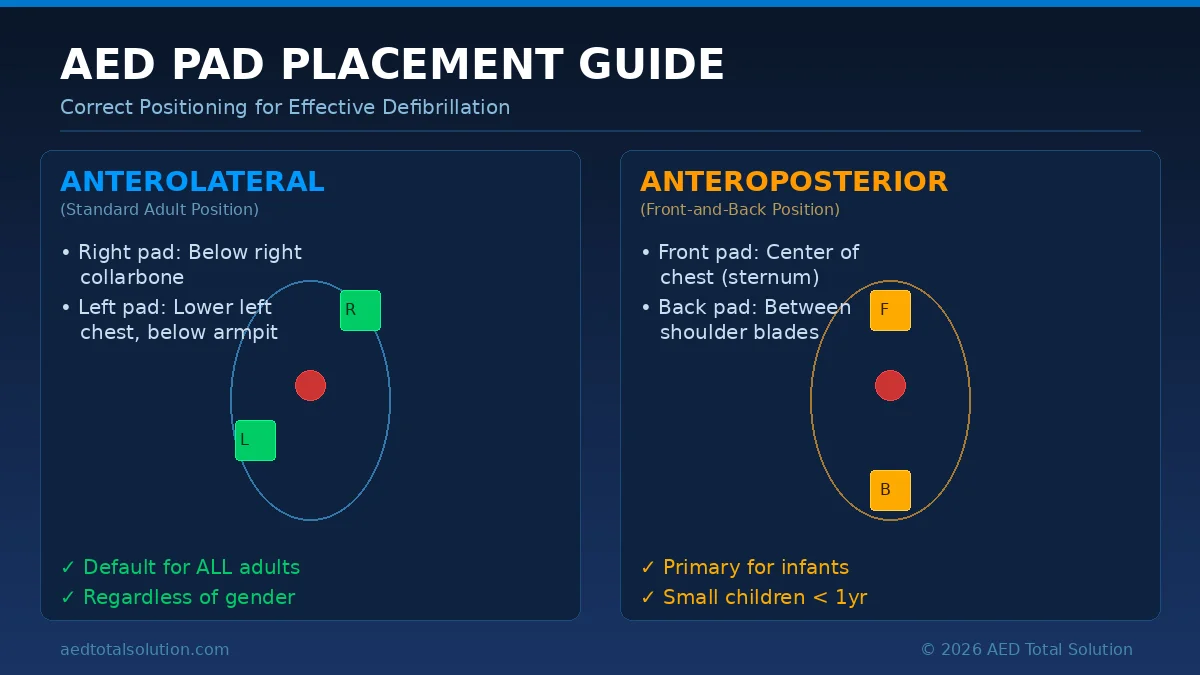
Quick Answer: Place one AED pad below the right collarbone and the second on the lower left side of the chest, below the armpit (anterolateral position). For infants, use front-and-back placement (anteroposterior). Always place pads on bare, dry skin at least 1 inch from pacemakers or medication patches. AED pads include diagrams — follow them for the best results.
Correct AED pad placement is one of the most critical factors in delivering an effective defibrillation shock during sudden cardiac arrest. Misplaced pads can reduce shock effectiveness by up to 30%, potentially costing someone their life.
This guide covers everything you need to know about positioning AED electrode pads on adults, children, and infants — including the two main placement methods, special situations, common mistakes, and step-by-step instructions you can follow in an emergency.
Two Types of AED Pad Placement
There are two standard AED pad placement positions recommended by the American Heart Association (AHA). Both are effective, but each has specific use cases:
Anterolateral Placement (Standard Adult Position)
Anterolateral placement is the default position for adults. “Anterior” means front, and “lateral” means side. You place the pads on the front and side of the chest:
- Right pad: Below the right collarbone, to the right of the sternum (breastbone)
- Left pad: On the lower left side of the chest, below the armpit, along the mid-axillary line
This positioning creates a diagonal electrical pathway through the heart, which is ideal for analyzing and correcting abnormal rhythms like ventricular fibrillation and pulseless ventricular tachycardia.
Anteroposterior Placement (Front-and-Back Position)
Anteroposterior placement positions pads on opposite sides of the body — one on the chest (anterior) and one on the back (posterior):
- Front pad: Center of the chest, over the sternum
- Back pad: Between the shoulder blades on the upper back
This method is primarily used for infants and small children whose chests are too small for side-by-side pad placement. It is also used in clinical settings with manual defibrillators.
Anterolateral vs. Anteroposterior: When to Use Each
| Factor | Anterolateral | Anteroposterior |
|---|---|---|
| Best for | Adults and older children | Infants and small children |
| Pad position | Both pads on the front/side of chest | One pad on chest, one on back |
| Shock pathway | Diagonal through the heart | Straight through the heart front-to-back |
| When to use | Default for all AEDs with adult pads | When pads are too close together on small chests |
| AHA recommendation | Primary recommendation for adults | Primary recommendation for infants |
Get certified in CPR

CPR & AED Training
3-hour in-person training with a 2-year nationally recognized certification.
CPR, AED & First Aid Certification
Instructor-led on-site. Practice on real manikins and AED trainers.
Step-by-Step AED Pad Placement for Adults
Follow these steps for correct adult AED pad placement in an emergency. Every second counts — the sooner you apply pads, the sooner the AED can analyze the heart rhythm.
- Expose the chest. Remove or cut away clothing to expose bare skin. AED pads will not work through clothing.
- Dry the chest. If the person is wet from sweat, rain, or water, quickly wipe the chest dry with a towel or cloth. Moisture can reduce pad adhesion and shock effectiveness.
- Check for obstructions. Look for excessive chest hair, medication patches, or implanted devices (visible bump under the skin indicating a pacemaker or ICD).
- Open the pad package. Peel the pads from their packaging. Each pad has a diagram showing correct placement.
- Place the right pad. Position it below the right collarbone, to the right of the sternum. Press firmly to ensure full contact.
- Place the left pad. Position it on the lower left side of the chest, below the armpit. The center of the pad should align with the mid-axillary line (the center of the side of the torso).
- Press firmly. Smooth out any air bubbles. The entire pad surface must contact the skin for effective shock delivery.
- Follow AED prompts. Once both pads are connected, the AED will analyze the heart rhythm and instruct you on next steps.
Important: AED pad placement is the same for all adults regardless of gender, body size, or pregnancy status. Do not delay defibrillation for any reason — survival rates decrease 7-10% for every minute without defibrillation.
AED Pad Placement for Children and Infants
Pediatric AED pad placement requires additional considerations based on the child’s size:
Children Ages 1-8 (or Under 55 lbs / 25 kg)
- Use pediatric AED pads if available. These deliver a reduced energy dose appropriate for smaller bodies.
- If pediatric pads are not available, use adult pads. A shock with adult pads is better than no shock at all.
- Use anterolateral placement if the pads fit without overlapping or touching each other.
- If pads are too close together or overlap, switch to anteroposterior placement (one pad on the center of the chest, one on the center of the back between the shoulder blades).
Infants (Under Age 1)
- Always use anteroposterior (front-and-back) placement for infants.
- Place the front pad on the center of the chest.
- Place the back pad on the center of the back, between the shoulder blades.
- Use pediatric pads or a pediatric dose attenuator if available.
- Pads must never touch or overlap. Overlapping pads can cause an electrical arc that reduces shock effectiveness.
Special Situations: Pacemakers, Medication Patches, and More
Several situations require you to adjust standard pad placement. Here is what to do in each case:
Pacemakers or Implantable Cardioverter Defibrillators (ICDs)
People with pacemakers or ICDs have a small, visible bump under the skin of the upper chest (usually on the left side). If you see or feel an implanted device:
- Place pads at least 1 inch (2.5 cm) away from the device.
- Do not place a pad directly over the device — the shock may damage it or be less effective.
- If the device is on the left side, shift the left pad lower or more toward the side.
- Do not delay defibrillation to check for a pacemaker. Apply pads and let the AED analyze.
Medication Patches (Nitroglycerin, Fentanyl, Nicotine)
Transdermal medication patches on the chest can block the electrical current or cause burns:
- Remove any patch in the pad placement area using gloves.
- Wipe the area clean before applying the AED pad.
- If you cannot remove the patch quickly, place the pad at least 1 inch away from it.
Excessive Chest Hair
Thick chest hair prevents pads from making full skin contact, which can trigger a “check pads” error on the AED:
- Press pads down firmly. Sometimes extra pressure is enough.
- If the AED shows a “check pads” or “poor connection” warning, quickly remove the pads (this rips away some hair), then apply a fresh set.
- If a razor is in the AED kit, shave the pad placement areas. Most AED kits include a razor for this purpose.
Wet or Sweaty Chest
Water conducts electricity and can cause the shock to travel across the skin surface rather than through the heart:
- Quickly towel-dry the chest before applying pads.
- Move the person away from standing water if possible, but do not delay defibrillation to do so.
- Pads can be used safely on someone who is damp — just avoid visible pooling water on the chest. Learn more about using an AED near water.
Pregnant Women
AED pad placement for pregnant women is identical to standard adult placement. The AHA confirms that defibrillation is safe during pregnancy and should not be delayed. The electrical current does not harm the fetus, and restoring the mother’s heartbeat is the highest priority for both lives.
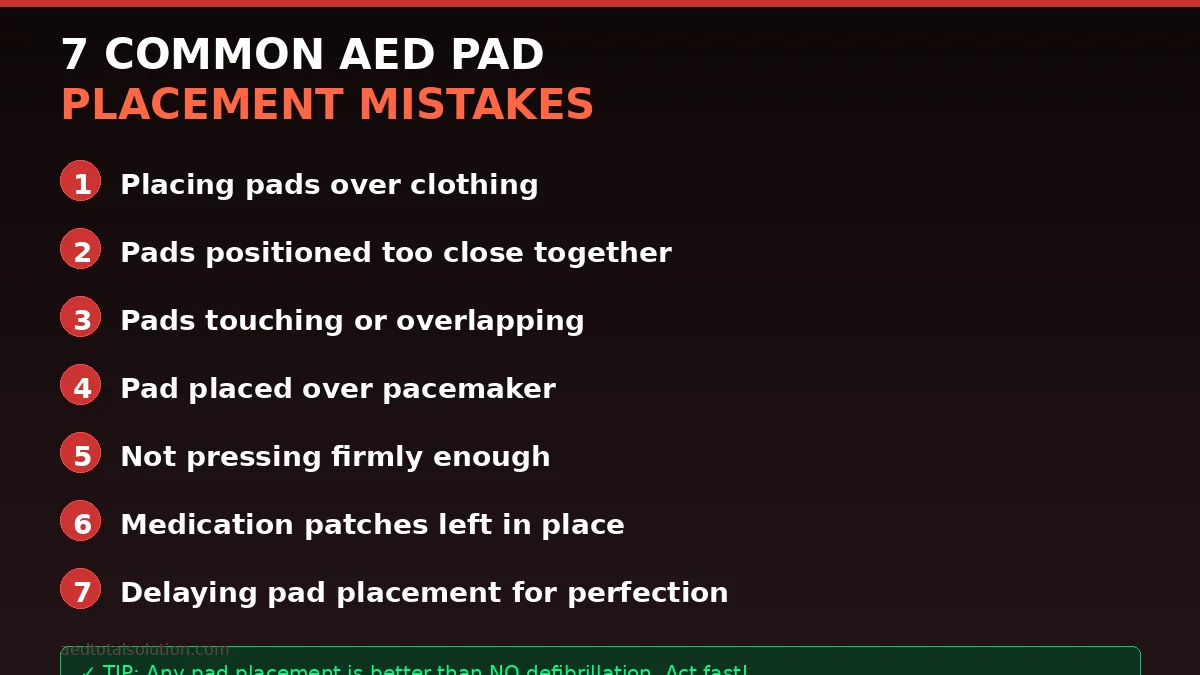
7 Common AED Pad Placement Mistakes
Avoid these errors that reduce defibrillation effectiveness:
- Placing pads over clothing. Pads must always contact bare skin directly.
- Pads too close together. This shortens the electrical pathway and may not adequately reach the heart. Maintain the recommended spacing.
- Pads touching or overlapping. This creates an electrical arc across the skin surface instead of through the heart. Especially common when using adult pads on children.
- Placing a pad directly over a pacemaker. Shift the pad at least 1 inch away from any implanted device.
- Not pressing firmly enough. Air pockets under the pad reduce electrical contact. Press and smooth out the entire pad surface.
- Leaving medication patches in place. Patches can cause burns and block current flow. Remove and wipe clean.
- Delaying pad placement. Do not waste time achieving “perfect” placement. Getting pads on quickly is more important than exact positioning. The AED will prompt you if adjustments are needed.
RECOMMENDED
HeartSine Samaritan 350P AED Package
Compact, fully-automatic AED designed for first-time responders. Pads, battery, carry case and wall sign included.
Does AED Pad Placement Really Matter?
Yes — proper pad placement directly impacts shock success rates. Research published in the journal Resuscitation shows that correct anterolateral placement delivers 15-30% more effective transthoracic impedance compared to incorrectly positioned pads. However, any pad placement is better than no defibrillation at all.
The AHA emphasizes: “Do not delay defibrillation for pad placement adjustments.” Place pads as quickly as possible, follow the diagrams on the pads, and let the AED guide you. Modern AEDs are designed with clear visual and audio prompts that make correct placement straightforward even for untrained bystanders.
Over 1,000 sudden cardiac arrests occur every day in the United States. Having an AED readily available and knowing correct pad placement can mean the difference between life and death.
AED Pad Placement FAQs
What is the correct anterolateral AED pad placement for adults?
Place one pad below the right collarbone to the right of the sternum. Place the second pad on the lower left side of the chest, below the armpit along the mid-axillary line. This is the standard placement recommended by the American Heart Association for all adult patients.
What is anteroposterior AED pad placement?
Anteroposterior placement means positioning one pad on the center of the chest (front) and the other pad on the upper back between the shoulder blades (back). This method is primarily recommended for infants and small children whose chests are too small for standard side-by-side pad placement.
Can you use adult AED pads on a child?
Yes. If pediatric pads are not available, use adult pads on a child. The AHA confirms that delivering a shock with adult pads is preferable to not shocking at all. Use anterolateral placement if the pads fit without overlapping; switch to anteroposterior (front-and-back) placement if they overlap.
What should you do if the person has a pacemaker?
Place AED pads at least 1 inch (2.5 cm) away from the pacemaker or ICD. Do not place a pad directly over the device. You can usually see or feel the device as a small bump under the skin of the upper chest. Do not delay defibrillation to check for a pacemaker.
Can you use an AED on a wet person?
Yes, but wipe the chest dry first with a towel or cloth. Water on the chest can reduce pad adhesion and cause the electrical current to travel across the skin surface instead of through the heart. Move the person away from standing water if it takes only a few seconds, but do not delay defibrillation.
What happens if AED pads are placed incorrectly?
The AED will still attempt to analyze the heart rhythm and may deliver a shock. However, incorrect placement can reduce shock effectiveness by directing current away from the heart. If the AED displays a “check pads” warning, reposition the pads according to the diagrams and press firmly to ensure full contact.
How long do AED pads last before they expire?
Most AED pads have a shelf life of 2-5 years depending on the manufacturer. The conductive gel dries out over time, which reduces adhesion and effectiveness. Check expiration dates regularly as part of your AED inspection routine. Replace expired pads immediately — learn more about AED pad expiration dates.
Does AED pad placement differ for obese patients?
The placement positions remain the same for obese patients. However, ensure the pads make firm contact with the skin by pressing down firmly and smoothing out any wrinkles or air pockets. In some cases, the anteroposterior position may provide better contact on patients with large chest circumferences.
Quick Reference: AED Pad Placement by Patient Type
| Patient | Pad Type | Position | Key Notes |
|---|---|---|---|
| Adult (8+ years) | Adult pads | Anterolateral (front/side) | Default position for all adult AEDs |
| Child (1-8 years) | Pediatric pads preferred | Anterolateral or anteroposterior | Use adult pads if pediatric unavailable |
| Infant (under 1) | Pediatric/infant pads | Anteroposterior (front/back) | One pad on chest, one between shoulder blades |
| Pregnant woman | Adult pads | Anterolateral (standard) | Do NOT delay defibrillation due to pregnancy |
| Patient with pacemaker | Adult pads | Anterolateral, 1+ inch from device | Place pad at least 1 inch from the implanted device |
| Wet patient | Adult pads | Anterolateral (standard) | Dry chest first, move away from standing water |
Troubleshooting AED Pad Issues During an Emergency
Even with proper training, you may encounter unexpected situations when placing AED pads during a cardiac emergency. Here is how to handle the most common problems:
AED Says “Check Pads” or “Pad Connection Error”
- Press pads firmly to ensure full skin contact. Air bubbles or loose edges prevent proper signal reading.
- Verify pads are plugged securely into the AED connector port.
- If skin is wet or sweaty, dry the area and reapply the pads.
- If pads are expired or dried out, replace with fresh pads from your AED maintenance kit.
Only One Pad Available
An AED requires both pads to function. If only one pad is available or one is damaged, continue CPR and call 911 immediately. A single pad cannot analyze or deliver a shock.
Pads Touch Each Other on a Small Patient
If anterolateral pads overlap or touch on a small child, switch to anteroposterior placement: one pad on the center of the chest and one on the back between the shoulder blades. The pads must not overlap, as this can short-circuit the shock.
Patient Has Jewelry or Metal on the Chest
Remove necklaces or metal objects that fall between or near the pad placement zones. Metal objects can cause burns or arc the electrical current. If a piercing cannot be quickly removed, place the pad at least 1 inch away from it.
Internal Links: Related AED and CPR Resources
Building a comprehensive AED program goes beyond pad placement. Explore these related guides:
- How to Use an AED: Step-by-Step Guide — complete instructions from power-on to shock delivery
- AED Training: Everything You Need to Know — certification courses, requirements, and renewal
- AED Maintenance Checklist — keep your AED pads, batteries, and device inspection-ready
- AED for Schools — requirements, laws, and implementation for K-12 and universities
- AED Laws by State — compliance requirements for your location
- Chain of Survival — how CPR and AED use fit into the 5 critical links
- Ventricular Fibrillation — the heart rhythm AED pads are designed to correct

Not sure which AED or program fits your facility?
An AED Total Solution program expert walks you through it — no obligation.
Make Sure Your AED Is Ready When It Matters
Correct AED pad placement is just one part of cardiac arrest readiness. Your organization needs a complete AED program management solution that ensures devices are inspected, pads are not expired, and staff are trained.
AED Total Solution provides full-service AED program management — from device selection and installation to ongoing compliance monitoring, pad and battery replacement tracking, and staff training coordination. We manage programs for organizations of all sizes, from single-location offices to multi-site enterprises.
Call us at 855-263-7772 or request a consultation to ensure your AED program is compliant and rescue-ready.