-
 Written By
Prabakar Mahalingam
Written By
Prabakar Mahalingam
- Published
How to Choose the Right AED for Your Organization
Every year, more than 350,000 Americans experience sudden cardiac arrest outside of a hospital. When it happens, survival depends on one thing: how quickly someone delivers a shock with an automated external defibrillator (AED). Using an AED within the first three to five minutes can increase the chance of survival to 50-70%.
For organizations responsible for the safety of employees, students, visitors, or members, selecting the right AED is a decision that directly impacts lives. But with more than a dozen models across six major brands on the market, comparing features, costs, and capabilities can be overwhelming.
This guide breaks down the most important selection criteria, compares every major AED brand side by side, and provides organization-specific recommendations so you can make a confident, informed decision.
What to Look for When Choosing an AED
Before comparing specific models, it helps to understand the core factors that separate one AED from another. Not every feature matters equally for every organization. Your environment, responder experience level, and compliance requirements should drive the decision.
Automation Level
AEDs come in two types: semi-automatic and fully automatic. A semi-automatic AED analyzes the heart rhythm and tells the rescuer to press a button to deliver the shock. A fully automatic AED delivers the shock on its own after a countdown, with no button press required.
Fully automatic models are ideal for locations where untrained bystanders are the most likely responders, such as churches, community centers, and public lobbies. Semi-automatic models give trained responders more control and are preferred in workplaces with certified first aid teams.
Ease of Use and Voice Guidance
During a cardiac emergency, stress levels are high and every second counts. The best AEDs provide clear, step-by-step voice prompts that guide even a first-time user through the entire process. Some models add visual diagrams on the pads or the device screen, while others include real-time CPR coaching that measures compression depth and rate.
Look for devices that use plain language rather than medical jargon. Models with CPR feedback technology can improve the quality of chest compressions, which directly impacts survival outcomes.
Durability and Environment Rating
An AED installed in a climate-controlled office has very different durability needs than one mounted at a construction site or outdoor sports complex. Check the IP (Ingress Protection) rating. A higher IP rating means better resistance to dust and water. Models rated IP55 or higher are suitable for outdoor and industrial environments.
Pad and Battery Lifespan
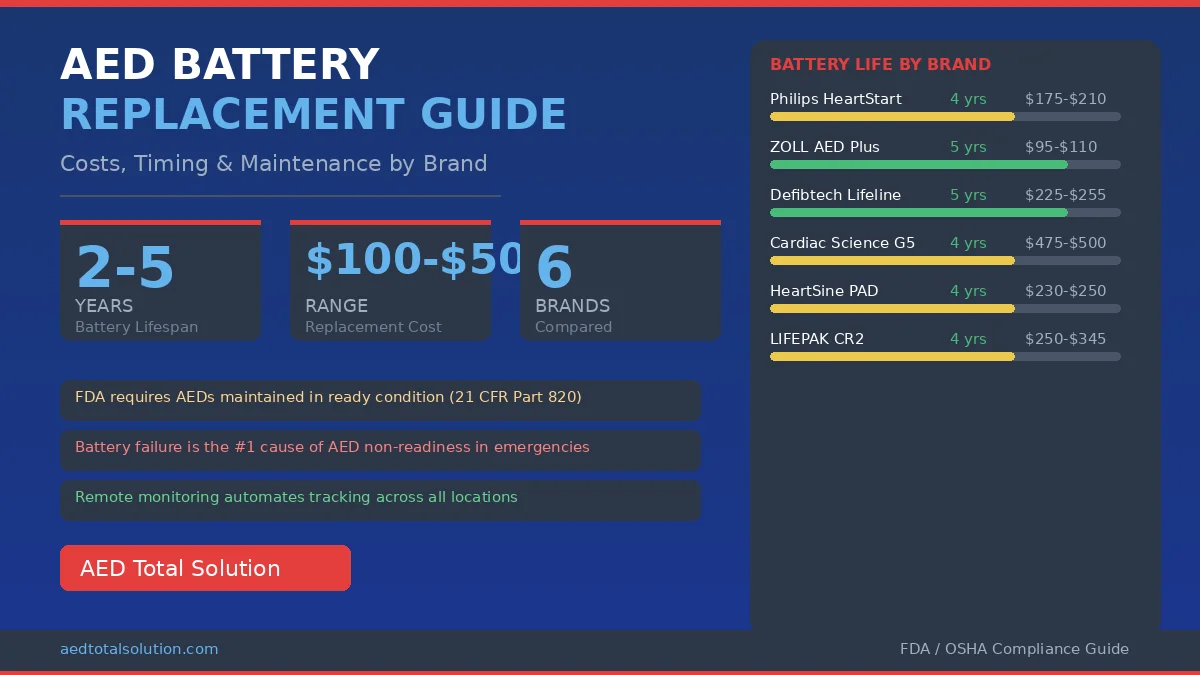
Replacement pads and batteries represent the biggest ongoing cost of AED ownership. Electrode pads typically last two to three years, while batteries last four to five years. Some models, like the ZOLL AED 3, use an integrated pad-battery design (CPR Uni-padz) that lasts five years and reduces the number of components to track.
Choosing a model with longer consumable lifespans can significantly reduce your total maintenance burden over time.
Pediatric Capability
Organizations that serve children, such as schools, daycare centers, and recreation facilities, need an AED that can treat pediatric patients. Some devices use separate pediatric pads, while others have a simple switch or key that adjusts the energy level for children. Models with a built-in pediatric mode eliminate the need to purchase and store separate child pads.
Total Cost of Ownership
The purchase price of an AED is only part of the equation. Factor in the cost of replacement pads, batteries, accessories, training, and program management over a four-to-five year lifecycle. A model that costs less upfront but requires frequent consumable replacements may end up costing more than a premium device with longer-lasting components.
For a detailed pricing breakdown, see our AED cost guide.
AED Brand and Model Comparison Matrix
The following table compares the most popular AED models across the key decision factors. Use this matrix to narrow your options based on the features that matter most for your organization.
| Feature | Philips HeartStart OnSite | Philips HeartStart FRx | ZOLL AED 3 | ZOLL AED Plus | LIFEPAK CR2 | Defibtech Lifeline VIEW | HeartSine 360P | Avive Connect |
|---|---|---|---|---|---|---|---|---|
| Type | Semi-Auto | Semi-Auto | Semi-Auto / Fully Auto | Semi-Auto | Semi-Auto / Fully Auto | Semi-Auto | Fully Auto | Semi-Auto |
| CPR Feedback | No | No | Yes (real-time) | Yes (audio + visual) | Yes (optional) | No | No | Yes |
| Voice Guidance | Yes | Yes | Yes | Yes | Yes | Yes (with screen) | Yes | Yes |
| Visual Display | No | No | Color touchscreen | No | No | Full-color LCD | No | LED indicators |
| Pediatric Mode | Separate pads | Child key | Child mode switch | Separate pads | Child mode setting | Separate pads | Pediatric pads | Separate pads |
| Pad Lifespan | 2 years | 2 years | 5 years (Uni-padz) | 5 years (CPR-D-Padz) | 2 years | 2 years | 4 years | 2 years |
| Battery Life | 4 years | 4 years | 5 years | 5 years | 4 years | 5 years | 4 years | 4 years |
| IP Rating | IP21 | IP55 | IP55 | IP55 | IP55 | IP54 | IP56 | IP55 |
| Weight | 3.3 lbs | 3.5 lbs | 5.5 lbs | 6.7 lbs | 4.6 lbs | 2.4 lbs | 2.4 lbs | 2.4 lbs |
| WiFi/Connectivity | No | No | Yes (WiFi) | No | Yes (WiFi/LTE) | No | No | Yes (LTE) |
| Best For | Offices, low-traffic | Outdoor, rugged | High-traffic, schools | Budget + CPR coaching | Campuses, multi-site | Travel, portable | Public spaces, churches | Connected fleet mgmt |
| Price Range | $1,400-$1,800 | $1,800-$2,200 | $2,100-$2,500 | $1,900-$2,200 | $2,200-$2,800 | $1,500-$1,900 | $1,300-$1,700 | $2,000-$2,500 |
Prices reflect typical package pricing including case, pads, battery, and basic accessories. Actual pricing may vary based on configuration and volume discounts.
Which AED Is Right for Your Organization Type?
Different environments create different requirements. Here are targeted recommendations based on the most common organization types.
Schools and Universities
Schools need AEDs that are easy for any staff member to use in a high-stress situation. Pediatric capability is essential, and state laws often mandate AED placement in schools. Look for models with CPR feedback to help non-medical staff deliver effective compressions.
Recommended: ZOLL AED 3 (CPR feedback, pediatric mode switch, WiFi monitoring for multi-building campuses) or Physio-Control LIFEPAK CR2 (fully automatic option, connected monitoring).
Gyms and Fitness Centers
Fitness facilities face elevated cardiac risk due to physical exertion. Many states require AEDs in gyms with over 100 members. Durability, fast deployment, and CPR coaching are priorities.
Recommended: ZOLL AED Plus (real-time CPR feedback, rugged IP55 design, cost-effective) or ZOLL AED 3 (upgraded display and WiFi monitoring).
Government and Municipal Buildings
Government facilities serve diverse populations and may need to deploy AEDs across multiple buildings. Centralized fleet monitoring, ease of compliance tracking, and durability for varied environments are key considerations.
Recommended: Physio-Control LIFEPAK CR2 (WiFi/LTE connected, fleet management) or Avive Connect (LTE-connected with remote monitoring dashboard).
Hotels and Hospitality
Hotels need AEDs that untrained staff can operate under pressure, often in guest-facing situations. Fully automatic models reduce hesitation. Multi-floor properties need strategic AED placement with devices accessible within a three-minute response window.
Recommended: HeartSine Samaritan PAD 360P (fully automatic, lightweight, simple) or Philips HeartStart OnSite (clear prompts, widely recognized brand).
Healthcare and Dental Offices
Clinical settings often have staff with medical training, making semi-automatic models with advanced feedback features a good fit. Dental offices and outpatient clinics should select models that integrate well with existing emergency protocols.
Recommended: ZOLL AED 3 (real-time CPR data, color screen, WiFi connectivity) or Physio-Control LIFEPAK CR2 (professional-grade, robust data capture).
Churches, Community Centers, and Nonprofits
These organizations often rely on volunteer responders with limited training. Fully automatic AEDs remove the barrier of pressing a shock button, which can cause hesitation in untrained users. Budget is often a factor.
Recommended: HeartSine Samaritan PAD 360P (fully automatic, affordable, four-year pad life) or Defibtech Lifeline VIEW (visual LCD screen guidance, lightweight).
Beyond the Device: Building a Complete AED Program
Choosing the right AED is the first step, but keeping it compliant, maintained, and ready for emergencies requires ongoing program management. A complete AED program should include:
- Medical oversight and physician prescription for each device
- Regular inspections on the schedule your state requires, as outlined in our AED inspection guide
- Automated tracking for pad and battery expiration dates
- Staff training and certification with documented records
- A written emergency response plan that includes AED locations, responder assignments, and post-event procedures
Managing these requirements in-house becomes increasingly complex as you scale across multiple locations. AED Total Solution provides full-service AED program management that handles compliance tracking, automated inspection reminders, supply replacement, medical oversight, and post-event support so your team can focus on their core responsibilities.
Frequently Asked Questions
What is the most important factor when choosing an AED?
Ease of use is the single most important factor. In a cardiac emergency, the responder may have no medical training. Choose a device with clear voice prompts, simple pad placement, and minimal steps between powering on and delivering a shock.
Can any AED be used on children?
Most AEDs can be used on children with the appropriate pediatric pads or a pediatric mode setting. Some models, like the ZOLL AED 3, have a built-in child mode switch. Others require separate pediatric electrode pads. Always verify pediatric capability before purchasing if your organization serves children.
How often do AED pads and batteries need to be replaced?
Electrode pads typically expire every two to three years, and batteries last four to five years. Some models offer extended-life consumables. The ZOLL AED 3 Uni-padz and ZOLL AED Plus CPR-D-Padz both last five years, reducing replacement frequency and cost. Review our AED battery replacement guide for brand-specific timelines.
Do I need a prescription to buy an AED?
In most states, AEDs require a physician prescription. AED Total Solution includes medical oversight and physician prescription as part of every AED program management plan, so organizations do not need to source this independently.
How many AEDs does my organization need?
The American Heart Association recommends placing AEDs so that one can be retrieved and applied within three minutes of recognizing a cardiac arrest. For most buildings, this translates to one AED per floor or per 50,000 square feet. Use our AED placement guide to map your specific facility.
Take the Next Step
Selecting the right AED does not have to be complicated. Start with the comparison matrix above, identify the features that match your organization’s environment and responder profile, and narrow your options from there.
If you need help choosing the right model, building a compliant program, or managing AEDs across multiple locations, AED Total Solution can help. Call us at 855.888.2771 or submit an inquiry to speak with an AED program specialist.
Disclaimer for information purposes only:
The information provided on this website is intended for general educational and informational purposes only. It is not medical advice and should not be used as a substitute for professional diagnosis, treatment, or care. Always consult a qualified healthcare or medical professional regarding any health-related questions or concerns.
While we strive to ensure the information shared is accurate and up to date, no guarantees are made regarding completeness, accuracy, or applicability to any individual situation. Use of this content is at the reader’s sole discretion and risk.
This website is part of the Response Ready family of emergency preparedness and training resources, including CPR & first aid training and compliance services, AED sales and program support, AED program management software, and medical oversight solutions provided through our affiliated platforms:
• CPR1.com
• AEDLeader.com
• ResponseReady.com
• MDSIMedical.com
By accessing or using this website, you agree to release, indemnify, and hold harmless the website owners, authors, contributors, and affiliated entities from any claims, losses, damages, or liabilities arising from the use or reliance on the information presented.