Why AED Training Matters: The Critical Window
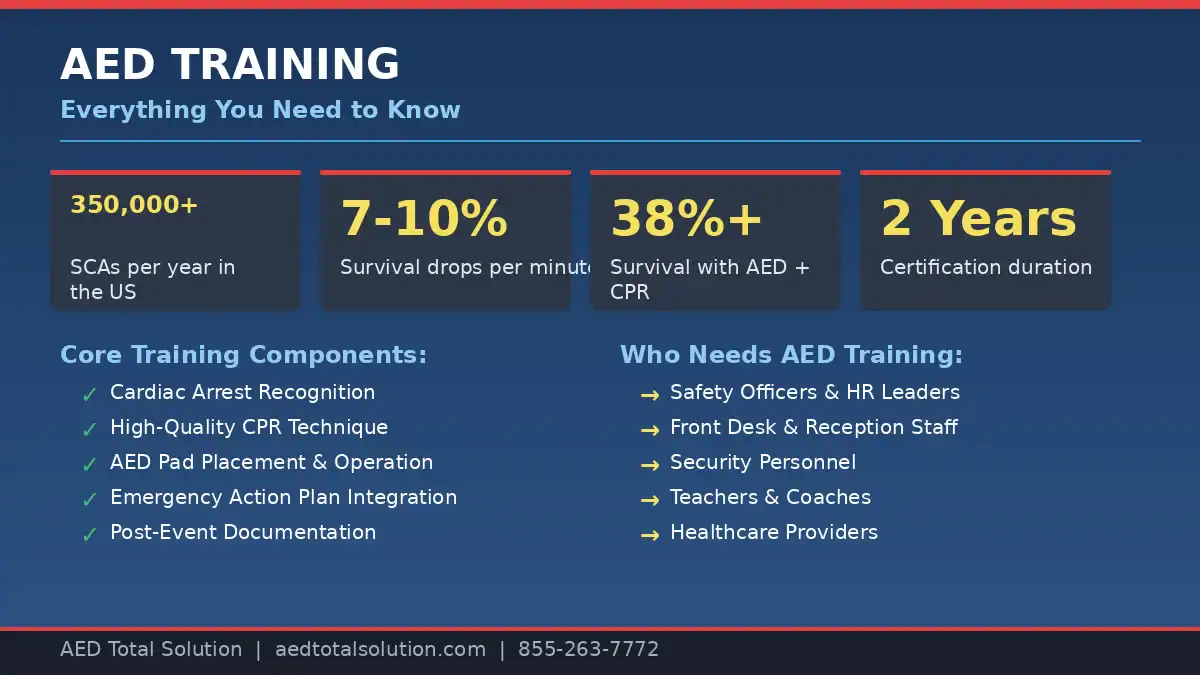
Every year, more than 350,000 Americans experience sudden cardiac arrest (SCA) outside of a hospital. Without immediate intervention, survival rates drop by 7% to 10% for every minute that passes. An automated external defibrillator (AED) can restore a normal heart rhythm, but only if someone nearby knows how to use it.
That is where AED training comes in. Proper training gives your team the confidence and skill to act in those critical first minutes before emergency medical services arrive. Organizations with trained responders and accessible AEDs see survival rates increase to 38% or higher, compared to just 10% with no intervention.
This guide covers everything you need to know about AED training: what it includes, who needs it, how long certification lasts, what it costs, and how to set up a training program at your workplace. Whether you are a safety officer, HR manager, facilities director, or business owner, this is your complete resource.
Need help setting up an AED training program? View AED Total Solution’s training programs or call 855-263-7772 to speak with a specialist.
What Is AED Training?
AED training is a structured educational program that teaches participants how to recognize sudden cardiac arrest, perform CPR, and operate an automated external defibrillator. Most AED training courses follow guidelines established by the American Heart Association (AHA) or the American Red Cross (ARC).
A typical AED training course covers these core competencies:
- Recognizing cardiac arrest: identifying unresponsiveness, absence of normal breathing, and no pulse
- Activating the emergency response: calling 911 and retrieving the nearest AED
- Performing high-quality CPR: proper hand placement, compression depth (at least 2 inches), rate (100 to 120 compressions per minute), and full chest recoil
- Operating the AED: powering on the device, placing electrode pads correctly, following voice prompts, and delivering a shock when advised
- Post-event procedures: continuing CPR after a shock, monitoring the patient until EMS arrives, and reporting the incident
Most courses combine classroom instruction with hands-on practice using training AEDs and CPR mannequins. Participants practice real scenarios so they can respond effectively under pressure. For a deeper look at how CPR and AED use work together in an emergency, see our CPR and AED guide.
Types of AED Training Programs
AED training is not one-size-fits-all. Different programs serve different audiences, industries, and regulatory requirements.
Basic AED and CPR Certification
This is the standard course most organizations use. It covers adult CPR, AED operation, and basic first aid for choking. Course duration is typically 2 to 4 hours. Both the AHA (Heartsaver CPR AED) and Red Cross offer this level of training.
BLS (Basic Life Support) for Healthcare Providers
Designed for nurses, EMTs, physicians, dentists, and other healthcare professionals. BLS training covers multi-rescuer techniques, bag-mask ventilation, and team-based resuscitation protocols. This is more intensive and typically requires renewal every two years.
Workplace-Specific AED Training
Customized programs tailored to your facility layout, AED locations, and emergency response plan. This type of training is particularly important for organizations with multiple locations managing AED devices because each site may have different configurations and responder teams.
Online and Blended Learning
Some providers offer online coursework combined with an in-person skills session. This reduces classroom time while still ensuring hands-on competency. The AHA’s blended learning option typically includes 1 to 2 hours of online modules followed by a shorter in-person skills check.
Pediatric and Infant AED/CPR Training
Specialized training for schools, daycare centers, and youth sports organizations. Covers the differences in CPR technique for children and infants, and the use of pediatric AED pads. Schools in many states are required to have AEDs and trained staff on site. See our AED for schools requirements guide for state-by-state details.
Who Needs AED Training?
While anyone can benefit from AED training, certain roles and industries have a stronger need, and in some cases, a legal obligation.
Roles That Should Be Trained
- Designated workplace responders: every organization with an AED should have trained responders on each shift
- Safety officers and emergency coordinators: the people responsible for your emergency action plan
- Front desk and reception staff: often the first to encounter a medical emergency
- Security personnel: typically first on scene in large facilities
- Fitness center staff: high-exertion environments carry elevated cardiac risk
- Teachers and school administrators: responsible for student safety during school hours
- Coaches and athletic trainers: commotio cordis and other cardiac events are a real risk in youth sports
Industries With Regulatory Requirements
While OSHA does not specifically mandate AED training, it does require employers to have an emergency action plan and to ensure trained first aid responders are available when emergency medical services are not within reasonable proximity. Many states go further with explicit AED requirements. Check our AED laws by state resource for your specific obligations.
Industries with heightened requirements include:
- Healthcare facilities: BLS training typically mandatory for all clinical staff
- Schools and universities: many states require AEDs and trained personnel (see New York’s youth sports AED requirements)
- Fitness centers and gyms: states like California, New York, and Illinois mandate AEDs in health clubs
- Construction and industrial sites: OSHA’s remote workplace guidance applies
- Government buildings: federal buildings are required to have AED programs
What AED Training Costs
AED training costs vary based on the type of program, group size, location, and provider. Here is a general breakdown:
| Training Type | Typical Cost | Duration | Certification Valid |
|---|---|---|---|
| Heartsaver CPR/AED (AHA) | $50 to $80 per person | 2 to 4 hours | 2 years |
| BLS for Healthcare Providers | $60 to $100 per person | 3 to 5 hours | 2 years |
| On-site group training (10+ people) | $785 to $1,882 per session | 2 to 4 hours | 2 years |
| Online + skills session (blended) | $40 to $65 per person | 1 to 2 hours online + 1 hour in-person | 2 years |
| Pediatric CPR/AED add-on | $15 to $30 additional | Additional 1 hour | 2 years |
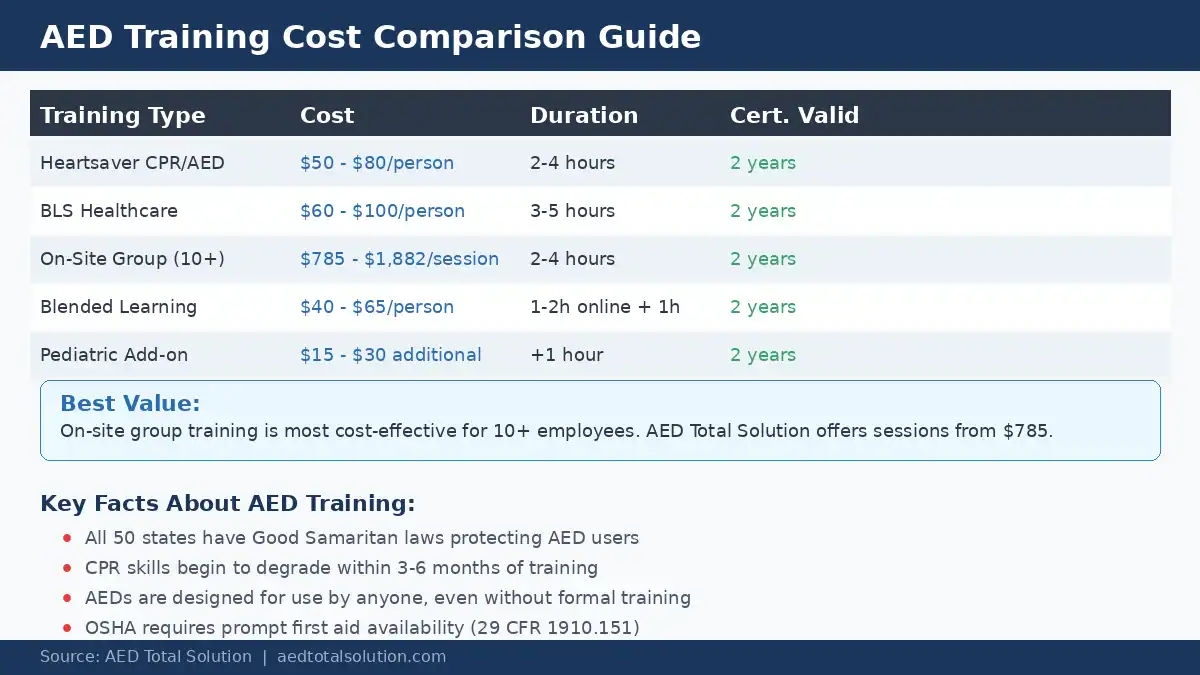
Pro tip for employers: On-site group training sessions are the most cost-effective option for organizations with 10 or more people to train. AED Total Solution offers on-site training programs starting at $785 per session. Request a quote to get pricing for your organization.
AED Training Certification: How Long Does It Last?
AED and CPR certifications from the American Heart Association and American Red Cross are valid for two years. After that, you must complete a renewal or recertification course to maintain your credentials.
Key points about AED certification:
- Renewal courses are shorter: typically 2 to 3 hours instead of the full initial course
- Skills degrade over time: research shows CPR skills begin to decline within 3 to 6 months of training. Some organizations conduct annual refreshers even though certification lasts two years
- Documentation matters: keep records of all training certifications, including dates, provider, and expiration. This is critical for compliance audits. AED Total Solution’s program management platform tracks certification dates and sends automatic renewal reminders 60 and 30 days before expiration
- State requirements may differ: some states require more frequent training for certain industries. California, for example, has specific inspection and training documentation requirements
How to Set Up an AED Training Program at Your Workplace
Building an effective AED training program requires more than scheduling a single class. Here is a step-by-step framework:
Step 1: Assess Your Needs
Determine how many AEDs you have (or need), where they are located, and how many responders you need per shift. A general guideline is to have at least 2 to 3 trained responders available during every shift. Consider your facility size, AED accessibility, and the average time for EMS to arrive at your location.
Step 2: Choose the Right Training Provider
Look for AHA or ARC authorized training centers. On-site training is ideal for workplaces because instructors can customize scenarios to your specific environment and AED models. Verify that the provider includes hands-on practice (not just video-based instruction).
Step 3: Integrate Training With Your Emergency Action Plan
AED training should not exist in isolation. Integrate it with your broader emergency response protocols. Trained responders should know:
- Where every AED is located in the facility
- How to activate your internal emergency notification system
- Their specific role in a cardiac emergency (who calls 911, who retrieves the AED, who starts CPR)
- How to complete post-event documentation
Step 4: Schedule Regular Refreshers
Do not wait for certifications to expire. Schedule brief refresher drills every 6 months to keep skills sharp. These can be as simple as 15-minute practice sessions with training AEDs. Track all training in your AED compliance management system.
Step 5: Maintain Compliance Documentation
Keep records of every training session, including attendee names, dates, certification numbers, and expiration dates. This documentation is essential for Good Samaritan law protection and regulatory compliance audits. States like California and New York require proof of trained responders as part of their AED program requirements.
AED Training and Good Samaritan Protection
One concern that stops people from acting in an emergency is fear of legal liability. The good news: all 50 states have some form of Good Samaritan law that provides legal protection for bystanders who use an AED in good faith during an emergency.
However, the level of protection varies. In many states, Good Samaritan immunity is conditional on:
- The rescuer acting in good faith and without expectation of compensation
- The AED being properly maintained and inspected
- The organization having a compliant AED program (including regular inspections and medical oversight)
Training strengthens your legal protection because it demonstrates that your organization took reasonable steps to prepare for cardiac emergencies. For a detailed overview of legal protections, read our Good Samaritan law and AED guide.
Common AED Training Mistakes to Avoid
Based on our experience managing AED programs for thousands of organizations, these are the most common training pitfalls:
- Training only a few people: if your trained responders are out sick, on vacation, or in a different building, you have a gap. Train enough people to cover every shift and location.
- Skipping hands-on practice: watching a video is not the same as physically placing pads and performing compressions. Insist on courses with mannequin and AED practice.
- Forgetting to retrain: skills decay faster than certifications expire. Schedule 6-month refreshers.
- Not practicing with your actual AED model: different AED brands have different pad configurations, button layouts, and voice prompts. Train with the specific devices in your facility. Not sure which AED you have? See our complete AED guide.
- Isolating training from your emergency plan: AED training should include site-specific scenarios, not just generic instruction.
- Failing to track certifications: expired certifications create compliance gaps and potential liability.
Frequently Asked Questions About AED Training
How long does AED training take?
A standard AED and CPR certification course takes 2 to 4 hours, depending on the provider and format. Blended learning options (online coursework plus in-person skills check) can reduce classroom time to about 1 hour. Renewal courses are typically 2 to 3 hours.
Do you need to be certified to use an AED?
No. AEDs are designed for use by anyone, even without training. The devices provide step-by-step voice prompts and will only deliver a shock if they detect a shockable heart rhythm. However, training significantly improves response speed and confidence, which directly impacts survival outcomes.
How often do you need to renew AED certification?
AHA and Red Cross AED/CPR certifications are valid for 2 years. However, research shows that CPR skills begin to degrade within 3 to 6 months. Many organizations schedule annual or semi-annual refresher sessions to maintain proficiency.
Is AED training required by OSHA?
OSHA does not specifically require AED training. However, under OSHA standard 29 CFR 1910.151, employers must ensure prompt first aid treatment is available, which may include AED readiness depending on EMS response times in your area. Some states have their own requirements. Check our OSHA AED requirements guide for details.
Can AED training be done entirely online?
The knowledge portion can be completed online, but both the AHA and Red Cross require an in-person hands-on skills evaluation for certification. Fully online courses may provide education but typically do not result in a nationally recognized certification card.
Take the Next Step: Get Your Team Trained
AED training is one of the most impactful investments a business can make in workplace safety. It takes just a few hours, costs are reasonable (especially for group sessions), and it gives your employees the ability to save a life.
AED Total Solution offers comprehensive AED training programs, including on-site group sessions customized to your workplace. Our programs include:
- AHA-aligned curriculum with hands-on AED and CPR practice
- Training customized to your specific AED models and facility layout
- Certification tracking through our program management platform
- Automatic renewal reminders so certifications never lapse
- Integration with your AED inspection and compliance program
Ready to set up AED training for your organization? Request a quote or call 855-263-7772 to discuss your training needs with our team.