Regular AED inspections are the difference between a device that saves a life and one that fails when it matters most. Studies show that AEDs used within the first few minutes of sudden cardiac arrest can increase survival rates to 74%, but only if the device is functional and ready. This guide breaks down exactly how often your AEDs should be inspected, what each inspection involves, and how to build a schedule that keeps your organization compliant and prepared.
Key Takeaways
- Daily visual checks take 30 seconds and catch the most common readiness issues, like a missing device or a failed self-test indicator.
- Monthly documented inspections are the industry standard recommended by the FDA and most manufacturers for maintaining compliance records.
- Annual professional assessments provide a comprehensive review of your entire AED program, including software updates, accessory inventory, and regulatory alignment.
- Manufacturer guidelines vary by brand, with some requiring quarterly checks and others recommending monthly intervals. Always follow your specific model’s requirements.
- A managed AED program from AED Total Solution automates inspection tracking, so nothing falls through the cracks.
Why AED Inspection Frequency Matters
An AED is a medical device, not a set-and-forget appliance. Batteries drain, electrode pads expire, and environmental conditions can degrade components over time. Without a structured inspection schedule, these issues go undetected until the moment someone needs the device.
The FDA classifies AEDs as Class III medical devices, which means they are subject to strict regulatory oversight. While federal law does not prescribe a specific inspection interval, the FDA recommends following manufacturer guidelines and maintaining documented proof of regular checks.
State laws add another layer. Many states, including California, New York, and others where AED Total Solution operates, have specific statutes requiring periodic inspections, often monthly. Failing to comply can expose your organization to liability in the event of a cardiac emergency.
The bottom line: a consistent inspection schedule is both a regulatory necessity and a practical safeguard.
The Three Tiers of AED Inspections
Not every inspection requires the same level of detail. Think of AED maintenance as a three-tier system, where each tier serves a different purpose.
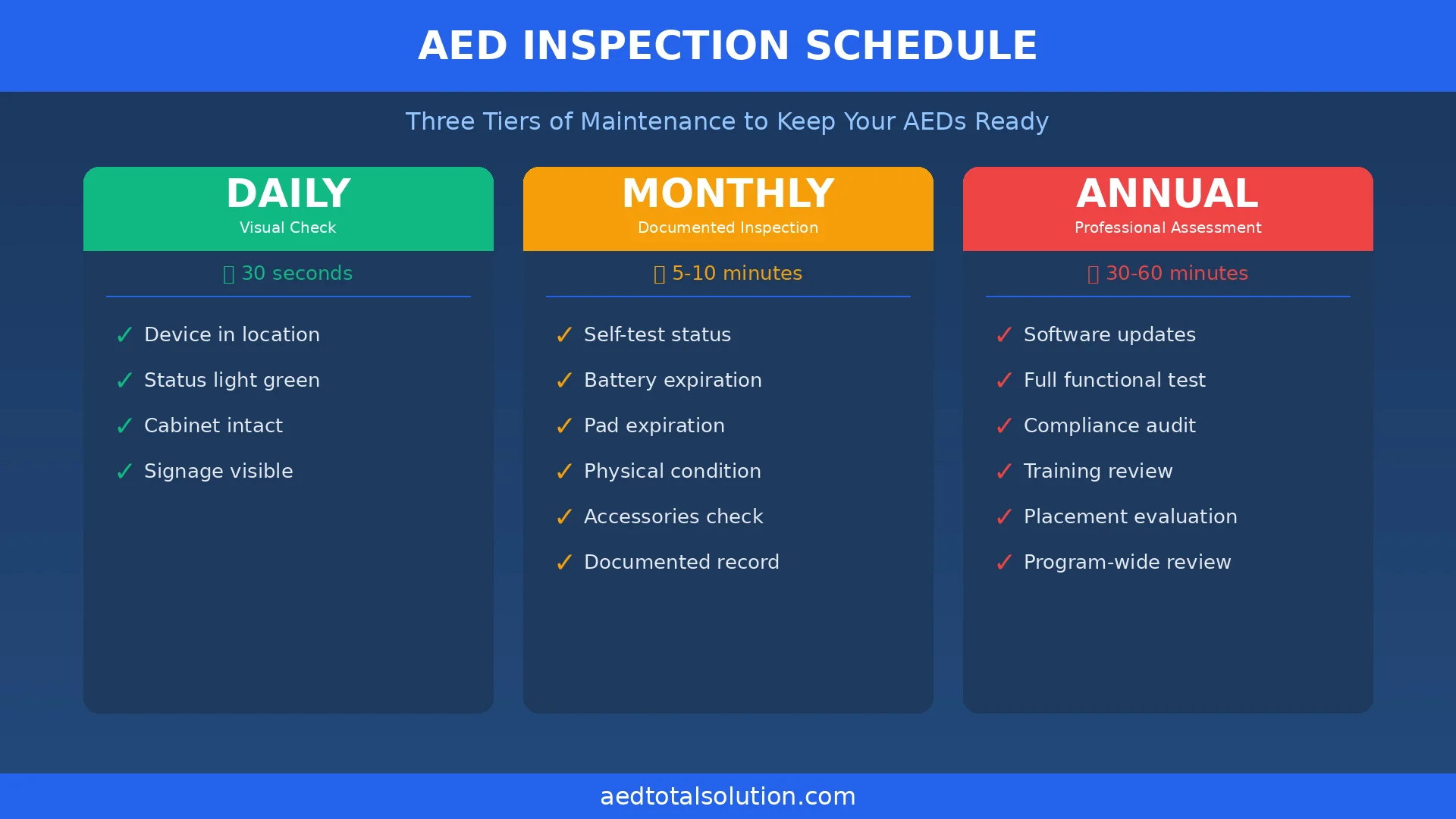
Tier 1: Daily Visual Checks (30 Seconds)
A daily visual check is the simplest and fastest form of AED inspection. It requires no tools, no paperwork, and no special training. The goal is to confirm that the device is present, accessible, and showing a “ready” status.
What to check:
- The AED is in its designated location and has not been moved or tampered with
- The status indicator light shows green (ready) rather than red or no light
- The cabinet is intact and the device is not visibly damaged
- Signage is visible and not obstructed
Daily checks are typically assigned to a receptionist, security guard, or facilities staff member who passes by the AED location as part of their routine.
Tier 2: Monthly Documented Inspections (5-10 Minutes)
The monthly inspection is the backbone of any AED maintenance program. This is the interval recommended by the FDA, OSHA guidance for workplace AEDs, and the majority of AED manufacturers.
What to check during a monthly inspection:
- Status indicator: Confirm the device passes its self-test and displays a ready status
- Battery expiration: Verify the battery has not expired and note the replacement date
- Electrode pad expiration: Check that adult and pediatric pads (if applicable) are within their shelf life
- Physical condition: Inspect the device, cables, and connectors for visible damage
- Accessories: Confirm rescue kit supplies are present (razor, gloves, scissors, CPR mask)
- Documentation: Record the inspection date, inspector name, and any issues found
Each monthly inspection should be logged in a centralized system. Paper binders work, but digital tracking through AED inspection software is more reliable and creates an audit-ready trail.
Tier 3: Annual Professional Assessment (30-60 Minutes)
An annual assessment goes beyond routine checks. It is a comprehensive review of your entire AED program conducted by a qualified professional or your AED program manager.
What an annual assessment covers:
- Firmware and software updates for the AED device
- Full functional test, including a simulated shock delivery (per manufacturer protocol)
- Review of all battery and pad replacement dates for the coming year
- Compliance audit against current state regulations
- Staff training verification and recertification scheduling
- Evaluation of AED placement and signage adequacy
- Review of your organization’s AED inspection policy
Annual assessments are particularly important for organizations managing AEDs across multiple locations, where inconsistencies can develop between sites. For a full breakdown of maintenance schedules and compliance requirements, read our complete guide to AED maintenance and compliance in 2026. AED Total Solution’s remote readiness monitoring provides centralized visibility across all devices, flagging issues before they become compliance gaps.
Manufacturer-Specific Inspection Schedules
Each AED manufacturer has its own recommended maintenance intervals. Here is a breakdown of the major brands:
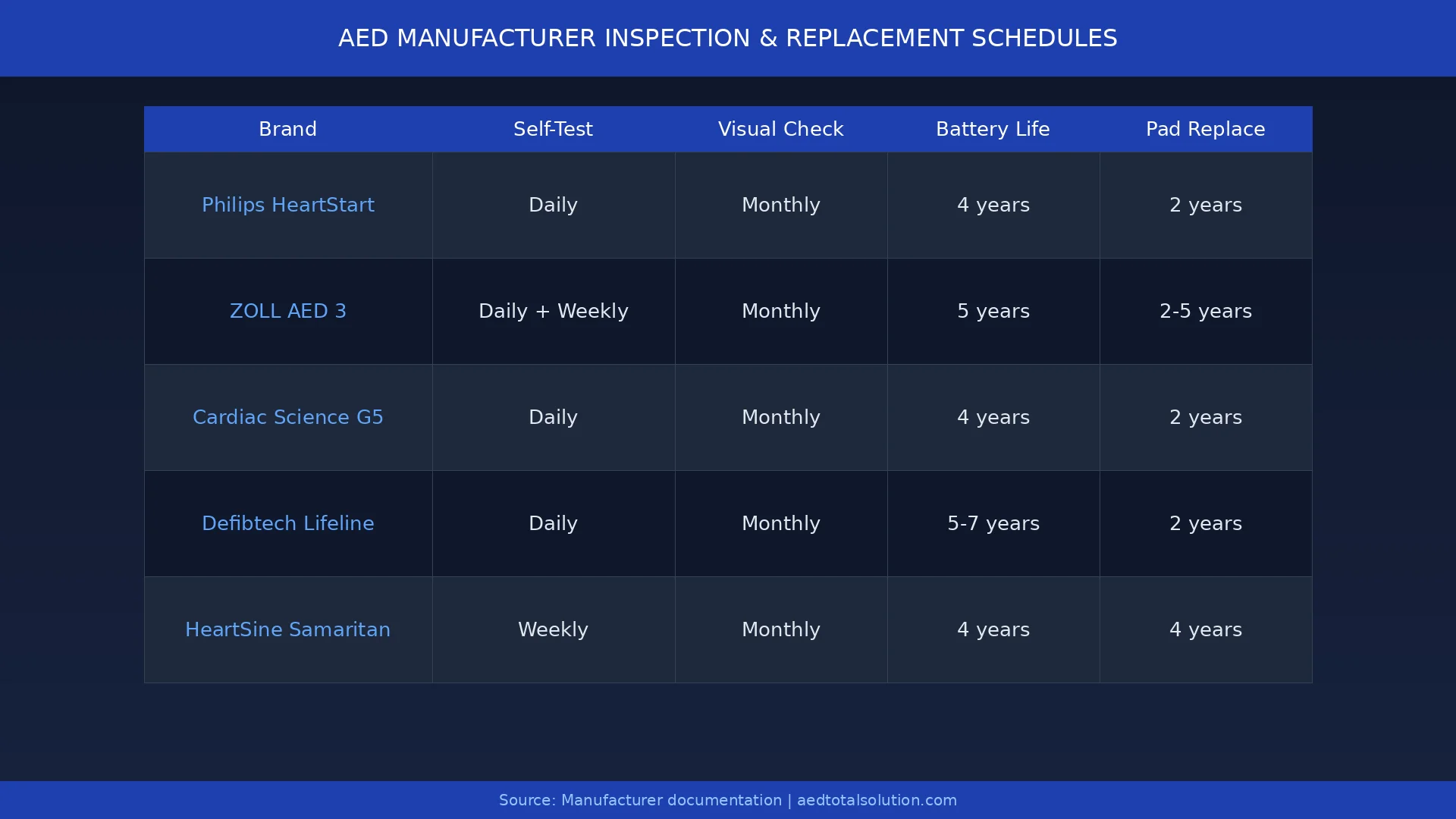
Philips HeartStart (FRx, OnSite, FR3)
- Self-test: Daily (automatic)
- Visual inspection: Monthly
- Battery life: 4 years (standby)
- Pad replacement: Every 2 years
ZOLL AED 3 / AED Plus
- Self-test: Daily (automatic) plus weekly extended self-test
- Visual inspection: Monthly
- Battery life: 5 years
- Pad replacement: Every 2-5 years depending on model
Cardiac Science Powerheart G5
- Self-test: Daily (automatic), including pad and battery checks
- Visual inspection: Monthly
- Battery life: 4 years
- Pad replacement: Every 2 years
Defibtech Lifeline
- Self-test: Daily (automatic)
- Visual inspection: Monthly
- Battery life: 5-7 years (depending on model)
- Pad replacement: Every 2 years
HeartSine Samaritan PAD
- Self-test: Weekly (automatic)
- Visual inspection: Monthly
- Battery life: 4 years
- Pad/battery (combined Pad-Pak): Every 4 years
Regardless of brand, the universal recommendation is clear: perform a documented inspection at least once per month. Some states require more frequent checks, so verify your state-specific AED requirements before finalizing your schedule.
How to Build an AED Inspection Schedule
Creating a reliable inspection schedule involves four steps:
Step 1: Inventory Your Devices
Document every AED in your organization, including its location, model, serial number, battery installation date, and pad expiration date. For multi-location organizations, a centralized inventory is essential.
Step 2: Assign Inspection Responsibilities
Designate a primary inspector and a backup for each AED location. Daily checks can be informal, but monthly inspections should have a named owner who is accountable for completing and documenting the check.
Step 3: Set Up Automated Reminders
Manual tracking relies on memory, which is unreliable. Use AED compliance management software or calendar reminders to ensure inspections happen on schedule. Automated systems also send alerts when batteries or pads are approaching their expiration dates.
Step 4: Document Everything
Every inspection should produce a record. This documentation serves two purposes: it proves compliance during audits and it creates a maintenance history that helps predict future replacement needs. Digital logs are preferable because they are searchable, cannot be lost, and can be shared across locations instantly.
What Happens When You Skip an Inspection?
Skipping an AED inspection might seem low-risk, but the consequences can be severe:
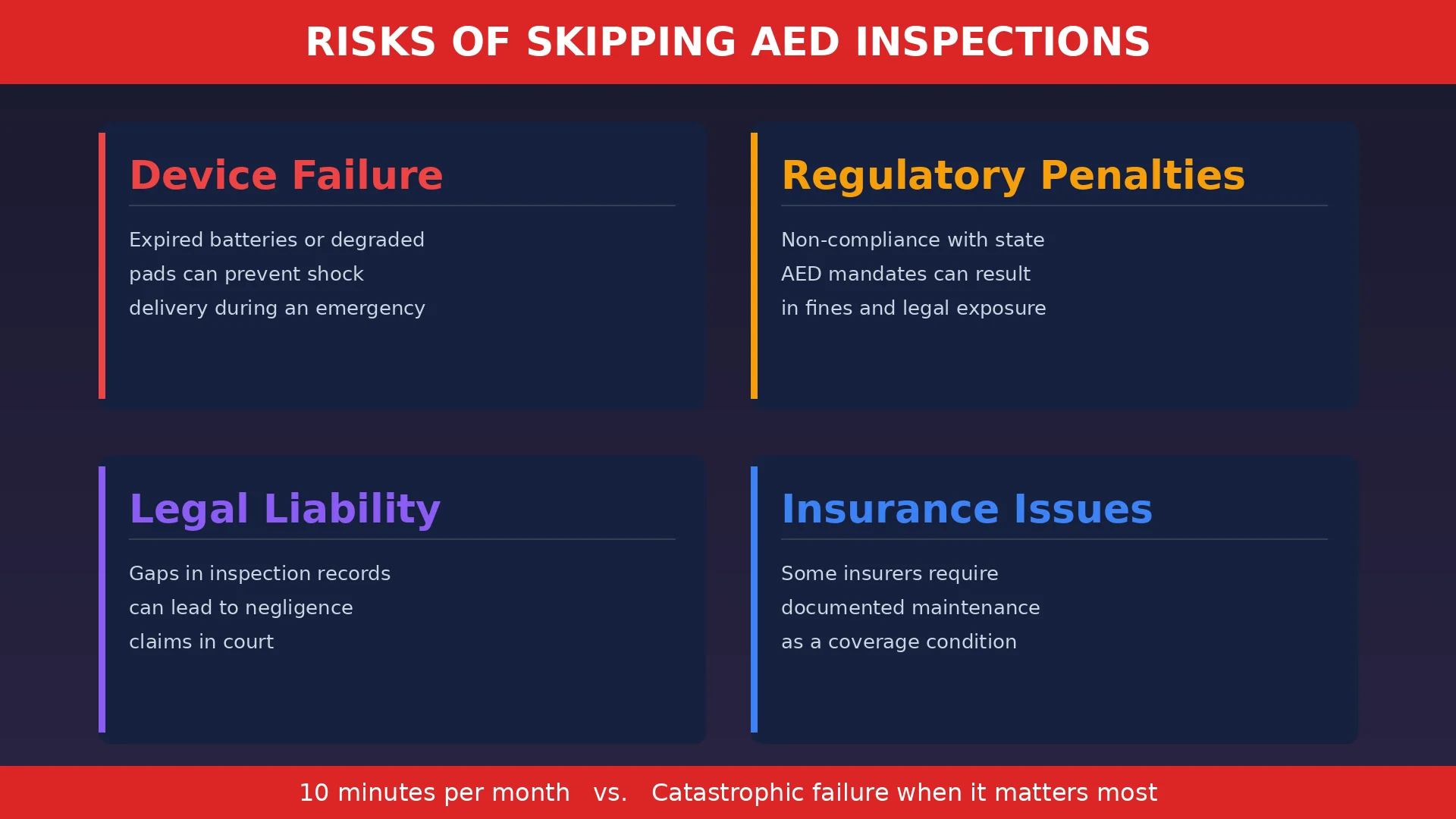
- Device failure during an emergency. An expired battery or degraded electrode pads can prevent the AED from delivering a shock when a life depends on it.
- Regulatory penalties. States with AED mandates often include inspection requirements. Non-compliance can result in fines or loss of Good Samaritan liability protections.
- Legal liability. If an AED fails during a cardiac arrest and your inspection records show gaps, your organization could face negligence claims.
- Insurance complications. Some insurers require documented AED maintenance as a condition of coverage.
The cost of a 10-minute monthly inspection is negligible compared to the cost of a failed rescue or a lawsuit.
How AED Total Solution Simplifies Inspections
Managing AED inspections in-house works for organizations with one or two devices. For larger programs, especially those spanning multiple locations, the complexity grows quickly.
AED Total Solution provides a full-service AED program management solution that handles inspections for you. Here is what that includes:
- Automated inspection reminders sent to designated staff via the mobile app and web portal
- QR code scanning for fast, error-free documentation during inspections
- Real-time dashboard showing the readiness status of every device across all locations
- Automatic alerts when batteries or pads are nearing expiration
- Medical direction and oversight from a licensed physician network
- Battery and pad replacement coordination so supplies arrive before they are needed
With AED Total Solution’s white-glove approach, your team conducts the physical checks while the platform handles the scheduling, documentation, and compliance tracking. Every inspection is recorded, every expiration date is monitored, and every location stays audit-ready.
Frequently Asked Questions
How often should an AED be inspected?
The standard recommendation is a visual check daily, a documented inspection monthly, and a comprehensive professional assessment annually. Most AED manufacturers and the FDA recommend monthly inspections at minimum. Some states require more frequent checks, so always verify your local regulations.
What does OSHA say about AED inspections?
OSHA does not mandate AEDs in the workplace, but its Best Practices Guide recommends that organizations with AEDs follow manufacturer maintenance schedules. This typically means monthly documented inspections and immediate replacement of expired components.
Do AEDs inspect themselves?
Most modern AEDs perform automatic self-tests, usually daily or weekly. These self-tests check internal circuitry, battery charge, and pad connectivity. However, self-tests do not replace human inspections. They cannot verify that the device is in its correct location, that accessories are present, or that pads have not been physically damaged.
How long do AED batteries last?
AED batteries typically last 2 to 5 years in standby mode, depending on the manufacturer and model. Temperature extremes and frequent self-testing can shorten battery life. Check your specific model’s documentation and replace batteries before their expiration date.
Who should perform AED inspections?
Any trained staff member can perform daily and monthly inspections. Annual assessments should be conducted by a qualified AED program manager or a professional service provider. Organizations that outsource AED management to a provider like AED Total Solution receive guidance and oversight for all inspection activities.
What should I do if an AED fails its self-test?
Remove the device from service immediately and contact the manufacturer or your AED program manager. Do not attempt to use an AED that has failed its self-test. Replace it with a backup device if one is available, and document the issue for your compliance records.
Take Control of Your AED Inspection Schedule
A reliable AED inspection schedule is the foundation of any effective cardiac emergency preparedness program. Whether you manage one device or hundreds across multiple sites, the principle is the same: inspect consistently, document thoroughly, and replace components before they expire.
If managing inspections in-house feels overwhelming, contact AED Total Solution to learn how our managed AED program can take the burden off your team while keeping every device compliant and ready to save a life.
By Prabakar Mahalingam, Managing Partner at AED Total Solution. Prabakar is a renowned national provider of safety training, products, and proprietary compliance software dedicated to addressing Sudden Cardiac Arrest (SCA).