Key Takeaway: CPR keeps blood flowing to the brain and organs during sudden cardiac arrest, while an AED delivers the electrical shock needed to restart the heart. Used together, CPR and AED can increase survival rates from less than 12% to over 50%. This guide covers how they work as a team, the chain of survival, certification paths, and workplace requirements.
Why CPR and AED Must Work Together
Sudden cardiac arrest (SCA) strikes more than 350,000 people outside of hospitals in the United States each year. When the heart stops, the clock starts. Without intervention, survival rates drop 7 to 10 percent for every minute that passes. CPR and AED are the two most critical tools bystanders have to keep someone alive until emergency responders arrive.
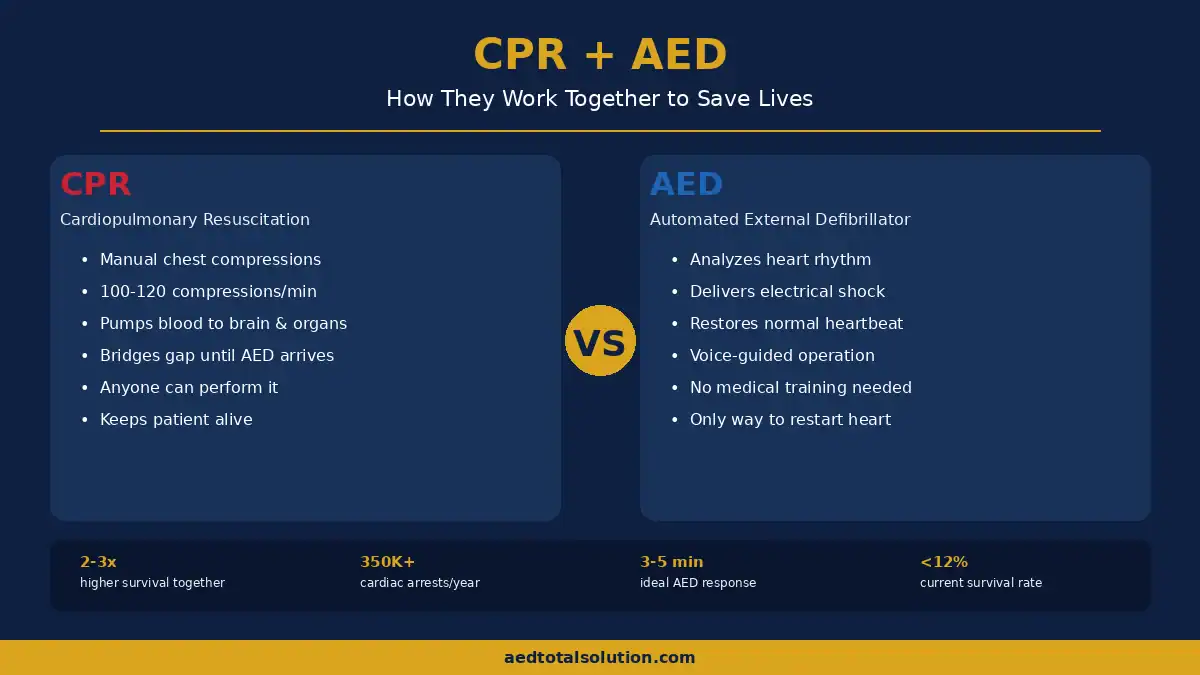
CPR and AED serve different but complementary functions. CPR manually pumps blood through the body, delivering oxygen to the brain and vital organs. An AED analyzes the heart’s rhythm and, if needed, delivers an electrical shock to restore a normal heartbeat. Neither tool alone is enough. CPR without defibrillation rarely restores a heartbeat on its own. An AED without CPR leaves the brain starved of oxygen during the minutes before and between shocks.
When bystanders combine high-quality CPR with early AED use, survival rates can increase two to three times compared to CPR alone. This is why every major medical organization, including the American Heart Association, teaches CPR and AED as an integrated response.
The Chain of Survival: A Framework for Saving Lives
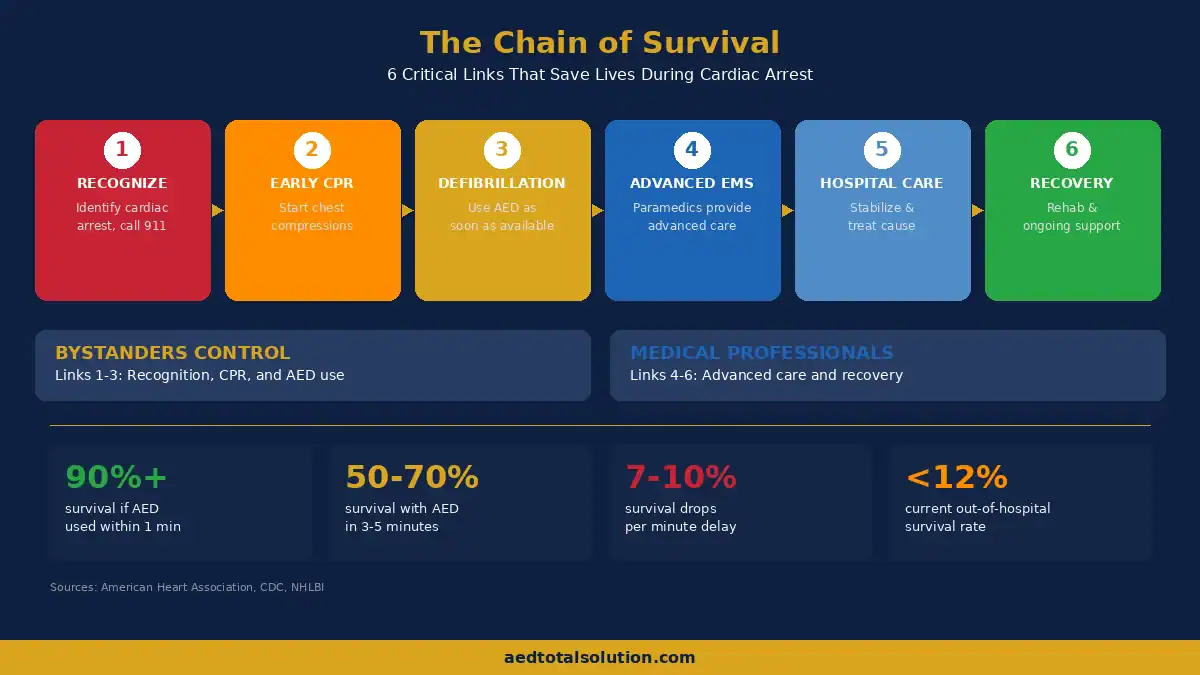
The American Heart Association developed the Chain of Survival to outline the critical steps needed to maximize survival during cardiac arrest. For details, see our guide on history of CPR. Each link in the chain depends on the ones before it. If any link is weak or missing, the entire chain breaks down.
The six links in the Chain of Survival are:
- Recognition and activation of the emergency response system. Identify that someone is in cardiac arrest (sudden collapse, no pulse, not breathing normally) and call 911 immediately.
- Early CPR with emphasis on chest compressions. Begin CPR right away. Push hard (at least 2 inches deep) and fast (100 to 120 compressions per minute). Effective chest compressions keep oxygenated blood circulating to the brain.
- Rapid defibrillation. Use an AED as soon as one is available. Early defibrillation within 3 to 5 minutes of collapse can increase survival rates to 50 to 70 percent.
- Advanced life support by EMS. Paramedics provide advanced interventions including IV medications, advanced airway management, and cardiac monitoring.
- Post-cardiac arrest care. Hospital-based treatment to stabilize the patient and address the underlying cause.
- Recovery. Rehabilitation, psychological support, and ongoing monitoring.
Bystanders control the first three links. That means ordinary people, not just medical professionals, have the greatest impact on whether someone survives cardiac arrest. Learning CPR and AED skills together prepares you to execute these first three links without hesitation.
How CPR Works During Cardiac Arrest
CPR, or cardiopulmonary resuscitation, is a technique that manually circulates blood when the heart can no longer pump on its own. During cardiac arrest, the heart either stops completely or quivers ineffectively (a condition called ventricular fibrillation). Without blood flow, the brain begins to suffer damage within 3 to 5 minutes.
CPR bridges the gap between cardiac arrest and defibrillation. By performing chest compressions at a rate of 100 to 120 per minute and a depth of at least 2 inches for adults, a rescuer forces blood through the circulatory system. If trained, the rescuer can also provide rescue breaths to deliver oxygen to the lungs. If not trained in rescue breathing, hands-only CPR (compressions without breaths) is still highly effective and recommended by the AHA for bystanders.
High-quality CPR requires minimizing interruptions to chest compressions, allowing full chest recoil between compressions, and avoiding excessive ventilation. For more on CPR technique, read our guide on high-quality CPR essentials.
How an AED Works During Cardiac Arrest
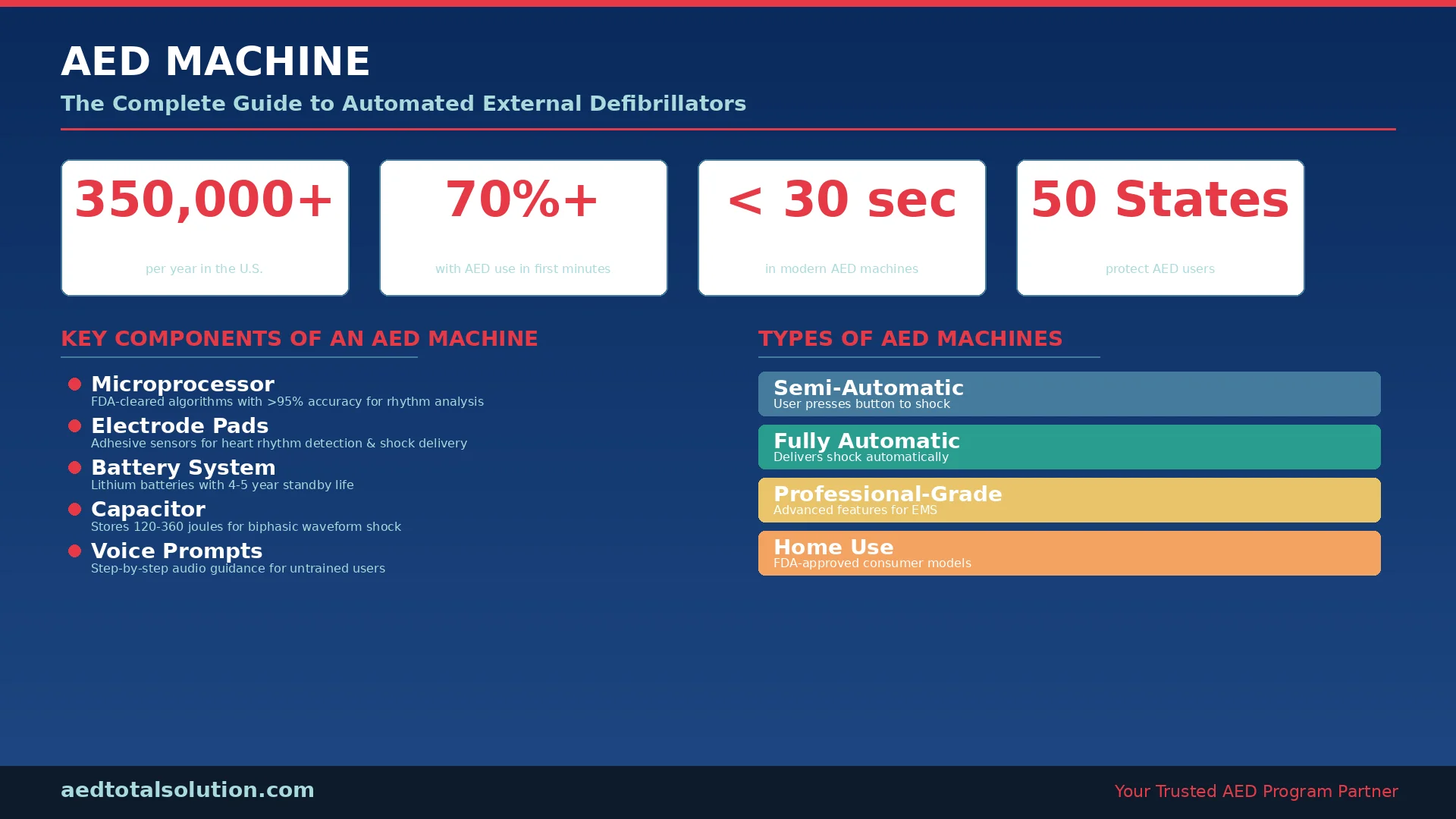
An automated external defibrillator (AED) is a portable device that analyzes the heart’s electrical activity and delivers a controlled shock if it detects a shockable rhythm, such as ventricular fibrillation or pulseless ventricular tachycardia. These abnormal rhythms account for the majority of witnessed sudden cardiac arrests.
AEDs are designed for use by anyone, regardless of medical training. The device provides voice prompts and visual instructions that guide the user through each step: powering on, placing electrode pads on the patient’s bare chest, standing clear during analysis, and pressing the shock button if advised. For details, see our guide on proper AED pad placement. For a complete walkthrough, see our step-by-step AED guide.
The key fact to understand: CPR keeps the patient alive, but an AED is the only way to correct the abnormal heart rhythm and restore a normal heartbeat. When an AED is used within the first minute of cardiac arrest, survival rates can exceed 90 percent. For details, see our guide on cardiac arrest survival rates. When used within 3 to 5 minutes, survival rates reach 50 to 70 percent. These numbers drop sharply with every additional minute of delay.
When to Use CPR vs. When to Use an AED
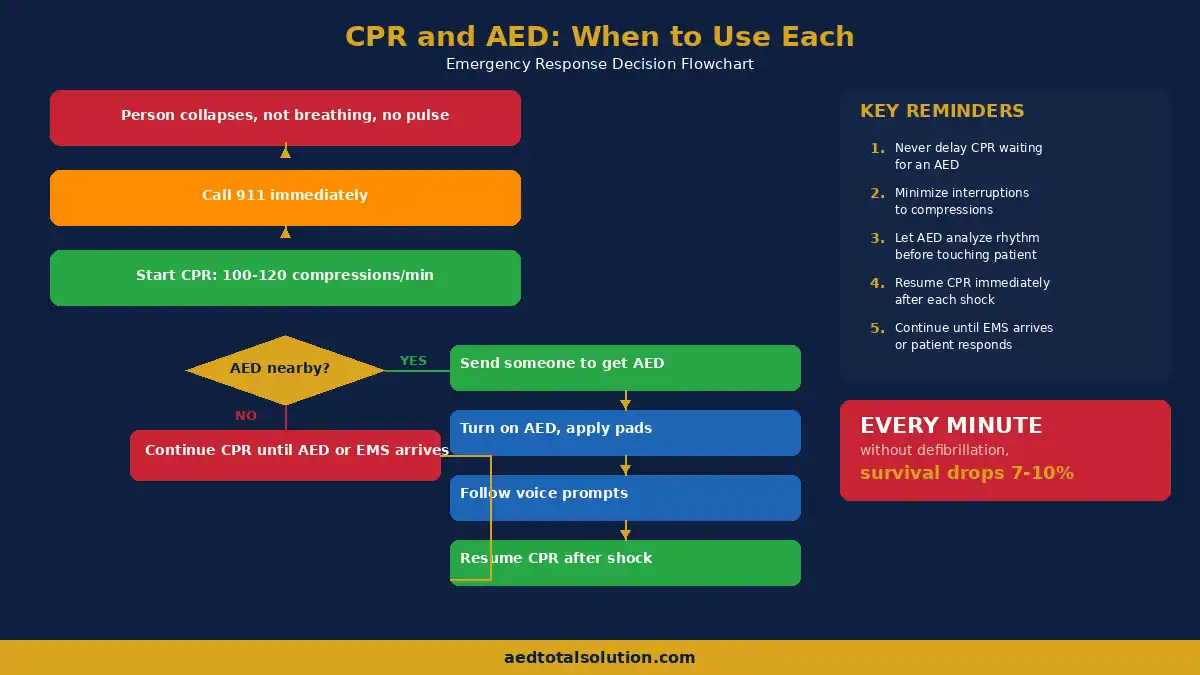
CPR and AED are not an either/or decision. They work as sequential and overlapping interventions:
- Start CPR immediately. If someone collapses and is not breathing or does not have a pulse, begin chest compressions right away. Do not wait for an AED.
- Send someone for the AED. While you perform CPR, direct a bystander to retrieve the nearest AED. Most AEDs in public buildings are located in hallways, lobbies, gyms, and near elevators.
- Apply the AED as soon as it arrives. Turn it on, attach the pads, and follow the voice prompts. The AED will analyze the heart rhythm and advise whether a shock is needed.
- Resume CPR immediately after the shock. After the AED delivers a shock (or advises no shock), resume CPR immediately. Continue cycles of CPR and AED analysis until EMS arrives or the patient shows signs of life.
If you are the only rescuer, prioritize calling 911 and starting CPR. If an AED is within sight (within a 1 to 2 minute walk), retrieve it quickly before starting compressions. If the AED is farther away, start CPR first and get the AED when help arrives.
For more on how AED and CPR survival rates compare, our detailed analysis shows why combining both interventions produces the best outcomes.
CPR and AED Certification: Your Options
Getting certified in both CPR and AED is straightforward, affordable, and typically takes just a few hours. The major certification providers all offer combined CPR/AED courses:
American Heart Association (AHA) Heartsaver CPR AED
The most widely recognized CPR AED certification for non-healthcare professionals. Covers adult CPR, AED use, and optionally child and infant CPR. Available as classroom, blended (online plus hands-on), or self-guided learning. Certification is valid for 2 years. Cost: $50 to $100.
AHA Heartsaver First Aid CPR AED
Adds comprehensive first aid training to the CPR AED curriculum. For details, see our guide on CPR and AED training. This is the most common course for meeting OSHA workplace requirements. Certification is valid for 2 years. Cost: $60 to $120.
AHA Basic Life Support (BLS)
Designed for healthcare professionals. Covers single-rescuer and team-based CPR, AED use, and bag-mask ventilation. Required for nurses, EMTs, paramedics, and medical students. Certification is valid for 2 years. Cost: $50 to $100.
American Red Cross First Aid/CPR/AED
Follows the same evidence-based science as the AHA. Available in classroom, blended, and online-only formats. Certification is valid for 2 years. Cost: $35 to $100.
All certifications expire after two years because studies show CPR and AED skills decline significantly after 12 to 24 months without practice. For a deeper look at what AED certification involves, see our AED certification guide.
Workplace CPR and AED Requirements
If your organization has AEDs on-site, having trained staff is not optional. It is a critical component of a compliant AED program. Here is what employers need to know:
- OSHA guidance. While OSHA does not have a specific standard mandating AEDs, it recommends them as part of workplace first-aid programs under 29 CFR 1910.151 (general industry) and 29 CFR 1926.50 (construction). Where AEDs are present, OSHA expects employers to have trained personnel available. Read more about OSHA AED requirements for workplaces.
- State laws. Many states require AEDs and trained staff in specific settings, including schools, fitness centers, government buildings, and dental offices. Requirements vary by state, so multi-location organizations face particular complexity.
- Good Samaritan protections. All 50 states provide some form of immunity for AED use in good faith. However, many of these laws require that the AED program includes training, maintenance, and medical oversight. Without these elements, organizations may lose their liability protections.
- Training documentation. Employers should maintain current certification records for all designated responders, conduct regular emergency response drills, and keep a written AED program that includes physician oversight and maintenance schedules.
For organizations that need AEDs in the workplace, understanding which businesses are required to have AEDs and the full scope of AED requirements for businesses is essential for compliance.
Building an Effective Workplace CPR and AED Program
Having AEDs on the wall and certifications on file is a good start, but a truly effective CPR and AED program requires ongoing oversight. The key components include:
- Strategic AED placement. Position devices so any person in the facility can reach an AED within 1 to 2 minutes. Consider high-traffic areas, distance between floors, and departments with higher-risk activities.
- Sufficient trained responders. Ensure enough employees are CPR/AED certified to cover all shifts, floors, and locations. The goal is to always have a trained responder within earshot of an emergency.
- Regular drills. Conduct emergency response drills at least annually. Drills build muscle memory, reduce hesitation, and identify gaps in your response plan.
- Equipment maintenance. AED batteries and electrode pads have expiration dates. Failing to replace them on schedule means your AED may not function when needed. Automated monitoring through AED compliance management software ensures nothing is missed.
- Documentation and compliance tracking. Maintain records of inspections, training dates, maintenance activities, and physician oversight. These records are essential for regulatory compliance and liability protection.
Managing all of these components across multiple locations is challenging. A managed AED program, like those offered by AED Total Solution, combines software-driven monitoring with hands-on program oversight to keep every device compliant and every team prepared.
Frequently Asked Questions
How long does CPR and AED certification last?
CPR and AED certification from the American Heart Association, American Red Cross, and other accredited providers is valid for two years. After expiration, you must complete a renewal or recertification course to maintain your credentials. Some employers require annual refresher training even though the formal certification lasts two years.
Can I use an AED without CPR training?
Yes. AEDs are designed for use by untrained bystanders. The device provides step-by-step voice prompts. However, formal training builds confidence, reduces hesitation, and teaches you how to perform CPR alongside AED use, which significantly improves outcomes.
Do I need to perform CPR if an AED is available?
Yes. Always start CPR immediately and continue it while someone retrieves the AED. After the AED delivers a shock or advises no shock, resume CPR right away. CPR keeps blood flowing to the brain between AED analyses and shocks.
How much does CPR and AED certification cost?
Most CPR AED certification courses cost between $35 and $120 depending on the provider, format, and whether first aid training is included. Group and on-site training is often the most cost-effective option for employers.
Is CPR AED certification required for work?
It depends on your role, industry, and state. Healthcare professionals typically need BLS certification. Many states require schools, fitness centers, and certain workplaces to have trained staff on-site. Even where not legally required, OSHA recommends CPR/AED training wherever AEDs are deployed.