Key Takeaways
- Hotels have a duty of care to guests: With hundreds of guests on-site at any time, including elderly travelers and those with pre-existing conditions, hotels face a significant risk of sudden cardiac arrest events. An AED can mean the difference between life and death.
- Many states require AEDs in hospitality venues: Several states mandate AEDs in public accommodations, fitness centers, and large assembly venues. Hotels often fall under multiple categories of these requirements.
- Strategic placement matters: A single AED at the front desk is not enough for a large hotel. Place devices at the front desk, near the fitness center, by the pool area, and on upper floors to ensure retrieval within 3 minutes from any guest room.
- Staff training transforms readiness: Front desk clerks, security staff, housekeeping supervisors, and event coordinators should all receive CPR/AED training. Quarterly drills keep response times fast.
- A managed program simplifies multi-property compliance: For hotel groups and chains managing AEDs across dozens of properties, centralized program management handles inspections, supply tracking, and state-specific compliance from one dashboard.
Why Hotels Need AEDs
Hotels are unique environments when it comes to cardiac emergency risk. At any given moment, a hotel hosts hundreds of guests spanning every age group, health profile, and activity level. Guests travel with the stress of airports and schedules, they exercise in the fitness center, they consume alcohol at events and restaurants, and many are far from their regular healthcare providers. This combination of factors creates a setting where sudden cardiac arrest (SCA) is a real and present possibility.
Consider the profile of a typical hotel guest population. Business travelers may be dealing with high stress and disrupted sleep. Elderly guests and retirees are a significant demographic for hotels, and cardiovascular risk increases with age. Event attendees at conferences and weddings are often in emotionally charged, physically active situations. And fitness center users are engaging in exertion that, while generally healthy, can trigger cardiac events in individuals with undiagnosed conditions.
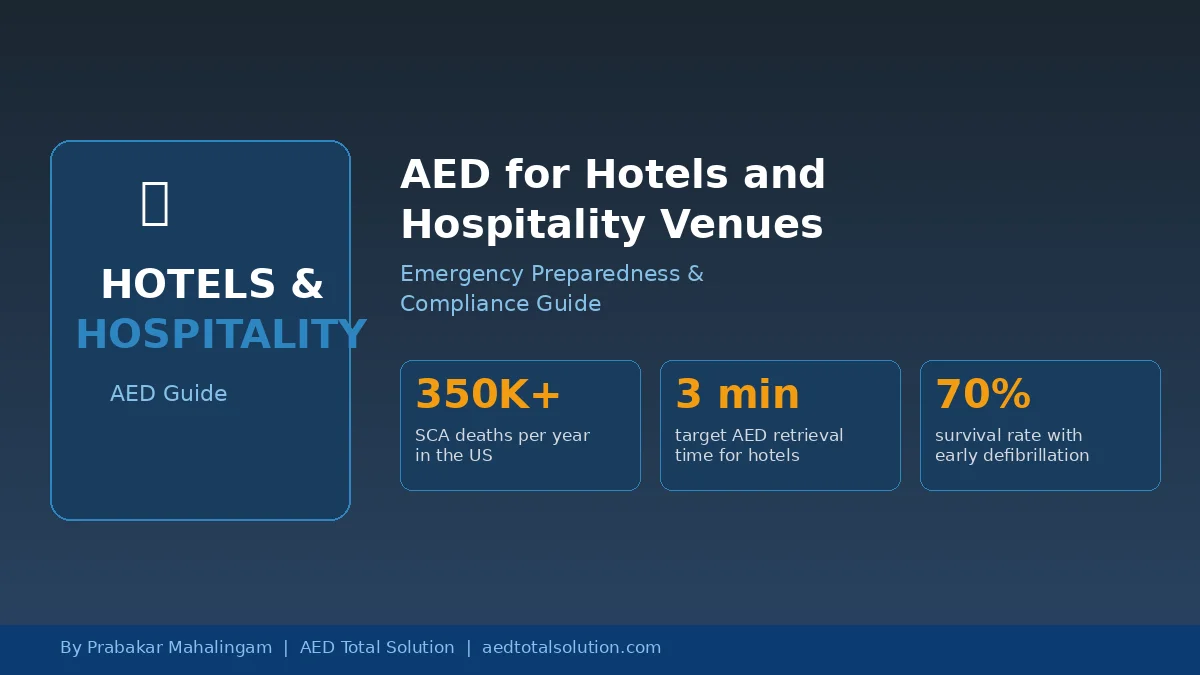
Sudden cardiac arrest claims over 350,000 lives in the United States each year. When SCA strikes, the victim’s survival chance drops by 7% to 10% for every minute without defibrillation. The average EMS response time is 8 to 12 minutes. An AED on-site can deliver a life-saving shock within the first 3 to 5 minutes, dramatically improving survival odds from under 10% to as high as 70% when defibrillation is provided quickly.
For hotel operators, having an AED is about protecting your guests, your staff, and your brand. A guest cardiac emergency without an available AED is not just a tragedy; it’s a liability event, a reputational risk, and a failure of the duty of care that hospitality businesses owe to every person who walks through their doors.
AED Requirements for Hotels and Hospitality Venues
AED requirements for hotels vary by state and are often determined by a combination of factors: the size of the facility, whether it includes a fitness center or pool, and whether it hosts large events or assemblies.
State Requirements That Affect Hotels
- Fitness center mandates: Many states, including New York, Illinois, California, and Massachusetts, require AEDs in fitness centers and health clubs. If your hotel operates a gym, pool, or spa, these laws almost certainly apply to you. See our AED Requirements for Gyms and Fitness Centers guide.
- Public accommodation laws: Some states require AEDs in large public accommodations, assembly venues, and buildings that regularly host more than a specified number of occupants. Hotels with ballrooms, conference centers, or event spaces may fall under these provisions.
- Local ordinances: Cities like Chicago, New York City, and San Francisco have local AED requirements that go beyond state mandates. Check both state and local regulations for your property’s specific location.
Even in jurisdictions without explicit AED mandates for hotels, OSHA’s general duty clause and medical services standard (29 CFR 1910.151) create an expectation that employers provide reasonable first aid capabilities. For more on OSHA’s framework, see our guide on OSHA Requirements for AEDs.
Insurance and Liability Considerations
Many commercial insurance providers now offer premium discounts for properties with documented AED programs. Conversely, a hotel without an AED that experiences a guest cardiac arrest may face heightened liability exposure. Good Samaritan laws protect AED users in all 50 states, but this protection is often contingent on proper maintenance and training documentation. Learn more about Good Samaritan Law protections for AED use.
How Many AEDs Does a Hotel Need?
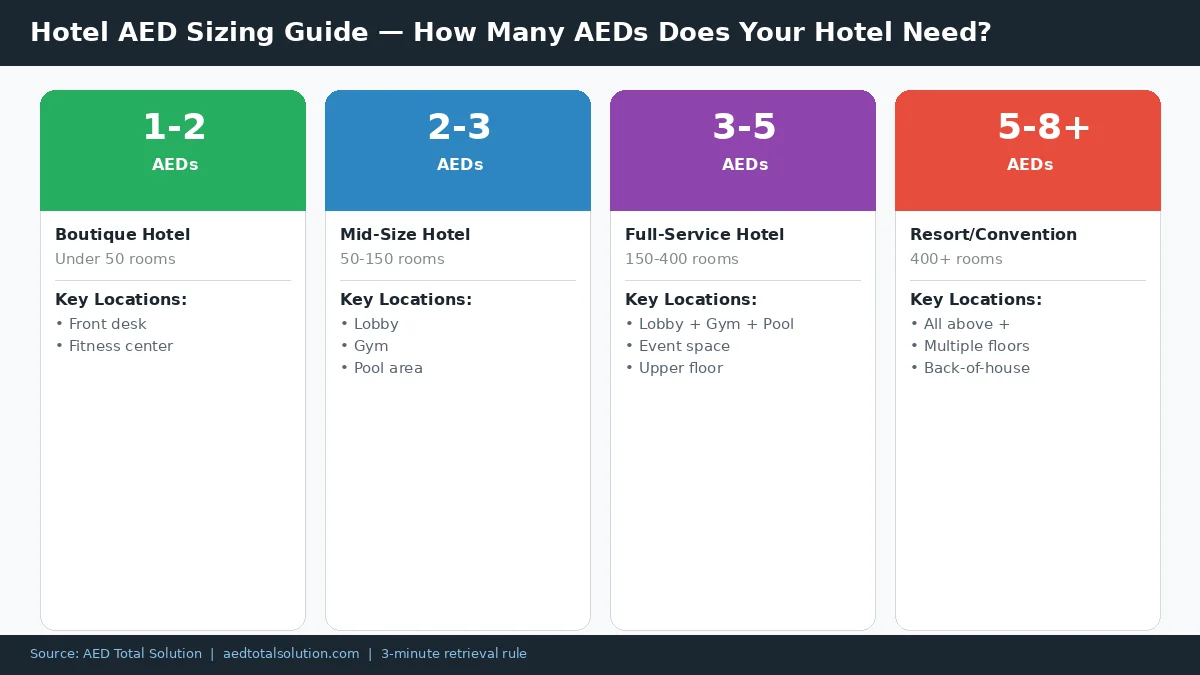
The number of AEDs a hotel needs depends on the property’s size, layout, and number of floors. The goal is simple: any staff member should be able to retrieve an AED and return to the victim within 3 minutes. For most hotels, that means one AED is not enough.
Placement Guidelines for Hotels
- Front desk or lobby: This is the central command point for your property and should always have an AED. It’s the most visible, most staffed location and the first place guests and staff will look in an emergency.
- Fitness center: This is often required by law. Mount the AED in a wall cabinet at the entrance to the gym where it’s visible from the workout area.
- Pool and spa area: Aquatic environments carry elevated cardiac risk. Place an AED near the pool deck entrance. Ensure staff know to move the victim to a dry surface before applying pads.
- Conference and event space: If your hotel hosts large events, a dedicated AED for the ballroom or meeting area ensures fast access during events when the lobby may be far away or difficult to reach through crowds.
- Upper floors: For hotels with more than 3 floors, consider placing AEDs on every 3rd floor at a minimum. Elevator wait times and stairwell distances can add critical minutes to retrieval during an emergency.
- Back-of-house areas: Don’t forget your employees. Kitchen staff, housekeeping, and maintenance teams work in areas far from the lobby. A back-of-house AED near the staff break room or kitchen protects your team.
Quick Sizing Guide
| Hotel Size | Recommended AEDs | Key Placement Locations |
|---|---|---|
| Boutique (under 50 rooms) | 1-2 | Front desk + fitness center |
| Mid-size (50-150 rooms) | 2-3 | Lobby, gym, pool area |
| Full-service (150-400 rooms) | 3-5 | Lobby, gym, pool, event space, upper floor |
| Resort/Convention (400+ rooms) | 5-8+ | Lobby, gym, pool, event space, multiple floors, back-of-house |
For detailed guidance on AED placement, including ADA height requirements and signage best practices, read our AED Placement Guidelines.
Best AED Models for Hotels
When selecting AEDs for a hotel, prioritize devices that are intuitive for non-medical staff, durable enough for high-traffic environments, and easy to manage across multiple units. Here are the top recommendations for hospitality settings.
Philips HeartStart OnSite
The Philips OnSite is one of the most popular AEDs for hotels because of its simplicity. With clear voice prompts and a pull-tab activation, it’s designed for bystanders with no medical training. The Ready-Pack configuration means pads and battery are pre-installed, so the device is always ready to use. Starting at $1,579 with a complete value package.
Physio-Control LIFEPAK CR2
For hotel groups managing multiple properties, the LIFEPAK CR2 offers WiFi connectivity that enables remote monitoring of device status, battery life, and pad expiration across your entire portfolio from a single dashboard. This is a game-changer for property management companies overseeing dozens of locations. Starting at $2,376.
ZOLL AED Plus
The ZOLL AED Plus provides real-time CPR feedback that coaches the rescuer on compression depth and rate. Its durable design and long battery life (5 years) make it ideal for hotels where the device may sit unused for extended periods but must be instantly ready. Starting at $2,142.
Browse our full selection of AED packages to find the right fit for your property.
Training Your Hotel Staff
In a hotel, the first responder to a cardiac emergency could be anyone on your team: a front desk agent, a security officer, a banquet server, or a housekeeper. Comprehensive training across all departments ensures that no matter where or when an emergency occurs, a trained responder is nearby.
Priority Training Groups
- Security and safety team: Your security staff should be the most highly trained, serving as the backbone of your emergency response program. They should receive CPR/AED/First Aid certification plus additional scenario training.
- Front desk and guest services: As the primary point of contact for guests, front desk staff must know how to activate the emergency response plan, direct responders to the AED, and communicate with 911 dispatchers.
- Fitness center and pool attendants: Staff in these areas are often the first to witness an exercise-related cardiac event. They should be CPR/AED certified and conduct regular drills in their specific environment.
- Event and banquet staff: For hotels that host large events, designating trained responders among event staff ensures coverage during conferences, weddings, and galas where guest counts are high.
- Housekeeping and maintenance supervisors: These team members are often the only staff in back-of-house areas or guest room floors. At least one supervisor per shift should be CPR/AED certified.
Visit our AED Training Guide for details on certification programs, training schedules, and how to build a comprehensive emergency response plan.
Managing AEDs Across Multiple Hotel Properties
For hotel management companies, brands, and ownership groups, managing AED compliance across multiple properties is a complex logistical challenge. Each property may be in a different state with different laws, have different numbers of devices, and operate on different inspection schedules. Manual tracking with spreadsheets and calendar reminders is a recipe for compliance gaps.
AED Total Solution specializes in multi-location AED program management. Our platform provides:
- Centralized dashboard: Track every AED across every property from one web portal. View device status, inspection history, pad and battery expiration dates, and training records in real time.
- Mobile app with barcode scanning: On-site staff can complete inspections in seconds using our mobile app. Scan the AED’s barcode, confirm the status indicator, and the inspection is logged automatically.
- Automated alerts: Receive email notifications 60 and 30 days before pad and battery expirations, monthly inspection reminders, and immediate alerts for failed inspections. Nothing slips through the cracks.
- Medical direction: A licensed physician provides the medical oversight and standing prescription required for your AED program, covering all your properties through our nationwide network of physician partners.
- Automatic supply replacement: With our Standard Plus plan, expired or used pads and batteries are shipped directly to the property at no additional cost, so your AEDs are always stocked and ready.
Our managed programs start at just $99 per device per year for the Standard plan, or $204 per device per year for Standard Plus with automatic supply replacement. Learn more about our AED Program Management Services.
Frequently Asked Questions
Are hotels required to have AEDs?
Requirements vary by state and locality. Hotels with fitness centers are often required to have AEDs under gym/health club mandates. Hotels in states with public accommodation AED laws or large assembly venue requirements may also be required. Even where not mandated, AEDs are considered a best practice for guest safety and liability protection. Check your state’s AED laws for specifics.
How many AEDs does a hotel need?
The general rule is that any staff member should be able to retrieve an AED and return to the victim within 3 minutes. For a boutique hotel under 50 rooms, 1-2 AEDs may suffice. Mid-size hotels typically need 2-3, full-service hotels need 3-5, and large resorts or convention hotels may need 5-8 or more, placed at the lobby, fitness center, pool, event space, upper floors, and back-of-house.
How much does an AED program cost for a hotel?
AED devices range from $1,500 to $2,800 per unit. Program management starts at $99/year per device (Standard) or $204/year per device (Standard Plus, includes automatic supply replacement). For a mid-size hotel with 3 AEDs on the Standard Plus plan, the total annual management cost would be approximately $612. Visit our AED Cost Guide for a full breakdown.
What training do hotel staff need for AEDs?
We recommend CPR/AED certification for all guest-facing and safety staff. The American Heart Association and American Red Cross both offer half-day certification courses. Training should be refreshed annually, with quarterly emergency drills that simulate real scenarios in your specific hotel environment.
Can an AED be used near water (pools)?
Yes, but the victim must be moved to a dry surface before applying AED pads. Remove the victim from the water, dry the chest area, and then apply the electrode pads. AEDs are safe to use near water as long as the pads and the area around the patient’s chest are dry. For step-by-step AED instructions, see our How to Use an AED Guide.