Why AED Maintenance and Compliance Matter
Automated External Defibrillators (AEDs) save lives, but only when they work. A poorly maintained AED can fail at the moment it matters most, during a sudden cardiac arrest (SCA) emergency. With approximately 350,000 out-of-hospital cardiac arrests occurring annually in the United States, organizations that deploy AEDs carry a serious responsibility: keeping those devices inspection-ready, compliant, and response-ready at all times.
AED maintenance and compliance go hand in hand. Maintenance ensures the device functions properly. Compliance ensures your organization meets federal guidelines, state-specific AED laws, and industry best practices. Together, they form the foundation of a trustworthy AED program.
This guide covers everything you need to know about AED maintenance and compliance in 2026, including what to inspect, how often, which regulations apply, and how to build a sustainable program that protects your people and your organization.
Understanding AED Maintenance: What It Involves
AED maintenance is the ongoing process of inspecting, testing, and servicing your defibrillator to ensure it remains operational. Unlike many medical devices, AEDs are designed for use by non-medical personnel in emergencies, which makes reliability non-negotiable.
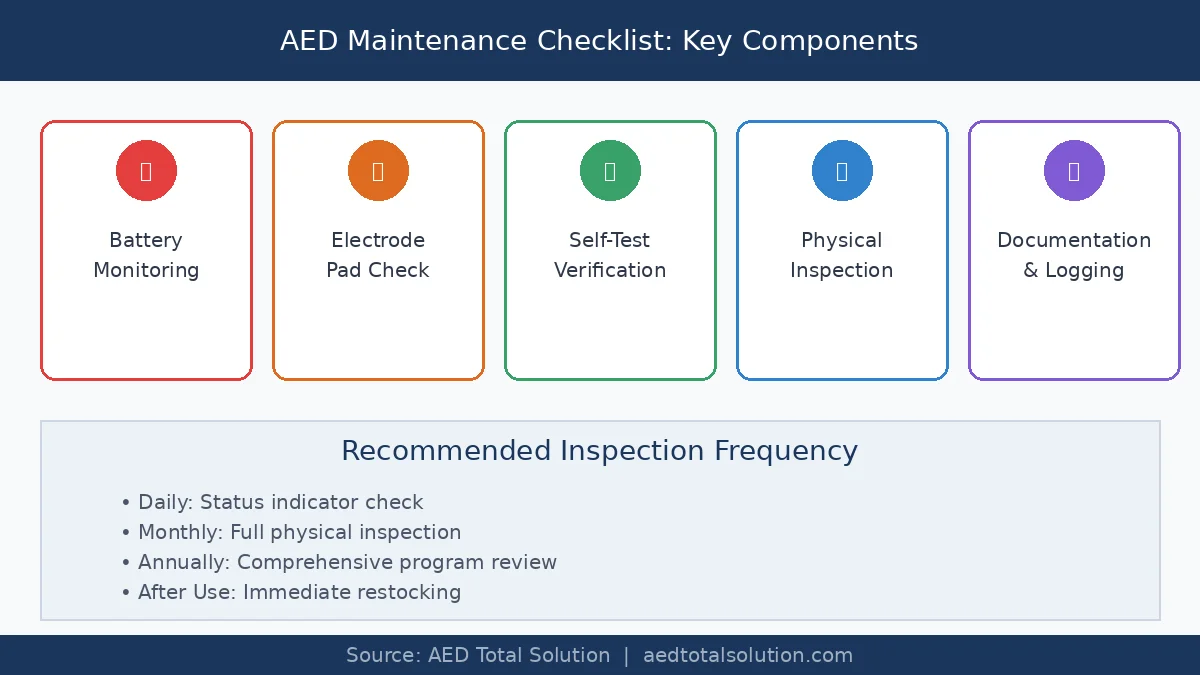
Key Components of AED Maintenance
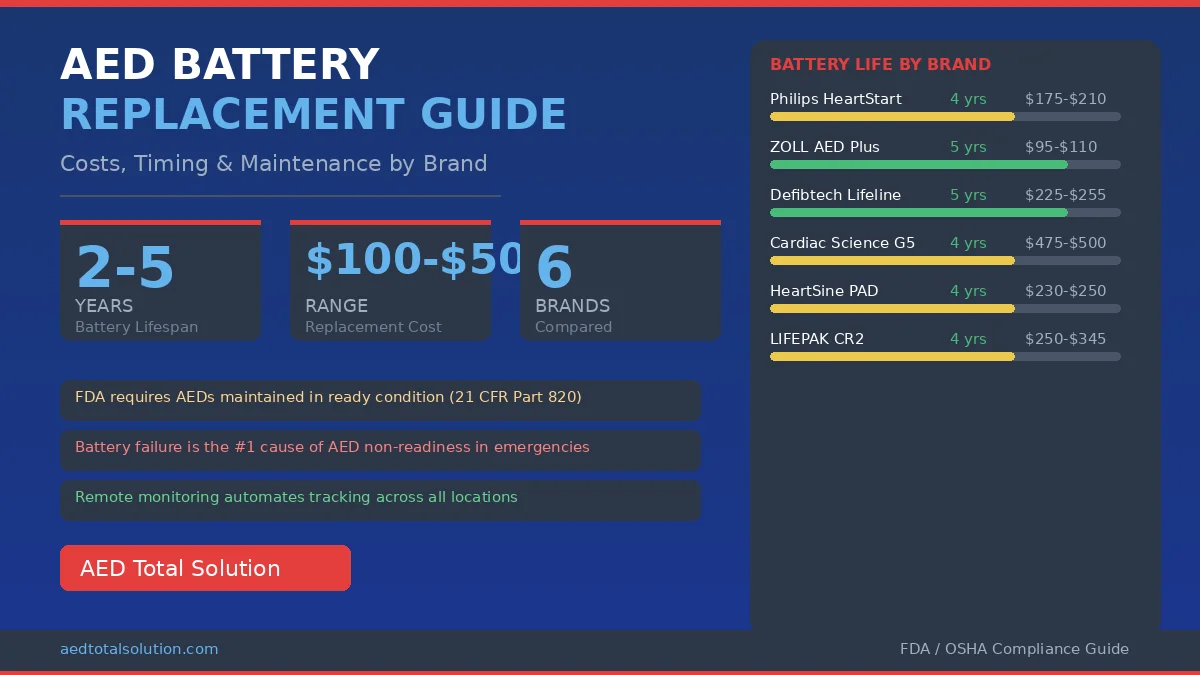
- Battery monitoring: AED batteries have a defined shelf life, typically 2 to 5 years depending on the manufacturer. Tracking AED battery expiration dates and replacing batteries before they expire is critical.
- Electrode pad replacement: AED pads also expire and must be replaced on schedule. Expired pads may not adhere properly or deliver an adequate shock. Learn more about AED pad expiration dates.
- Self-test verification: Most modern AEDs perform automatic self-tests (daily, weekly, or monthly). Reviewing self-test indicators is a core part of routine maintenance.
- Physical inspection: Checking the AED cabinet, signage, accessories (rescue kit, CPR mask), and overall device condition.
- Software and firmware updates: Some AED manufacturers release protocol updates based on the latest resuscitation guidelines.
- Documentation: Recording every inspection, replacement, and service action in a maintenance log for audit purposes.
For a step-by-step breakdown of what to check and when, see our AED Maintenance Checklist.
How Often Should AEDs Be Inspected?
The frequency of AED inspections depends on your organization’s policies, state regulations, and manufacturer recommendations. As a general guideline:
- Daily or weekly: Visual check of the AED status indicator (green light = ready; red light = needs attention).
- Monthly: Full physical inspection including battery level, pad expiration, accessories, cabinet condition, and signage.
- Annually: Comprehensive review of the entire AED program, including device inventory, compliance documentation, training records, and medical direction.
- After every use: Immediate inspection, pad replacement, and restocking of supplies.
Organizations managing multiple AEDs across multiple locations face additional challenges in maintaining consistent inspection schedules. Read our detailed guide on how often AEDs should be inspected for manufacturer-specific recommendations.
AED Compliance Requirements in 2026
AED compliance refers to meeting the legal, regulatory, and best-practice standards that govern how AEDs are deployed, maintained, and used within an organization. Compliance is not optional; it protects both the people who may need an AED and the organization that provides one.
Federal Guidelines
While there is no single federal law mandating AEDs in all workplaces, several federal agencies provide guidance:
- OSHA: The Occupational Safety and Health Administration recommends AEDs as part of workplace first aid programs and has published best practice letters supporting AED deployment. See our guide on OSHA requirements for AEDs.
- FDA: AEDs are FDA-regulated medical devices. Only FDA-cleared AEDs should be purchased and deployed.
- AHA/ARC guidelines: The American Heart Association and American Red Cross publish resuscitation guidelines that influence AED protocols and training requirements.
State-Specific AED Laws
AED regulations vary significantly by state. Some states mandate AEDs in specific facilities (schools, fitness centers, government buildings), while others focus on Good Samaritan protections and training requirements.
Key state-level compliance considerations include:
- Registration with local EMS or health departments
- Medical direction or physician oversight requirements
- Training and certification mandates for designated responders
- Notification protocols (calling 911 before or after AED use)
- Maintenance and inspection documentation requirements
For a comprehensive breakdown, visit our AED laws by state resource. Organizations in California should also review California-specific AED requirements.
Building an AED Maintenance and Compliance Program
A sustainable AED program requires more than buying a device and mounting it on the wall. It requires structured oversight, clear accountability, and consistent follow-through. Here is how to build one:
Step 1: Conduct an AED Program Assessment
Start by inventorying all AEDs in your organization. Document each device’s location, make, model, serial number, battery expiration, pad expiration, and last inspection date. For organizations with multiple locations, a centralized tracking system is essential.
Step 2: Establish an Inspection Policy
Create a written AED inspection policy that defines who is responsible for inspections, how often they occur, what gets checked, and how results are documented. Assign a program coordinator at each location.
Step 3: Ensure Proper AED Placement
AEDs should be placed in high-traffic, easily accessible locations with clear signage. The goal is to retrieve the AED and deliver the first shock within 3 to 5 minutes of a cardiac arrest. Our AED placement guidelines cover building layout best practices.
Step 4: Implement Training Programs
While AEDs are designed for use by untrained bystanders, formal training significantly improves outcomes. Ensure designated responders receive CPR and AED training, and schedule refresher courses annually. Review our AED training guide for program development tips.
Step 5: Maintain Documentation
Keep detailed records of every inspection, battery replacement, pad replacement, training session, and device deployment. These records are essential for regulatory compliance, liability protection, and audit readiness.
Step 6: Review and Update Annually
AED technology, regulations, and best practices evolve. Conduct an annual program review to update policies, replace aging equipment, refresh training, and verify compliance with current state laws.
Common AED Maintenance Mistakes to Avoid
Even well-intentioned organizations make maintenance errors that can compromise AED readiness:
- Ignoring expiration dates: Batteries and pads expire on specific dates. Using expired components risks device failure during an emergency.
- Skipping monthly inspections: Relying solely on the AED’s self-test indicator is insufficient. Monthly physical inspections catch issues that automated tests miss.
- No designated program coordinator: Without clear ownership, AED maintenance falls through the cracks. Every location needs an assigned responsible person.
- Poor documentation: If it is not documented, it did not happen. Incomplete records create compliance gaps and liability exposure.
- Failing to replace pads after use: After every AED deployment, electrode pads must be replaced immediately. A used AED without fresh pads is not ready for the next emergency.
- Not tracking battery replacement schedules: Battery life varies by manufacturer, and replacement timelines must be tracked proactively.
The Role of Technology in AED Program Management
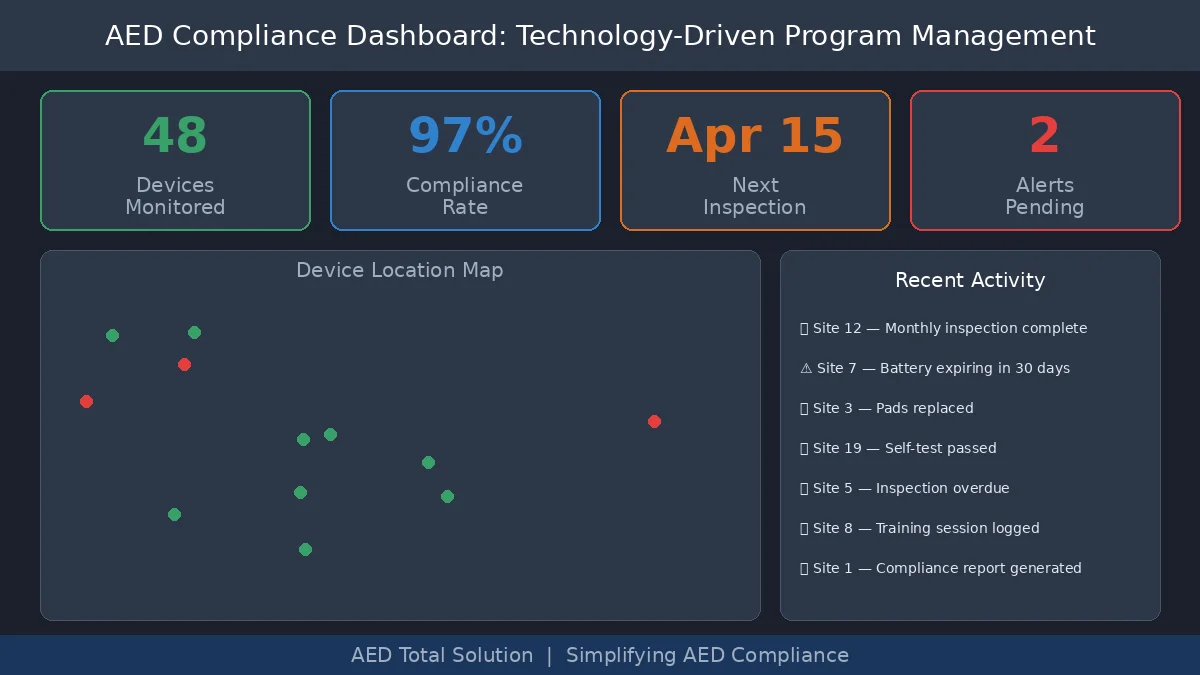
Modern AED program management leverages technology to reduce human error and streamline compliance. Key capabilities include:
- Remote readiness monitoring: Cloud-connected AED monitoring systems provide real-time status alerts, notifying program managers when a device needs attention. Learn about remote AED monitoring.
- Automated compliance reminders: Software-driven alerts for upcoming pad and battery expirations, scheduled inspections, and training renewals.
- Centralized dashboards: A single view of all AEDs across all locations, with status indicators, inspection history, and compliance scores.
- Audit-ready reporting: One-click report generation for regulatory audits, insurance reviews, and internal compliance checks.
- AED compliance management software: Purpose-built platforms that combine all of these capabilities. See our comparison of AED compliance management software options.
Why Outsource AED Maintenance and Compliance?
Managing an AED program in-house requires dedicated staff time, regulatory knowledge, vendor relationships, and consistent follow-through. For many organizations, especially those with multiple locations or limited safety staff, outsourcing AED program management is the more effective choice.
A managed AED program partner like AED Total Solution provides:
- End-to-end lifecycle management: From device selection to decommissioning, every stage is handled.
- Combined software and human oversight: Automated monitoring verified by expert program managers ensures nothing falls through the cracks.
- Multi-location scalability: Centralized visibility and management across all sites, regardless of geography.
- Regulatory expertise: Stay current with OSHA guidance, state law changes, and industry best practices without dedicating internal resources to tracking them.
- Audit-ready documentation: Compliance records maintained and ready for review at any time.
- Reduced liability: A fully managed program demonstrates due diligence and reduces organizational risk.
For a deeper look at the advantages, read about outsourced AED compliance benefits.
Frequently Asked Questions
What is the recommended maintenance schedule for an AED?
Most AED manufacturers and safety organizations recommend daily or weekly visual checks of the status indicator, monthly physical inspections, and annual comprehensive program reviews. Always follow the specific maintenance schedule outlined in your AED’s user manual. For fitness facilities, maintenance needs vary based on the gym environment, device placement, and usage patterns. Our AED for Gyms best practices guide covers facility-specific maintenance protocols.
Are businesses legally required to have AEDs?
Requirements vary by state. Some states mandate AEDs in schools, fitness centers, or government buildings. Others encourage but do not require AED deployment. Check your state-specific AED requirements for details.
What happens if an AED is not properly maintained?
A poorly maintained AED may fail to power on, deliver an inadequate shock, or fail to analyze the heart rhythm correctly. This can result in a preventable death, potential legal liability, regulatory fines, and reputational damage to the organization.
How long do AED batteries and pads last?
Battery life ranges from 2 to 5 years depending on the AED model and manufacturer. Electrode pads typically last 18 to 24 months. Both should be replaced before their expiration dates. Track replacement schedules proactively to avoid gaps in readiness.
Can I manage AED compliance without software?
Yes, but it becomes increasingly difficult as your AED program scales. Manual tracking with spreadsheets works for one or two devices, but organizations with multiple AEDs across multiple locations benefit significantly from dedicated AED inspection software.
Take the Next Step Toward Full AED Compliance
AED maintenance and compliance is not a one-time task. It is an ongoing commitment to emergency preparedness that protects your employees, visitors, students, or customers. Whether you are launching a new AED program or strengthening an existing one, the right strategy and the right partner make all the difference.
AED Total Solution provides full-service AED program management that combines automated monitoring, expert oversight, and audit-ready documentation. We handle every aspect of your AED program so you can focus on your core operations with confidence that your devices are always ready.
Ready to simplify your AED maintenance and compliance? Contact AED Total Solution today or call 855-263-7772 to speak with an AED program specialist.