What Are Pediatric AED Pads?
Pediatric AED pads (also called infant/child pads) are specialized electrode pads designed for use on children under 8 years old or weighing less than 55 pounds (25 kg). Unlike standard adult AED pads, pediatric pads deliver a lower energy shock appropriate for a child’s smaller body and developing heart.
When a child experiences sudden cardiac arrest, every second counts. Having the right pads available can mean the difference between life and death. While sudden cardiac arrest is less common in children than adults, approximately 7,000 to 23,000 children experience out-of-hospital cardiac arrest in the United States each year.
Pediatric AED Pads vs. Adult AED Pads: Key Differences
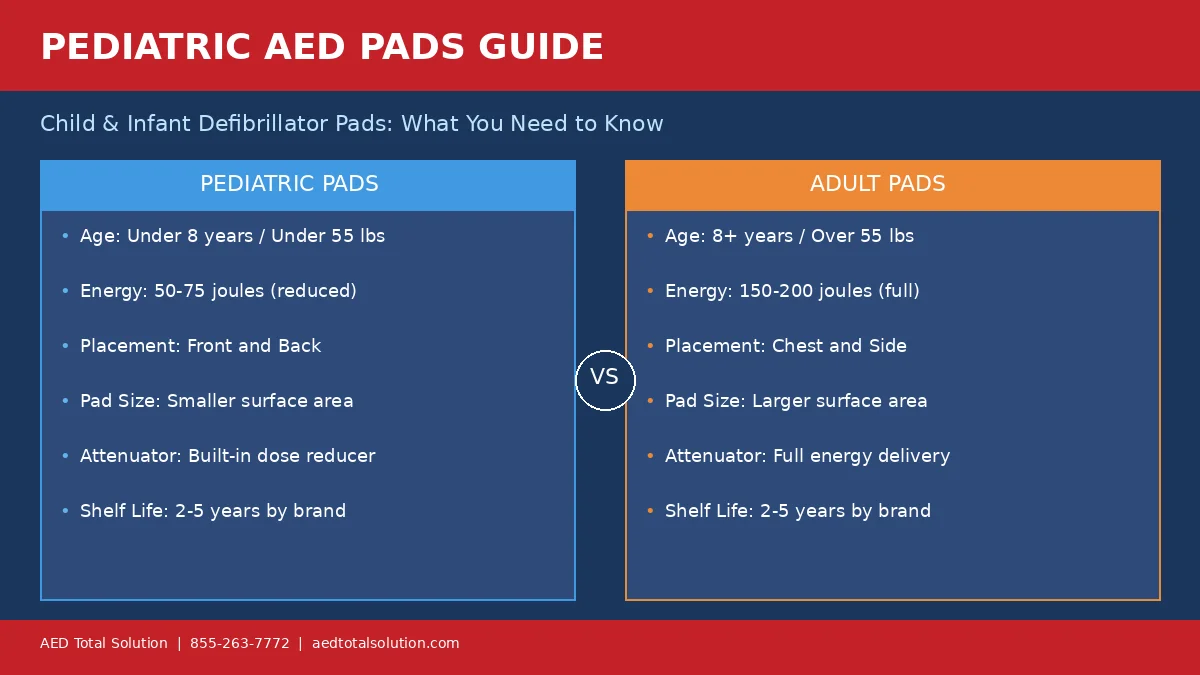
Understanding the differences between pediatric and adult pads is critical for proper emergency response. Here are the main distinctions:
| Feature | Pediatric AED Pads | Adult AED Pads |
|---|---|---|
| Age Range | Under 8 years / under 55 lbs | 8 years and older / over 55 lbs |
| Energy Level | 50-75 joules (reduced dose) | 150-200 joules (full dose) |
| Pad Size | Smaller surface area | Larger surface area |
| Placement | Anterior-posterior (front and back) | Anterior-lateral (chest and side) |
| Energy Attenuator | Built-in dose reducer | Full energy delivery |
Important: If pediatric pads are not available during an emergency, use adult pads on a child. An AED shock with adult pads is always better than no shock at all. The American Heart Association confirms that using an AED with adult pads on a child is preferable to not using an AED.
How to Place Pediatric AED Pads
Proper pad placement is essential for effective defibrillation. For children, the recommended placement differs from adults:
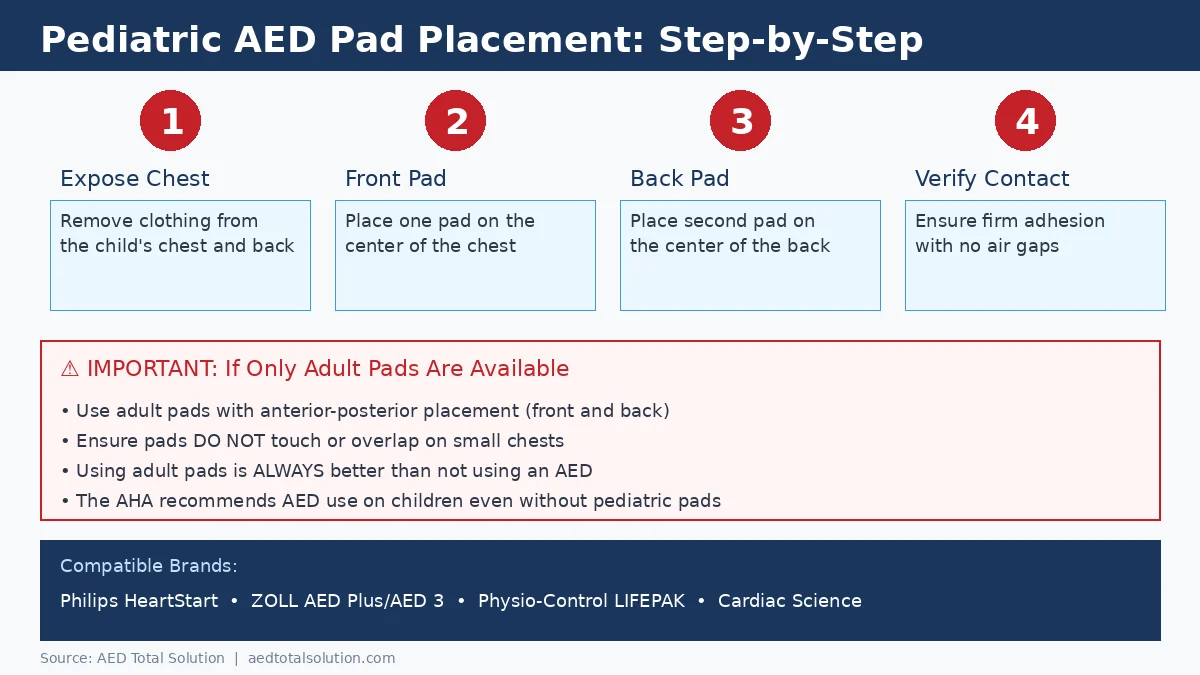
Anterior-Posterior Placement (Recommended for Children)
- Front pad: Place one pad on the center of the child’s chest, between the nipples
- Back pad: Place the second pad on the center of the child’s back, between the shoulder blades
- Ensure contact: Make sure both pads are firmly adhered to the skin with no air gaps
- Check spacing: Pads must not touch or overlap each other
This anterior-posterior placement is preferred for smaller children because it ensures the electrical current passes directly through the heart, which is particularly effective given a child’s smaller chest cavity.
When Using Adult Pads on a Child
If only adult pads are available, use the anterior-posterior method. Place one pad on the chest and one on the back. Make certain the pads do not touch or overlap. If the child’s chest is too small for both pads to fit on the front without overlapping, anterior-posterior placement is mandatory.
Top Pediatric AED Pads by Brand
Different AED manufacturers offer brand-specific pediatric pads. Here are the most common options available through AED Total Solution:
Philips HeartStart Pediatric Pads
- Philips HeartStart Pediatric Pads (M5072A) — Compatible with the Philips HeartStart OnSite and HeartStart Home AEDs. These pads include a built-in energy attenuator that reduces the shock energy to an appropriate pediatric dose.
- Philips HeartStart FRx Infant/Child Key — Rather than separate pads, the FRx uses a special key that reduces the energy output when inserted into the AED. You use the same adult pads but with the child key activated.
- Philips HeartStart FR3 Infant/Child Key — Similar concept to the FRx key, designed specifically for the professional-grade FR3 model.
ZOLL Pediatric Pads
- ZOLL Pedi-Padz II — Designed for the ZOLL AED Plus. These pads feature child-friendly graphics and reduce energy delivery to pediatric levels. They include clear placement diagrams printed directly on the pads.
- ZOLL AED 3 CPR Uni-padz — Universal pads that work for both adults and children. A simple switch on the AED toggles between adult and pediatric energy levels, eliminating the need to carry separate pad sets.
Physio-Control LIFEPAK Pediatric Pads
- Physio-Control LIFEPAK Infant/Child Pad Starter Kit — Compatible with LIFEPAK CR2 and other Physio-Control AEDs. Includes reduced-energy electrode pads with pediatric-specific placement instructions.
Pediatric AED Pad Expiration and Replacement
Like all AED pads, pediatric pads have a limited shelf life and must be replaced before they expire. Expired pads may not adhere properly to the skin or conduct the electrical signal effectively, potentially compromising a rescue attempt.
Typical Shelf Life by Brand
- Philips pediatric pads: Approximately 2 years from manufacture date
- ZOLL Pedi-Padz II: Approximately 2 years from manufacture date
- ZOLL CPR Uni-padz: Up to 5 years (universal pads)
- Physio-Control LIFEPAK: Approximately 2 years from manufacture date
Regular AED maintenance checks should include verifying pad expiration dates. Many organizations include pediatric pad expiration tracking as part of their compliance management software, which sends automated alerts before pads expire.
When Are Pediatric AED Pads Required?
Any facility where children are present should have pediatric AED pads available. This includes:
- Schools and universities — Many states require AEDs in schools, and pediatric pads should be part of every school AED program
- Childcare centers and daycares — Children under 8 are the primary demographic requiring pediatric pads
- Youth sports facilities — Youth sports programs should carry pediatric pads for younger participants
- Community recreation centers — Pools, gyms, and recreation facilities that serve families
- Churches and houses of worship — Congregations with children’s programs
- Pediatric medical offices — Even with full medical equipment, an AED with pediatric pads is essential
- Theme parks and entertainment venues — High foot traffic with families
AED Models with Universal Pad Systems
Some newer AED models have simplified pediatric use by eliminating the need for separate pad sets entirely:
- ZOLL AED 3 with CPR Uni-padz: One set of pads for all ages. A simple switch toggles between adult and pediatric energy delivery. This is the most convenient option for facilities that serve both adults and children.
- Philips HeartStart FRx with Infant/Child Key: Uses the same adult pads but reduces energy output when the child key is inserted. Eliminates expired pediatric pad concerns.
- Physio-Control LIFEPAK CR2: Features a child mode button that adjusts energy delivery without changing pads.
These universal systems reduce maintenance complexity and ensure your AED is always ready for any patient, regardless of age. Learn more about choosing the right device in our best portable AED guide.
How to Store Pediatric AED Pads
Proper storage extends the life of your pediatric pads and ensures they perform when needed:
- Keep sealed: Never open the foil packaging until the pads are needed for use
- Store with the AED: Pediatric pads should be stored alongside the AED unit, clearly labeled and easily accessible
- Temperature control: Store between 32°F and 122°F (0°C to 50°C). Avoid extreme heat or cold
- Humidity: Keep in a dry environment. Moisture can degrade the adhesive gel
- Label clearly: Use visible labels to distinguish pediatric pads from adult pads. Color coding (often pink or blue) helps responders quickly identify the correct pads during an emergency
Common Questions About Pediatric AED Pads
Can you use adult AED pads on a child?
Yes. If pediatric pads are not available, adult pads should be used. The American Heart Association states that using an AED with adult pads on a child is always better than not using an AED at all. Use anterior-posterior placement (front and back) to prevent the pads from overlapping.
Can you use pediatric AED pads on an adult?
No. Pediatric pads deliver a reduced energy dose that is insufficient for an adult patient. The lower energy level may fail to convert a life-threatening heart rhythm in an adult. Always use adult pads on patients 8 years and older or weighing more than 55 pounds.
What age defines “pediatric” for AED use?
The American Heart Association defines pediatric as children aged 1 to 8 years or weighing less than 55 pounds (25 kg). For infants under 1 year, a manual defibrillator is preferred, but an AED with pediatric pads should be used if no manual defibrillator is available.
How much do pediatric AED pads cost?
Pediatric AED pad pricing varies by brand and model. Dedicated pediatric pads typically range from $100 to $275 per set. Universal systems like the ZOLL CPR Uni-padz (which serve both adults and children) can reduce long-term costs by eliminating the need for separate pad inventories. Contact AED Total Solution for current pricing and bulk options. For organizations looking for a cost-effective option, our AED rental program includes pediatric-ready devices with full compliance management.
How often should pediatric AED pads be replaced?
Pediatric pads should be replaced before their expiration date, typically every 2 years. Additionally, pads must be replaced immediately after any use (successful or not) and if the sealed packaging has been opened or damaged. Regular AED inspections should include checking pediatric pad expiration dates.
Pediatric AED Compliance and Your Organization
Maintaining pediatric AED readiness is part of a comprehensive AED compliance program. Organizations serving children should:
- Assess your needs: Determine how many AED locations serve areas where children are present
- Equip appropriately: Ensure each relevant AED has pediatric pads or a universal pad system
- Train your staff: AED training should cover pediatric-specific protocols, including pad placement and age/weight assessment
- Track expiration dates: Use compliance management software to automate expiration tracking
- Document everything: Maintain records of pad purchases, installations, inspections, and replacements for audit readiness
- Know your state laws: AED requirements vary by state, and some jurisdictions have specific mandates for pediatric readiness in schools and youth facilities
Get Pediatric AED Pads for Your Facility
AED Total Solution carries pediatric pads from all major manufacturers, including Philips, ZOLL, and Physio-Control. Whether you need replacement pads for your current AED or want to upgrade to a universal pad system, our team can help you find the right solution.
Need help choosing the right pediatric pads? Call us at 855-263-7772 or visit our online store to browse available options. For organizations managing multiple AED locations, ask about our multi-location compliance programs that include automated pad replacement tracking.
Written by Prabakar Mahalingam, Managing Partner at AED Total Solution and nationally recognized provider of safety training, products, and proprietary compliance software dedicated to addressing Sudden Cardiac Arrest (SCA).