Every year, more than 350,000 people in the United States experience sudden cardiac arrest outside of a hospital. An automated external defibrillator that is properly maintained can increase survival rates by up to 70% when used within the first few minutes. But here is the reality that many organizations overlook: an AED that is not maintained is an AED that may not work when someone’s life depends on it.
AED maintenance is not optional. It is a critical responsibility that involves regular inspections, timely component replacements, and thorough documentation. Whether you manage one device or a fleet across multiple locations, following a structured AED maintenance checklist ensures your equipment stays compliant, functional, and truly response-ready.
This guide walks you through everything you need to know about AED maintenance, from FDA and OSHA requirements to manufacturer-specific schedules, monthly inspections, and the advantages of automated monitoring over manual checks. For a broader overview of how maintenance connects to your overall compliance strategy, see our complete guide to AED maintenance and compliance.
Why AED Maintenance Matters
AED maintenance is the ongoing process of inspecting, testing, and servicing your automated external defibrillator to ensure it will function properly during a cardiac emergency. Without consistent maintenance, even the most advanced AED can fail when it is needed most.
Device Failure Statistics
Research published by the FDA and reported in emergency medicine journals indicates that a significant percentage of AED failures during actual cardiac emergencies are caused by preventable issues. The most common causes include expired electrode pads, depleted batteries, and devices that were never set up or tested after initial purchase. According to the American Heart Association, every minute without defibrillation reduces a victim’s chance of survival by approximately 7 to 10 percent.
Liability and Legal Exposure
Organizations that deploy AEDs take on a responsibility to maintain them. If an AED fails during an emergency due to neglected maintenance, the organization may face serious legal consequences. Good Samaritan laws, which exist in all 50 states, generally protect AED users and owners, but this protection is often contingent on the device being properly maintained and documented. A poorly maintained AED can void those legal protections and expose your organization to negligence claims.
Compliance Requirements
Multiple regulatory frameworks require or strongly encourage AED maintenance. Federal guidelines from the FDA and OSHA, state-specific AED laws, and industry best practices from the American Heart Association all point to the same conclusion: maintaining your AED is not just good practice, it is a compliance obligation. For details, see our guide on AED compliance laws by state. Organizations that fail to document their maintenance activities risk non-compliance penalties and increased liability.
FDA AED Maintenance Requirements
The FDA classifies AEDs as Class III medical devices, which means they are subject to strict regulatory oversight. While the FDA does not prescribe a specific maintenance schedule for end users, it does require that AED manufacturers provide clear maintenance guidelines with every device.
What the FDA Requires
- Manufacturer maintenance instructions must be included with every AED sold in the United States
- Recall and safety alert compliance: Organizations must register their AEDs with the manufacturer to receive recall notifications and firmware updates
- Adverse event reporting: Any AED malfunction during a rescue attempt must be reported to the FDA through the MedWatch system
- Device tracking: The FDA requires manufacturers to track the distribution of AEDs, and organizations should maintain records of device location and condition
How This Affects Your Maintenance Program
Following the manufacturer’s maintenance instructions is not just a recommendation; it is a regulatory expectation. The FDA expects that AED owners will perform the inspections and replacements outlined in the device’s user manual. Failure to do so can be cited in litigation and regulatory proceedings.
OSHA Guidelines for AED Maintenance
While OSHA does not have a specific standard mandating AEDs in every workplace, the agency strongly recommends them as part of a comprehensive emergency action plan. OSHA’s Medical Services and First Aid Standard (29 CFR 1910.151) establishes the framework for workplace emergency preparedness.
Key OSHA Recommendations
- Include AEDs in your written emergency action plan
- Designate a qualified individual to oversee the AED program
- Establish a system for regular device checks and maintenance documentation
- Train employees in AED use and CPR
- Register AEDs with the manufacturer to receive updates and recalls
- Ensure AEDs are accessible within a three-minute walk from any point in the facility
OSHA’s guidance makes it clear that simply purchasing an AED is not enough. A properly maintained and documented AED program is essential for meeting workplace safety obligations.
Manufacturer-Specific AED Maintenance Schedules
Each AED manufacturer has its own maintenance requirements. Understanding the specific schedule for your device model is essential for keeping it compliant and operational. Below are the maintenance guidelines for the five most widely used AED brands.
Philips HeartStart AEDs
Philips HeartStart devices, including the OnSite (HS1) and FRx models, are among the most popular AEDs in commercial and public settings.
- Daily self-test: Automatic; the device runs a self-diagnostic check every day
- Battery life: Approximately 4 years in standby mode (200 shocks capacity)
- Electrode pad expiration: Typically 2 years from the date of manufacture
- Monthly visual inspection: Check the green ready light on the handle, verify pad connection, inspect for physical damage
- Software updates: Register with Philips to receive firmware update notifications
ZOLL AED 3
The ZOLL AED 3 features real-time CPR feedback and Wi-Fi connectivity for program management.
- Daily self-test: Automatic; includes full energy discharge test weekly
- Battery life: Approximately 5 years in standby mode
- Electrode pad expiration: CPR Uni-padz have a 5-year shelf life
- Monthly visual inspection: Confirm the green checkmark on the status display, verify pad connection, check for damage
- Wi-Fi monitoring: The ZOLL AED 3 can connect to Wi-Fi and report its status to program managers automatically
- Software updates: Delivered over Wi-Fi when connected
Cardiac Science Powerheart G5
The Powerheart G5 from Cardiac Science features Rescue Ready technology with daily self-testing.
- Daily self-test: Automatic; tests battery, hardware, software, and electrode pads
- Battery life: 4-year standby life with Intellisense battery
- Electrode pad expiration: Approximately 2 years
- Monthly visual inspection: Check the green Rescue Ready indicator, inspect pads and device housing
- ICPR technology: Provides real-time CPR feedback to rescuers
Defibtech Lifeline AEDs
Defibtech offers the Lifeline, Lifeline AUTO, and Lifeline VIEW models, known for their durability and simplicity.
- Daily self-test: Automatic; comprehensive self-test including hardware, software, battery, and pad connectivity
- Battery life: Standard battery lasts approximately 4 years; high-capacity battery lasts up to 7 years
- Electrode pad expiration: Approximately 2 years
- Monthly visual inspection: Verify the active status indicator (blinking green light), check pad expiration, inspect device exterior
- Software updates: Available through Defibtech’s service network
HeartSine Samaritan PAD
HeartSine (now part of Stryker) produces the Samaritan PAD series, including the 350P, 360P, and 450P models.
- Daily self-test: Automatic weekly and monthly self-tests
- Battery and pad replacement: The Pad-Pak cartridge combines the battery and pads into a single unit with a 4-year shelf life
- Monthly visual inspection: Check the status indicator light (flashing green), inspect the device for damage, verify Pad-Pak is connected
- Unique advantage: The combined Pad-Pak simplifies replacement tracking since the battery and pads are one unit
Monthly AED Visual Inspection Checklist
Monthly inspections are the foundation of any AED maintenance program. For details, see our guide on how often an AED should be inspected. These checks take only a few minutes per device but provide essential assurance that your AED is ready for an emergency.
What to Inspect Every Month
- Status indicator light: Verify the device shows a green ready light, checkmark, or other manufacturer-designated “ready” indicator
- Electrode pad connection: Confirm pads are properly connected to the device and the sealed package is intact
- Electrode pad expiration date: Check that pads have not expired or are not approaching expiration within the next 30 days
- Battery status: Verify the battery indicator shows adequate charge and has not passed its expiration date
- Device exterior: Inspect the AED case for cracks, dents, moisture, or other physical damage
- Accessory kit: Confirm the rescue kit includes scissors, razor, gloves, CPR barrier mask, and towel
- Storage environment: Ensure the AED is stored within the manufacturer’s recommended temperature range (typically 32 to 122 degrees Fahrenheit)
- Signage and accessibility: Verify AED location signage is visible and the device is not blocked or obstructed
- Cabinet alarm: If the AED is in a wall cabinet, test that the alarm activates when the door is opened
- Documentation: Record the inspection date, inspector name, and device status in your maintenance log
Quarterly Functional Checks
Quarterly checks go beyond the monthly visual inspection to verify the AED’s operational capabilities.
Quarterly Checklist
- Power-on test: Turn the device on and confirm it activates properly with voice prompts and visual indicators
- Self-test review: Verify the device has been passing its automated daily and weekly self-tests by reviewing the status log or indicator
- Pad integrity test: If your AED model supports it, run a pad connectivity test to confirm proper electrical contact
- Battery voltage check: For models with accessible battery diagnostics, verify the battery voltage meets minimum requirements
- Software version: Confirm the AED is running the most current firmware version recommended by the manufacturer
- Accessory replenishment: Replace any used or expired items in the rescue kit
- Emergency response review: Confirm that your emergency action plan documents are current and posted near the AED
- Training status: Verify that designated AED responders have current CPR/AED certifications
Annual Comprehensive Review
An annual review provides a thorough assessment of your entire AED program, not just individual devices.
Annual Review Checklist
- Full device diagnostic: Have each AED serviced or inspected by the manufacturer or an authorized service provider
- Battery replacement assessment: Determine if any batteries are within 6 months of expiration and order replacements proactively
- Electrode pad inventory: Order replacement pads for any units with pads expiring in the next 6 months
- Compliance documentation audit: Review all maintenance logs, inspection records, and compliance documentation for completeness
- Medical direction review: Confirm your AED program’s medical oversight and physician authorization are current
- AED registration verification: Ensure all devices are registered with the manufacturer and local emergency services
- Policy and procedure update: Review and update your AED inspection policy and emergency action plan
- Training renewal: Schedule CPR/AED recertification for all designated responders
- Risk assessment: Evaluate whether AED placement, quantity, and coverage are adequate based on any changes to your facility or workforce
- Program performance review: Analyze any AED deployments or near-miss events from the past year
AED Battery Replacement Schedule by Brand
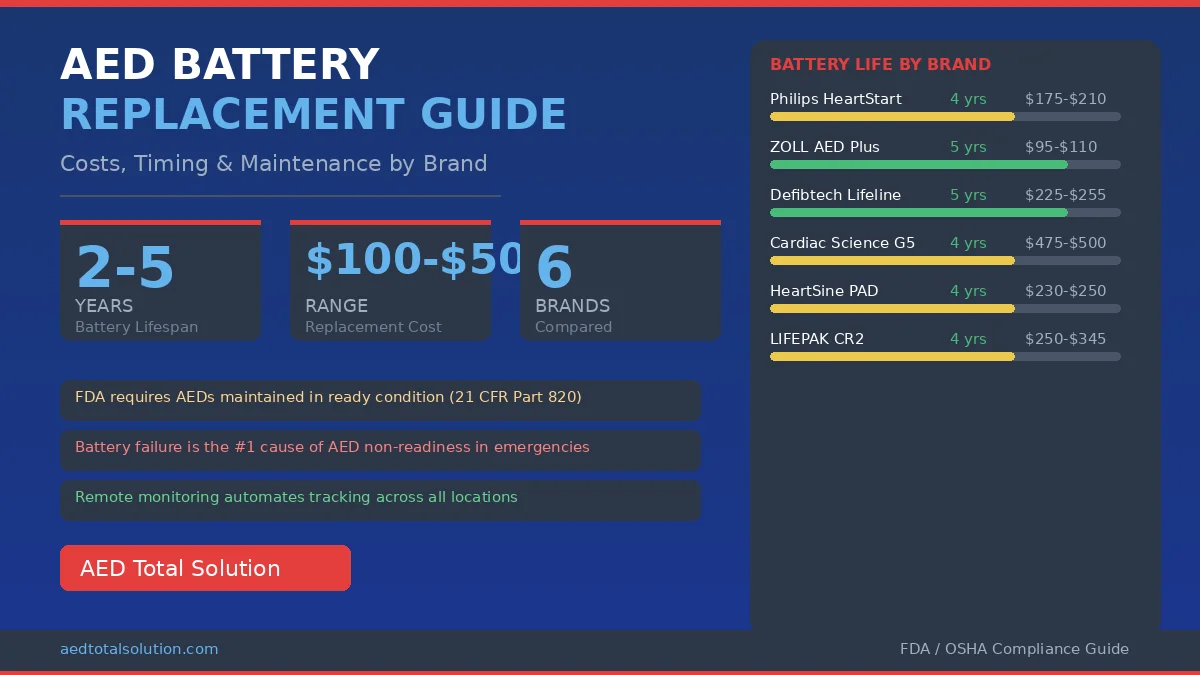
Battery replacement is one of the most critical maintenance tasks. A dead battery renders an AED completely useless. Here is a quick reference for battery replacement timelines by major manufacturer.
| Brand | Model | Standby Battery Life | Replacement Cost Range |
|---|---|---|---|
| Philips | HeartStart OnSite/FRx | 4 years | $100 – $200 |
| ZOLL | AED 3 | 5 years | $150 – $275 |
| Cardiac Science | Powerheart G5 | 4 years | $150 – $250 |
| Defibtech | Lifeline (standard) | 4 years | $100 – $175 |
| Defibtech | Lifeline (high-capacity) | 7 years | $175 – $275 |
| HeartSine | Samaritan PAD (Pad-Pak) | 4 years | $150 – $225 |
Important: These are standby life estimates. Actual battery life depends on the number of self-tests performed, environmental conditions, and any device activations. Always track the installation date and manufacturer’s recommended replacement timeline for each battery.
Electrode Pad Expiration Tracking
Electrode pads are the direct interface between the AED and the patient. For details, see our guide on AED pad placement. Expired pads may not adhere properly, conduct electrical signals reliably, or deliver an effective shock.
Best Practices for Pad Management
- Record the expiration date for every set of pads at the time of installation
- Set reminders at 90 days, 60 days, and 30 days before expiration
- Keep backup pads on hand so replacements are immediately available
- Replace pads after every use, even if the expiration date has not been reached
- Store pads within the manufacturer’s recommended temperature range to prevent gel degradation
- Inspect pad packaging monthly for tears, punctures, or signs that the sealed pouch has been compromised
Most electrode pads have a shelf life of 2 to 4 years depending on the manufacturer. HeartSine’s Pad-Pak is unique in that it combines the battery and pads into a single replaceable unit, simplifying the tracking process.
Software Updates and Firmware Management
Modern AEDs are computerized medical devices that rely on software to analyze heart rhythms, guide rescuers, and manage self-tests. Keeping the firmware up to date is an often-overlooked aspect of AED maintenance.
Why Software Updates Matter
- Algorithm improvements: Manufacturers periodically update the heart rhythm analysis algorithms to improve accuracy
- Bug fixes: Software updates may resolve known issues with device operation
- Regulatory compliance: The FDA may require manufacturers to push updates in response to safety findings
- New features: Some updates add capabilities such as improved CPR coaching or connectivity options
How to Stay Current
- Register your AED with the manufacturer immediately after purchase
- Enable Wi-Fi connectivity on models that support it (such as the ZOLL AED 3) for automatic updates
- Check for updates quarterly on the manufacturer’s website or through their customer portal
- Document all updates in your maintenance log, including the date and version number
Common AED Maintenance Failures and How to Avoid Them
Even well-intentioned AED programs can fall short when common maintenance pitfalls are not addressed.
1. Expired Electrode Pads
The problem: Pads expire silently. If no one is checking, an AED can sit with expired pads for months or years.
The fix: Implement a tracking system with automated expiration alerts. Record pad expiration dates during monthly inspections.
2. Depleted Batteries
The problem: Batteries drain over time, especially in extreme temperatures. Self-tests also consume battery power.
The fix: Track battery installation dates and follow manufacturer replacement schedules. Do not wait for the low-battery indicator to appear.
3. Missed Inspections
The problem: Without a designated responsible person and a structured schedule, inspections get skipped.
The fix: Assign a primary and backup AED coordinator. Use calendar reminders or automated inspection tracking software.
4. Unregistered Devices
The problem: If your AED is not registered with the manufacturer, you will not receive recall notices, safety alerts, or firmware updates.
The fix: Register every device immediately after purchase and verify registration status during your annual review.
5. Poor Storage Conditions
The problem: AEDs stored in environments outside the recommended temperature range (extreme heat, cold, or humidity) may suffer accelerated component degradation.
The fix: Store AEDs in temperature-controlled, accessible locations. Use indoor wall cabinets with environmental monitoring where possible.
6. No Documentation
The problem: Without maintenance records, you cannot prove compliance. This matters in litigation and regulatory audits.
The fix: Maintain a written or digital maintenance log for every AED. Record every inspection, replacement, and service event.
Automated Remote Monitoring vs. Manual Checks
Organizations managing AED programs face a choice between relying on manual inspection processes and leveraging automated remote monitoring technology.
Manual Checks
Manual AED inspections require a designated person to physically visit each device on a regular schedule. This approach works for organizations with one or two AEDs in a single location, but it has significant limitations:
- Human error: Inspections get forgotten, skipped, or performed inconsistently
- Scalability issues: Organizations with multiple locations and dozens of devices struggle to maintain inspection schedules
- Delayed issue detection: Problems discovered only during scheduled checks may go unresolved for weeks
- Documentation burden: Paper-based logs are prone to errors and difficult to audit
Automated Remote Monitoring
Remote monitoring systems use cellular or Wi-Fi connectivity to continuously track AED status and send real-time alerts when issues arise. AED Total Solution’s remote readiness monitoring provides this capability as part of its full-service AED program management.
Benefits of automated monitoring include:
- 24/7 device status tracking: Know the status of every AED in your program at all times
- Automated alerts: Receive immediate notifications for battery depletion, pad expiration, device errors, or missed self-tests
- Centralized dashboard: View all devices across all locations from a single platform
- Compliance documentation: Inspection records and device status reports are generated automatically
- Proactive replacements: Batteries and pads are tracked and replaced before they expire, not after
- Audit-ready reporting: Comprehensive records are always available for regulatory review
Why Remote Monitoring Is the Future of AED Maintenance
For organizations managing AEDs across multiple sites, manual processes simply cannot match the reliability and consistency of automated monitoring. The cost of a missed inspection, an expired battery, or an undocumented maintenance event can be measured in lives and legal exposure. Remote monitoring eliminates these risks by removing the human error factor from the maintenance equation.
Compliance Documentation and Record-Keeping
Proper documentation is not just a best practice; it is a regulatory expectation and a legal safeguard.
What to Document
- Monthly inspection results: Date, inspector, device status, any issues found
- Component replacements: Battery and pad replacement dates, expiration dates of new components, part numbers
- Firmware updates: Date, version number, method of update
- Training records: Employee names, certification dates, training provider, recertification schedule
- Incident reports: Any AED deployment, including date, outcome, and device performance
- Maintenance schedule: Planned inspection and replacement dates for the coming year
- Compliance audits: Results of annual compliance reviews
Record Retention
Industry best practices recommend retaining AED maintenance records for a minimum of 7 years. Some states may require longer retention periods. Digital record-keeping systems are strongly preferred over paper logs because they are easier to search, back up, and produce during audits.
How AED Total Solution Simplifies Your Entire Maintenance Program
Managing AED maintenance in-house can be complex, time-consuming, and risky, especially for organizations with devices spread across multiple locations. AED Total Solution’s full-service AED program management removes this burden entirely.
Our white-glove approach includes:
- Remote readiness monitoring that tracks every device, every day, across all locations
- Automated alerts for battery depletion, pad expiration, device errors, and missed inspections
- Proactive component replacements managed on your behalf
- Centralized dashboard with real-time visibility into your entire AED fleet
- Audit-ready documentation generated automatically, always available for compliance reviews
- Expert program management with dedicated oversight from experienced AED compliance specialists
- Medical direction and physician oversight support
- Multi-location scalability designed for organizations managing AEDs across dozens or hundreds of sites
Instead of relying on internal staff to remember inspection dates, track expiration schedules, and maintain paper logs, AED Total Solution handles every aspect of AED maintenance so you can focus on running your organization. Organizations that do not yet have defibrillators can get started with our AED rental program, which includes full maintenance coverage and compliance management starting at $45 per month.
Frequently Asked Questions About AED Maintenance
How often should an AED be inspected?
At minimum, AEDs should receive a visual inspection every month. Most manufacturers also recommend checking the device’s status indicator daily. Quarterly functional checks and an annual comprehensive review round out a thorough maintenance program.
What happens if AED maintenance is neglected?
An unmaintained AED may fail during an emergency due to expired pads, a depleted battery, or a software error. Beyond the immediate safety risk, neglecting maintenance can void Good Samaritan protections, expose your organization to liability, and result in non-compliance with state AED laws and OSHA recommendations.
Who is responsible for AED maintenance?
The organization that owns or manages the AED is responsible for its maintenance. Most programs designate a specific AED coordinator, along with a backup coordinator, to manage inspections and documentation. Alternatively, organizations can outsource this responsibility to a professional AED program management service.
Can AED maintenance be automated?
Yes. Modern AED program management platforms, including AED Total Solution’s remote readiness monitoring, can automate much of the maintenance process. Automated systems track device status, send expiration and inspection alerts, generate compliance reports, and manage component replacement schedules without manual intervention.
How long do AED batteries last?
AED battery life varies by manufacturer, typically ranging from 4 to 7 years in standby mode. Factors that affect battery life include the frequency of self-tests, environmental conditions, and whether the device has been activated. Always follow the manufacturer’s specific replacement schedule for your AED model.
Do AED electrode pads expire?
Yes. Electrode pads have a shelf life of approximately 2 to 5 years depending on the manufacturer. The conductive gel on the pads degrades over time, which can prevent proper adhesion and electrical conductivity. Always replace pads before their expiration date.
Written by Prabakar Mahalingam, Managing Partner at AED Total Solution. With extensive experience in safety training, AED program management, and compliance software, Prabakar leads AED Total Solution’s mission to address sudden cardiac arrest through comprehensive AED programs across North America.
Disclaimer for information purposes only:
The information provided on this website is intended for general educational and informational purposes only. It is not medical advice and should not be used as a substitute for professional diagnosis, treatment, or care. Always consult a qualified healthcare or medical professional regarding any health-related questions or concerns.
While we strive to ensure the information shared is accurate and up to date, no guarantees are made regarding completeness, accuracy, or applicability to any individual situation. Use of this content is at the reader’s sole discretion and risk.
This website is part of the Response Ready family of emergency preparedness and training resources, including CPR & first aid training and compliance services, AED sales and program support, AED program management software, and medical oversight solutions provided through our affiliated platforms:
• CPR1.com
• AEDLeader.com
• ResponseReady.com
• MDSIMedical.com
By accessing or using this website, you agree to release, indemnify, and hold harmless the website owners, authors, contributors, and affiliated entities from any claims, losses, damages, or liabilities arising from the use or reliance on the information presented.