AED for Schools: Requirements, Laws & Implementation Guide
AED for Schools: Requirements, Laws, and How to Build a Compliant Program
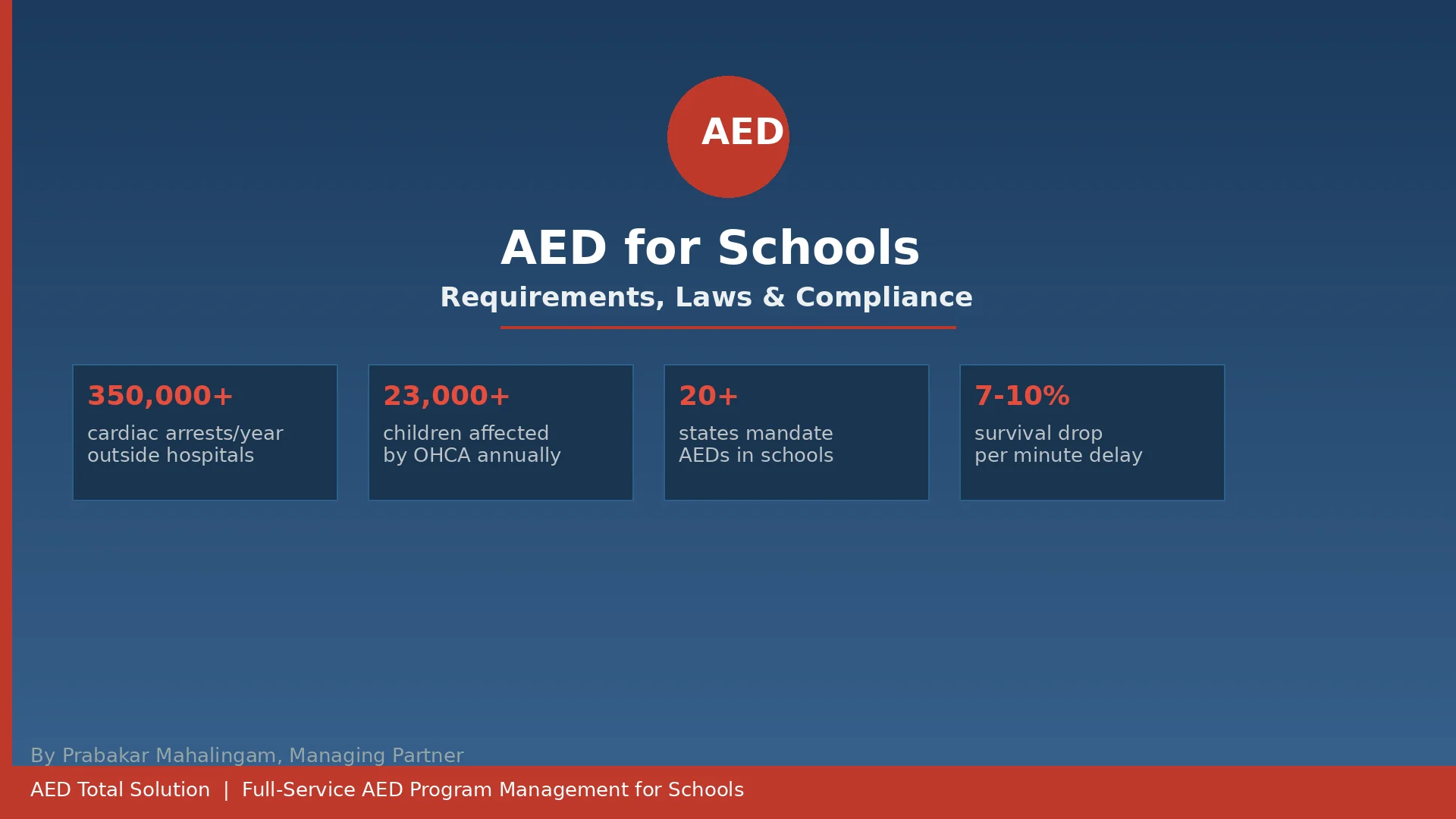
Every year, more than 23,000 children in the United States experience out-of-hospital cardiac arrest (OHCA), with 40% of those cases linked to sports and physical activity. When sudden cardiac arrest (SCA) strikes a student on a playground, a teacher in a hallway, or an athlete on the field, the availability of an automated external defibrillator (AED) can mean the difference between life and death.
Schools are uniquely high-stakes environments. On any given day, roughly 25% of the U.S. population can be found in a school building. Yet many schools still lack the AEDs, training, and emergency plans required to respond effectively when seconds count. This guide covers the current landscape of AED requirements for schools, state-by-state laws, federal initiatives, and a step-by-step framework for building a compliant, life-saving school AED program.
Why Schools Need AEDs: The Cardiac Emergency Reality
Sudden cardiac arrest is the leading medical cause of death among young competitive athletes. According to the American Heart Association’s 2025 Heart Disease and Stroke Statistics Update, sports-related SCA accounts for 39% of all sudden cardiac arrests among individuals 18 years of age and younger. In 2023, only 15.9% of children ages 1 to 18 who experienced OHCA and were treated by emergency medical services survived to hospital discharge.
These statistics reveal a critical gap. Survival rates from SCA drop 7% to 10% for every minute that passes without defibrillation. Most EMS systems cannot reach a victim within the critical 3-to-5-minute window. This is why on-site AED access, combined with trained responders, is not optional for schools. It is essential.
Who Is at Risk?
SCA in schools does not only affect student athletes. It can occur in:
Students with undiagnosed congenital heart conditions such as hypertrophic cardiomyopathy or myocarditis
Teachers and staff, who represent the largest adult population on school campuses
Visitors and parents attending school events, games, and performances
Student athletes during practices, games, and conditioning activities
A 2024 study published in Circulation found that 88% of sports-related SCA cases in children and adolescents occurred in male individuals, with a median age of 15 years. Critically, 58% of cases had no AED available at the scene. Among those who received both immediate CPR and early AED use, survival rates reached 60%, compared to far lower rates without intervention.
Are AEDs Required in Schools? Understanding the Legal Landscape
There is currently no federal law mandating AEDs in all U.S. schools. However, more than 20 states have enacted legislation requiring AEDs in public schools or at school-sponsored athletic events. For details, see our guide on AED laws by state. The legislative trend is accelerating, with multiple states introducing new requirements each year. For a broader overview, see our AED state law compliance guide.
State-by-State AED Requirements for Schools
Below is a summary of AED requirements in states where AED Total Solution operates and key states with notable legislation:
California
California Education Code requires at least one AED in all public and charter schools that participate in interscholastic athletic programs. Schools must also develop a cardiac emergency response plan and ensure trained personnel are available during athletic events. For details, see our guide on AED training programs. Athletic coaches are required to maintain current CPR/AED certification.
New York
New York Education Law requires every public school that participates in interscholastic sports to have an AED on school premises and at athletic events. The law also mandates that school staff members be trained in AED use and that the AED is accessible during school hours and at all school-sponsored events. For more detail, read our guide on NYS AED requirements for youth sports.
New Jersey
New Jersey law requires AEDs in all public and private schools. The state mandates that schools with an AED also develop a written emergency action plan and that designated responders receive AED and CPR training. New Jersey is among the most comprehensive states for school AED legislation.
Florida
Florida was one of the first states to enact AED laws for schools. Current law requires an operational AED on school grounds at all times. Members of the Florida High School Athletic Association (FHSAA) must have an AED available at all athletic events.
Pennsylvania
Pennsylvania requires all school entities to develop emergency action plans for athletic events. The law mandates AED availability at athletic venues and requires athletic coaches to complete CPR/AED training. Schools are encouraged to place AEDs in high-traffic areas beyond athletics.
Massachusetts
Massachusetts requires all schools to have AEDs available in school buildings and at school-sponsored athletic events. The state also requires CPR training as a high school graduation requirement, building a culture of preparedness from an early age.
Georgia
Effective July 1, 2025, Georgia House Bill 874 requires all public K-12 schools to have at least one AED. Previously, the mandate applied only to public high schools with interscholastic athletics programs. Schools must also develop written emergency action plans and designate internal response teams.
Alabama
Alabama HB 45 requires all K-12 public and private schools to have AEDs that are regularly inspected and maintained. The state also mandates CPR/AED education for students in grades 9-12, effective October 2024.
District of Columbia
D.C. requires AEDs in all schools and mandates CPR/AED training as a high school graduation requirement. The D.C. Fire and Emergency Medical Services Department has published a comprehensive guide for developing school CERPs.
Federal Guidelines and the HEARTS Act
While no federal law mandates AEDs in schools, several federal initiatives and guidelines support school AED programs:
The HEARTS Act (Signed December 2024)
The Cardiomyopathy Health Education, Awareness, Research, and Training in Schools (HEARTS) Act was signed into law by President Biden on December 26, 2024. This bipartisan legislation:
Establishes a federal grant program through the Department of Health and Human Services to provide CPR training and AEDs in public schools
Directs the CDC to develop guidelines for AED placement in schools and childcare centers
Requires HHS to develop risk assessment tools for cardiomyopathy and disseminate information to school professionals and families
Authorizes funding for cardiac emergency response plans in schools
The American Heart Association is advocating for $50 million annually for five years to support HEARTS Act implementation. As of mid-2025, appropriations are still being finalized, but the law represents a major step toward universal AED access in schools.
OSHA Guidance
OSHA does not specifically mandate AEDs in schools but encourages organizations, including educational institutions, to adopt AED programs under first-aid and workplace safety guidelines. For details, see our guide on OSHA requirements for AEDs. OSHA’s guidance recommends that AED programs include: device selection and placement, trained responders, medical oversight, and regular maintenance protocols.
American Heart Association Recommendations
The AHA recommends that every school adopt a Cardiac Emergency Response Plan (CERP) and maintain AEDs accessible within a 3-minute response time from any point on campus. The AHA’s school CERP template, developed in collaboration with 11 national health and safety organizations, is freely available for any school to download and implement.
American Academy of Pediatrics
The AAP supports AED availability in schools and pediatric healthcare settings, emphasizing that AEDs with pediatric settings or pediatric pads should be available in schools serving younger students.
Good Samaritan Protections for School Staff
One of the most common concerns among school administrators is liability: “What happens if a staff member uses an AED and something goes wrong?”
All 50 U.S. states have Good Samaritan laws that provide some level of civil immunity for bystanders who use an AED in good faith during a cardiac emergency. These protections generally cover:
Trained and untrained responders who act in good faith and without willful misconduct
Schools and organizations that maintain AED programs in compliance with state requirements
Training providers who certify responders according to accepted standards
These legal protections are specifically designed to remove the fear of liability and encourage prompt action. Staff members who receive CPR/AED training and respond during an emergency are protected, not exposed. The key requirements for maintaining these protections typically include keeping the AED maintained according to manufacturer guidelines, ensuring trained personnel are designated, and having a written emergency action plan in place.
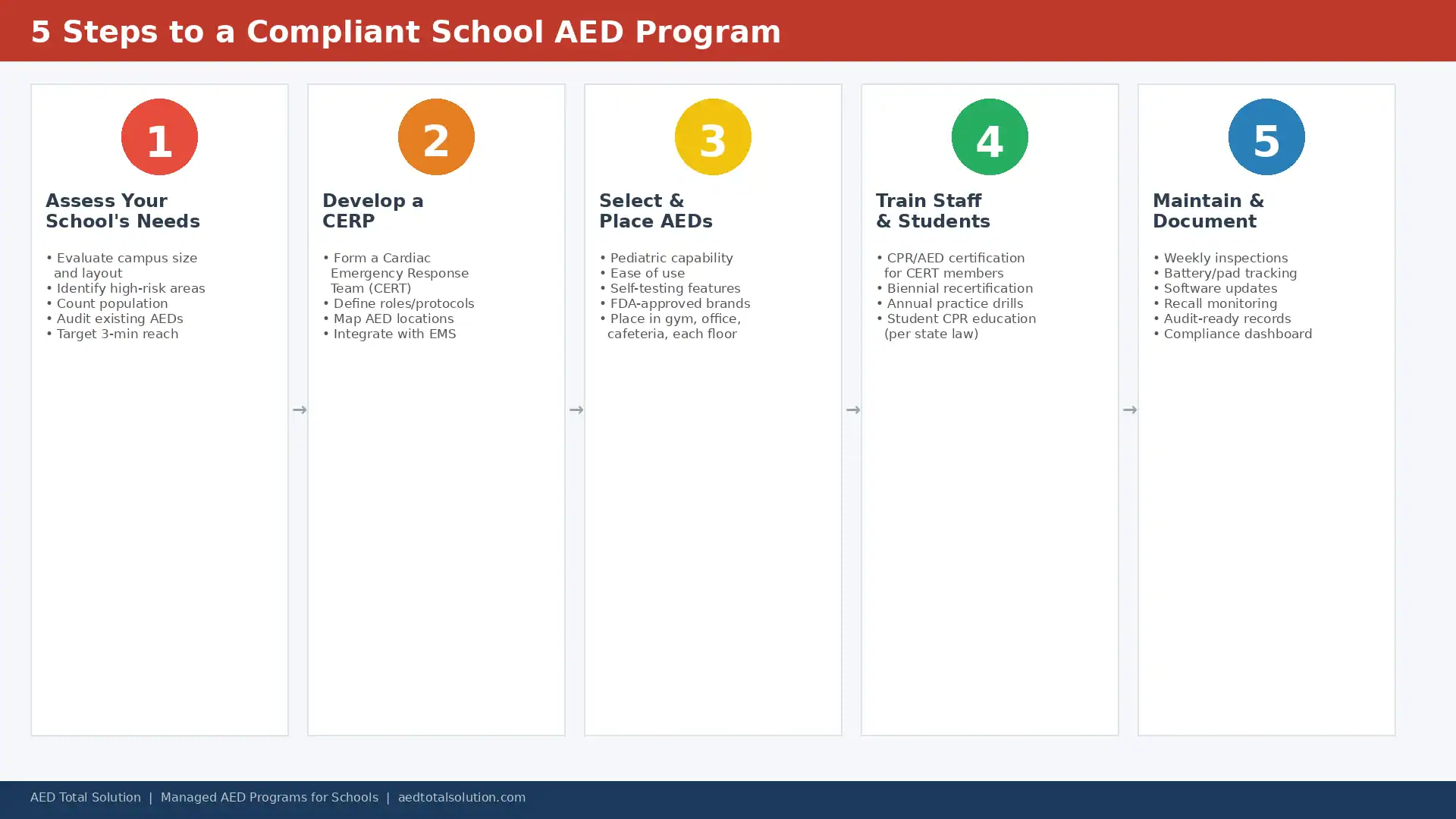
How to Build a School AED Program: A Step-by-Step Guide
Building a compliant school AED program requires more than purchasing a device and mounting it on a wall. It requires planning, training, maintenance, and ongoing oversight. Here is a framework aligned with AHA and state requirements.
Step 1: Assess Your School’s Needs
Begin by evaluating your campus:
Building size and layout: How many buildings, floors, and wings does your campus have?
Student and staff population: How many people are on campus daily?
High-traffic and high-risk areas: Gymnasiums, athletic fields, cafeterias, auditoriums, playgrounds, and main offices
Current AED inventory: Do you already have AEDs? Are they current and maintained?
A general guideline is to place enough AEDs so that any location on campus can be reached within a 3-minute response time. For large campuses, this may require multiple devices. Our AED placement guidelines article covers placement best practices in detail.
Step 2: Develop a Cardiac Emergency Response Plan (CERP)
A CERP is a written document that outlines specific steps your school will take during a cardiac emergency. The AHA’s CERP framework includes:
Establish a Cardiac Emergency Response Team (CERT): Identify 5 or more staff members (roughly 10% of staff) who receive CPR/AED training. Ensure coverage across hallways, wings, and high-traffic areas during all school hours and events.
Define roles and protocols: Create a clear, simple action sequence for responding to a cardiac emergency:
Recognize the emergency (unresponsive, abnormal breathing)
Call 911 immediately
Begin CPR
Retrieve and apply the nearest AED
Direct EMS to the exact location
Map AED locations: Identify placement locations on a campus map. Mark high-risk areas, radio dead zones, and locked-door choke points. AEDs should be in unlocked, visible, and easily accessible locations.
Integrate with local EMS: Coordinate with your local fire department and EMS. Share your CERP, campus map, and AED locations so responders know exactly where to go.
Establish a communication plan: Define how staff will be notified of an emergency (PA system, two-way radios, phone tree).
Step 3: Select and Place AEDs
When choosing AEDs for a school environment, prioritize:
Pediatric capability: Devices with pediatric settings or pediatric pads for younger students
Ease of use: Voice and visual prompts that guide even untrained users. See our guide to the best AEDs for schools for model comparisons.
Dual-language support: Important in schools with diverse populations
Durability and reliability: FDA-approved devices from trusted manufacturers
Self-testing features: Devices that run automatic daily or weekly self-checks and alert you to maintenance needs
Place AEDs in:
– Main office and front entrance areas
– Gymnasiums and athletic facilities
– Cafeterias and auditoriums
– Near outdoor athletic fields (consider climate-controlled cabinets)
– Each floor of multi-story buildings
– Any area more than 3 minutes from another AED
Step 4: Train Staff and Build a Culture of Readiness
Training is not a one-time event. A strong school AED program includes:
Initial CPR/AED certification for all CERT members through AHA or Red Cross courses
Biennial recertification to keep skills current
Annual practice drills that simulate a cardiac emergency response
Student education: Many states now require CPR training as a high school graduation requirement. Some states begin instruction as early as 7th grade.
Step 5: Maintain AEDs and Document Compliance
An AED is only effective if it works when you need it. Maintenance includes:
Regular inspections: Check status indicators weekly or monthly
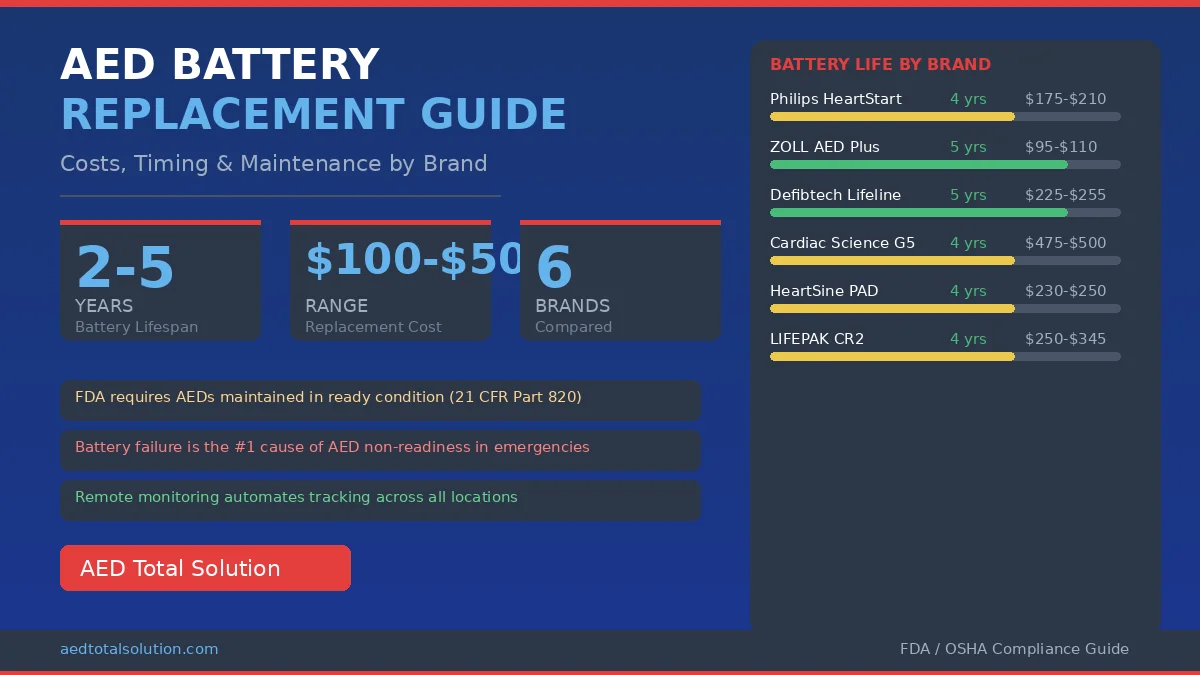
Battery tracking: Most AED batteries last approximately 4 years. Track expiration dates and replace proactively.
Electrode pad replacement: Pads have expiration dates and must be replaced when expired or after each use
Software and firmware updates: Monitor for manufacturer recalls and updates
Documentation: Maintain records of all inspections, battery replacements, pad changes, and training certifications
This is where many school AED programs fail. Without consistent oversight, AEDs can expire, malfunction, or be unprepared when needed most. For a deeper dive, read our AED compliance management guide.
AED Grant Funding for Schools
Cost is one of the most frequently cited barriers to school AED programs. Several funding sources can help:
Federal Funding
HEARTS Act Grants: Once fully appropriated, the HEARTS Act will provide federal grants to local educational agencies for AED purchases, CPR training, and CERP development.
Homeland Security grants: Some schools have accessed FEMA and homeland security preparedness grants for emergency equipment, including AEDs.
State Funding
Several states, including Arkansas, offer grants and fundraising support specifically for school AED programs.
State health departments may provide AEDs or funding assistance as part of public health initiatives.
Private and Community Sources
Parent-teacher organizations (PTOs/PTAs): Fundraising campaigns for AEDs are popular and effective.
Local foundations and nonprofits: Organizations such as the Sudden Cardiac Arrest Foundation and Project ADAM provide resources and support for school AED programs.
Corporate sponsors: Local businesses and healthcare organizations may sponsor AED purchases.
Athletic booster clubs: Often a natural fit for funding AEDs that protect student athletes. Schools with tight budgets can also explore AED rental programs for temporary coverage at events.
AED Maintenance and Compliance for Educational Institutions
Schools face unique compliance challenges. Devices are distributed across multiple buildings, athletic facilities, and event venues. Staff turnover means training must be ongoing. And regulatory requirements vary by state.
A managed AED program addresses these challenges by centralizing oversight:
Automated readiness monitoring: Software-driven alerts notify you when batteries expire, pads need replacement, or inspections are due.
Centralized compliance dashboards: Track every AED across every campus location from a single view.
Inspection scheduling and verification: Ensure inspections happen on schedule and are documented.
Recall management: Receive immediate notification of manufacturer recalls and coordinated replacement.
Audit-ready documentation: Maintain records that satisfy state inspectors, district administrators, and legal requirements.
AED Total Solution provides exactly this kind of full-service AED program management for schools and multi-site educational institutions. Rather than placing the burden of compliance on school nurses, coaches, or administrators, a managed program ensures every device is monitored, maintained, and response-ready at all times.
Real-World Impact: Lives Saved by School AEDs
The evidence for school AED programs is not theoretical. Across the country, school AEDs have saved lives:
At Bixby High School in Oklahoma, staff members Josh Smith and Roland Vernon used their school’s AED to revive student Jonathan Fussell during a cardiac arrest. The school had a cardiac emergency action plan, and that plan saved his life.
In January 2023, NFL player Damar Hamlin was revived on the field during Monday Night Football after SCA, using CPR and an AED. The incident sparked a national movement: since then, 17.7 million more adults in the U.S. report having the confidence to perform CPR, according to the AHA.
A Circulation study found that schools with AED programs and trained responders have demonstrated survival rates from SCA that far exceed the national average for out-of-hospital cardiac arrest.
These outcomes demonstrate that preparedness saves lives. AEDs, combined with trained staff and a solid CERP, transform schools from vulnerable environments into first lines of defense.
Frequently Asked Questions
Are AEDs required in all U.S. schools?
There is no federal law requiring AEDs in all schools. However, more than 20 states mandate AEDs in public schools or at school-sponsored athletic events. Requirements vary by state, so it is important to check your state’s specific legislation.
How many AEDs does a school need?
The number depends on campus size and layout. The AHA recommends placing AEDs so that any location on campus can be reached within 3 minutes. Large campuses with multiple buildings, athletic fields, and event venues may require several devices.
Who should be trained to use an AED in a school?
At a minimum, the school’s Cardiac Emergency Response Team (CERT) members should hold current CPR/AED certification. This typically includes school nurses, coaches, athletic trainers, administrators, and designated staff from each wing or building. Many states also require coaching staff to maintain CPR/AED certification.
Can untrained staff or students use an AED?
Yes. Modern AEDs are designed for use by anyone, including untrained bystanders. The device provides voice and visual prompts that guide the user through each step. All 50 states provide Good Samaritan protections for individuals who use an AED in good faith during an emergency.
How much does a school AED program cost?
AED devices typically range from $1,200 to $2,500 each. Additional costs include cabinets, signage, training, replacement pads, and batteries. The HEARTS Act, once funded, will provide federal grants to help offset these costs for public schools.
How does AED Total Solution support school AED programs?
AED Total Solution provides full-service, white-glove AED program management for schools and educational institutions. This includes AED selection and procurement, compliance monitoring, automated readiness alerts, inspection tracking, battery and pad lifecycle management, and audit-ready documentation. Our managed approach removes the administrative burden from school staff and ensures every device is always response-ready.
Protect Your Students and Staff with a Managed AED Program
Building and maintaining a compliant school AED program does not have to fall entirely on school administrators, nurses, or coaches. AED Total Solution delivers managed AED programs designed specifically for schools and multi-site educational institutions.
Our white-glove approach includes:
AED procurement, placement, and registration
Cardiac Emergency Response Plan development support
Ongoing compliance monitoring and readiness verification
Battery, pad, and accessory lifecycle management
Centralized dashboards for district-wide visibility
Audit-ready documentation for state and regulatory compliance
Whether you manage a single school or an entire district, AED Total Solution ensures your AED program is always compliant, always maintained, and always ready when seconds matter most.
Prabakar Mahalingam is the Managing Partner of AED Total Solution, a national provider of safety training, AED products, and proprietary compliance software dedicated to addressing Sudden Cardiac Arrest (SCA). With a mission to combat the devastating effects of SCA, Prabakar leads in offering comprehensive AED program management, CPR training, and compliance solutions throughout North America.
Disclaimer for information purposes only:
The information provided on this website is intended for general educational and informational purposes only. It is not medical advice and should not be used as a substitute for professional diagnosis, treatment, or care. Always consult a qualified healthcare or medical professional regarding any health-related questions or concerns.
While we strive to ensure the information shared is accurate and up to date, no guarantees are made regarding completeness, accuracy, or applicability to any individual situation. Use of this content is at the reader’s sole discretion and risk.
This website is part of the Response Ready family of emergency preparedness and training resources, including CPR & first aid training and compliance services, AED sales and program support, AED program management software, and medical oversight solutions provided through our affiliated platforms:
By accessing or using this website, you agree to release, indemnify, and hold harmless the website owners, authors, contributors, and affiliated entities from any claims, losses, damages, or liabilities arising from the use or reliance on the information presented.
Prabakar Mahalingam
Renowned National provider of safety training, products, and proprietary compliance software dedicated to addressing Sudden Cardiac Arrest (SCA). With a mission to combat the devastating effects of SCA, Prabs leads in offering widespread CPR training and AED programs throughout North America and Internationally.
Equip your home, office, or organization with FDA-approved AEDs. Trusted by professionals, our defibrillators are easy to use and ready for emergencies. Shop now for exclusive discounts and free shipping!