Placing an AED on the wall is the first step, but it’s far from the last. A truly effective safety program requires ongoing management, from tracking battery expiration dates to ensuring staff certifications are always current. For busy youth sports administrators, these details can easily fall through the cracks, creating serious compliance gaps. The NYS AED requirements youth sports organizations must follow demand a proactive approach to readiness. This guide is designed to help you build a system that works. We will cover how to choose the right equipment, create a maintenance schedule that sticks, and document everything properly, ensuring your program is not just equipped, but truly ready to save a life.
Key Takeaways
- Meet New York’s core requirements: Your program must have an accessible AED on-site, at least one staff member certified in its use, and a detailed written emergency action plan for every activity.
- Maintain constant readiness: An AED program requires consistent upkeep, including regular maintenance checks, tracking battery and pad expiration dates, and keeping detailed records to ensure your device is always functional.
- Protect your players and your program: Proper AED compliance safeguards your organization from liability, fines, and insurance problems while building a culture of safety that empowers your team to respond confidently in an emergency.
What Are New York’s AED Requirements for Youth Sports?
Keeping young athletes safe is every youth sports organization’s top priority. In New York, this commitment includes being prepared for sudden cardiac arrest (SCA), a life-threatening emergency that can happen to anyone, at any time. While we often think of SCA affecting older adults, it can strike young, seemingly healthy athletes without warning. To address this risk, the state has established clear guidelines to ensure that if a young player collapses on the field or court, your team has the tools and training to respond effectively.
These rules aren’t just about checking a box for legal compliance; they are about creating a safer environment for every child who participates in your program. New York’s requirements are built on three core pillars: having a life-saving device ready, ensuring staff knows how to use it, and having a clear, documented plan for emergencies. Understanding these responsibilities is the first step toward building a robust safety protocol that protects your players and your organization. Whether you’re starting a new league or reviewing your current procedures, getting these fundamentals right gives everyone from parents to coaches peace of mind. Our AED program management services can help you handle every detail.
Having an AED On-Site
The foundation of New York’s law is simple: your program must have an automated external defibrillator (AED) available. According to New York State Public Health Law Section 3000-F, all regulated children’s camps and youth sports programs are required to provide an AED. This means the device can’t be locked away in an office miles from the field. It needs to be present and accessible during all practices, games, and organized activities. Think of it as a critical piece of equipment, just like first aid kits or water coolers. Having a reliable AED device on your sideline is a non-negotiable part of running a youth sports program in New York.
Required Staff Training
Having an AED is only half the equation. You also need someone who knows how to use it. New York law mandates that at least one staff member or volunteer present must be trained and certified in AED use. This designated person is your team’s first responder, ready to act decisively in a high-stress situation. Proper training removes the guesswork and fear, empowering your coach or team parent to apply the pads and follow the device’s instructions without hesitation. This training ensures that when seconds count, your team has a confident leader prepared to deliver life-saving care while waiting for emergency medical services to arrive.
Creating a Written Action Plan
A great response doesn’t happen by accident; it happens by design. That’s why New York requires every youth sports program to develop a written emergency action plan. This document is your playbook for a cardiac emergency. It must detail where the AED is located, outline the step-by-step process for using it, and define who does what during an incident. Your plan should clearly state how to access the AED quickly and who is responsible for calling 911. This written plan ensures a coordinated and efficient response, turning potential chaos into a series of calm, life-saving actions. It’s a critical document that supports your AED compliance efforts.
Which Youth Sports Programs Must Comply?
Figuring out if your youth sports program needs an AED can feel a bit confusing, but New York State has laid out specific guidelines to follow. The rules are designed to protect young athletes in organized sports environments where the risk of sudden cardiac arrest, though rare, is a serious concern. It’s not just about having a team; it’s about the size and structure of your organization. Understanding whether your program falls under these requirements is the first step toward building a safe and compliant environment for everyone involved, from players to coaches and parents.
Covered Programs and Age Groups
So, who exactly needs to comply? According to New York State Public Health Law, the requirement applies to all youth sports leagues that have at least five teams participating in organized events like games or tournaments. This also extends to regulated children’s camps. The law aims to cover structured athletic programs where emergency medical situations could arise. If you’re running a small, informal group, you might not be covered, but for established leagues, this is a must. The goal is to ensure that an AED is available and ready for use during scheduled athletic activities where children are present.
Rules for Venues and Locations
Simply owning an AED isn’t enough; it has to be accessible when seconds count. Your emergency action plan must include specific details about where the AED is located and how to get to it quickly. For programs held at schools, the rules are even more direct. Schools are required to have a sufficient number of AEDs that are easy to find, clearly marked, and properly maintained. This ensures that no matter where an emergency happens on the grounds, a device is nearby. Proper AED placement and management are critical components of a successful readiness program, removing any guesswork during a crisis.
Understanding Exemptions
While the state provides a clear framework, not every situation is identical. The specific laws can vary depending on who operates the program or owns the facility. A league run by a school district might have different obligations than one using a municipal park or a private facility. Because these nuances can affect your legal responsibilities, organizations like Little League strongly advise teams to get legal advice to clarify which rules apply to them. Staying informed about your specific requirements is key, as compliance is not a one-size-fits-all issue. This helps you create a program that is not only safe but also fully protected from liability.
What AED Training Do Staff Members Need?
Having an AED on hand is the first step, but ensuring your team knows how to use it confidently is what truly saves lives. When a cardiac emergency happens, there’s no time to read a manual. Proper training empowers your coaches and staff to act decisively, turning a moment of panic into a coordinated and effective response. New York State has specific requirements for training to make sure every youth sports program is prepared.
Think of it less as a requirement and more as a core part of your safety strategy. A well-trained team not only meets legal standards but also provides peace of mind for parents, players, and the entire community. The goal is to build muscle memory so that when the pressure is on, your staff can perform the necessary steps without hesitation. From recognizing the signs of sudden cardiac arrest to applying the AED pads and performing CPR, every second counts, and training makes every second more effective.
This preparation is the difference between having a piece of equipment and having a life-saving program that protects your athletes and fulfills your duty of care. It transforms your staff from bystanders into capable first responders, ready to manage a chaotic scene with clarity and purpose. This confidence is contagious and helps create a safer environment for everyone involved in your sports program. Effective training covers not just the technical “how-to” of using the device, but also the critical thinking needed during an emergency: how to clear the area, how to communicate with 911, and how to work as a team until professional help arrives. It’s about building a complete response system, not just checking a box.
Certification for Coaches and Staff
New York State law is clear: at least one staff member on-site must be trained and certified to use an AED during all games and practices. While this is the minimum requirement, relying on a single person can be risky. What if they’re busy with another player, are at the other end of the field, or can’t make it that day?
Best practice is to have multiple staff members, including head coaches, assistants, and team managers, complete certification. This creates layers of protection and ensures someone is always ready to respond. The certification process covers how to operate the AED, perform CPR, and act as part of a coordinated emergency response. It’s a small investment of time that delivers an incredible return in safety and preparedness.
Training and Renewal Schedules
AED and CPR certifications aren’t a one-and-done task. These life-saving skills require regular refreshers to stay sharp, and guidelines can evolve. Most certifications are valid for two years, so it’s essential to keep track of every staff member’s renewal date. Letting a certification lapse can put your program out of compliance and, more importantly, leave your team unprepared.
Creating a simple tracking system or spreadsheet can help you manage these dates. Set reminders for staff members 60 to 90 days before their certification expires so they have plenty of time to schedule a renewal course. Consistent training ensures that your team’s skills remain fresh and that their confidence stays high. This is a critical part of any effective AED program management plan.
Integrating CPR and First Aid
An AED is a vital tool, but it’s just one piece of the emergency response puzzle. The most effective safety plans integrate AED training with CPR and basic first aid. When someone suffers a cardiac arrest, performing CPR is crucial for keeping oxygenated blood flowing to the brain and other organs until the AED can be used. Many certification courses bundle these skills together for this very reason.
Encouraging staff to complete a comprehensive first aid, CPR, and AED training course prepares them for a wider range of emergencies, from sprains and fractures to life-threatening events. This holistic approach builds a true culture of safety within your organization, showing everyone involved that you are fully committed to protecting your young athletes.
What Goes in Your AED Action Plan?
An Automated External Defibrillator (AED) is a powerful tool, but its effectiveness depends on having a clear and practiced plan. When a cardiac emergency strikes, there’s no time for confusion. A written AED action plan is your team’s playbook, ensuring everyone knows exactly what to do to act quickly and confidently. This document outlines the specific steps to take, from the moment an incident occurs until professional help arrives. It turns a chaotic situation into a coordinated response.
Outline Your Emergency Response
Your action plan should be a simple, step-by-step guide for responding to a sudden cardiac arrest. Think of it as a script for your team to follow. The plan should detail the entire sequence of events: who recognizes the emergency, who calls 911, who retrieves the AED, and who begins CPR. According to state guidance, every program needs a written plan that shows how the AED will be used and what steps to take. By outlining these actions ahead of time, you remove the guesswork and empower your staff to respond effectively when every second is critical. This document should be reviewed regularly with all coaches and staff.
Document AED Location and Access
A hidden AED is a useless AED. Your action plan must clearly state where every device is located and how to access it. Is it in the main office, near the concession stand, or in a mobile case on the field? Be specific. Use maps and clear descriptions. Ensure the path to the AED is always unobstructed and that the device is stored in a visible, well-marked cabinet. New York State requires your plan to include information about AED accessibility, so make sure this section is thorough. Everyone, from coaches to parent volunteers, should be able to find the AED without hesitation.
Define Staff Roles and Communication
During an emergency, clear roles prevent chaos. Your action plan should assign specific responsibilities to trained team members. For example, designate one person to call 911, another to retrieve and operate the AED, and a third to direct emergency responders to the scene. This ensures all critical tasks are handled simultaneously. The plan should also establish a communication protocol. How will the team alert each other? A simple shout or a specific code word can work. Having these roles defined in advance ensures your response is organized and efficient, which is why having a comprehensive AED program management system is so valuable.
Coordinate with Emergency Services
Your response doesn’t end when you call 911; it’s a partnership with local emergency medical services (EMS). Your action plan should include details that help first responders, such as the precise address of the field, the best entry point for an ambulance, and who will meet them upon arrival. As the New York State Education Department advises, your plan should work well with local emergency medical services. Providing this information saves precious time and helps ensure a smooth transition of care from your team to the professionals. Keep a copy of the plan in your first aid kit for easy reference.
How Does Desha’s Law Affect Youth Sports?
If your youth sports program is connected to a New York school, a new piece of legislation called Desha’s Law directly impacts your emergency preparedness plan. This law was created to ensure every school is ready to respond effectively to a sudden cardiac arrest (SCA) incident, especially during athletic events where the risk can be higher. Understanding its requirements is the first step toward creating a safer environment for every student-athlete.
What Is Desha’s Law?
Desha’s Law is a New York State mandate requiring schools to develop and implement a detailed emergency response plan for sudden cardiac arrest. This isn’t just a suggestion; the law requires these cardiac emergency plans to be formally integrated into each building’s emergency response plan and the district’s overall safety plan. A major component of the law is the requirement for schools to have Automated External Defibrillators (AEDs) available. These devices must be easy to access in an emergency, clearly marked, and properly maintained to ensure they are ready to use at a moment’s notice. You can find the official guidance on the New York State Education Department website.
Impact on School Preparedness
Under Desha’s Law, having an AED on the wall isn’t enough. Schools must have trained staff, including coaches, who are certified in CPR and AED use and ready to act. The law pushes schools to build their response plans using evidence-based guidelines, like those from the American Heart Association, to make sure their procedures are effective. It also encourages schools to coordinate their plans with local emergency medical services (EMS). This ensures that from the moment an incident occurs to the time professional help arrives, there is a clear, practiced, and seamless chain of survival in place. A well-managed AED program is key to meeting these requirements.
Applying the Law to Youth Sports
Desha’s Law has a significant and direct impact on youth sports, as it applies to any school-sponsored athletic activity. This means your school’s cardiac emergency plan must cover practices, games, and tournaments. The law sets clear deadlines for compliance: building-level emergency plans must be updated by October 1, 2025, and district-wide safety plans must be amended and presented at a public hearing before January 20, 2026. This proactive approach is designed to protect the health and safety of student-athletes by making sure your sports programs are fully prepared for a cardiac emergency.
What Happens If You Don’t Comply?
Meeting New York’s AED requirements is about more than just checking a box; it’s a fundamental part of keeping young athletes safe. While the primary goal is always readiness for an emergency, failing to comply with state laws carries serious consequences that can affect your program’s finances, legal standing, and even its ability to operate.
Ignoring these mandates creates unnecessary risks for everyone involved, from the players on the field to the coaches and administrators running the program. The consequences aren’t just hypothetical. They can include significant legal liability in the event of an incident, direct financial penalties from the state, and major operational hurdles with insurance providers and league organizers. Understanding these risks is the first step toward building a compliance plan that protects your athletes and your organization. A well-managed AED program isn’t an expense; it’s an essential investment in your community’s well-being and your program’s long-term health.
Understanding Liability and Risks
Failing to have a required AED on-site during a cardiac emergency can expose your youth sports program to significant liability risks. If a tragedy occurs and your organization is found to be non-compliant, you could face negligence lawsuits that carry devastating financial and reputational costs. This legal exposure doesn’t just affect the organization as a whole; it can also extend to individual board members and staff. Ensuring your program is compliant is one of the most important steps you can take to protect your players, your staff, and the future of your organization.
Potential Fines and Penalties
Beyond the risk of lawsuits, New York State can issue direct penalties for non-compliance. Public Health Law Section 3000-F clearly outlines the mandate for youth sports programs to have an AED available, and state or local health departments have the authority to enforce it. These fines can place a major strain on a youth sports program’s budget, diverting funds that would otherwise go toward equipment, field maintenance, and player development. Staying compliant is the most cost-effective approach and ensures your resources are dedicated to the athletes.
Impact on Insurance and Participation
The consequences of non-compliance often create a ripple effect. Many insurance carriers require proof of AED compliance as a condition of coverage. Failing to meet state requirements could lead to higher premiums, a denial of coverage, or the cancellation of an existing policy, leaving your organization uninsured. Furthermore, your teams may face restrictions on participation in leagues or tournaments. Many governing bodies and event hosts require visiting teams to adhere to all state safety laws, meaning non-compliance could keep your players off the field entirely.
How to Choose and Maintain Your AED
Once your emergency action plan is in place, the next step is to focus on the device itself. Choosing the right AED and keeping it in perfect working order are critical pieces of your compliance puzzle. An AED is not a “set it and forget it” piece of equipment. It requires regular attention to ensure it’s ready to perform during a sudden cardiac arrest emergency. This involves more than just buying a device and mounting it on a wall; it means creating a system for routine checks, supply management, and record-keeping.
Think of your AED as a key player on your team. Just like any athlete, it needs to be in peak condition to perform when the pressure is on. Proper maintenance ensures your device is always ready, your program meets New York State legal standards, and you’re providing the safest possible environment for your young athletes. Let’s walk through the essential steps for selecting an AED and building a maintenance routine that protects both your players and your organization. This proactive approach is the foundation of a truly effective and compliant AED program.
Picking an AED for Outdoor Sports
Youth sports often take place outdoors, where equipment is exposed to everything from extreme heat to rain and dust. When choosing the right AED, look for a model with a high IP (Ingress Protection) rating for water and dust resistance. Portability is another key factor. You’ll want a lightweight device that can be quickly transported from a storage office to a field. Your implementation plan should identify exactly where the AED will be located during games and practices to ensure it’s always accessible. Clear signage is also essential so that in a moment of panic, anyone can find it without delay.
Create a Maintenance Schedule
Meeting New York State’s requirements means having a consistent maintenance schedule. This isn’t just a best practice; it’s a core part of your legal responsibility. Your schedule should include weekly or monthly visual inspections to confirm the AED’s readiness indicator shows it’s functional and that all supplies are present. Document every check, noting the date, the inspector’s initials, and the device’s status. This routine creates accountability and ensures small issues, like a low battery, are caught long before they become a problem during an emergency. A well-managed schedule is proof of your commitment to safety and compliance.
Track Battery and Pad Replacements
AED batteries and electrode pads have finite shelf lives, typically lasting between two to five years. Letting these components expire can cause the device to fail when you need it most. Create a system to track the expiration dates for every battery and set of pads in your inventory. Set calendar reminders at least 90 days before they are due to expire to give yourself plenty of time to order and install replacements. Keeping your device’s components up-to-date is a simple but crucial step in ensuring your AED is always response-ready and your program is aligned with comprehensive management services.
Keep Compliance Records
Thorough documentation is your best defense in the event of an incident or audit. Your records should be a complete history of your AED program. This includes proof of purchase, all maintenance check logs, records of battery and pad replacements, and copies of staff training certifications. This paperwork demonstrates that you have followed all state requirements and have been diligent in managing your program. Store these records in a centralized, accessible location, whether it’s a physical binder or a digital folder. Meticulous record-keeping closes the loop on compliance and protects your organization from liability.
Where to Find Help with AED Compliance
Meeting New York’s AED requirements can feel like a big project, but you don’t have to figure it all out on your own. Plenty of resources are available to guide you, from state-issued documents and training programs to full-service compliance partners. The key is knowing where to look. Whether you need help writing your action plan, getting your staff certified, or managing the day-to-day details of your program, there’s a solution that fits your organization’s needs.
Tackling compliance one step at a time makes the process much more manageable. Start by familiarizing yourself with the official state guidelines, then focus on getting your team the right training. If cost is a concern, you can look into grants designed to help youth programs acquire life-saving equipment. And if you want to ensure every detail is covered without adding more to your plate, partnering with an expert in AED program management can provide the peace of mind you need.
NY State Guides and Sample Plans
The New York State Department of Health provides official documents to help youth sports leagues understand and meet their legal obligations. These guides break down the requirements of the law and often include templates or sample plans you can adapt for your own organization. Your written plan needs to cover critical details, including where your AED is located and how staff can access it quickly during an emergency. Using these state-provided resources is the best way to ensure your Cardiac Emergency Response Plan is fully compliant from the start.
Training and Certification Programs
Your AED is only effective if your staff knows how to use it. New York law requires coaches and other designated staff members to be certified in CPR and AED use. Reputable national organizations offer courses that satisfy these requirements. The American Heart Association, for example, provides a range of training options, including in-person and blended online classes. Scheduling regular training and keeping certifications current is a critical part of maintaining a safe environment for your young athletes and a compliant AED program.
Explore Grants and Funding
The cost of purchasing and maintaining an AED can be a challenge for some youth sports programs. Fortunately, many non-profit organizations and foundations offer grants to help offset these expenses. Groups like the American Heart Association and other local community foundations often have funding available specifically for placing AEDs in schools and sports leagues. Taking the time to research and apply for grants can make acquiring this essential equipment possible for programs working with a tight budget, ensuring you can protect your community without financial strain.
Partner with an AED Program Manager
Coordinating with local EMS, tracking maintenance schedules, and keeping up with documentation can become overwhelming. This is where an AED program manager can step in. A dedicated partner handles all the complexities of compliance, from initial setup to ongoing monitoring. They ensure your device is always ready, your staff’s certifications are up to date, and your records are audit-proof. Opting for comprehensive program management removes the administrative burden and liability risk, letting you focus on your sports program with confidence that your safety plan is in expert hands.
Common Myths About Youth Sports AEDs
When it comes to the safety of young athletes, misinformation can be a major roadblock. Many sports organizations hesitate to implement an AED program because of common myths and misunderstandings. Let’s clear the air and separate fact from fiction. Addressing these concerns head-on will give you the confidence to build a program that truly protects your community and ensures you’re prepared for a sudden cardiac arrest emergency.
Myths About Training and Liability
One of the biggest myths is that you need to be a medical professional to use an AED. This simply isn’t true. Modern AEDs are designed for anyone to use, with clear voice instructions that guide you through every step. The device analyzes the heart’s rhythm and will only deliver a shock if it’s medically necessary. Another common worry is liability. Fortunately, Good Samaritan laws exist in most states to protect bystanders who step in to help during an emergency. These laws are designed to encourage action, ensuring you won’t be held liable for trying to save a life. A well-managed program can further reduce liability exposure by ensuring everything is documented and compliant.
Fears About Age and AED Use
Many people worry that AEDs are unsafe for children, but they are safe and effective for all ages when used correctly. Sudden cardiac arrest can happen to anyone, including young athletes. To address different body sizes, many AEDs come equipped with special pediatric pads or a child mode setting. These features adjust the energy level of the shock to make it appropriate for a child or infant. When you shop for an AED, you can look for models that include these pediatric capabilities, ensuring your device is ready to protect every member of your sports community, no matter their age.
Assumptions About Cost and Upkeep
The cost and maintenance of an AED program can seem daunting, but it’s more manageable than you might think. While there is an initial investment, the long-term value of being prepared is priceless. For organizations on a tight budget, options like grants or an AED rental program can make getting started much more accessible. As for upkeep, you do need to track battery and pad expiration dates and perform routine checks. However, you don’t have to do it alone. Partnering with a program management service can automate these tasks, sending you reminders and ensuring your device is always ready for use without adding more work to your plate.
How to Implement Your AED Compliance Program
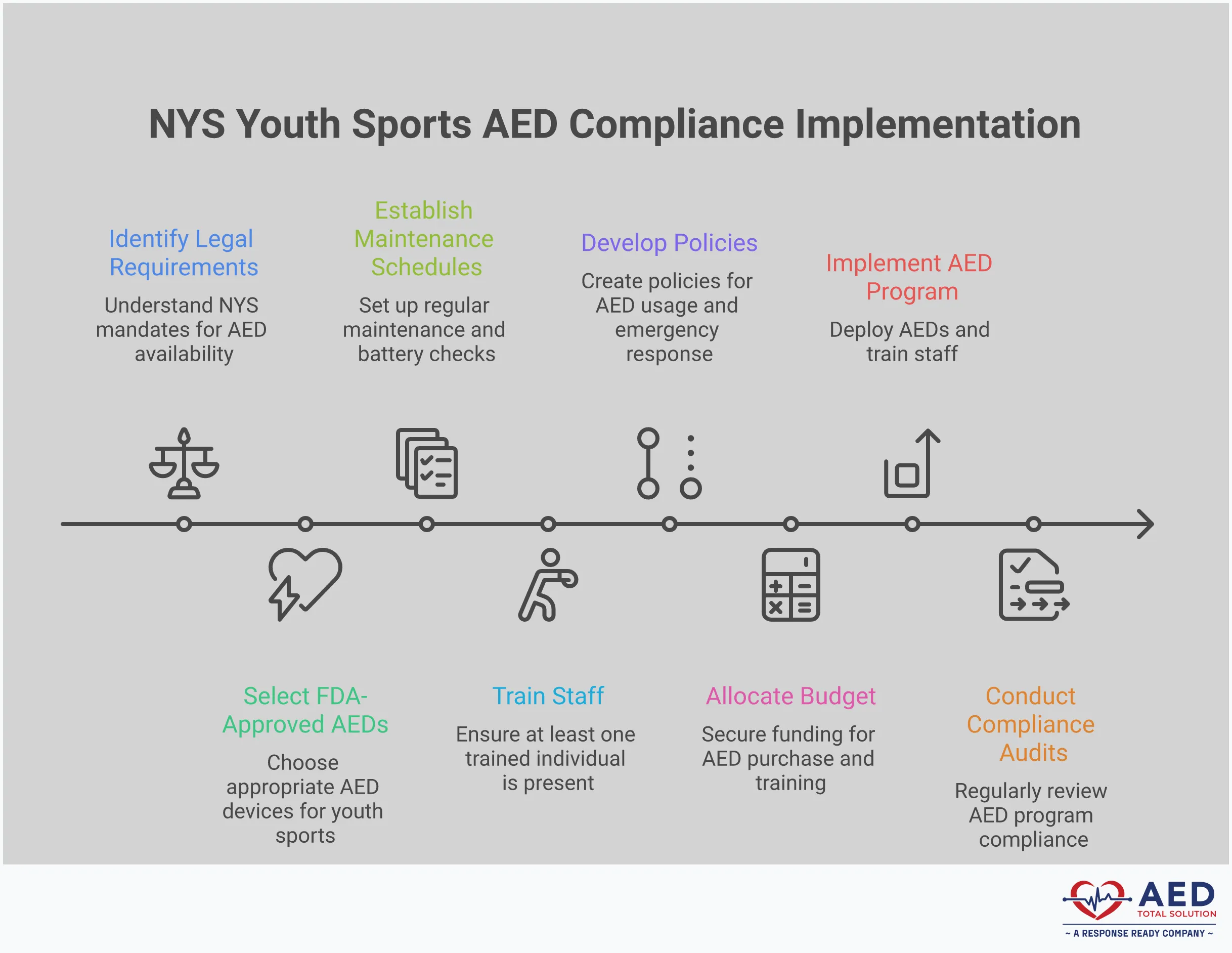
Putting an AED compliance program in place might feel like a huge undertaking, but you can get it done by breaking it down into a few key steps. A thoughtful approach ensures you not only meet legal requirements but also build a program that genuinely keeps your players, staff, and spectators safe. From initial planning to ongoing maintenance, each step builds on the last to create a solid foundation for emergency preparedness.
Think of it as your game plan for safety. By tackling it one piece at a time, you can move from uncertainty to confidence, knowing your organization is ready to respond when it matters most. Here’s how to get started.
Assess and Plan Your Program
Before you do anything else, take a moment to understand your specific needs and legal obligations. New York State law requires youth sports programs to have a written plan that outlines how your AED will be used in an emergency. This plan should detail the AED’s location, the steps to take during a cardiac event, and who is responsible for what. This is also the time to map out your facility or fields to determine the best placement for your device, ensuring it’s accessible within minutes from anywhere on-site. A well-documented strategy is the cornerstone of a successful AED program.
Get and Install Your Equipment
Once you have a plan, it’s time to get your AED. New York law is clear: youth sports programs must have an automated external defibrillator available during games and practices. When choosing a device, consider factors like durability for outdoor use, ease of use for lay responders, and whether you want to purchase or rent an AED. After you have your equipment, install it in a visible, unlocked, and clearly marked location as outlined in your plan. Proper placement is critical because every second counts during a cardiac emergency. Make sure everyone knows where it is and can get to it quickly.
Schedule and Coordinate Staff Training
An AED is only effective if people know how to use it. Your program must have at least one staff member or volunteer on-site who is trained and certified in CPR and AED use. This person is your designated responder, ready to act in an emergency. It’s a great idea to train more than one person to cover absences and build a stronger safety net. Schedule regular training and certification renewals for your coaches, staff, and key volunteers. Integrating this training into your regular onboarding or seasonal kick-off meetings helps keep skills fresh and ensures everyone feels prepared to step in and help.
Manage and Monitor Your Program
Your responsibility doesn’t end once the AED is on the wall. Ongoing management is essential for keeping your program compliant and your device ready. This includes performing regular readiness checks to confirm the AED is functional and documenting these inspections. You also need to track the expiration dates for batteries and electrode pads and replace them before they expire. Keeping detailed records of your maintenance checks, training certifications, and incident reports is crucial for liability protection. An AED program management service can automate these tasks, sending reminders and maintaining digital records to simplify compliance and give you peace of mind.
Related Articles
Frequently Asked Questions
Does my small youth sports league really need an AED? In New York, the rule is pretty clear. If your league has five or more teams participating in organized activities, you are required to have an AED on-site. This isn’t just about following the law; it’s about being prepared for a worst-case scenario. Sudden cardiac arrest can affect young athletes, and having a device ready can make all the difference. Even if your program is smaller, having an AED is a best practice that shows parents and your community you prioritize safety.
I’m just starting to set up our AED program. What are the first three things I absolutely must do? Getting started can feel overwhelming, but you can focus on three core actions. First, get a reliable AED and make sure it’s accessible during all games and practices. Second, get at least one person (though more is better) certified in CPR and AED use so someone is always prepared to act. Third, create a simple, written emergency action plan that details where the AED is, who does what in an emergency, and how to contact 911. Nailing these three steps builds a strong foundation for your entire safety program.
Our league plays at a local school. Does that change our responsibilities? That’s a great question, especially with the new Desha’s Law. While the school is required to have its own cardiac emergency plan and accessible AEDs, your league still has its own responsibilities. You should coordinate with the school to understand their plan, know where their AEDs are located, and ensure your staff is trained. Your league’s emergency action plan should reflect this partnership. Think of it as a shared responsibility to create the safest possible environment for the athletes.
Once we have the AED, are we done? What kind of upkeep is required? An AED program is an ongoing commitment, not a one-time purchase. The device itself requires regular attention to stay ready. You’ll need to perform routine checks to make sure the readiness indicator is green and track the expiration dates for the battery and electrode pads, which typically need replacing every few years. Keeping detailed records of these checks and any supply replacements is also a key part of staying compliant and protecting your organization.
I’m worried about the legal risk of using an AED. What should I know? This is a very common concern, but you can put your mind at ease. New York has Good Samaritan laws that protect people who step in to help during a medical emergency. As long as you act in good faith, you are shielded from liability. In fact, the greater legal risk comes from not having a compliant AED program. By following state requirements for equipment, training, and maintenance, you are taking the most important steps to protect both your players and your organization from legal issues.