What Is the Good Samaritan Law?
Good Samaritan laws are state-level statutes that provide legal protection to individuals who voluntarily assist a person experiencing a medical emergency. These laws exist to encourage bystanders to take action, especially in life-threatening situations like sudden cardiac arrest, without fear of being sued for unintentional harm.
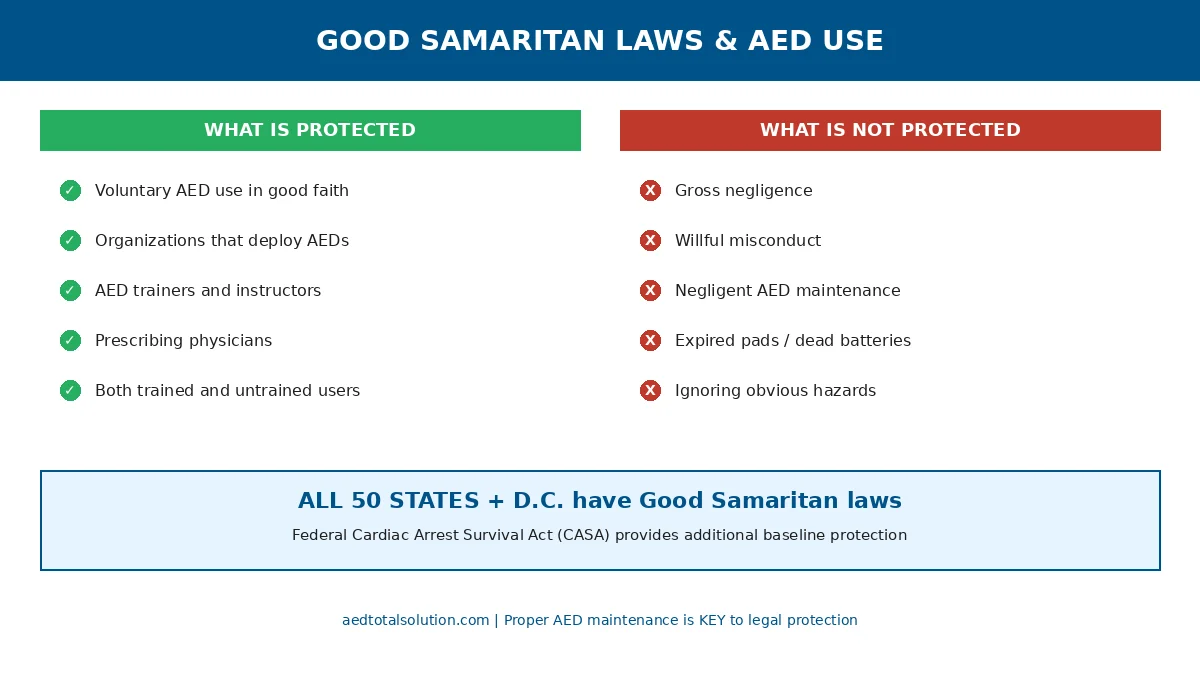
All 50 U.S. states and the District of Columbia have some form of Good Samaritan law, though the specifics vary by state. When it comes to AED use, these protections are particularly important because they remove one of the biggest barriers to bystander action: the fear of legal liability.
Understanding how Good Samaritan laws apply to AED use is critical for workplace safety officers, school administrators, and anyone responsible for managing an AED program. This guide explains what the laws cover, where they apply, and how your organization can ensure full protection.
How Good Samaritan Laws Apply to AED Use
Most state Good Samaritan laws specifically mention AEDs and defibrillation as protected activities. In general, these laws protect you when:
- You act voluntarily without expectation of compensation
- You act in good faith with reasonable belief that the person needs emergency help
- You use the AED as directed following the device’s voice prompts and instructions
- You are not grossly negligent or acting with willful misconduct
These protections typically extend to:
- Bystanders who use an AED on a cardiac arrest victim
- Organizations that purchase, maintain, and make AEDs available
- Individuals who provide AED training
- Prescribing physicians who authorize AED programs
Federal AED Protections: The Cardiac Arrest Survival Act
In addition to state laws, the federal Cardiac Arrest Survival Act (CASA) provides liability protections for individuals and organizations that use or provide AEDs. Signed into law in 2000, CASA establishes that:
- Any person who uses an AED in a perceived medical emergency is protected from civil liability (absent gross negligence or willful misconduct)
- Any entity that acquires an AED for public use is protected from civil liability, provided they maintain the device according to guidelines and ensure expected users receive basic AED training
The federal law sets a baseline, but many states have enacted even broader protections. Your state’s specific statute governs which protections apply to your organization.
State-by-State Good Samaritan Law Highlights
While all states provide some form of protection, the scope and conditions vary. Here are key patterns across states:
States with broad AED protection
Many states, including California, New York, Texas, Florida, Illinois, Pennsylvania, and Ohio, have comprehensive AED-specific Good Samaritan laws that protect both individual users and organizations that deploy AEDs. These states generally:
- Protect anyone who uses an AED in good faith, regardless of training level
- Protect the entity that owns or places the AED
- Require that AED owners maintain their devices and follow manufacturer guidelines
States with conditional AED protection
Some states require specific conditions to be met for full protection:
- AED registration with local EMS or the state health department
- Medical oversight by a prescribing or supervising physician
- Regular maintenance and inspection records
- Training documentation showing expected users completed AED/CPR training
Check your state’s specific AED legislation on our AED legislation by state page for exact requirements.
What Good Samaritan laws do NOT protect
Good Samaritan protections have limits. They generally do not cover:
- Gross negligence: Reckless disregard for the patient’s safety (for example, ignoring obvious hazards)
- Willful misconduct: Intentionally causing harm
- Professional duty: Healthcare professionals acting within the scope of their employment may be held to a higher standard
- Negligent maintenance: Organizations that fail to maintain AEDs (expired pads, dead batteries) may lose liability protection
Why AED Maintenance Matters for Legal Protection
Here is where many organizations make a critical mistake. They purchase an AED, hang it on the wall, and assume they are protected. But most state Good Samaritan laws require the AED to be properly maintained as a condition of liability protection.
If an AED fails during a cardiac emergency because the batteries were dead or the pads had expired, the organization could face liability that would otherwise have been covered under the Good Samaritan statute. This means:
- AED batteries must be replaced before their expiration date
- AED pads must be current and properly sealed
- Regular AED inspections must be documented
- The device must pass its self-test protocol
- Staff must be aware of AED locations and how to access them
This is precisely why professional AED program management is not just a convenience but a legal safeguard. A managed AED program ensures every device is inspection-ready, every component is current, and your organization has the documentation to prove it.
Do You Need AED Training to Be Protected?
In most states, no formal training is required for a bystander to use an AED and be protected under the Good Samaritan law. AEDs are classified by the FDA as devices that can be used by laypeople without medical training, and they provide step-by-step voice instructions to guide the user.
However, there is an important distinction between individual use and organizational responsibility:
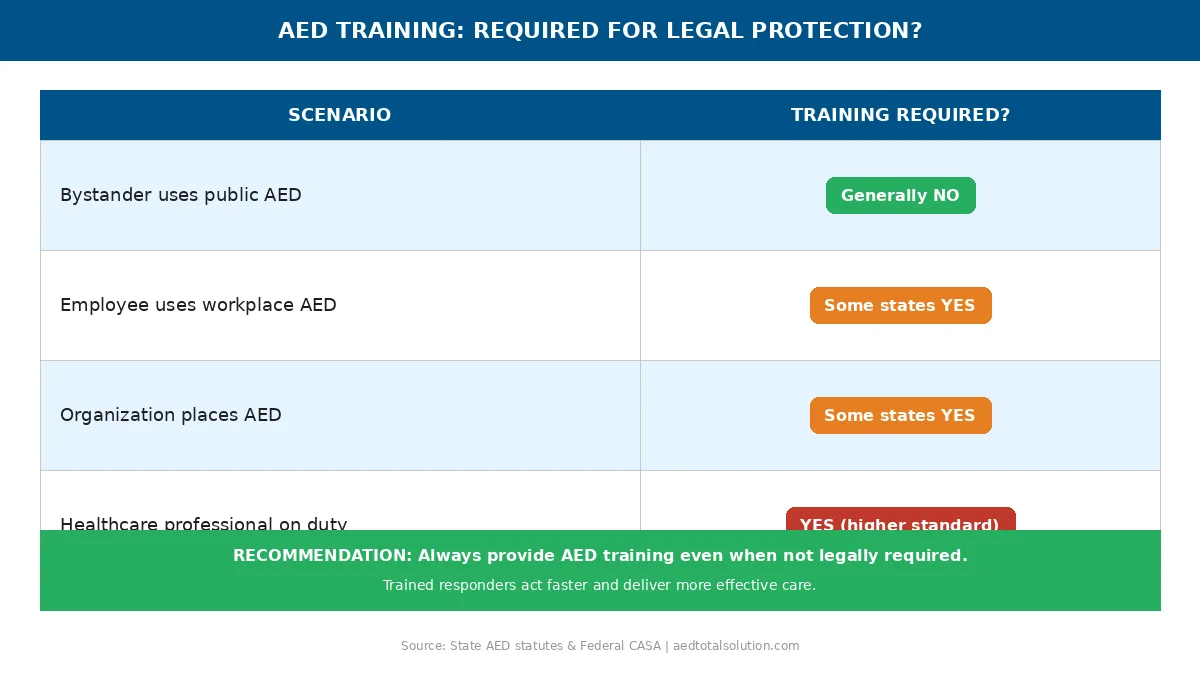
| Scenario | Training Required for Legal Protection? |
|---|---|
| Bystander uses a public AED during a cardiac emergency | Generally no (Good Samaritan protection applies) |
| Employee uses a workplace AED | Some states require the employer to provide training to designated responders |
| Organization places an AED in a building | Some states require training as a condition of the organization’s liability protection |
| Healthcare professional uses an AED on duty | Yes, held to professional standard of care |
Even when not legally required, AED training is strongly recommended. Trained responders act faster, make fewer errors, and deliver more effective care. Training also strengthens every link in the Chain of Survival.
How to Ensure Your Organization Is Fully Protected
To maximize your legal protection under Good Samaritan and AED-specific statutes, follow these best practices:
1. Register your AEDs
Many states require AED registration with local EMS or the state health department. Even where not required, registration ensures emergency dispatchers know AEDs are available at your location and can direct 911 callers to them.
2. Implement a maintenance program
Document all inspections, battery replacements, pad changes, and device tests. A compliance management system automates this process and creates a verifiable paper trail.
3. Provide training
Offer CPR and AED certification courses to designated workplace responders. Keep training records on file.
4. Post AED signage
Mark AED locations with clear, visible signage that meets state requirements. This makes AEDs accessible and demonstrates organizational diligence.
5. Establish medical oversight
Some states require a prescribing physician to oversee the AED program. Even where not required, having physician oversight strengthens your program’s credibility and legal standing.
6. Create a written emergency action plan
Document your organization’s cardiac emergency response protocol, including AED locations, designated responders, 911 notification procedures, and follow-up steps. Review and update it annually.
Frequently Asked Questions About Good Samaritan Laws and AEDs
Can I be sued for using an AED on someone?
While anyone can technically file a lawsuit, Good Samaritan laws provide a strong legal defense for individuals who use an AED in good faith during a medical emergency. Courts consistently uphold these protections, and successful lawsuits against good-faith AED users are extremely rare.
What if the person is injured by the AED shock?
AEDs only deliver a shock when they detect a shockable heart rhythm. The device makes the medical decision, not the user. Good Samaritan protections cover unintentional harm that occurs during good-faith emergency assistance.
Does my organization need insurance for AEDs?
Most general liability and professional liability policies already cover AED use. However, it is wise to confirm coverage with your insurer and ensure your AED program meets the state requirements that trigger Good Samaritan protections.
Are there penalties for NOT having an AED?
Several states require AEDs in specific settings such as schools, gyms, and government buildings. Failure to comply with these mandates can result in fines and increased liability exposure. Check your state’s AED requirements for details.
Do Good Samaritan laws protect companies that rent AEDs?
Yes, in most states, the protections extend to entities that make AEDs available, whether owned or rented. AED rental programs for events, construction sites, and temporary facilities are covered under the same Good Samaritan framework, provided the devices are properly maintained.
What happens if our AED was not maintained and someone sues?
If an AED malfunctions due to negligent maintenance (expired pads, dead battery, missing components), the organization may lose its Good Samaritan protection and face civil liability. This is why regular AED inspections and documented maintenance are critical for legal protection.
About the Author: Prabakar Mahalingam is the Managing Partner of AED Total Solution and a nationally recognized provider of safety training, products, and proprietary compliance software dedicated to addressing Sudden Cardiac Arrest (SCA).
Protect your organization and your people. Contact AED Total Solution for a fully managed AED program that ensures compliance, proper maintenance, and legal protection under Good Samaritan laws. Call 855-263-7772 for a free consultation.