
Think of your organization’s safety program like an airline. You wouldn’t let each pilot manage their own flight path without a central control tower providing guidance and oversight. Yet, many large companies manage their life-saving AEDs in silos, with each location following a different process. This creates inconsistency, compliance gaps, and unnecessary risk across the board. An enterprise AED management solution acts as that central command center for your entire AED fleet. It provides a single, unified view of every device, standardizing procedures and ensuring consistent readiness from one site to the next, no matter how widespread your operations are.
Key Takeaways
- Active management is more than tracking: A simple list of your AEDs isn’t enough. A true management solution actively monitors device readiness, automates supply reminders, and provides expert oversight to ensure your program is always compliant and prepared for an emergency.
- Centralize control for consistent compliance: Managing AEDs across multiple locations creates risk. A centralized dashboard provides a single view of your entire fleet, helping you standardize procedures and ensure every site meets all local and state regulations without the guesswork.
- Choose a partner, not just a platform: Software alone leaves the final responsibility on your team. A full-service management partner combines technology with hands-on support to handle compliance, document inspections, and track training, reducing your administrative burden and liability.
What Is an Enterprise AED Management Solution?
Think of an enterprise AED management solution as the command center for your organization’s entire AED program. It’s a comprehensive system designed specifically for businesses with multiple locations, helping you oversee every device in your fleet from one central place. This isn’t just about owning AEDs; it’s about ensuring each one is functional, compliant, and ready for an emergency, no matter where it’s located. A great management solution combines smart software with hands-on service to take the complexity off your plate.
These systems handle the critical details that are easy to miss when you’re managing devices at scale. This includes everything from tracking battery and pad expiration dates to scheduling routine maintenance and documenting inspections. The goal is to move beyond a simple checklist and implement a proactive system that guarantees readiness. With a full-service AED program management partner, you get the technology and the expert oversight needed to protect your employees, customers, and your organization. It closes the gaps in your safety plan and gives you confidence that your program is always prepared.
Key Components of an AED Management System
A robust AED management system is built on a few core components that work together to keep your program running smoothly. At its heart is a centralized online dashboard where you can see the status of every AED at a glance. This is paired with automated alerts that notify you about upcoming maintenance needs, like expiring pads or batteries, so nothing falls through the cracks. Modern systems also use advanced connectivity, like Wi-Fi and cellular technology, to monitor device readiness remotely.
Beyond the technology, a true management solution includes expert support. This means you have a partner who understands the ins and outs of compliance and can help you create a program tailored to your business. This includes guidance on device placement, registration with local emergency services, and tracking staff training. It’s this combination of smart tools and dedicated program oversight that makes a system truly effective, turning a logistical challenge into a manageable part of your safety protocol.
Why Large Organizations Need Dedicated AED Management
Managing AEDs across multiple locations introduces a layer of complexity that simple spreadsheets can’t handle. Each site may fall under different state and local regulations, making it difficult to maintain consistent compliance. On top of that, keeping track of maintenance schedules, inspection logs, and staff training for dozens or even hundreds of devices is a huge administrative burden. When these tasks are handled manually, the risk of human error grows, and a single missed expiration date can render a device useless in an emergency.
This is where a dedicated management solution becomes essential. It standardizes your process, ensuring every location meets the same high standard of readiness and complies with all relevant workplace safety guidance. It simplifies the oversight of different device types and models, giving you a single, unified view of your entire program. For large organizations, this isn’t just a matter of convenience; it’s a critical tool for reducing liability and ensuring your emergency response plan is reliable everywhere.
Tracking vs. Management: What’s the Difference?
It’s easy to confuse AED tracking with AED management, but they are fundamentally different. Tracking is a passive activity. It might involve a spreadsheet or a basic software tool that logs where your AEDs are and when their parts expire. While it’s better than nothing, the responsibility to check the tracker, schedule maintenance, and ensure compliance still rests entirely on you and your team. It’s a system that requires constant manual input and oversight to be effective.
AED management, on the other hand, is an active, full-service approach. A true management solution doesn’t just show you what needs to be done; it helps you get it done. It includes proactive monitoring, automated follow-ups, and expert guidance to ensure every task is completed correctly and on time. It’s the difference between having a list of problems and having a partner who delivers solutions. You can learn more about these differences by exploring some frequently asked questions about comprehensive program management.
Essential Features of an AED Management Solution
When you’re managing AEDs across multiple locations, a simple spreadsheet just won’t cut it. A true enterprise AED management solution is built with specific features designed to keep your program compliant, your devices ready, and your team prepared. These tools move beyond basic tracking to offer a complete system for oversight and accountability. Let’s look at the essential features you should expect from any comprehensive management solution.
Centralized Dashboards for Real-Time Monitoring
Imagine seeing the status of every AED in your organization, whether you have ten or a thousand, all on one screen. That’s the power of a centralized dashboard. This command center gives you a real-time overview of your entire AED fleet, showing which devices are ready, which need attention, and where they are located. Instead of chasing down information from different sites, you get a complete picture instantly. This visibility is the foundation of effective AED program management, allowing you to spot issues quickly and manage your inventory from a single, accessible online portal.
Automated Maintenance and Compliance Alerts
AEDs aren’t “set it and forget it” devices. Their batteries and electrode pads have expiration dates, and missing a replacement deadline can render a device useless in an emergency. A great management solution automates this entire process. It tracks expiration dates for all your supplies and sends you timely alerts when it’s time to reorder. This proactive system also sends reminders for scheduled inspections and compliance deadlines, so you never have to worry about falling behind. It takes the human error out of maintenance scheduling, ensuring every device is always equipped with functional components.
Remote Monitoring to Verify AED Readiness
How do you know an AED is ready to work right now? With remote monitoring, the device tells you itself. Modern, connected AEDs perform daily or weekly self-checks on their internal circuitry, battery levels, and pad readiness. The results are automatically sent to your management platform. If an error is detected, you receive an immediate alert. This technology eliminates the need for frequent and time-consuming manual checks, especially in large or remote facilities. It provides confidence that every AED is functional and ready for an emergency, 24/7, without you having to physically inspect each one.
Training and Documentation Tracking
Having a ready AED is only half the battle; you also need trained responders who feel confident using it. An enterprise solution should include features for tracking employee training and certifications. You can log who has completed CPR and AED training, when their certifications expire, and who needs a refresher course. This ensures you always have a sufficient number of prepared staff at every location. Keeping this information organized and accessible is also crucial for demonstrating due diligence and maintaining a culture of safety within your organization. It closes the loop between having the right equipment and having the right people to operate it.
Audit-Ready Reporting
When an auditor or inspector visits, you need to provide clear, organized documentation of your AED program’s compliance. A robust management solution makes this simple by generating audit-ready reports on demand. These reports can detail inspection histories, maintenance records, supply expiration dates, and staff training logs for any or all of your locations. Instead of scrambling to pull together paper records or scattered files, you can produce comprehensive documentation with a few clicks. This not only simplifies audits but also provides a clear record of compliance, which is essential for reducing liability exposure and protecting your organization.
How Does Centralized AED Management Benefit Large Organizations?
When your organization spans multiple offices, facilities, or even states, managing your AED program can feel like a logistical puzzle. Each location has its own devices, staff, and local regulations to consider. Juggling dozens or hundreds of AEDs with spreadsheets and calendar reminders is not just inefficient; it’s risky. A missed battery replacement or a failed inspection could mean a device isn’t ready when a life is on the line. This is where a centralized management solution makes a significant difference.
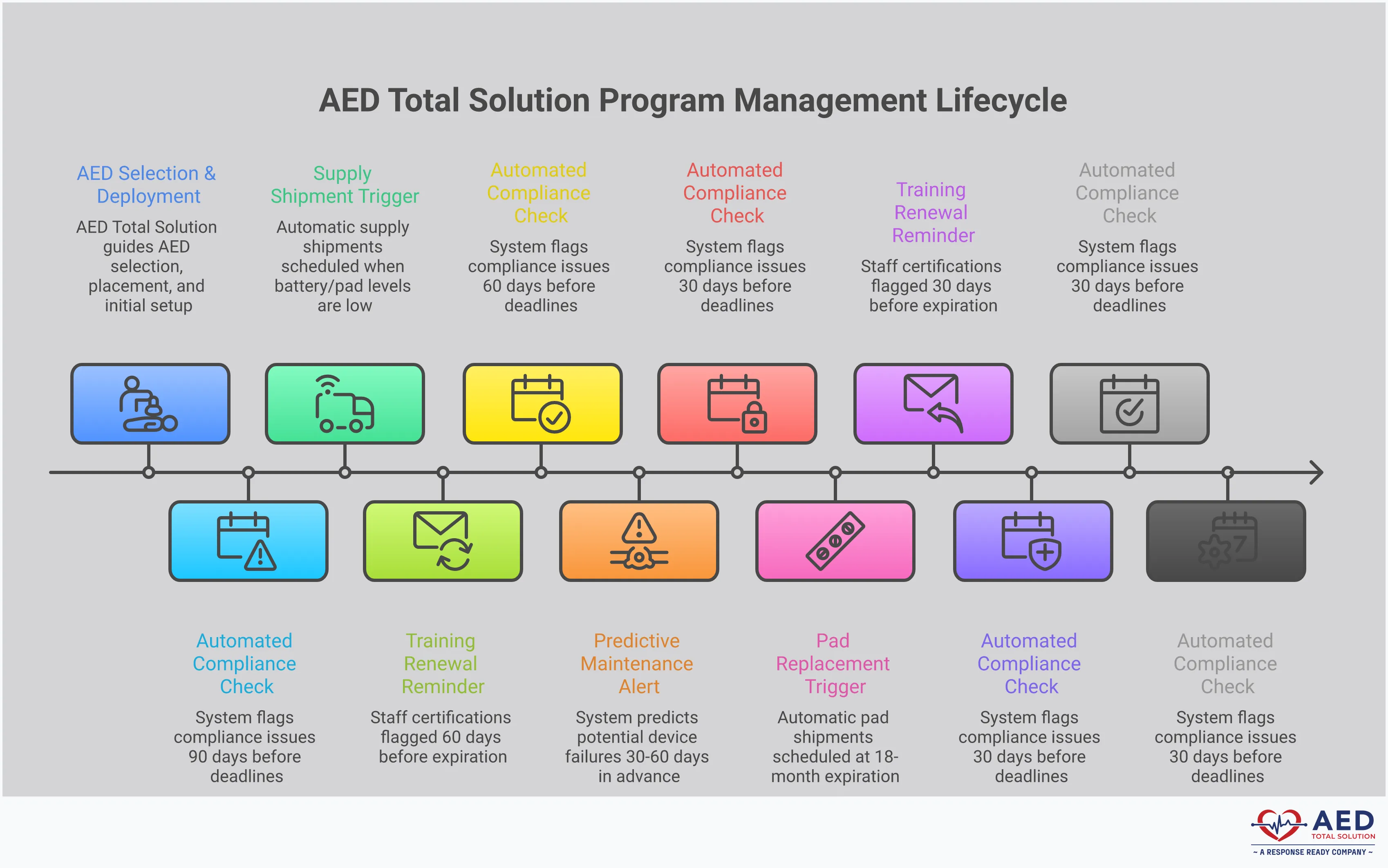
By bringing every device, compliance deadline, and maintenance task into a single, unified system, you gain complete visibility and control over your entire program. Instead of reacting to problems, you can proactively manage the readiness of every AED, no matter where it’s located. This approach transforms your program from a scattered collection of devices into a cohesive, reliable safety net. A full-service AED program doesn’t just track your devices; it ensures they are always compliant, functional, and ready to respond, giving you confidence and peace of mind.
Simplify Oversight Across Multiple Locations
Managing AEDs across several business locations is a major challenge. Each site might have different device models, maintenance schedules, and staff members responsible for inspections. A centralized system cuts through the complexity by providing a single dashboard to monitor every AED in your portfolio. You can instantly see the status of each device, track upcoming expirations, and verify that inspections are completed on time. This unified view makes it easier to standardize your procedures and ensure every location meets the same high standard of readiness, simplifying oversight for your entire enterprise.
Ensure Compliance at Every Site
AED regulations can vary significantly from one state or city to another, creating a compliance minefield for multi-location organizations. A dedicated AED management solution is designed to handle these complexities. It helps ensure your program meets all local, state, and federal standards for every single one of your locations. The system tracks specific requirements, automates necessary documentation, and sends alerts for tasks like physician oversight and local EMS registration. This removes the guesswork and helps protect your organization from fines and liability associated with non-compliance.
Save Money with Proactive Maintenance
Unexpected costs can quickly add up when you’re managing a large fleet of AEDs. A device failure can lead to expensive emergency repairs, and expired supplies often require rush shipping. Centralized management helps you get ahead of these issues with proactive maintenance scheduling. The system automatically tracks expiration dates for batteries and pads, alerting you well in advance so you can order replacements on a regular schedule. This proactive approach not only prevents readiness gaps but also helps you budget more effectively and avoid the premium costs of last-minute fixes.
Improve Emergency Response Readiness
An AED is only effective if it works perfectly during a cardiac arrest emergency. Manual inspections are helpful, but they can be forgotten or performed incorrectly. Modern AED management solutions often include remote monitoring that verifies device readiness daily. The system can confirm that the AED has passed its automated self-test and is ready for use, providing a much higher level of assurance. This constant oversight ensures that when an emergency happens, your team can grab the nearest AED with confidence, knowing it’s fully functional and prepared to save a life.
Reduce Administrative Burden and Liability
Your team has enough on its plate without adding the constant worry of AED maintenance and documentation. A centralized management program automates many of the tedious tasks that consume your staff’s time, from sending inspection reminders to generating compliance reports. By partnering with a program management expert, you offload the administrative weight and reduce your organization’s liability exposure. With every inspection logged and every device monitored, you have an audit-ready record that demonstrates due diligence and a commitment to safety.
Common Challenges of Managing AEDs Across Multiple Locations
Managing an AED at a single office is one thing. But when you’re responsible for devices across dozens or even hundreds of locations, the complexity grows exponentially. What was once a simple checklist becomes a major logistical challenge. Each new site adds another layer of compliance rules, maintenance schedules, and training needs. Without a centralized system, it’s easy for critical tasks to fall through the cracks, putting your organization at risk and undermining your entire emergency preparedness plan. Let’s look at the most common hurdles large organizations face.
Keeping Up with Compliance and Regulations
AED requirements aren’t one-size-fits-all. The rules can change significantly from one state to the next, covering everything from device registration and placement to required signage and medical oversight. For a national enterprise, tracking these varying local and state standards is a full-time job. A missed regulation at one location can lead to compliance violations and increase your liability. A comprehensive AED program management service simplifies this by ensuring every device in your portfolio meets the specific legal standards for its location. This removes the guesswork and helps protect your organization from fines and legal complications, no matter how many states you operate in.
Preventing Device Failures and Expired Parts
An AED is only effective if it’s ready to work at a moment’s notice. The reality is that an AED with dead batteries or expired pads is almost as useless as not having one at all. Each device has components with their own expiration dates, and manually tracking them across an entire network of AEDs is a recipe for human error. A single missed replacement can lead to a device failure during a cardiac arrest emergency. Proactive management involves tracking every battery and pad expiration date, ensuring timely replacements are sent out long before they expire, so every device remains fully functional and ready to save a life.
Ensuring Consistent Staff Training
Having a working AED is just one piece of the puzzle; you also need people who are confident and prepared to use it. For large organizations, ensuring consistent and up-to-date training across all locations is a significant challenge, especially with employee turnover. An emergency medical services worker once noted how rare it is to find companies with fully trained staff ready to act. An effective AED program includes tracking which employees are certified, sending reminders when their certifications are about to expire, and identifying training gaps at specific sites. This ensures you always have designated responders on hand who know exactly what to do when seconds count.
Avoiding Documentation Gaps During Audits
If you can’t prove your AEDs are properly maintained, you open your organization up to significant risk. During an audit or in the event of a legal inquiry, you’ll need to provide clear documentation for everything: routine inspections, battery and pad replacements, staff training records, and post-use reports. Piecing this information together from spreadsheets or paper files stored at different locations can be a nightmare. Working with an AED service company helps you maintain meticulous, audit-ready records in one centralized place. This not only demonstrates responsible ownership but also provides a clear, defensible record that your program is compliant and your devices are always ready for an emergency.
What to Know About AED Compliance and Regulations
Keeping your AED program compliant can feel like trying to hit a moving target. Regulations vary by state, industry, and even building type, making it tough to know if you’re checking all the right boxes. But when you break it down, compliance generally falls into a few key categories: federal guidance, state laws, documentation requirements, and liability protections. Understanding these areas is the first step toward building a program that’s not just compliant, but truly effective.
A well-managed program gives you confidence that every device is ready for an emergency and that your organization is protected. Let’s walk through what you need to know to keep your program on track and your people safe.
OSHA Workplace Safety Guidance
Many people assume the Occupational Safety and Health Administration (OSHA) requires all businesses to have AEDs, but that’s not quite the case. While OSHA doesn’t have a universal mandate for AEDs, it strongly encourages them as part of a comprehensive first-aid and emergency response plan. The agency’s guidelines focus on creating a safe workplace, and having an AED readily available is a critical part of that mission.
Think of it less as a strict requirement and more as an industry best practice. For organizations committed to employee safety, an AED program is a non-negotiable part of their preparedness strategy. Following OSHA’s guidance on placement, maintenance, and training helps ensure your workplace is ready to respond effectively during a cardiac emergency.
State-Specific AED Laws
This is where compliance gets more detailed. While federal guidance is broad, state laws often have very specific requirements for certain types of businesses and public spaces. For example, many states legally require health clubs, gyms, schools, and government buildings to have AEDs on-site. These laws recognize that the risk of sudden cardiac arrest can be higher in environments with strenuous physical activity or large crowds.
Because these regulations differ so much from one state to another, it’s essential to know the specific AED laws that apply to each of your locations. These rules often dictate not just the presence of an AED but also its placement, signage, and maintenance schedule.
Documentation for Audits
Having an AED is one thing; proving it’s ready for use is another. Proper documentation is a cornerstone of any compliant AED program. During an audit or inspection, you’ll need to provide clear records showing that each device has been regularly checked, maintained, and is fully operational. This includes tracking battery and pad expiration dates, logging routine inspections, and confirming that all necessary accessories are in place.
Without organized documentation, you create significant risk for your organization and leave gaps in your emergency preparedness. A centralized management system ensures all your records are accurate, up-to-date, and easily accessible, giving you audit-ready confidence that your AED program management meets all standards.
Good Samaritan Laws and Liability Protection
A common concern for many organizations is the liability associated with using an AED. Thankfully, all 50 states have Good Samaritan laws designed to protect bystanders who step in to help during a medical emergency. These laws provide legal protection to individuals who use an AED in good faith, encouraging immediate action without the fear of a lawsuit.
These protections are vital because they empower employees and even untrained bystanders to act decisively when seconds matter most. By properly maintaining your devices and encouraging a culture of response, you can be confident that these laws support your efforts to save a life. Understanding your state’s specific Good Samaritan protections can help reinforce the importance of your AED program.
Common Myths About Enterprise AED Management
When it comes to managing AEDs across a large organization, a few common misconceptions can create serious compliance gaps. Believing these myths can lead to a false sense of security, leaving your program vulnerable and your devices unprepared for an emergency. Let’s clear up some of the confusion so you can build a program based on facts, not fiction.
Myth: Remote Monitoring Replaces Human Oversight
Technology is a fantastic partner in AED management, but it isn’t a substitute for people. While remote monitoring systems are great for flagging issues like a low battery, they can’t tell you if a device has been moved, blocked by new furniture, or if its pads are about to expire. That’s why consistent human oversight is still critical. Think of technology as your first line of defense, providing real-time data, while your team performs the essential hands-on inspections to confirm everything is truly ready to go. A complete management solution combines the best of both worlds: smart technology and diligent people.
Myth: AEDs Are Too Complicated for Non-Medical Staff
This is one of the most persistent and dangerous myths out there. Modern AEDs are specifically designed for anyone to use, regardless of their medical background. Once you open the device, clear voice prompts and simple diagrams guide the user through every single step, from placing the pads to administering a shock. The device even analyzes the person’s heart rhythm and will only deliver a shock if it’s needed. The reality is that an untrained person can effectively use an AED, so don’t let fear of complexity stop you from building a life-saving program.
Myth: Management Solutions Are Only for High-Risk Environments
Sudden cardiac arrest doesn’t just happen in high-risk settings like gyms or manufacturing plants; it can happen anywhere, at any time. An office building, a school, or a retail space can become the scene of a cardiac emergency in an instant. Believing that AEDs are only for certain types of businesses overlooks the universal risk of SCA. A well-managed AED program is a core part of comprehensive safety preparedness for any environment where people gather. Proactive readiness is always better than reactive regret, no matter what industry you’re in.
Myth: Basic Tracking Tools Are Good Enough
Using a simple spreadsheet or a basic calendar reminder to track your AEDs is not the same as managing them. Tracking tells you where a device is, but it doesn’t tell you if it’s ready. Is the battery charged? Are the pads within their expiration date? Has the device passed its self-test? An unready AED is just as bad as no AED at all. This is where comprehensive management solutions make all the difference. They actively monitor readiness, automate alerts for expiring parts, and create a verifiable record of compliance, ensuring your devices are always prepared for the moment they’re needed most.
Comparing AED Management Approaches
Choosing how to manage your AED program is a big decision. The right approach depends on your organization’s size, the number of devices you have, and the resources you can dedicate to oversight. Not all management styles are created equal, and what works for a single-location business might not be enough for a large enterprise spread across multiple sites. Understanding the differences between full-service management, software-only platforms, and basic tracking systems will help you find the best fit for your needs, ensuring your program is both compliant and effective when it matters most.
Let’s break down the most common approaches to see how they stack up. Each has its own set of benefits and potential drawbacks, especially when it comes to managing AEDs at scale.
Full-Service Program Management
Think of this as the “white-glove” option for your AED program. With full-service management, you partner with a provider who handles every single detail from start to finish. This includes using a central dashboard to monitor all your devices, automatically scheduling maintenance for things like battery and pad replacements, and ensuring you follow all local and national regulations. This approach combines powerful software with hands-on expert oversight, so you can be confident that every task is not just tracked, but completed. It’s the most comprehensive way to manage your AEDs, removing the burden from your team.
Software-Only Monitoring Platforms
Software-only platforms provide the digital tools you need to manage your AEDs in-house. These systems typically offer a dashboard to view the status of all your devices in one place and send automated email reminders for inspections or when parts are about to expire. Some can even automatically ship new supplies. While these tools are a major step up from manual tracking, the responsibility for performing the checks, ordering parts, and documenting compliance still falls on your staff. This can be a good middle ground if you have a dedicated safety team, but it can leave dangerous gaps if responsibilities are unclear or team members are stretched thin.
Basic Tracking Systems and Their Limitations
The most hands-on approach involves using basic tools like spreadsheets or calendar reminders to track AED maintenance. While this method has a low upfront cost, it is highly prone to human error and is the riskiest option for any organization. A single missed reminder can result in an AED with expired pads or a dead battery, rendering it useless in an emergency. An AED that isn’t ready to use is almost as bad as not having one at all. For enterprises with multiple locations, this manual method simply doesn’t scale and can create significant administrative headaches and liability exposure.
Understanding Pricing and Total Cost
When comparing options, it’s important to look at the total cost of ownership, not just the initial price tag. Full-service solutions typically come with a simple, predictable monthly fee that covers all maintenance, monitoring, and support, so there are no surprise costs. Software-only platforms usually involve a subscription fee, but you also have to factor in the cost of your team’s time to manage the program and purchase supplies. Basic tracking might seem free, but the hidden costs of administrative labor, missed expirations, and the financial risk of non-compliance can quickly add up.
How to Choose the Right AED Management Solution
Finding the right AED management solution isn’t a one-size-fits-all process. The best choice for your organization depends on your specific size, industry, and operational complexity. A small business with a single AED has very different needs than a national corporation with devices in hundreds of locations. To make the right decision, you need to look beyond the price tag and consider how a solution will support your compliance, readiness, and long-term growth.
Think of it as choosing a partner, not just a piece of software. You need a system that simplifies your workload, reduces your organization’s liability, and gives you confidence that every device is ready to go when it matters most. A great management solution should feel like an extension of your team, handling the tedious details so you can focus on the bigger picture. As you evaluate your options, focus on four key areas: your compliance requirements, the number of locations you manage, technological capabilities, and your plans for future expansion. Let’s walk through what to look for in each of these areas.
Assess Your Organization’s Compliance Needs
First things first, you need a clear picture of your legal obligations. AED regulations can vary quite a bit depending on your location and industry. A good management solution simplifies regulatory compliance by ensuring your program meets all local, state, and federal standards. Before you commit to a provider, ask them how they stay on top of changing laws and how their system helps you create audit-ready documentation. Your goal is to find a partner who can provide expert program management and remove the guesswork from staying compliant.
Account for Single vs. Multiple Locations
Managing one AED is straightforward. Managing dozens across multiple sites is a completely different challenge. As one expert notes, overseeing AEDs across many business locations is tough because of different rules and logistical hurdles. If your organization is spread out, you need a centralized system that gives you a bird’s-eye view of your entire program. Look for a solution with a single dashboard where you can track the status of every device, no matter where it is. This makes it much easier to ensure consistency and accountability across all your sites.
Look for Integration Capabilities
Modern AEDs are smarter than ever, and your management solution should be, too. Many new devices come with built-in connectivity that allows for remote monitoring. For example, some AEDs use cellular, Wi-Fi, and GPS technology to automatically report their status, streamlining maintenance and eliminating the need for constant manual checks. When choosing a solution, ask about its ability to integrate with these connected devices. This capability can save your team significant time and provide real-time assurance that your AEDs are ready to use. You can explore different AED models to see which ones offer these features.
Plan for Future Growth
The solution you choose today should be able to grow with you. Whether you plan to open new locations or add more devices to existing ones, you need a system that can scale effortlessly. Look for a platform that offers features like automated maintenance scheduling, 24/7 monitoring, and comprehensive training records. A scalable solution ensures you won’t have to switch providers down the road. Think of this as a long-term investment in your organization’s safety program and choose a partner who is equipped to support you for years to come.
Related Articles
- AED Program Management | Full-Service Compliance & Readiness
- Top 4 AED Compliance Management Software Platforms
- AED Program Management | Compliance and Maintenance
- Home AED Solutions – Expert Service & Support
Frequently Asked Questions
My team already performs monthly inspections. Why do we need a management solution? Monthly inspections are a great start, but they only provide a snapshot of an AED’s readiness on that specific day. A comprehensive management solution adds layers of protection that manual checks can miss. For example, remote monitoring can verify that an AED passes its automated self-test every single day, catching potential electronic faults immediately. A full-service program also ensures that compliance tasks, like local EMS registration and medical oversight, are handled correctly, which is something a simple physical check doesn’t cover.
What’s the main difference between a software platform and a full-service management program? Think of it as the difference between getting a tool and hiring an expert. A software-only platform gives you the tool, like a dashboard and email alerts, but your team is still responsible for doing all the work: following up on inspections, ordering supplies, and ensuring every compliance task is completed. A full-service management program acts as your expert partner. It uses those same tools but also provides the hands-on oversight to manage every detail for you, ensuring nothing ever falls through the cracks.
How does a management solution help with compliance if laws are different in every state? This is one of the biggest benefits for organizations with multiple locations. A dedicated management partner stays current on the specific AED regulations for every state and county where you operate. The service ensures each of your sites meets its unique local requirements for things like device registration, signage, and physician oversight. This removes the complex and time-consuming research from your team’s plate and protects your organization from compliance violations.
Will my staff still have a lot of administrative work to do with a full-service solution? The primary goal of a full-service solution is to significantly reduce your team’s administrative workload. The management partner handles the proactive monitoring, tracks all expiration dates, generates compliance reports, and manages the automatic shipment of replacement supplies. Your staff’s role is simplified to performing quick, guided physical inspections and responding to any critical alerts, freeing them from the day-to-day stress of program administration.
What happens after an AED is used in an emergency? Does the management service help with that? Yes, a true management partner supports you through the entire lifecycle of an event. After an AED is used, the service helps you handle the critical next steps. This includes assisting with downloading the event data for medical review, arranging for the device to be serviced and prepped for its next use, and automatically replenishing the electrode pads and any other necessary supplies. This ensures your AED is returned to a ready state quickly and correctly.