Clear, visible AED signage is a critical but often overlooked element of any AED program. When someone collapses from sudden cardiac arrest, every second counts. Bystanders need to locate the nearest AED immediately, and proper signage is what makes that possible. Beyond saving precious time during emergencies, correct AED signage is a compliance requirement in many states and municipalities.
This guide covers AED signage requirements, recommended mounting heights, sign types, and how to ensure your facility meets both regulatory and best-practice standards.
Why AED Signage Matters
An AED that cannot be found quickly is an AED that cannot save a life. Studies show that for every minute defibrillation is delayed during sudden cardiac arrest, survival rates decrease by 7% to 10%. Proper signage reduces the time it takes for bystanders, employees, or first responders to locate the device.
AED signage serves three essential functions:
- Wayfinding: Directional signs guide people from any point in a building to the nearest AED location.
- Identification: AED location signs mark exactly where a device is mounted or stored.
- Awareness: Visible signage reminds occupants that an AED is available, increasing the likelihood that someone will retrieve it during an emergency.
Without proper signage, even a facility with multiple AEDs can fail to provide timely defibrillation simply because no one knew where to look.
AED Sign Types and Standards
Several types of AED signs work together to create a complete wayfinding system within a building or campus.
AED Location Signs
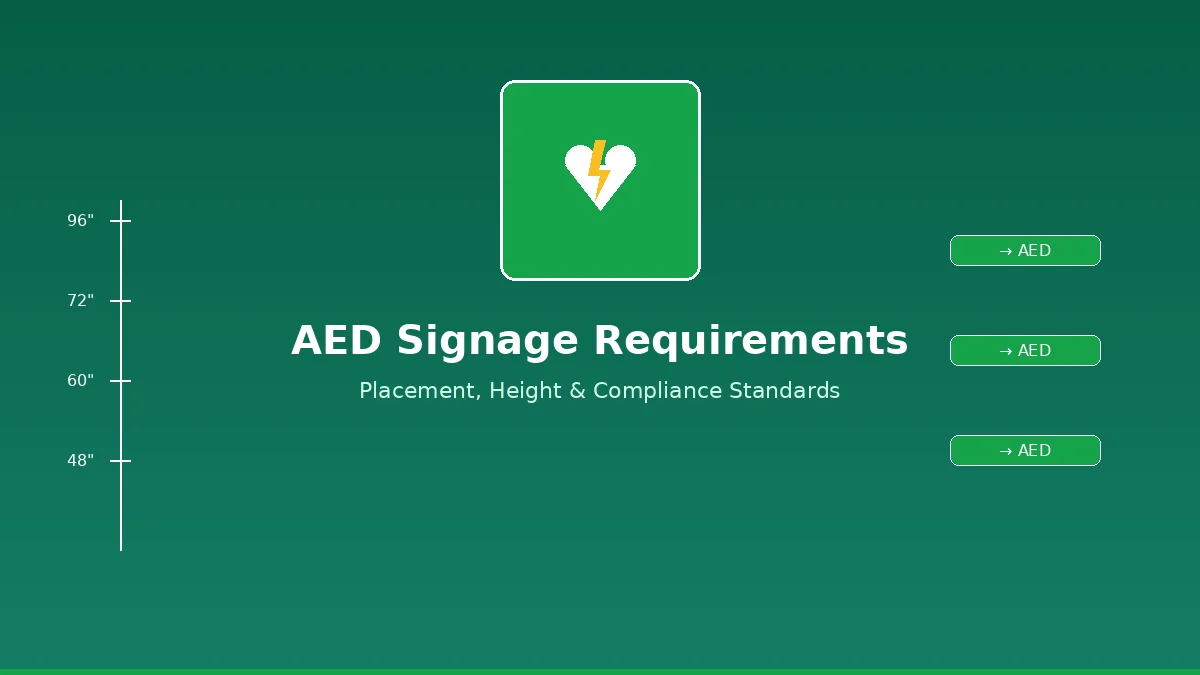
These signs are placed directly above or adjacent to where the AED is mounted. They feature the universally recognized green AED symbol (a white heart with a lightning bolt on a green background) as defined by the International Liaison Committee on Resuscitation (ILCOR). Location signs should be visible from at least 50 feet away in well-lit conditions.
Directional AED Signs
Directional signs are placed at hallway intersections, stairwells, elevators, and building entrances to guide people toward the nearest AED. They include the AED symbol along with an arrow indicating direction. These signs are essential in large facilities, multi-story buildings, and campuses where AEDs may not be visible from every area.
AED Wall Cabinet Signs
When AEDs are stored inside wall cabinets, the cabinet itself should display the AED symbol. Many AED cabinets come with integrated signage, but additional overhead or perpendicular “flag” signs improve visibility from a distance or around corners.
Floor Plan and Map Signs
Large facilities such as convention centers, hospitals, universities, and corporate campuses benefit from posting AED location maps at building entrances and common areas. These maps show the positions of all AEDs relative to the viewer’s location, similar to fire extinguisher and exit maps.
AED Sign Mounting Height Requirements
While no single federal law dictates a universal AED sign mounting height, several standards and local codes provide guidance:
- OSHA general signage guidelines: Safety signs should be mounted at a height visible to all building occupants, typically between 48 and 72 inches from the floor to the center of the sign.
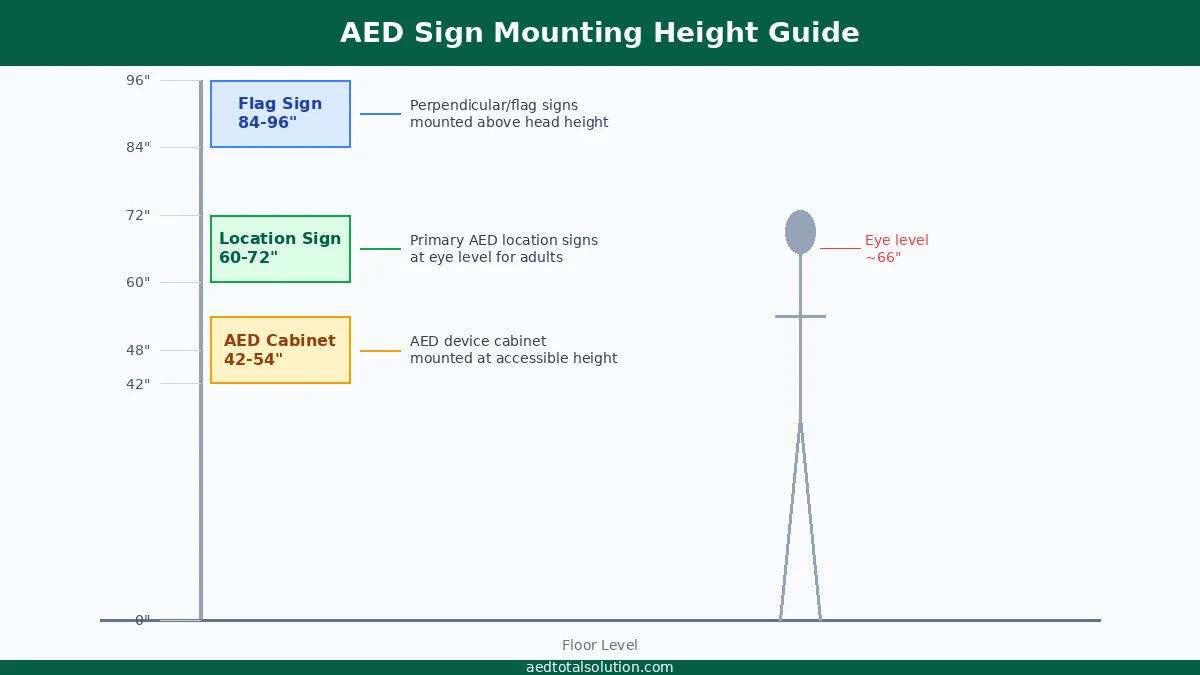
- ADA considerations: Wall-mounted signs that identify a permanent room or space must have their baseline between 48 and 60 inches above the finished floor. AED location signs near cabinets should follow this range for accessibility.
- NFPA guidelines: While the National Fire Protection Association does not have AED-specific signage rules, its general guidelines for emergency equipment signage recommend mounting at or above eye level (approximately 60 inches) for standing adults.
- IBC (International Building Code): Some jurisdictions incorporate AED sign requirements into building code amendments, often referencing a minimum mounting height of 48 inches and a maximum of 84 inches.
The most common recommended mounting height for AED location signs is between 60 and 72 inches from the floor to the center of the sign. This ensures visibility for standing adults while remaining within accessible reach for sign identification.
Perpendicular (Flag) Sign Placement
Perpendicular or “flag” signs that project from the wall above an AED cabinet should be mounted at 84 to 96 inches from the floor to the bottom of the sign. This higher placement ensures the sign is visible above head height in crowded hallways and corridors.
State and Local AED Signage Requirements
AED signage requirements vary by state and municipality. Some states include signage mandates within their broader AED legislation, while others leave it to local building codes or recommend compliance with industry standards.
States with Specific AED Signage Provisions
- California: Requires AEDs to be placed in locations that are “readily accessible” with appropriate signage indicating the AED’s presence. The state’s building code may require additional signage compliance depending on facility type.
- New York: Facilities required to maintain AEDs must post clear signage indicating AED locations. This is particularly enforced in health clubs, schools, and public assembly spaces.
- Illinois: Mandates that AEDs in required facilities be accompanied by “conspicuous signage.” The Physical Fitness Facility Medical Emergency Preparedness Act specifically references signage requirements for gyms and fitness centers.
- New Jersey: Requires AED signage in facilities where AEDs are mandated, including schools and health clubs.
Industry and Accreditation Standards
Even in states without explicit signage laws, several industry bodies establish AED signage as a best practice:
- ILCOR: Defines the universal AED sign symbol (ISO 7010 E010) used globally.
- OSHA: While OSHA does not mandate AEDs, facilities that deploy them should follow OSHA’s general signage and safety communication standards.
- Joint Commission: Healthcare facilities accredited by The Joint Commission must maintain clear identification of emergency equipment locations, including AEDs.
- AHA (American Heart Association): Recommends that all AED locations be marked with standardized signage as part of a complete AED program.
AED Signage Best Practices
Follow these best practices to maximize the effectiveness of your AED signage program:
- Use the universal AED symbol. The green and white ILCOR/ISO 7010 symbol is recognized internationally. Avoid custom designs that may confuse people unfamiliar with your facility.
- Install both location and directional signs. A location sign alone is not sufficient. Place directional signs at decision points throughout the building so people can navigate to the AED from any starting point.
- Choose photoluminescent or illuminated signs. AED emergencies can occur during power outages. Photoluminescent (glow-in-the-dark) signs remain visible without electricity and meet most building code requirements for emergency equipment marking.
- Ensure signs are not obstructed. Regularly verify that furniture, decorations, seasonal displays, or equipment have not blocked AED signs. Include a sign visibility check in your regular AED inspection routine.
- Size signs appropriately. Location signs should be at least 6 by 6 inches. Directional hallway signs should be large enough to read from at least 25 feet away. Flag signs projecting from walls should be at least 8 by 8 inches.
- Include AED locations on emergency action plans. Update your facility’s emergency action plan and posted evacuation maps to include AED positions.
- Mark AED locations on digital maps. If your organization uses digital wayfinding, facility management software, or an internal app, add AED locations to the digital floor plan.
How to Audit Your Current AED Signage
If your facility already has AEDs deployed, conduct a signage audit using the following checklist:
- ☐ Every AED has a location sign mounted directly above or beside it
- ☐ Directional signs are posted at key decision points (hallway junctions, stairwells, entrances)
- ☐ Signs use the universal ILCOR/ISO AED symbol
- ☐ Location signs are mounted between 60 and 72 inches from the floor
- ☐ Flag signs (if used) are mounted at 84 to 96 inches
- ☐ Signs are visible from at least 25 feet away
- ☐ No signs are obstructed by furniture, equipment, or decorations
- ☐ AED locations are marked on posted emergency maps
- ☐ Signs comply with local building codes and state AED laws
- ☐ Photoluminescent or illuminated signs are used in areas prone to power loss
Frequently Asked Questions
What is the standard AED sign?
The standard AED sign uses the ILCOR/ISO 7010 E010 symbol: a white heart with a lightning bolt on a green background. This internationally recognized symbol is recommended by the American Heart Association and required by many state and local regulations.
What height should an AED sign be mounted at?
AED location signs should be mounted with the center of the sign between 60 and 72 inches from the floor. Perpendicular flag signs that project from the wall should be mounted at 84 to 96 inches from the floor to the bottom of the sign for visibility above head height.
Are AED signs required by law?
Several states, including California, New York, Illinois, and New Jersey, require AED signage in facilities where AEDs are mandated. Even in states without explicit signage laws, proper AED marking is considered an industry best practice and may be required by local building codes or accreditation bodies.
Do AED signs need to glow in the dark?
Photoluminescent (glow-in-the-dark) AED signs are not universally required but are strongly recommended, especially in facilities where power outages are possible. Some building codes require photoluminescent emergency equipment signage in specific occupancy types.
How many AED signs does a building need?
At minimum, every AED location needs one identification sign. Beyond that, the number of directional signs depends on the building’s size and layout. A general rule is to place a directional sign at every decision point (intersection, stairwell, or entrance) within the building so that someone can navigate to the nearest AED from any location.
AED Total Solution Can Help
Proper AED signage is one component of a complete, compliant AED program. AED Total Solution’s managed AED programs include guidance on device placement, signage compliance, staff training, inspection schedules, and ongoing maintenance so your organization stays ready and compliant.
Need help building or auditing your AED program? Contact AED Total Solution or call 855-263-7772 to speak with a program specialist.