
Think Good Samaritan laws give you a free pass just for having an AED on-site? Think again. That legal protection is almost always conditional. To be shielded from liability, your organization has to prove you’ve followed every single rule in your state’s statute—from regular inspections to proper team training. One missed check or an expired battery could put your legal immunity at risk. A well-managed program is your best defense, and it all starts with a clear understanding of the AED requirements for businesses. Here’s what you need to do to ensure your program is truly compliant.
Key Takeaways
- Treat Your AED as a Program, Not Just a Product: An AED’s effectiveness depends on a complete readiness system. This includes strategic placement for quick access, consistent maintenance checks, and ensuring it’s prepared to function correctly in an emergency.
- Compliance Is Your Best Defense Against Liability: State laws offer legal protection, but it’s conditional. Following all rules for maintenance, training, and documentation is essential to shield your organization from negligence claims and fines.
- Document Everything to Prove Readiness: Meticulous records of inspections, supply expiration dates, and team training are non-negotiable. This documentation is your proof of due diligence during an audit or in the event of an incident.
Why Your Business Needs an AED
When you think about workplace safety, fire extinguishers and first-aid kits probably come to mind. But what about the single most effective tool for responding to a sudden cardiac arrest (SCA)? An Automated External Defibrillator (AED) isn’t just a piece of medical equipment; it’s a lifeline that can mean the difference between life and death for an employee, a customer, or a visitor. Having an AED on-site is one of the most impactful decisions you can make for the well-being of everyone in your facility.
Beyond the profound moral responsibility to protect your people, a well-managed AED program is a cornerstone of modern corporate safety and risk management. It demonstrates a clear commitment to preparedness and can significantly reduce legal and financial liability. The reality is that sudden cardiac arrest can happen to anyone, at any time, regardless of age or health status. When it does, the clock starts ticking immediately. Having an AED accessible and ready to use empowers your team to act decisively in those critical first few minutes before emergency medical services (EMS) can arrive. Let’s break down exactly why this device is so essential.
Foundational Legal Steps for Starting a Business
Setting up your business correctly from a legal standpoint is like pouring a strong foundation for a house. It’s the framework that supports everything else and protects you from future trouble. While it might seem like a lot of paperwork, getting these foundational steps right is one of the most important things you can do to manage risk and set your company up for long-term success. It ensures your personal assets are separate from your business liabilities and establishes your company as a legitimate entity in the eyes of the law, your partners, and your customers. Let’s walk through the essential building blocks you’ll need to put in place.
Choosing Your Business Structure
One of your first major decisions is selecting a legal structure. This choice impacts everything from how you’re taxed to your personal liability if something goes wrong. The most common options are a sole proprietorship, partnership, Limited Liability Company (LLC), or a corporation (like an S Corp or C Corp). A sole proprietorship is the simplest, but it offers no liability protection. According to American Public University, structures like an LLC or corporation are designed to create a legal barrier between your personal and business finances, which is a critical step in protecting your personal assets.
Registering Your Business with the State
If you decide on an LLC or corporation, you can’t just declare it and start operating. You must formally register your business with the state where you conduct business, typically through the Secretary of State’s office. This registration officially creates your company as a legal entity, which is what grants you liability protection and certain tax advantages. This step makes your business a matter of public record and is a prerequisite for many other compliance tasks, like opening a business bank account or obtaining the necessary licenses to operate legally.
Foreign Qualification for Multi-State Operations
If your business plans to operate in more than one state, you’ll likely need to complete a process called foreign qualification. This involves registering your business as a “foreign” entity in any state outside of your primary state of incorporation. For example, if your LLC is registered in Delaware but you also have an office or significant operations in Texas, you’ll need to qualify to do business in Texas. This ensures you are compliant with each state’s unique business and tax laws, preventing potential penalties for unauthorized operation.
Appointing a Registered Agent
When you register your business, most states require you to appoint a registered agent. As explained by Wolters Kluwer, a registered agent is a designated person or third-party service that agrees to accept official legal documents and government notices on behalf of your company. This individual or entity must have a physical address in the state of registration and be available during normal business hours. The registered agent ensures that critical communications, like a lawsuit or tax notice, are reliably received and forwarded to you, so you never miss an important deadline.
Protecting Your Brand
Your brand is more than just a name; it’s your company’s identity and one of its most valuable assets. Protecting it legally from the very beginning is crucial. This involves making sure your chosen business name is available for use and taking the proper steps to secure it. It also means protecting the unique logos, slogans, and product names that distinguish you from your competitors. Failing to secure your brand identity can lead to customer confusion, legal disputes, and the costly process of rebranding down the road.
Registering Your Business Name and DBA
When you register your LLC or corporation, its legal name is automatically registered with the state. However, if you plan to operate under a different name—often called a trade name or a “Doing Business As” (DBA)—you’ll need to register that name separately with the state or local government. For example, if your legal company name is “Main Street Ventures, LLC,” but you run a coffee shop called “The Daily Grind,” you would need to register “The Daily Grind” as a DBA.
Filing for a Trademark
While registering your business name protects it within your state, a trademark offers much broader, national protection for your brand. A federally registered trademark can safeguard your business name, logo, or slogan from being used by other companies in the same industry anywhere in the U.S. This is a key step in building a strong, recognizable brand and preventing others from profiting off your hard work and reputation. It gives you the exclusive right to use your branding for your specific goods or services.
Complying with Local and Industry Rules
Beyond state and federal requirements, your business must also follow local rules that can vary significantly from one city or county to another. These regulations often govern where you can operate, what kind of business you can run in a specific location, and what standards you must meet to serve the public. Many industries, such as healthcare, food service, or construction, also have their own set of specific regulations you must follow. Researching these local and industry-specific rules is a critical compliance step.
Checking Zoning Regulations
Before you sign a lease or purchase a property, you need to verify that your type of business is permitted in that location. Local governments use zoning ordinances to designate specific areas for commercial, industrial, or residential use. For example, you generally can’t open a manufacturing plant in a residential neighborhood. Running a business from home may also be subject to zoning rules. A quick check with your local planning or zoning department can save you from a costly mistake.
Securing Necessary Licenses and Permits
Nearly every business needs at least one license or permit to operate legally. These can be issued by federal, state, and local government agencies. The specific requirements depend on your industry and location. For example, a restaurant needs health department permits, a construction company needs contractor licenses, and a salon needs cosmetology licenses. According to American Public University, failing to obtain the proper licenses can result in fines and even force your business to shut down, so it’s essential to research what you need before you open your doors.
Financial and Tax Compliance Essentials
Once your legal structure is in place, the next critical step is to organize your finances and prepare for your tax obligations. Proper financial management isn’t just good business practice; it’s a legal requirement. Keeping your business and personal finances separate is essential for liability protection, and understanding your tax duties from day one will prevent major headaches with the IRS and state tax agencies. Getting these financial systems set up correctly provides a clear picture of your company’s health and ensures you stay compliant with the law.
Setting Up Your Finances Correctly
Establishing a distinct financial identity for your business is non-negotiable. This means getting the right tax identification numbers and opening a dedicated bank account for all business-related income and expenses. This separation is what maintains the liability shield provided by an LLC or corporation. If you co-mingle personal and business funds, you risk “piercing the corporate veil,” which could make your personal assets vulnerable in a lawsuit. A clean financial setup also makes bookkeeping, tax preparation, and tracking profitability much simpler.
Obtaining Federal and State Tax IDs
Most businesses are required to obtain an Employer Identification Number (EIN) from the IRS. An EIN is like a Social Security number for your company. You’ll need it to hire employees, open a business bank account, and file your federal business taxes. You can apply for an EIN for free directly on the IRS website. Depending on your state and business activities, you may also need to register for a separate state tax ID number for things like state income tax or sales tax.
Opening a Separate Business Bank Account
One of the golden rules of business ownership is to always keep your business and personal finances separate. Opening a dedicated business bank account is the most straightforward way to do this. All company income should be deposited into this account, and all business expenses should be paid from it. This practice not only simplifies your accounting but also reinforces the legitimacy of your business as a separate legal entity, which is crucial for protecting your personal assets from business debts and lawsuits.
Understanding Your Federal Tax Obligations
Every business owner must get familiar with their federal tax responsibilities. The type of taxes you pay and how you pay them depends on your business structure. These obligations go beyond just a year-end income tax return; you may need to make quarterly estimated payments and pay other specific taxes related to your industry or employees. Staying on top of these requirements is essential for avoiding interest and penalties from the IRS. It’s always a good idea to consult with a tax professional to ensure you’re meeting all your obligations.
Income and Estimated Taxes
Unlike a traditional employee who has taxes withheld from each paycheck, business owners are responsible for paying their own income taxes. For most businesses, this is done through quarterly estimated tax payments to the IRS throughout the year. These payments should cover your income tax and self-employment tax liability. Calculating the correct amount can be tricky, as you have to project your annual income, but it’s a critical step in avoiding a large, unexpected tax bill and underpayment penalties.
Self-Employment and Excise Taxes
If you are a sole proprietor, partner, or LLC member, you will likely have to pay self-employment tax, which covers your Social Security and Medicare contributions. This is paid in addition to your regular income tax. Furthermore, some businesses are required to pay federal excise taxes. These are taxes on specific goods or services, such as fuel, airline tickets, or tobacco. It’s important to determine if your business deals with any goods or services that are subject to federal excise tax.
Navigating Employment and Labor Laws
Hiring your first employee is a major milestone, but it also introduces a whole new layer of legal responsibilities. As soon as you have people on your payroll, you become subject to a complex web of federal and state labor laws designed to protect workers. These laws govern everything from how much you pay your employees and what benefits you must offer to ensuring a safe and non-discriminatory workplace. Understanding these rules is not just about compliance; it’s about building a fair and positive work environment that attracts and retains great talent.
Understanding Federal and State Requirements
As an employer, you are required to follow numerous federal labor laws, and your state will likely have its own set of rules that may be even stricter. The U.S. Department of Labor (DOL) oversees many of these federal regulations, which cover issues like minimum wage, overtime pay, workplace safety, and family and medical leave. It’s your responsibility to understand and adhere to both federal and state requirements to ensure your employment practices are fully compliant and to avoid potential lawsuits and government audits.
Fair Labor Standards Act (FLSA)
The Fair Labor Standards Act (FLSA) is a cornerstone of federal employment law. It establishes the federal minimum wage, sets overtime pay requirements for non-exempt employees working more than 40 hours in a week, and regulates child labor. One of the most important aspects of the FLSA for employers is correctly classifying employees as either “exempt” or “non-exempt” from overtime, as misclassification can lead to significant back-pay penalties. Many states also have their own wage and hour laws that may provide greater protections for employees.
Family and Medical Leave Act (FMLA)
If your business has 50 or more employees, you are likely covered by the Family and Medical Leave Act (FMLA). This federal law requires you to provide eligible employees with up to 12 weeks of unpaid, job-protected leave per year for specific family and medical reasons, such as the birth of a child, a serious health condition, or to care for a sick family member. You must also maintain their group health benefits during the leave. Several states have their own family leave laws that may cover smaller businesses or offer more generous benefits.
Employee Health and Benefit Regulations (ACA, COBRA, ERISA)
If you offer employee benefits like health insurance or retirement plans, you must follow several key federal laws. The Affordable Care Act (ACA) requires businesses with 50 or more full-time equivalent employees to offer affordable health insurance. COBRA gives workers who lose their health benefits the right to choose to continue group health benefits for a limited period. The Employee Retirement Income Security Act (ERISA) sets minimum standards for most voluntarily established retirement and health plans in private industry to protect individuals in these plans.
Managing Payroll and State-Specific Rules
Running payroll is more than just writing checks. It involves precise calculations, withholdings, and timely payments to government agencies. You are responsible for withholding federal and state income taxes, as well as Social Security and Medicare taxes (FICA), from your employees’ paychecks. You must also pay your own share of employer taxes. Each state has its own rules for things like workers’ compensation and unemployment insurance, so it’s crucial to understand the specific requirements where your employees work.
Withholding and Paying Payroll Taxes
As an employer, you act as a collection agent for the government. You must accurately calculate and withhold the correct amount of taxes from each employee’s wages. Then, you are required to deposit these funds, along with your own employer tax contributions, with the IRS and state tax agencies on a regular schedule. You also have to file periodic payroll tax reports, such as Form 941. Managing this process correctly is critical, as the IRS holds business owners personally liable for unpaid payroll taxes.
State Workers’ Compensation and Unemployment Insurance
Nearly every state requires employers to carry workers’ compensation insurance, which provides benefits to employees who get injured or become ill on the job. This insurance covers medical bills and lost wages and protects your business from lawsuits related to the injury. You must also pay into state and federal unemployment insurance programs. These funds provide temporary financial assistance to workers who lose their jobs through no fault of their own. Rates and requirements for both programs vary by state.
Informing Your Employees of Their Rights
A key part of labor law compliance is making sure your employees are aware of their rights under federal and state law. This isn’t just good practice; it’s a legal requirement. Government agencies provide official posters that summarize major employment laws, and you are obligated to display them in a conspicuous place where all employees can easily see them, such as a break room or near a time clock. This ensures transparency and helps your team understand their protections regarding wages, safety, and discrimination.
Displaying Required Workplace Posters
Federal and state laws require employers to display a number of official posters in the workplace. These posters cover topics like the federal minimum wage, job safety and health protections (OSHA), equal employment opportunity rights, and FMLA rights. The specific posters you need depend on the size of your business and the laws that apply to you. The Department of Labor offers a Poster Advisor tool to help you determine which posters you are required to display. Failing to display the correct posters can result in fines during a government audit.
Ongoing Compliance and Risk Management
Launching your business is just the beginning. True risk management comes from maintaining compliance over the long term. Just like an AED requires regular checks to ensure it’s ready for an emergency, your business requires ongoing attention to its legal and regulatory obligations. This means filing annual reports, staying current on changing laws, and maintaining the corporate formalities that protect your liability shield. A proactive approach to ongoing compliance is the best way to protect the business you’ve worked so hard to build and ensure it remains in good standing.
Meeting Annual Reporting Requirements
Most states require corporations and LLCs to file an annual or biennial report and pay a fee to remain in good standing. This report typically confirms or updates basic information about your business, such as its address, registered agent, and the names of its directors or members. Failing to file this report on time can lead to late fees, penalties, and even administrative dissolution of your business by the state. It’s a simple but critical task for maintaining your company’s legal status.
Filing Annual Reports and Franchise Taxes
In addition to a standard annual report, some states impose a franchise tax on businesses for the privilege of being registered in that state. This tax may be based on your company’s net worth, revenue, or number of shares. It’s important to understand your state’s specific requirements for both annual reports and franchise taxes and to mark those deadlines on your calendar each year. Missing these filings can jeopardize your company’s good standing and its ability to legally conduct business.
Beneficial Ownership Information (BOI) Reporting
A newer federal requirement that many small businesses must now follow is Beneficial Ownership Information (BOI) reporting. Under the Corporate Transparency Act, most LLCs, corporations, and other similar entities must file a report with the Financial Crimes Enforcement Network (FinCEN) identifying their beneficial owners—the individuals who ultimately own or control the company. This rule is aimed at combating illicit financial activity, and non-compliance can result in steep penalties. It’s a critical new step in your ongoing compliance checklist.
Maintaining Internal Corporate Formalities
If your business is structured as a corporation, you are legally required to follow certain internal rules known as corporate formalities. This includes holding regular meetings for the board of directors and shareholders, keeping detailed minutes of those meetings, and officially recording major business decisions. While LLCs have more flexibility, it is still a best practice to document major decisions. Following these formalities is essential for maintaining your liability protection and demonstrating that your business is a legitimate, separate entity from its owners.
Following Key Federal Regulations
Beyond labor and tax laws, your business is subject to a wide range of other federal regulations designed to protect employees, consumers, and the public. These rules cover everything from workplace safety and advertising practices to data privacy and accessibility for people with disabilities. Staying informed about the key federal laws that apply to your industry is a fundamental part of risk management. Compliance in these areas helps you avoid costly fines and litigation while building trust with your customers and your community.
Workplace Safety (OSHA)
The Occupational Safety and Health Administration (OSHA) requires employers to provide a workplace that is free from recognized hazards that could cause serious harm or death. This includes following specific safety standards, providing employee training, and keeping records of workplace injuries. A key part of creating a safe environment is being prepared for medical emergencies. While not always mandatory, OSHA encourages businesses to install AEDs and train employees to use them as part of a comprehensive first-aid program, reinforcing the importance of a well-managed emergency response plan.
Advertising and Data Privacy Rules
When you market your business, you must follow truth-in-advertising laws enforced by the Federal Trade Commission (FTC). This means your claims must be truthful and not deceptive. Additionally, if you collect personal information from customers, you are subject to a growing number of data privacy and security laws. These regulations require you to protect consumer data and be transparent about how you use it. Violating these rules can damage your reputation and lead to significant financial penalties.
Americans with Disabilities Act (ADA)
The Americans with Disabilities Act (ADA) prohibits discrimination against people with disabilities in all areas of public life, including employment and access to goods and services. As an employer, you must provide reasonable accommodations for qualified applicants and employees with disabilities. If your business is open to the public, you must also ensure your physical location is accessible. This law ensures that everyone has equal opportunity to work and to access your company’s services.
Protecting Your Business with Insurance
Even with the best compliance plan, accidents and unexpected events can still happen. Business insurance is a critical safety net that protects your company from financial loss. The types of insurance you need will depend on your industry and specific risks, but most businesses start with general liability insurance, which covers things like bodily injury or property damage. Other common policies include commercial property insurance, professional liability insurance (also known as errors and omissions), and cybersecurity insurance to protect against data breaches.
How an AED Can Save a Life
Sudden cardiac arrest occurs when the heart’s electrical system malfunctions, causing it to stop beating effectively. An AED is designed to fix this specific problem. The device analyzes the heart’s rhythm and, if it detects a life-threatening arrhythmia, delivers a controlled electrical shock to restore a normal heartbeat. It’s the only definitive treatment for SCA. The impact is staggering: a Johns Hopkins study found that when a victim receives AED treatment before EMS arrives, their chance of survival can increase from a national average of about 8% to 38 percent. Modern AEDs are incredibly user-friendly, providing clear voice and visual prompts to guide anyone through the process, making it possible for any bystander to save a life.
Why Every Second Matters in a Cardiac Emergency
During a cardiac arrest, time is the most critical factor. For every minute that passes without a defibrillating shock, a person’s chance of survival drops by 7-10%. While calling 911 is the first step, the average response time for paramedics can often exceed the narrow window for a successful outcome. An on-site AED bridges that crucial gap. Having a device immediately available allows your team to intervene while help is on the way, dramatically improving the odds. Simply put, placing an AED in your facility gives a person experiencing SCA the best possible chance at survival by putting life-saving technology in the hands of those closest to the emergency.
Protect Your Employees and Your Company
Implementing an AED program is a powerful way to show your employees and customers that you prioritize their safety. It fosters a culture of care and preparedness that resonates with everyone who enters your building. From a business perspective, it’s also a critical component of risk management. While many organizations install AEDs voluntarily, some states and industries have specific laws requiring them. Properly maintaining your AED and adhering to local regulations is key to insulating your business from potential liability. A comprehensive AED program management plan ensures your device is always ready, your team is prepared, and your organization is protected.
What Are the Legal Requirements for AEDs in Businesses?
The short answer is: it depends. While you won’t find a sweeping federal law that requires every business to have an automated external defibrillator (AED), the legal landscape is a patchwork of state and local regulations. For many organizations, the question isn’t just about a legal mandate but about liability, safety, and doing the right thing for your employees and customers.
Understanding your specific obligations is the first step. Federal bodies like the Occupational Safety and Health Administration (OSHA) provide guidance, but the real requirements are often found in your state’s laws. These rules can be surprisingly detailed, covering everything from where an AED must be placed to how often it needs to be inspected. On top of that, certain industries face stricter requirements than others. Navigating these rules is key to not only ensuring safety but also protecting your organization from potential negligence claims. The good news is that Good Samaritan laws offer a layer of legal protection, but that protection often hinges on having a well-managed and compliant AED program.
What Do Federal and OSHA Guidelines Say?
Let’s start at the top. Currently, there is no federal law that requires all businesses to have an AED on-site. OSHA encourages workplaces to include AEDs as part of their first-aid and emergency response programs, but it stops short of a mandate for most industries. Instead, federal guidance focuses on ensuring a safe workplace, which can be interpreted to include readiness for cardiac emergencies, especially in high-risk environments.
Because there isn’t a single federal rule, the responsibility falls on individual states to set their own standards. This is why you can’t assume you’re in the clear just because OSHA doesn’t have a specific AED requirement for your industry. The most important regulations you’ll need to follow will almost always be at the state or even local level.
Checking Your State’s AED Requirements
This is where compliance gets complicated. Nearly every state has laws related to AEDs, but they vary dramatically. Some states only require them in specific locations, while others have broader legislation. These laws often come with a detailed list of requirements for any business that chooses to implement an AED program. This can include registering your device with local emergency services, performing regular maintenance checks, and ensuring proper signage.
Many of these state laws offer legal immunity to businesses, but this protection is usually conditional. To be protected from a lawsuit, you often have to prove you followed every single rule in the statute. Missing an inspection or failing to replace expired pads could put your organization’s immunity at risk. You can find a helpful overview of AED requirements by state to see what your local obligations are.
Special AED Rules for Gyms, Schools, and Venues
While not all businesses are required to have an AED, some industries are held to a higher standard due to the nature of their activities or the number of people they serve. State laws frequently single out specific types of facilities and mandate that they have AEDs readily available. These often include:
- Schools and universities
- Gyms, fitness centers, and health clubs
- Dental offices and other healthcare facilities
- Large public venues like stadiums and concert halls
- Government buildings and airports
If your business falls into one of these categories, it’s critical to research your state’s specific laws. The requirements are often non-negotiable and may dictate the number of devices needed, staff training protocols, and placement for optimal accessibility.
How Good Samaritan Laws Protect Your Business
All 50 states have Good Samaritan laws designed to protect bystanders who step in to help during a medical emergency. These laws were created to encourage people to act without fear of being sued if their efforts are unsuccessful. In most cases, this protection extends to the use of an AED.
For a business, these laws can also provide a shield from liability, but it’s not automatic. This legal protection is often tied directly to the management of your AED program. If your device was not properly maintained, its batteries were dead, or your staff wasn’t trained, that immunity could disappear. A compliant, well-documented AED program management system is your best defense, ensuring your organization is protected when you provide a life-saving device.
What Happens if You Don’t Comply with AED Laws?
Placing an AED in your facility is a critical first step, but the responsibility doesn’t end there. State and federal laws include specific rules for maintenance, training, and documentation. Falling short on these requirements can create serious problems for your organization, turning a life-saving device into a significant liability. Ignoring these rules not only puts lives at risk but also exposes your business to legal and financial consequences that are entirely avoidable. Let’s walk through what can happen when an AED program isn’t managed correctly.
Avoiding Costly Liability and Negligence Claims
One of the biggest risks of non-compliance is being exposed to a negligence lawsuit. If someone suffers a cardiac arrest at your facility and the AED fails to work because of a dead battery, expired pads, or improper maintenance, your organization could be held responsible. Many business owners believe that simply having an AED protects them, but the opposite can be true if the device isn’t ready for use. Courts have shown that providing a faulty AED can be considered worse than providing none at all. To protect your organization, you must demonstrate that you’ve followed all maintenance and readiness protocols outlined in your state’s laws.
The Reality of Fines and Regulatory Penalties
Beyond civil lawsuits, failing to comply with AED regulations can lead to direct fines and penalties from state or local authorities. While federal OSHA guidance is less specific, many states have strict laws that mandate AEDs in certain types of businesses, such as gyms, schools, and large public venues. For example, states like California and Illinois require health clubs to have AEDs because of the higher risk of sudden cardiac arrest during exercise. If your business falls into one of these categories and you fail an inspection or don’t meet the requirements, you could face costly citations. These penalties are designed to enforce compliance and ensure public safety, making them a serious financial concern for any business owner.
How You Could Lose Your Legal Immunity
Most states have Good Samaritan laws that offer legal protection to organizations that provide and use AEDs in good faith. However, this immunity is almost always conditional. To be protected, you must follow every requirement in your state’s AED statute, which can include device registration, routine inspections, and staff training. According to legal experts, failing to comply with even a single rule could cause you to forfeit your immunity from negligence claims. This means one missed inspection or one expired set of pads could be all it takes to expose your organization to a devastating lawsuit. Maintaining meticulous records and a consistent maintenance schedule is your best defense.
The Headache of Failed Audits and Extra Work
A poorly managed AED program creates ongoing administrative headaches. Whether it’s an internal safety audit or an official inspection, your program’s records will be scrutinized. If you can’t produce documentation proving your AEDs are properly maintained, registered, and inspected, you will fail the audit. This outcome does more than just look bad on paper; it triggers a cascade of extra work. You’ll likely be required to create a corrective action plan, undergo follow-up inspections, and dedicate significant time and resources to fixing the gaps in your program. This diverts focus from your core business operations and adds unnecessary stress for your entire team.
Your Guide to a Compliant Workplace AED Program
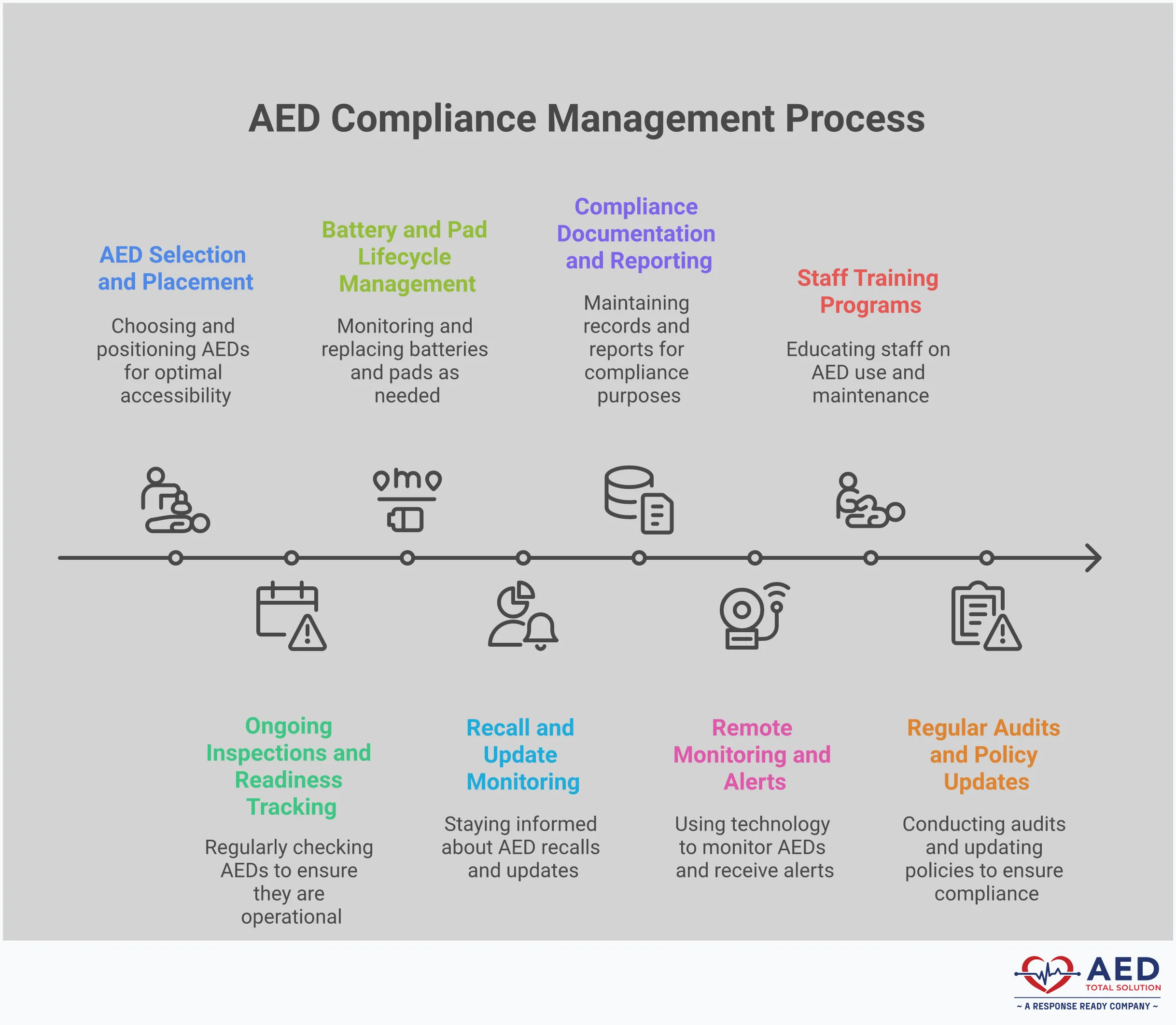
Putting a compliant AED program in place is more than just buying a device and mounting it on the wall. It’s about creating a complete system that ensures your AED is always ready and your team is prepared to act. A strong program protects your employees, reduces liability, and gives everyone peace of mind. Building one from the ground up involves a few key steps, from strategic placement and team training to diligent maintenance and record-keeping.
Think of it as a readiness plan. Each component works together to close compliance gaps and make sure your investment in safety truly pays off when it matters most. By following a structured approach, you can create a program that is not only compliant with regulations but also genuinely effective in an emergency. Let’s walk through the essential steps to get your program up and running.
Where to Place Your AEDs for the Fastest Response
Where you put your AED is just as important as having one. During a cardiac arrest, every second is critical, so the device needs to be easy to find and grab. Place your AEDs in central, high-traffic locations like lobbies, break rooms, or near elevators. The goal is for someone to be able to retrieve the AED and return to the victim within three minutes.
Make sure the AED is clearly visible and not hidden in a closet or an unmarked cabinet. Use standardized signage to point the way from multiple directions. This ensures that even visitors or new employees can locate it quickly in a high-stress situation. A well-placed AED is the first step toward a successful response.
Train Your Team to Act with Confidence
An AED is designed to be used by almost anyone, with clear voice prompts guiding the user. However, panic can be a major obstacle in an emergency. Providing your team with formal training in CPR and AED use builds the confidence they need to step in and act decisively. This training helps them understand the “why” behind each step and prepares them to respond effectively.
Regular refresher courses keep these life-saving skills sharp. When employees feel prepared, they are far more likely to use the AED correctly, manage the scene, and provide critical care until professional help arrives. A well-trained team transforms a piece of equipment into a true life-saving program.
Your Simple AED Maintenance Checklist
An AED is a medical device that requires regular attention to stay ready for use. You can’t just set it and forget it. A consistent maintenance schedule is essential for compliance and readiness. This involves routinely checking that the indicator light is green, confirming that electrode pads and batteries have not expired, and ensuring supplies are fully stocked.
Most AEDs perform daily self-tests, but monthly visual inspections are a best practice. It’s also important to stay on top of manufacturer notices or recalls. A comprehensive AED program management service can automate these checks, tracking expiration dates and inspection logs to ensure your device is always prepared for an emergency.
What Is Medical Oversight (And Why You Need It)?
Most state laws require an AED program to be managed under the guidance of a physician. This is known as medical oversight. A medical director provides a prescription for the device, reviews protocols, and helps ensure your program follows established best practices. They can also review event data after the AED is used to provide feedback and ensure quality control.
This oversight is a critical piece of a compliant and medically sound program. It connects your workplace response efforts to the broader emergency medical system, ensuring your team is providing care that aligns with professional standards. It’s a layer of assurance that protects both the victim and your organization.
Simple Steps for AED Documentation
If it isn’t written down, it didn’t happen. Meticulous documentation is your proof of compliance and a key part of limiting liability. You should keep detailed records of everything related to your AED program, including monthly inspection logs, battery and pad expiration dates, training certificates for your volunteer responders, and any maintenance performed.
These records are essential for passing audits and demonstrating due diligence. In the event of an incident, having a complete and organized file shows that you have responsibly managed your program. Centralized, audit-ready reporting simplifies this process, giving you a clear view of your program’s status at all times.
How to Budget for Your AED Program
The initial purchase of an AED is just one part of the overall investment. To maintain a state of readiness, you need to budget for ongoing costs. These include replacing electrode pads and batteries every two to five years, running regular training sessions for your team, and covering the cost of program administration and medical oversight.
Factoring these recurring expenses into your budget from the start ensures your program remains effective and compliant for the long haul. For predictable costs, some organizations choose an AED rental or a full-service management plan that bundles equipment, maintenance, and support into one consistent fee.
Related Articles
- AED Laws & Requirements Across State — AED Total Solution
- Mastering Life-Saving Devices: Why AEDs Are Crucial — AED Total Solution
- Florida AED Statutes & Regulations — AED Total Solution
- Texas AED Statutes & Regulations — AED Total Solution
- Pennsylvania AED Statutes & Regulations — AED Total Solution
Frequently Asked Questions
If my state doesn’t legally require an AED for my business, why should I still get one? While your state may not mandate an AED, the decision to have one is about more than just checking a legal box. It’s a fundamental part of workplace safety and risk management. Sudden cardiac arrest can happen to anyone, and having an AED on-site dramatically increases a person’s chance of survival. It shows your employees and customers that you are prepared to protect them, which builds a strong culture of care. From a business standpoint, it also reduces your liability by demonstrating a commitment to safety.
What’s the difference between just buying an AED and having a full AED program? Buying the device is only the first step. A full AED program is the complete system that ensures the device is ready to use at a moment’s notice. This includes everything from strategic placement and staff training to regular maintenance checks, supply replacement tracking, and medical oversight. A comprehensive program addresses all the legal and readiness requirements, making sure your AED is an asset that protects people, not a liability collecting dust on a wall.
Can any employee use an AED, or is special training required? Modern AEDs are designed to be incredibly simple, with clear voice prompts that guide a user through every step. In an emergency, anyone can and should use one. However, providing formal CPR and AED training is a crucial part of a compliant program. Training gives your team the confidence to act quickly and correctly under pressure, helping them overcome the hesitation that can cost precious seconds. It prepares them to manage the scene effectively until paramedics arrive.
Are Good Samaritan laws enough to protect my business from a lawsuit? Good Samaritan laws offer important legal protections, but they aren’t a blank check. This immunity is almost always tied to you properly managing your AED program according to your state’s specific rules. If an AED fails because of a dead battery or expired pads, that legal protection could be voided. The best way to ensure you are protected is to maintain meticulous records of your inspections, maintenance, and training.
What is the most common reason an AED fails during an emergency? The most frequent and preventable cause of AED failure is a lack of maintenance. This usually comes down to two simple things: an expired battery or expired electrode pads. AEDs perform regular self-checks, but if no one is physically inspecting the device and tracking these expiration dates, it can easily become unusable without anyone realizing it. A consistent inspection schedule is the only way to guarantee your AED is ready when you need it most.