Key Takeaways
- Dental emergencies demand AED access: Patients in dental offices face elevated cardiac risk from anesthesia, stress, and drug interactions, making an on-site AED a clinical necessity, not an optional accessory.
- Many states require AEDs in dental offices: States like California, New York, and Illinois have laws requiring AEDs in healthcare facilities, including dental practices. Check your state’s specific regulations to stay compliant.
- The right AED for a dental office should be simple and compact: Look for devices with clear voice prompts, CPR coaching, and a small footprint that fits into a clinical environment without disruption.
- Staff training is non-negotiable: Every team member, from the front desk to the hygienist, should know how to use the AED. Annual CPR/AED certification keeps your team prepared.
- A managed AED program eliminates compliance guesswork: Automated tracking of inspections, pad and battery expirations, and state-specific documentation keeps your practice audit-ready without adding to your administrative burden.
Why Every Dental Office Needs an AED
A dental office might not seem like a high-risk environment for cardiac emergencies, but the reality tells a different story. Every year, medical emergencies occur in dental practices across the country, and sudden cardiac arrest (SCA) is among the most serious. The combination of patient anxiety, local anesthesia, vasoconstrictors like epinephrine, and pre-existing cardiovascular conditions creates a unique risk profile that makes dental offices one of the most important settings for AED deployment.
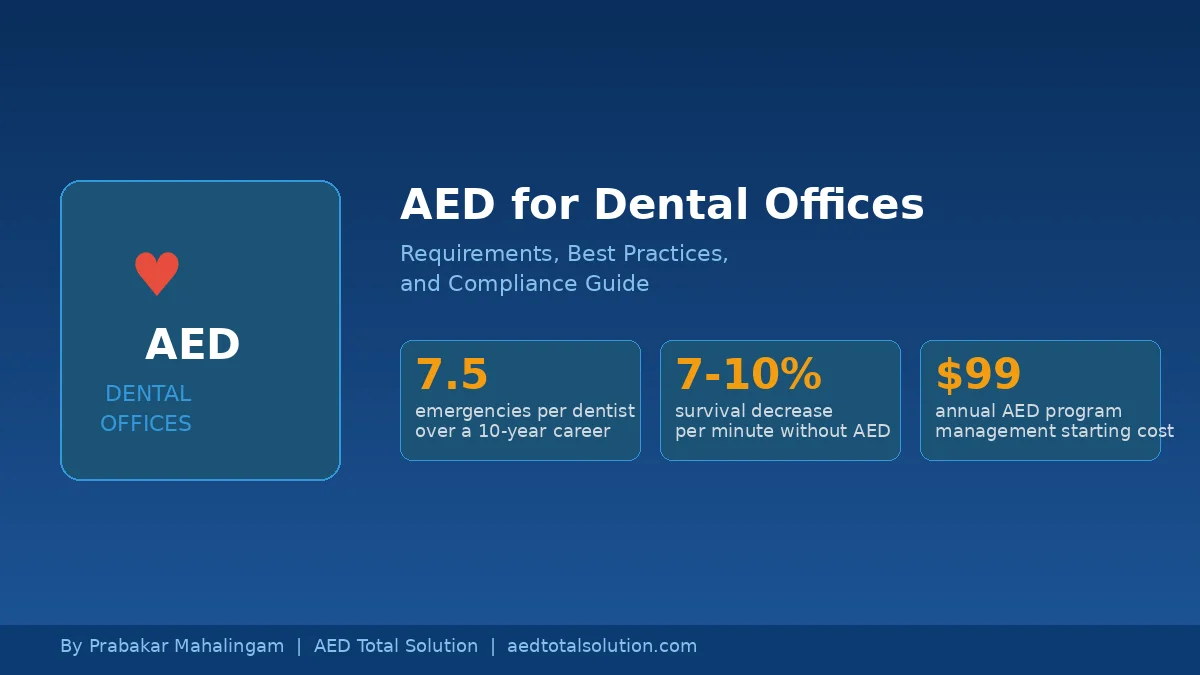
According to the American Dental Association (ADA), medical emergencies in dental offices occur at a rate of approximately 7.5 events per dentist over a 10-year career. While most are minor (syncope, allergic reactions), SCA events do happen, and when they do, the response time is everything. For every minute that passes without defibrillation, a victim’s chance of survival drops by 7% to 10%. An AED on-site can deliver a life-saving shock within seconds, bridging the critical gap before EMS arrives.
Beyond the clinical argument, having an AED demonstrates your commitment to patient safety. It’s the kind of investment that builds trust with patients, protects your practice from liability, and aligns with the standard of care that regulatory bodies and insurance providers expect from healthcare facilities.
State Requirements for AEDs in Dental Offices
While OSHA does not have a specific federal mandate requiring AEDs in dental offices, many states have passed legislation that effectively requires them in healthcare settings. Understanding your state’s requirements is the first step toward building a compliant AED program.
States with Explicit Healthcare Facility AED Requirements
Several states require AEDs in healthcare facilities, which includes dental practices:
- California: Requires AEDs in dental offices and mandates that dental practices maintain a written emergency action plan. The California Dental Board recommends AEDs as part of the standard emergency kit.
- New York: Requires AEDs in healthcare facilities open to the public, including dental offices. The state mandates training for designated staff and regular maintenance documentation.
- Illinois: Requires AEDs in facilities where sedation is administered, which applies to many dental practices that offer oral sedation or nitrous oxide.
- Florida: Requires AEDs in certain healthcare facilities. The Florida Board of Dentistry recommends AEDs as standard equipment for offices performing sedation procedures.
Sedation and Anesthesia Requirements
Even in states without a blanket AED requirement for dental offices, practices that administer any form of sedation typically must have an AED on-site. If your practice offers:
- Moderate (conscious) sedation
- Deep sedation
- General anesthesia
- IV sedation
Then you are almost certainly required to have an AED as part of your emergency equipment, along with supplemental oxygen, a pulse oximeter, and emergency medications. This requirement comes from your state dental board’s regulations on sedation permits.
For a comprehensive state-by-state breakdown of AED requirements, see our AED Laws by State: Complete Compliance Guide.
Choosing the Best AED for a Dental Office
Not every AED is the right fit for a dental practice. The clinical environment, space constraints, and the likelihood that non-medical staff may need to operate the device all factor into the decision. Here’s what to prioritize when selecting an AED for your dental office.
Ease of Use
In a dental practice, the person who reaches the AED first might be a dental assistant, office manager, or receptionist. The device must provide clear, step-by-step voice prompts that anyone can follow under pressure. Models with visual displays that show pad placement and CPR rhythm guidance are especially valuable in a clinical setting where multiple team members may be responding simultaneously.
CPR Feedback Technology
High-quality CPR dramatically improves survival outcomes. AEDs with real-time CPR feedback, such as the ZOLL AED 3 or ZOLL AED Plus, coach the rescuer on compression depth and rate. This feature is particularly useful in a dental office where staff may have CPR training but rarely practice the skill in a real emergency.
Compact Size and Clinical Fit
Dental operatories and hallways are often tight spaces. Choose an AED with a compact form factor that fits in a wall-mounted cabinet without obstructing patient flow or emergency access. The Philips HeartStart OnSite and the Physio-Control LIFEPAK CR2 are excellent choices that balance portability with professional-grade capability.
Pediatric Capability
If your dental practice treats children, having pediatric pad capability is essential. Many modern AEDs include a pediatric mode or accept child-specific electrode pads that automatically adjust the energy level for smaller patients. For more information on pediatric AED considerations, see our guide on Pediatric AED Pads.
Recommended AED Models for Dental Offices
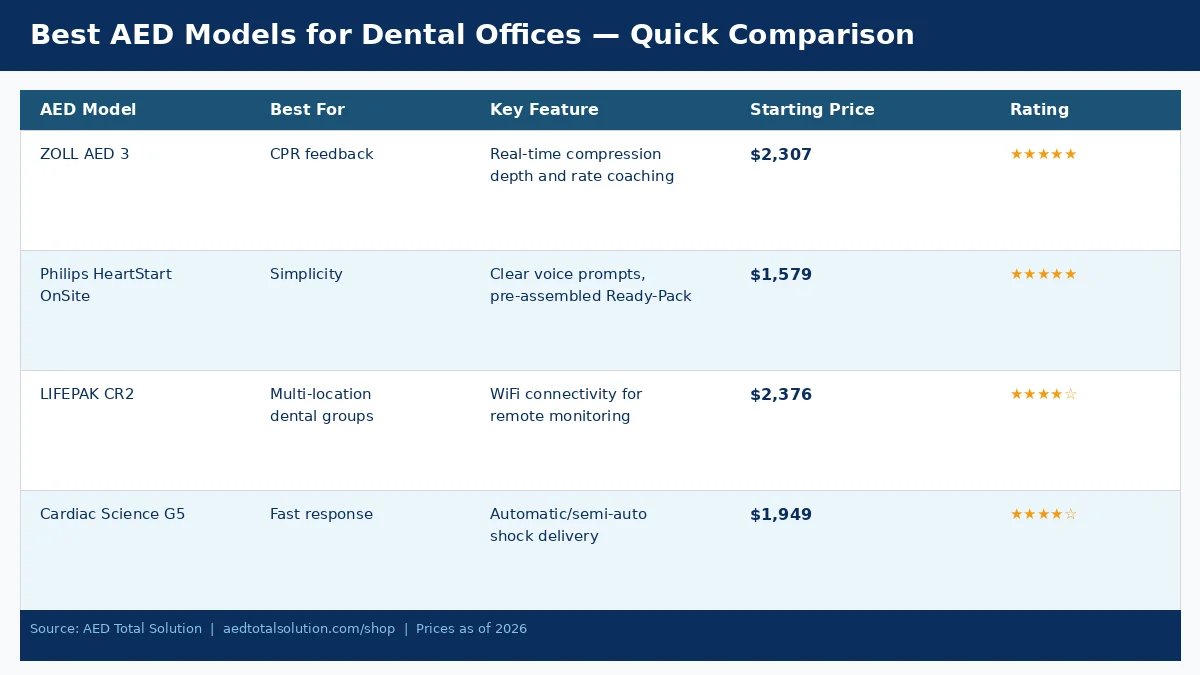
| AED Model | Best For | Key Feature | Starting Price |
|---|---|---|---|
| ZOLL AED 3 | Practices wanting CPR feedback | Real-time CPR coaching with depth and rate feedback | $2,307 |
| Philips HeartStart OnSite | Simplicity and reliability | Clear voice prompts, pre-assembled Ready-Pack | $1,579 |
| Physio-Control LIFEPAK CR2 | Multi-location dental groups | WiFi connectivity for remote monitoring | $2,376 |
| Cardiac Science Powerheart G5 | Fast rescue response | Automatic or semi-automatic shock delivery | $1,949 |
Where to Place an AED in Your Dental Office
Strategic AED placement ensures the device can be retrieved and applied within the critical first few minutes of a cardiac event. In a dental office, follow these placement guidelines:
- Central, visible location: Mount the AED in a wall cabinet in a hallway or common area that is accessible from all treatment rooms. The ideal location allows any staff member to retrieve the device and return to the patient within 60 seconds.
- Mount at the right height: The AED cabinet handle should be no higher than 48 inches from the floor to comply with ADA accessibility guidelines. Place the AED sign above the cabinet at approximately 7 feet for visibility from a distance.
- Near the front desk or break room: In smaller offices, the front desk area or staff break room often provides the best central access point. Avoid placing the AED inside a locked room or behind barriers that could delay access.
- Multiple AEDs for larger practices: For multi-operatory practices or offices spread across multiple floors, consider placing an AED on each floor or wing. The goal is to keep retrieval time under 90 seconds from any point in the facility.
For detailed placement guidelines, including building code requirements and best practices, read our AED Placement Guidelines.
Training Your Dental Team
An AED is only as effective as the person using it. While modern devices are designed for untrained bystanders, having a trained team dramatically improves response time and outcomes. Here’s how to build a prepared dental office team.
Who Should Be Trained
The short answer: everyone. In a dental office, any team member could be the first to recognize a cardiac emergency. Front desk staff, dental assistants, hygienists, and dentists should all complete CPR/AED certification. This ensures that no matter who is closest when an emergency strikes, they can act immediately without hesitation.
Certification Requirements
Most dental boards require dentists and clinical staff to maintain current CPR/BLS certification as a condition of licensure. Extend this requirement to all staff members, including administrative personnel. The American Heart Association (AHA) and the American Red Cross both offer CPR/AED certification courses that can be completed in a single session.
Practice Drills
Training once isn’t enough. Conduct quarterly emergency drills that simulate a cardiac arrest scenario in your office. These drills should cover:
- Recognizing the signs of sudden cardiac arrest
- Activating your office’s emergency action plan
- Calling 911
- Retrieving and applying the AED
- Performing high-quality CPR until EMS arrives
For a comprehensive overview of AED training, visit our AED Training Guide.
Maintaining Your AED Program
Purchasing an AED is the first step. Maintaining it so it’s always ready to perform is the ongoing commitment. An AED that fails during an emergency due to expired pads or a dead battery is worse than having no AED at all, because it wastes precious minutes and creates a false sense of security.
Monthly Inspections
Perform a visual inspection of your AED at least once per month. Check:
- The status indicator light shows the device is rescue-ready
- Electrode pads are sealed and within their expiration date
- The battery charge level is adequate
- The cabinet is clean, unlocked, and the AED is easily accessible
- All accessories (rescue kit, razor, gloves) are stocked
Pad and Battery Replacement
AED electrode pads typically expire every 2 to 5 years depending on the manufacturer, and batteries last 2 to 5 years as well. When pads are used during a rescue or expire, they must be replaced immediately. Tracking these dates manually is one of the most common compliance failures in dental offices.
Documentation
Keep records of every inspection, maintenance action, and training session. This documentation is essential for:
- State regulatory compliance
- Dental board audits
- Insurance liability protection
- Good Samaritan law coverage
For a complete maintenance guide, see our AED Maintenance Checklist.
Why Dental Practices Choose Managed AED Programs
For dental offices, especially multi-location groups like dental service organizations (DSOs), managing AED compliance manually is a significant administrative burden. Tracking pad expirations, scheduling inspections, maintaining training records, and staying current with state regulations across multiple locations quickly becomes overwhelming.
This is where a managed AED program delivers real value. AED Total Solution provides comprehensive program management that handles every aspect of AED compliance, so your dental team can focus on patient care.
What a Managed Program Includes
- Medical direction and oversight: A licensed physician provides the medical oversight required for your AED program, including the standing prescription for your devices.
- Automated compliance tracking: Our web portal and mobile app track every device, battery, pad expiration, and inspection across all your locations in one centralized dashboard.
- Proactive supply replacement: With the Standard Plus plan, expired or used pads and batteries are automatically shipped to your office at no additional cost.
- Post-event support: If your AED is ever deployed, we handle data download, physician review, device refurbishment, and coordination with EMS, so you are back to full readiness as quickly as possible.
- State registration and documentation: We manage AED registration with your state and maintain all compliance documentation for audit readiness.
For dental groups managing 10, 50, or even 400+ locations, this centralized approach eliminates the guesswork and risk of manual tracking. Learn more about our AED Program Management Services.
Frequently Asked Questions
Are AEDs required in dental offices?
It depends on your state. Many states require AEDs in healthcare facilities, which includes dental offices. Additionally, almost all states require AEDs in dental practices that administer sedation. Even where not legally required, the ADA and OSHA strongly recommend AEDs as part of a dental office’s emergency preparedness plan. Check your state dental board’s regulations and our AED Laws by State guide for specifics.
How much does an AED cost for a dental office?
AED device packages typically range from $1,500 to $2,800, depending on the model and included accessories. Program management services start at $99 per year per device for the Standard plan, or $204 per year for the Standard Plus plan that includes automatic supply replacement. For a detailed cost breakdown, see our AED Cost Guide.
How often should a dental office AED be inspected?
Perform a visual inspection at least monthly. Check the status indicator, pad and battery expiration dates, and overall accessibility. Most states require documented monthly inspections. A managed AED program automates these reminders and creates inspection records for you. Read our AED Inspection Guide for details.
Can dental staff use an AED without medical training?
Yes. Modern AEDs are designed to be used by anyone, with clear voice and visual prompts that guide the operator step by step. However, formal CPR/AED training dramatically improves response time and effectiveness. Most dental boards require clinical staff to maintain current CPR/BLS certification, and we recommend extending this requirement to all office personnel.
What happens if an AED is used on a patient in our dental office?
After an AED deployment, immediately call 911 if not already done. Continue following the AED’s prompts and perform CPR as directed until EMS arrives. After the event, your AED program manager will handle the data download and physician review. The device will be sent for refurbishment and a loaner AED will be provided to keep your office protected. Good Samaritan laws in all 50 states provide liability protection for individuals who use AEDs in good faith during an emergency. Learn more about Good Samaritan Law protections.