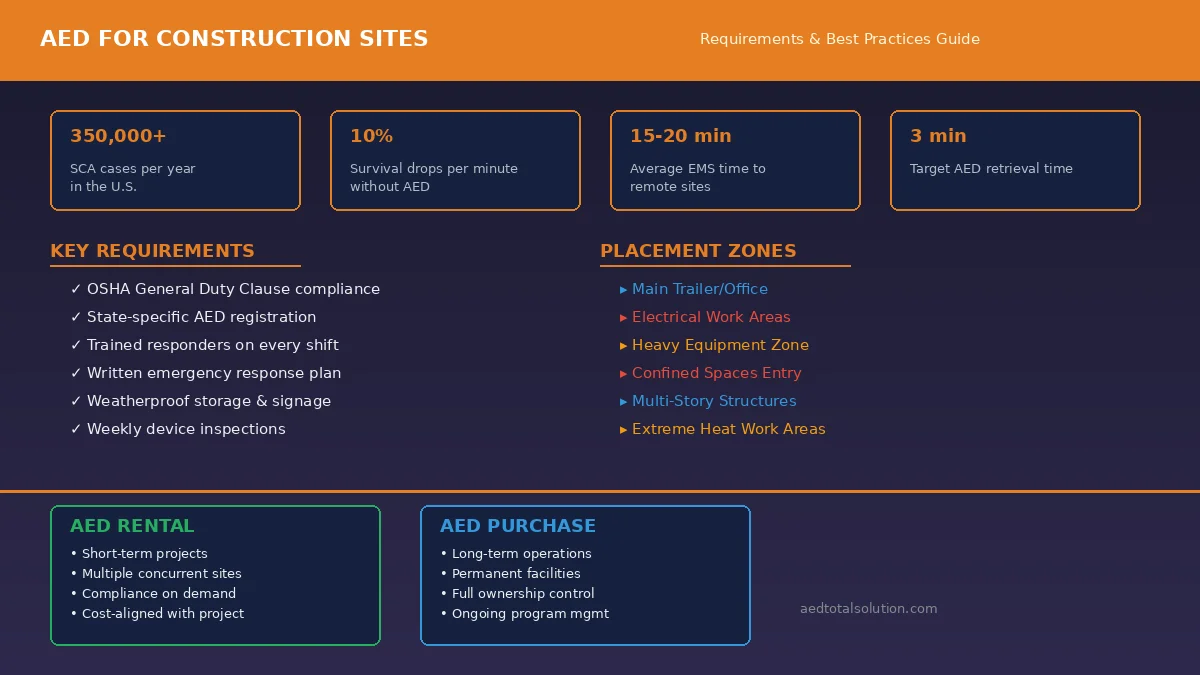
Construction sites rank among the most hazardous work environments in the United States. Between heavy physical labor, exposure to extreme temperatures, risk of electrocution, and the stress these conditions place on the cardiovascular system, construction workers face an elevated risk of sudden cardiac arrest (SCA). When a cardiac emergency strikes on a jobsite, every second counts, and emergency medical services may be 15 to 20 minutes away from a remote or active construction zone.
An automated external defibrillator (AED) on the construction site can mean the difference between a worker going home to their family and a preventable fatality. This guide covers the regulatory landscape, placement best practices, rental options for temporary sites, and program management strategies to keep construction crews protected.
Why Construction Sites Need AEDs
The construction industry consistently appears among the top sectors for workplace fatalities. While falls, struck-by incidents, and electrocutions receive the most attention, cardiac events account for a significant percentage of on-site deaths. Several factors make construction workers particularly vulnerable:
- Physical exertion. Heavy lifting, operating equipment, and sustained manual labor in demanding conditions place extreme stress on the heart.
- Heat exposure. Working outdoors in high temperatures increases the risk of heat stroke and cardiac events, especially during summer months.
- Electrocution risk. Electrical injuries can trigger fatal cardiac arrhythmias, including ventricular fibrillation, which requires immediate defibrillation.
- Demographics. The construction workforce skews older and includes individuals who may have undiagnosed cardiovascular conditions.
- Remote locations. Many construction sites are located in areas far from hospitals or fire stations, resulting in extended EMS response times that can exceed 10 to 15 minutes.
For every minute without defibrillation, a cardiac arrest victim’s survival rate drops by approximately 10%. An AED can deliver a life-saving shock within seconds, restoring the heart’s normal rhythm while the crew waits for paramedics to arrive.
OSHA and Federal Guidelines for AEDs on Construction Sites
OSHA does not currently mandate AEDs on construction sites through a specific standard. However, OSHA’s General Duty Clause (Section 5(a)(1)) requires employers to provide a workplace free from recognized hazards that could cause death or serious physical harm. Given the elevated cardiac risk factors present on construction sites, maintaining an AED program is a reasonable and recommended step toward meeting that obligation.
OSHA’s first aid standards (29 CFR 1926.50 for construction) require employers to ensure the availability of first aid services in reasonable proximity to the worksite. When a construction project is located far from a hospital or clinic, OSHA requires a person trained in first aid to be available at the site. While this standard does not specifically name AEDs, the agency’s best practice guidance on AED requirements encourages their inclusion in workplace first aid programs.
Several important regulatory developments are pushing the construction industry toward mandatory AED adoption:
- Ontario, Canada enacted regulations effective January 1, 2026, requiring AEDs on all construction projects with 20 or more regularly employed workers.
- Multiple U.S. states require AEDs in specific facility types, and construction-related industries are increasingly included. Check the AED laws by state to understand your specific obligations.
- Industry best practices from organizations like the American Heart Association and National Safety Council strongly recommend AEDs at any worksite where EMS response times exceed four to five minutes.
AED Placement Best Practices for Construction Sites
Placing AEDs on a construction site requires a different approach than a fixed office building. The site changes daily as new structures are built, work areas shift, and crews move between zones. Here are the guidelines for effective AED placement on construction sites:
Location and Accessibility
- Central staging area. Place at least one AED in the main trailer, tool crib, or site office where it is accessible throughout the workday.
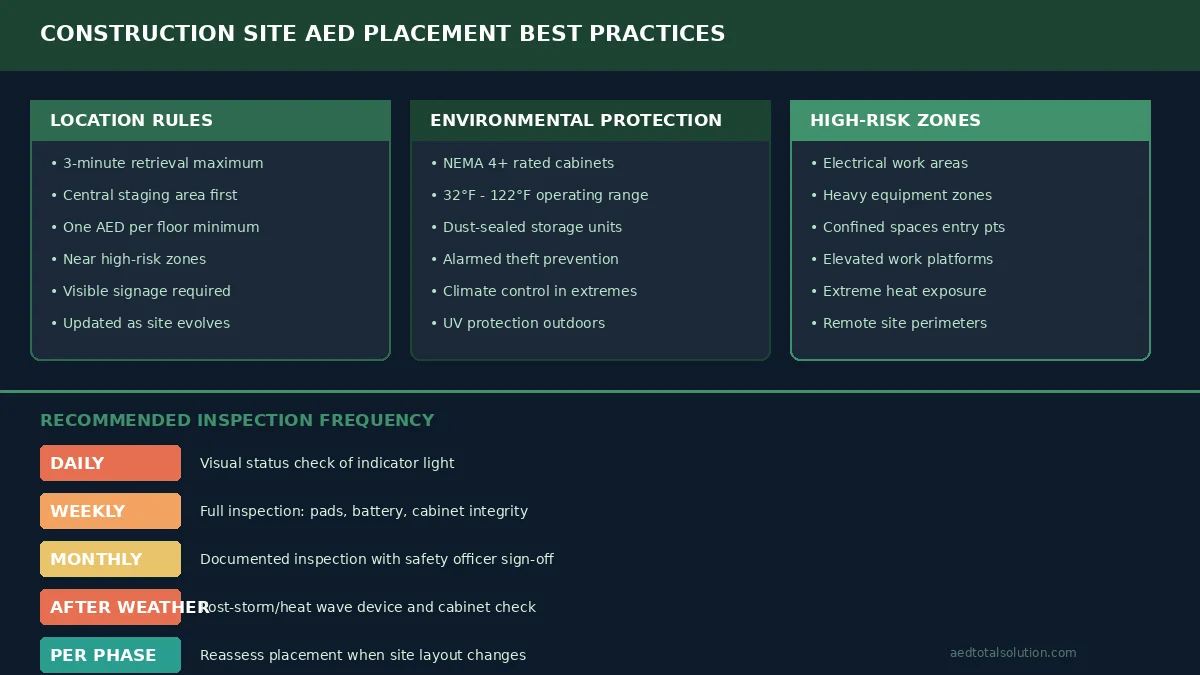
- Three-minute rule. Any worker on the site should be able to retrieve an AED and return within three minutes. On large sites, this may require multiple units placed at strategic intervals.
- High-risk zones. Position additional AEDs near areas with elevated cardiac risk: electrical work zones, heavy equipment operation areas, enclosed or confined spaces, and any area where workers perform sustained physical labor in extreme heat.
- Visible and signed. Mark AED locations with highly visible signage. On a busy construction site with changing layouts, use consistent placement markers that crews can identify quickly.
Environmental Protection
Construction sites expose equipment to conditions that standard indoor AEDs are not designed for. Address these challenges:
- Weather protection. Use weatherproof AED cabinets rated for outdoor use (NEMA 4 or higher). Protect devices from direct rain, snow, dust, and extreme temperatures.
- Temperature range. Most AED manufacturers specify an operating range of 32°F to 122°F (0°C to 50°C). In regions with extreme cold or heat, use insulated cabinets with climate control features.
- Dust and debris. Seal AED storage units against construction dust, which can compromise electrode pad adhesion and device functionality.
- Theft prevention. Use alarmed cabinets to deter theft while maintaining immediate access during emergencies.
For detailed guidance on device positioning, see our AED placement guidelines.
AED Rental Options for Temporary Construction Sites
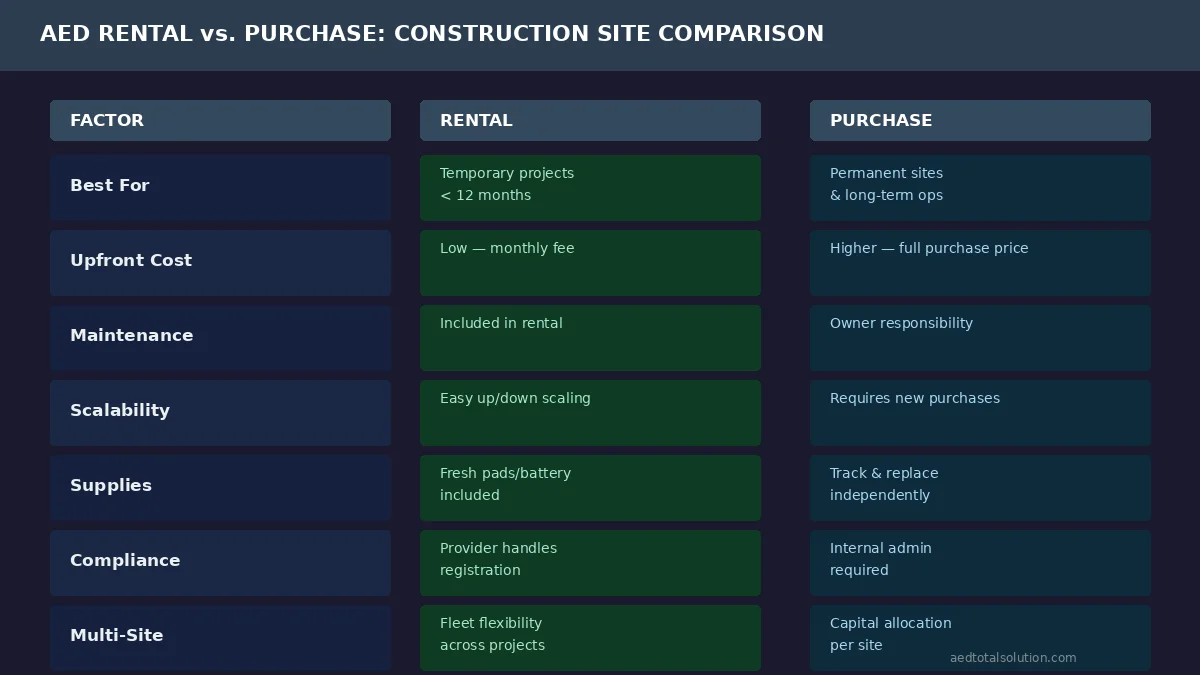
One of the biggest challenges for construction companies is the temporary nature of jobsites. Purchasing AEDs for every project may not be cost-effective, especially for projects with short timelines. This is where AED rental programs offer a practical solution.
When Renting Makes Sense
- Short-term projects. Construction phases lasting weeks to a few months benefit from rental programs that align costs with project duration.
- Multiple concurrent sites. General contractors managing several active projects can scale their AED coverage up or down without a large capital investment.
- Compliance on demand. When a contract or jurisdiction requires AEDs on-site, rentals provide immediate compliance without long-term financial commitment.
- Event-based needs. Large concrete pours, steel erection, and other high-risk phases may warrant additional temporary AED coverage beyond the baseline.
What a Good AED Rental Program Includes
Not all rental programs are created equal. A comprehensive construction AED rental should include:
- FDA-approved AED devices that are current-generation, fully inspected, and rescue-ready upon delivery.
- Fresh electrode pads and batteries with expiration dates that extend beyond the project timeline.
- Weatherproof cabinets and signage appropriate for outdoor construction environments.
- Training coordination to ensure designated site personnel know how to operate the device and respond to cardiac emergencies.
- Maintenance and swap service for devices that are used in a rescue event or require battery or pad replacement during the rental period.
AED Total Solution offers flexible AED rental programs designed specifically for temporary worksites, events, and construction projects. Our rentals include fully inspected devices, fresh supplies, and coordination with your site safety team.
Building a Construction Site AED Program
Whether you purchase or rent, having an AED on-site is only part of the equation. A compliant and effective AED program for construction includes several additional components.
Designate Trained Responders
Assign at least two trained responders per shift who have completed CPR/AED certification. On construction sites with rotating crews, track certifications carefully to ensure trained personnel are always present during active work hours. Consider including AED/CPR training as part of your standard site orientation for new workers.
Create a Site-Specific Emergency Response Plan
Every construction project should have a written AED emergency response plan that covers:
- Location of all AEDs on the site
- Names of trained responders on each shift
- Step-by-step response protocol for cardiac emergencies
- Site address and specific directions for EMS access (gate codes, road names, building identifiers)
- Post-event procedures including device data download and physician review
Update this plan as the site evolves and new phases begin.
Establish a Maintenance Schedule
AEDs require regular inspection to remain rescue-ready. On a construction site, inspections should be more frequent than in a controlled indoor environment due to harsher conditions:
- Weekly visual checks of the device status indicator, cabinet integrity, and pad/battery expiration dates.
- Monthly documented inspections with sign-off by the site safety officer.
- Immediate inspection after extreme weather events (storms, heat waves, freezing temperatures) that may have affected the device.
For a detailed inspection framework, see our AED maintenance checklist.
Register and Document
Most states require AED registration with local EMS agencies. Construction sites add complexity because the “facility” is temporary. Work with your AED program provider to:
- Register AEDs with the local emergency communications center serving the project site
- Maintain documentation of training records, inspection logs, and maintenance history
- Ensure medical direction (physician oversight) is in place for the AED program
- Keep all compliance records organized and accessible for audits or incident investigations
Multi-Site AED Management for Construction Companies
General contractors, construction management firms, and large subcontractors often manage AEDs across dozens of active projects simultaneously. Tracking devices, supplies, training, and compliance across multiple temporary sites creates an administrative challenge that spreadsheets and manual tracking cannot reliably handle.
AED Total Solution provides AED program management services built for exactly this scenario. Our platform offers:
- Centralized device tracking across all active job sites with real-time status visibility
- Automated alerts for pad and battery expirations, upcoming inspections, and certification renewals
- Remote readiness monitoring to confirm devices are rescue-ready without sending someone to physically check each unit
- Scalable coverage that adapts as projects start and finish throughout the year
- Audit-ready documentation for every device, every site, every inspection
For construction companies operating across multiple states, our team also tracks state-specific AED requirements to ensure compliance at every location.
Frequently Asked Questions
Are AEDs required on construction sites?
In the United States, OSHA does not have a specific standard mandating AEDs on construction sites. However, OSHA’s General Duty Clause and first aid standards create a strong expectation that employers will provide appropriate first aid resources, particularly on sites far from medical facilities. Several states have their own AED requirements, and Ontario, Canada, now requires AEDs on construction projects with 20 or more workers. Check your state and local requirements, and consider AEDs a best practice regardless of mandates.
How many AEDs do I need on a construction site?
Follow the three-minute retrieval rule: any worker should be able to retrieve an AED and return to the victim within three minutes. For a small site with a single staging area, one AED may be sufficient. For large sites spanning multiple acres or with work happening on different floors or in separate buildings, multiple AEDs are necessary. Conduct a site assessment at the beginning of each project phase to determine the right number and placement.
Can I rent an AED for a construction project instead of buying one?
Yes. AED rental programs are specifically designed for temporary needs like construction projects, events, and seasonal operations. Renting aligns your costs with the project duration and includes fully inspected devices, fresh supplies, and often maintenance support. AED Total Solution offers flexible rental terms for construction companies.
What type of AED is best for a construction site?
Look for devices that are durable, dust-resistant, and rated for a wide temperature range. Semi-automatic AEDs with clear voice prompts are ideal because they guide untrained or infrequently trained users through the rescue process step by step. Models with a high IP rating (dust and water resistance) are preferred for outdoor construction environments. Your AED provider can recommend the best model based on your site conditions.
Who should be trained to use an AED on a construction site?
At minimum, designate two trained responders per shift. In practice, training as many crew members as possible is the safest approach, since cardiac emergencies can happen anywhere on the site and the closest person may not be a designated responder. Include AED/CPR training in your standard site safety orientation and schedule refresher courses every two years.
Protect Your Crews on Every Jobsite
Construction companies invest heavily in fall protection, electrical safety, and PPE. Adding AEDs to your jobsite safety program addresses one of the most time-critical emergencies your workers can face. Whether you are managing a single project or coordinating safety across dozens of active sites, AED Total Solution provides the devices, rental programs, training coordination, and program management to keep your crews protected.
Contact AED Total Solution at 855-263-7772 or submit an inquiry to discuss AED solutions for your construction sites.