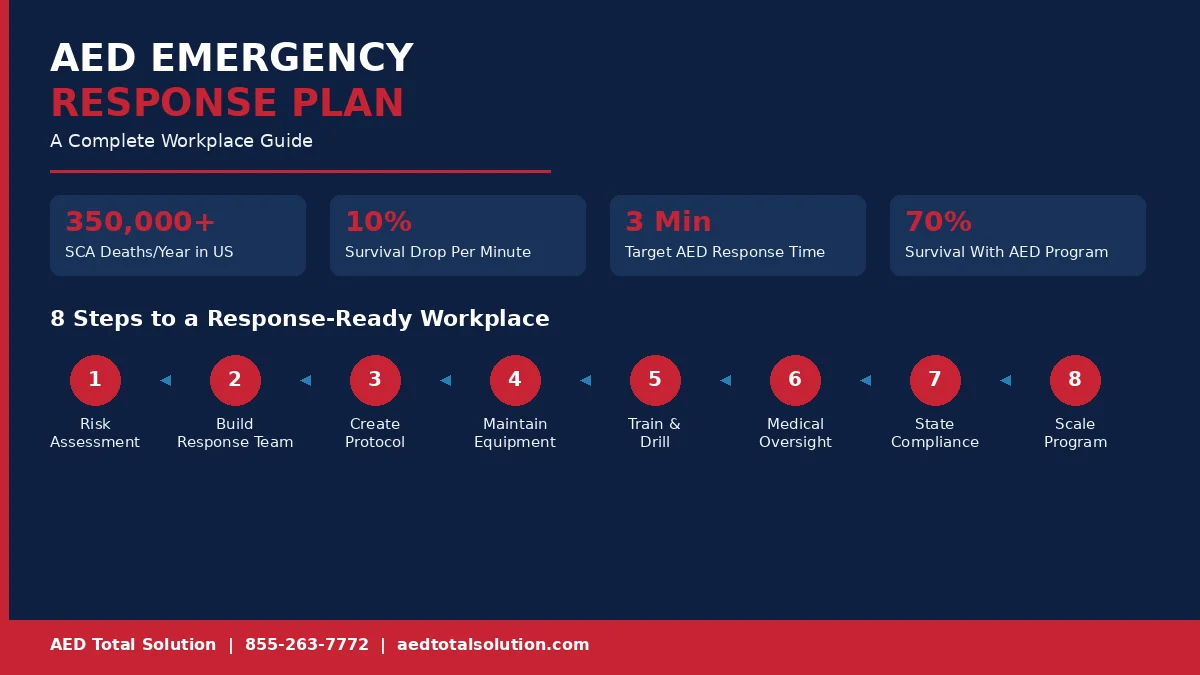
Sudden cardiac arrest (SCA) strikes more than 350,000 people in the United States every year, and a significant number of these events happen in the workplace. When an employee, visitor, or customer collapses from cardiac arrest, the difference between life and death often comes down to one thing: how fast your team can respond with an AED.
Having an automated external defibrillator on-site is a strong first step. But a device on the wall without a plan behind it creates a false sense of security. An effective AED emergency response plan ensures that trained people, functioning equipment, and clear procedures are all in place before an emergency happens.
This guide walks you through every step of building a workplace AED emergency response plan, from conducting a site assessment to establishing ongoing compliance and documentation.
Why Every Workplace Needs an AED Emergency Response Plan
Cardiac arrest is not a scheduled event. It strikes without warning, and for every minute a victim goes without defibrillation, their chance of survival drops by approximately 10%. Average EMS response times in many urban areas range from 7 to 12 minutes, meaning that relying solely on 911 can reduce survival odds to near zero.
An AED emergency response plan bridges the gap between the moment someone collapses and the arrival of professional medical help. Organizations with a documented AED program in place can achieve survival rates of 50% to 70%, compared to less than 10% when no immediate intervention occurs.
Beyond saving lives, a formal AED emergency response plan:
- Satisfies regulatory requirements. Many states mandate AED programs in specific facilities, including schools, fitness centers, and government buildings. A documented plan is often a prerequisite for compliance. Learn more about AED laws by state.
- Reduces organizational liability. Good Samaritan protections in most states require that AED programs follow established guidelines, including training, maintenance, and medical oversight.
- Demonstrates due diligence. In the event of a cardiac emergency, having a documented response plan shows that your organization took reasonable steps to protect people on your premises.
- Aligns with OSHA guidance. While OSHA does not mandate AEDs in most workplaces, the agency encourages employers to include AEDs in their emergency action plans. Read the full breakdown of OSHA requirements for AEDs.
Step 1: Conduct a Workplace Risk Assessment
Before purchasing equipment or assigning roles, assess your workplace to understand the specific risks and needs of your environment.
Evaluate Your Facility
Consider the following factors during your assessment:
- Number of employees and visitors. Larger populations increase the statistical likelihood of a cardiac event.
- Building layout and size. Multi-story buildings, campuses, and facilities spread across large areas require multiple AED units to ensure rapid access.
- Distance from emergency services. Remote locations, industrial sites, and facilities far from hospitals have longer EMS response times. Construction sites are a prime example of environments where on-site AEDs are critical.
- Demographics of occupants. Workplaces with older employees, high-stress environments, or physically demanding jobs face elevated cardiac risk.
- Existing emergency resources. Evaluate what first aid equipment, trained personnel, and emergency procedures are already in place.
Determine AED Quantity and Placement
The goal is to ensure that any person in your facility can retrieve an AED and return to the victim within three minutes. As a general guideline:
- Place AEDs in high-traffic, visible, and accessible locations such as lobbies, break rooms, and near elevators. For detailed recommendations, see our AED placement guidelines.
- In multi-story buildings, place at least one AED per floor.
- Consider placing AEDs near high-risk areas such as gyms, cafeterias, loading docks, and manufacturing floors.
- Use AED signage (wall signs, overhead markers, window decals) to ensure visibility.
For organizations managing multiple locations, a centralized tracking system is essential for maintaining oversight of every device across every site.
Step 2: Build Your AED Response Team
An AED sitting in a cabinet is only effective if someone nearby knows how to use it. Your emergency response plan should designate specific individuals as AED responders.
Selecting Team Members
- Choose volunteers from every shift and department. Ensure coverage during all operating hours.
- Aim for a ratio of at least one trained responder per AED location.
- Include both primary responders and backups to account for absences, vacations, and turnover.
- Prioritize employees who are already in first aid or safety roles, such as security personnel, front desk staff, and floor supervisors.
Defining Roles and Responsibilities
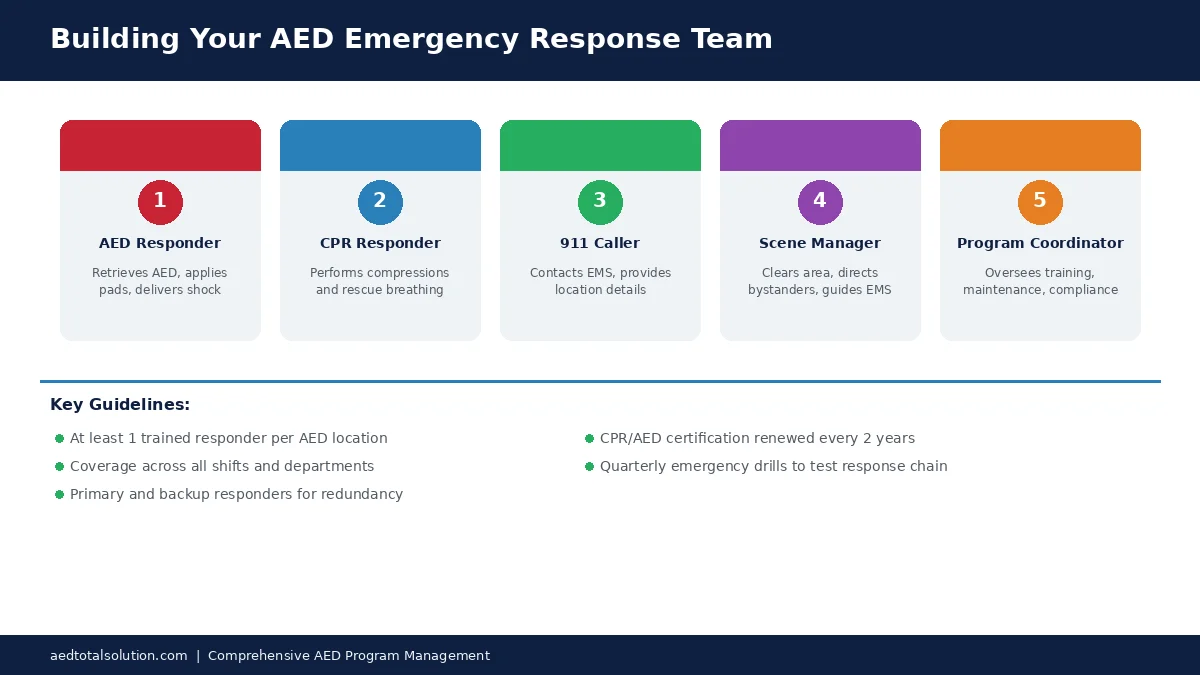
A typical AED response team includes:
| Role | Responsibility |
|---|---|
| AED Responder | Retrieves the AED, applies pads, delivers shock as directed by the device |
| CPR Responder | Performs chest compressions and rescue breathing until the AED is ready |
| 911 Caller | Contacts emergency services immediately and provides building location details |
| Scene Manager | Directs bystanders, clears the area, and guides EMS to the victim’s location |
| AED Program Coordinator | Oversees the entire AED program including training, maintenance, and compliance |
Every responder should complete a certified AED training program that covers device operation, CPR technique, and emergency protocols.
Step 3: Develop Your Emergency Response Protocol
Your AED emergency response plan needs a clear, step-by-step protocol that every employee can follow. Post this protocol near each AED and include it in employee orientation materials.
Sample Cardiac Emergency Response Protocol
- Recognize the emergency. Check if the person is unresponsive and not breathing normally.
- Call 911. Designate someone to call emergency services immediately. Provide the facility address, floor, and room number.
- Retrieve the nearest AED. Send someone to get the closest AED while CPR begins.
- Start CPR. Begin chest compressions immediately. Push hard and fast at a rate of 100 to 120 compressions per minute.
- Apply the AED. Turn on the device, follow the voice prompts, attach the electrode pads, and allow the AED to analyze the heart rhythm.
- Deliver a shock if advised. Ensure no one is touching the victim and press the shock button when instructed. For more on what to do when the AED says no shock advised, see our detailed guide.
- Continue CPR. Resume compressions immediately after the shock (or if no shock is advised) and continue until EMS arrives.
- Transfer care to EMS. Provide EMS with information about what happened, when CPR started, and how many shocks were delivered.
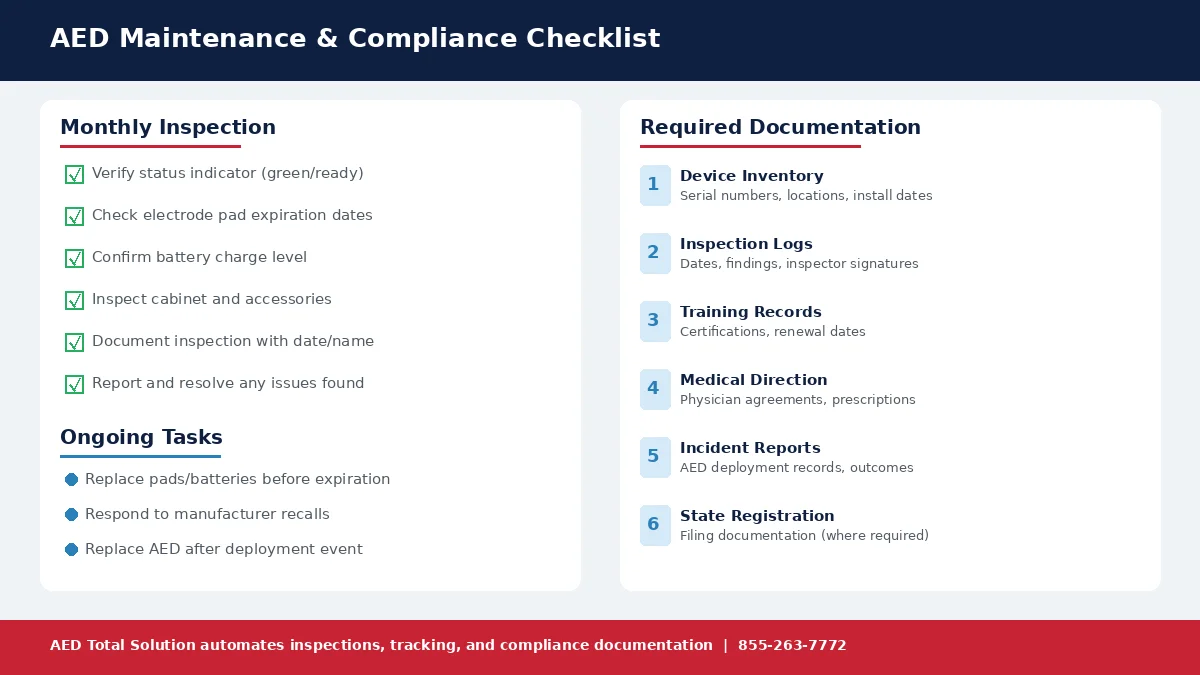
- Verify the AED status indicator shows the device is rescue-ready (green light or checkmark).
- Check that electrode pads are sealed, undamaged, and within their expiration date.
- Confirm the battery is charged and within its usable life.
- Inspect the AED cabinet and ensure the device is clean, accessible, and all accessories are present.
- Document every inspection with date, inspector name, and any issues noted.
- Replace electrode pads and batteries before they expire. AED Total Solution’s Standard Plus plan includes automatic no-cost replacement of pads and batteries for both expiration and use.
- Respond to manufacturer recalls and software updates promptly.
- Replace any AED deployed in a rescue event. Loaner devices should be available to maintain coverage while the used AED is inspected and refurbished.
- Hands-on practice with an AED trainer device
- CPR technique for adults, children, and infants
- Recognition of cardiac arrest symptoms including agonal breathing
- Proper AED pad placement for adults and pediatric patients
- Scenario-based practice drills
- Test the full response chain from recognition to AED deployment
- Measure response time (target: AED applied within 3 minutes)
- Identify gaps in communication, equipment access, or training
- Include a post-drill debrief to document lessons learned and action items
- Physician prescription for each AED device
- Written response protocols reviewed and approved by a licensed physician
- Post-event review with physician analysis of AED data downloads and ECG recordings
- Annual program review to update protocols based on new guidelines or regulatory changes
- AED device inventory (serial numbers, locations, installation dates)
- Inspection logs with dates and findings
- Training records and certification dates for all responders
- Medical direction agreements and physician prescriptions
- Incident reports for any AED deployment
- State and local AED registration forms (where required)
- Centralized device tracking. Use a single platform to monitor AED status, supply expiration dates, and inspection schedules across all locations.
- Standardized protocols. Ensure every location follows the same response procedures, adjusted for state-specific requirements.
- Coordinated training. Track responder certifications across all sites and schedule training renewals proactively.
- Unified reporting. Generate compliance reports that cover your entire organization, not just individual locations.
- Organization name and locations covered
- Plan effective date and review schedule
- AED Program Coordinator contact information
- Medical director name and contact information
- List of all AED devices (model, serial number, location)
- Accessory inventory (pads, batteries, cabinets, signage)
- Maintenance schedule and responsible parties
- Roster of trained responders by location and shift
- Certification dates and renewal schedule
- Backup responder assignments
- Step-by-step response procedure
- Communication chain (who calls 911, who retrieves the AED)
- Post-event procedures (data download, physician review, equipment replacement)
- State registration and filing documentation
- Medical direction agreements
- Inspection logs and training records
- Incident reports
For a detailed walkthrough of operating an AED, visit our step-by-step AED guide.
Step 4: Ensure Proper AED Maintenance and Readiness
An AED that fails during an emergency is worse than having no AED at all. Regular maintenance is a non-negotiable part of any AED emergency response plan.
Monthly Inspection Checklist
Ongoing Maintenance Tasks
For a complete maintenance framework, see our AED maintenance checklist.
Step 5: Train Employees and Conduct Drills
Training is what turns equipment and protocols into a coordinated, effective response.
Initial Training Requirements
All designated AED responders should complete a certified CPR/AED training course that includes:
Refresher Training and Certification Renewal
CPR/AED certifications typically expire every two years. Establish a system to track certification dates and schedule renewals before they lapse. AED Total Solution’s management platform includes automated certification tracking with 60-day and 30-day expiration notifications.
Emergency Drills
Conduct unannounced cardiac emergency drills at least twice per year. Drills should:
Step 6: Establish Medical Oversight and Compliance Documentation
Most states require some level of medical oversight for AED programs. Even in states where it is not mandated, physician oversight strengthens your program’s legal protections and clinical credibility.
Medical Direction Components
A comprehensive AED program should include:
AED Total Solution provides medical oversight through a nationwide physician network (MDSI), ensuring compliance regardless of your organization’s location.
Required Documentation
Maintain the following records as part of your AED program:
This documentation is critical for regulatory compliance and liability protection. Organizations using AED Total Solution’s management platform have all records centralized in a digital dashboard with automated alerts and audit-ready reporting.
Step 7: Address State-Specific AED Requirements
AED regulations vary significantly by state. Your emergency response plan must account for the specific requirements in every state where your organization operates.
Common State Regulatory Models
| Regulatory Model | Example States | Key Requirements |
|---|---|---|
| Comprehensive Regulation | California | Facility mandates, biannual testing, 90-day inspections, conditional Good Samaritan immunity |
| Medical Oversight Required | Texas | Physician oversight mandate, monthly inspections, post-event physician review |
| Collaborative Agreement | New York | EMS council filing, quarterly reporting, capacity-based mandates (1,000+ person facilities) |
| Encouraged, Not Mandated | Florida | Unconditional Good Samaritan protection, voluntary compliance encouraged |
| Administrative Focus | Illinois | Registration with state health department, penalty structures ($1,500-$2,000+), fitness center mandates |
For multi-state organizations, managing compliance across different regulatory frameworks adds significant complexity. A complete guide to AED laws by state is available to help you understand your specific obligations.
Step 8: Scale Your AED Program Across Multiple Locations
Organizations with more than one facility face unique challenges in maintaining consistent AED readiness across all sites.
Multi-Location Program Management
AED Total Solution specializes in multi-location AED program management, providing centralized dashboards, automated monitoring, and dedicated program specialists for organizations of any size.
AED Emergency Response Plan Template
Use this template as a starting point for your organization’s plan:
Section 1: Program Overview
Section 2: Equipment Inventory
Section 3: Response Team
Section 4: Emergency Protocol
Section 5: Compliance Records
Frequently Asked Questions
Does OSHA require employers to have an AED?
OSHA does not mandate AEDs in most workplaces. However, OSHA’s best practice guidelines encourage employers to include AEDs in their emergency action plans, especially in workplaces where the risk of cardiac events is elevated or EMS response times exceed five minutes. Many state laws independently require AEDs in specific facility types.
How many AEDs does my workplace need?
The standard guideline is to place AEDs so that a responder can retrieve the device and return to the victim within three minutes. For a typical office building, this translates to at least one AED per floor. Large facilities, campuses, and multi-building complexes may need additional units based on square footage and occupant count.
How often should AED emergency response drills be conducted?
Best practice is to conduct at least two unannounced cardiac emergency drills per year. Some states and industries require more frequent drills. Each drill should test the full response chain and be followed by a documented debrief.
What happens after an AED is used in an emergency?
After an AED deployment, several steps must be taken: the AED data (ECG recordings) should be downloaded and reviewed by a physician, the used electrode pads and battery must be replaced, and the device should be inspected and returned to service. AED Total Solution handles all post-event services, including data download, physician review, device refurbishment, and loaner AED deployment.
Can I manage an AED program in-house without a third-party provider?
You can, but managing an AED program in-house requires significant ongoing effort: tracking inspections, managing supply expirations, coordinating training, maintaining physician oversight, and staying current with changing state regulations. Many organizations find that partnering with a dedicated AED program management provider like AED Total Solution reduces administrative burden and ensures consistent compliance.
Take the Next Step Toward a Response-Ready Workplace
Building an AED emergency response plan is one of the most important safety investments your organization can make. Whether you are deploying your first AED or managing a program across hundreds of locations, the fundamentals remain the same: assess your risks, equip your sites, train your people, and maintain your program.
AED Total Solution provides comprehensive AED program management that covers every element discussed in this guide, from device selection and placement to medical oversight, maintenance, training tracking, and compliance documentation. Our managed service eliminates the guesswork and ensures your AEDs are always ready when every second counts.
Contact AED Total Solution at 855-263-7772 or visit our services page to learn how we can help you build and manage a compliant, response-ready AED program.