Managing an AED program across multiple sites can feel chaotic. You’re buried in spreadsheets trying to track battery expirations, chasing down local managers for inspection reports, and trying to make sense of conflicting state regulations. It’s a reactive, stressful cycle that leaves you wondering if your program is truly ready for an emergency. It doesn’t have to be this way. You can move from a state of administrative chaos to one of proactive confidence. This guide provides a clear roadmap, breaking down the essential AED compliance requirements for multiple business locations into actionable steps that will help you build a streamlined, audit-ready, and life-saving program.
Key Takeaways
- Treat each location’s compliance individually: A one-size-fits-all policy is a major risk; you must follow the specific state, local, and industry regulations for every single site to maintain legal protection and ensure your program is effective.
- A successful program goes beyond the device: True readiness involves strategic placement for a three-minute response time, consistent maintenance schedules for all equipment, and thorough employee training so your team is prepared to act confidently.
- Centralize management to simplify complexity: Instead of using scattered spreadsheets and manual reminders, a single system for tracking device status, supply expirations, and training records gives you complete oversight and ensures no critical task is missed.
What AED Compliance Laws Apply to Multi-Location Businesses?
If your business operates in more than one state, or even just a few different cities, you know that staying compliant can feel like hitting a moving target. When it comes to your AED program, this is especially true. There isn’t a single, universal set of rules. Instead, compliance is a patchwork of federal guidelines, state laws, local ordinances, and even industry-specific mandates. Understanding each layer is the first step to protecting your organization and ensuring your devices are truly ready to save a life.
For multi-location businesses, this means you can’t apply a one-size-fits-all approach. The rules that apply to your Austin office might be completely different from the ones for your Chicago headquarters. A policy that keeps you compliant in one state could leave you exposed to liability in another. Getting a handle on these different requirements is essential for managing risk and maintaining a safe environment for your employees and customers across all your sites. Let’s break down what you need to look out for at each level.
Federal AED Requirements
While there isn’t a sweeping federal law that requires every private business to have an AED, federal guidelines do set a foundation for public access defibrillation programs. For instance, many federal buildings are required to have AEDs. More importantly for private businesses, the federal Cardiac Arrest Survival Act (CASA) provides Good Samaritan protections. This law shields responders and businesses from liability when an AED is used in good faith, which encourages more organizations to install them. Think of federal rules as the baseline that promotes AED placement, while the more specific, day-to-day compliance tasks are typically dictated by state and local laws.
State and Local Regulations
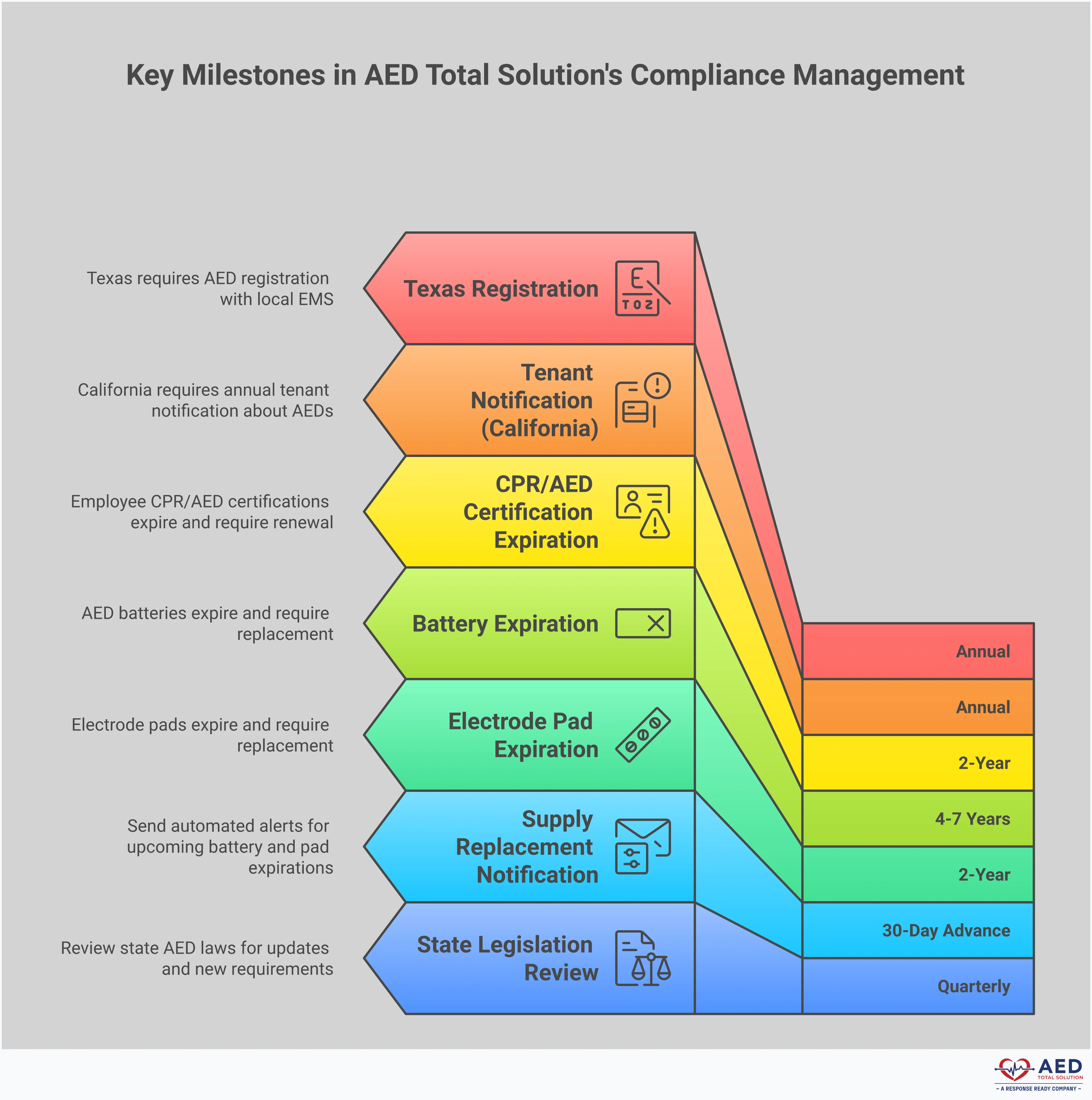
This is where AED compliance gets tricky for multi-location organizations. State AED laws vary dramatically, and what’s required in one state might not even be mentioned in another. For example, some states require you to register your device with local emergency services, while others mandate specific training protocols. Many states offer legal immunity from lawsuits, but only if you follow their rules to the letter, including maintenance, inspections, and documentation. A simple oversight could put your organization at risk. California law, for instance, requires building owners to notify tenants of an AED’s location every year. You have to know the specific rules for every single location to stay protected.
Industry-Specific Mandates
On top of federal and state rules, your specific industry might have its own set of AED requirements. Health clubs, dental offices, schools, and nursing homes are often required by law to have AEDs on-site and to follow specific protocols for their use and maintenance. These mandates can come from state legislation or local ordinances tailored to certain types of businesses. If you operate fitness centers in three different states, for example, you’ll need to research the specific requirements for gyms in each of those locations. Never assume that compliance in one area covers you everywhere; always check for rules that apply directly to your field.
How Many AEDs Do You Need Across Your Locations?
Deciding on the right number of AEDs for your organization isn’t about meeting a minimum quota; it’s about creating an effective safety net. The goal is to ensure that from the moment someone collapses, an AED can be retrieved and used within three minutes. This three-minute window is critical because the chance of survival from sudden cardiac arrest drops significantly with every passing minute. A quick response can literally be the difference between life and death.
For businesses with multiple sites, this calculation gets more complex. You need a strategy that works for a sprawling warehouse, a multi-story office building, and a small retail shop. Instead of guessing, you can determine your needs by looking at three key factors: the size and layout of each building, the number of floors, and the specific activities that happen within your walls. Thinking through these elements will help you build a plan that protects everyone, everywhere, and ensures your program is truly response-ready.
Calculate Your Device Count by Building Size
The physical size of your facility is the first piece of the puzzle. The core principle is that a person should be able to get an AED and return to the victim in under three minutes, and ideally much faster. A good way to test this is to perform a simple walk-through. Start from the farthest corner of a floor or work area and time how long it takes to walk to the proposed AED location and back. If it takes longer than 90 seconds, you likely need another device to cover that zone. This quick exercise helps you move beyond guesswork and base your plan on real-world response times.
Plan for Floor-by-Floor Coverage
If your facilities have more than one level, a good rule of thumb is to place at least one AED on every floor. During an emergency, waiting for an elevator or running up and down stairs wastes precious seconds. Having a dedicated device on each level removes that barrier and is a key part of effective AED placement best practices. For very large floors, you may even need multiple devices to maintain that crucial three-minute response window. By planning for floor-by-floor coverage, you ensure your team can act decisively without critical delays.
Identify High-Risk Areas
Some areas of your business naturally carry a higher risk of sudden cardiac arrest. Think about places where people engage in physical activity or where large groups gather. On-site fitness centers, cafeterias, large conference rooms, and manufacturing floors are all prime examples. These locations should have their own dedicated AED, even if another device is located just down the hall. Certain AED requirements for businesses also call for devices in places like schools, sports facilities, and health centers. Placing AEDs in these high-traffic, high-risk zones ensures you are prepared where an emergency is most likely to occur.
Where Should You Place Your AEDs?
An AED is only effective if you can get to it in time. That’s why deciding where to place your devices is one of the most critical parts of your safety plan. Simply having AEDs on-site isn’t enough to be compliant or prepared; they must be strategically located so a rescuer can retrieve and use one within minutes of a sudden cardiac arrest event. When mapping out your AED locations, focus on three key factors: accessibility, visibility, and protection. A well-placed AED can dramatically shorten the time between collapse and first shock, which is the single most important factor in survival. For organizations with multiple sites, creating a standardized placement strategy ensures every location offers the same high level of protection for employees and visitors. This consistent approach simplifies training, streamlines maintenance, and strengthens your overall emergency response program.
Prioritize Accessibility and Fast Response Times
When someone suffers a sudden cardiac arrest, every second is critical. The best practice is to ensure an AED is reachable within a three-minute roundtrip from anywhere in your building. This “three-minute rule” is the gold standard because a victim’s chance of survival decreases by about 10% for every minute without defibrillation. To test your layout, walk through your facility from its farthest corners. Can you get to an AED and return within three minutes at a brisk pace? If not, you may need to add more devices. Consider placing them in central, high-traffic locations like lobbies, cafeterias, fitness centers, and near elevators to ensure someone can always get to a device quickly.
Meet Visibility and Signage Requirements
A hidden AED is an unused AED. To make sure people can find your devices during a high-stress emergency, you need to make them highly visible. Use clear, universally recognized signage to point the way. Place signs at building entrances, in main hallways, and directly above the AED cabinet so it can be spotted from a distance. Three-dimensional signs that project from the wall are especially effective in long corridors. Storing your AED in a wall-mounted cabinet with an alarm not only keeps it secure but also draws immediate attention when the door is opened. Making your AEDs easy to find empowers anyone in the vicinity to act, turning bystanders into first responders.
Protect Devices from Environmental Factors
Your AEDs need to be ready to perform flawlessly at a moment’s notice, which means they must be protected from environmental damage. Extreme heat, cold, humidity, dust, and moisture can degrade the device’s battery, electrode pads, and sensitive electronic components over time. For devices in warehouses, manufacturing floors, or outdoor areas, use a durable, weatherproof cabinet. If a device is stored in a cold environment, a heated cabinet is essential to keep it within its operational temperature range. Protecting your AEDs is the first step, but regular inspections are necessary to confirm they remain in working order. A comprehensive AED program management plan includes routine checks to ensure your devices are always ready to save a life.
What Employee Training Does Compliance Require?
Placing AEDs in your facilities is a critical first step, but your responsibility doesn’t end there. For your program to be effective and compliant, your team needs to be prepared to act in an emergency. Employee training is more than just a best practice; in many states, it’s a legal requirement tied directly to liability protection. If an incident occurs, having a well-trained team and the records to prove it can make all the difference.
For businesses with multiple locations, managing a consistent and compliant training program presents unique challenges. You have to account for varying state laws, track certifications for employees across different sites, and maintain organized records that are accessible at a moment’s notice. A successful training program ensures your designated responders feel confident and capable, turning a piece of equipment into a life-saving tool. It involves covering the right topics, staying on top of certification schedules, and keeping meticulous records.
Cover Mandatory Training Topics
Effective AED training programs are built on a foundation of CPR and AED operation. Your designated responders should be able to recognize the signs of sudden cardiac arrest, perform high-quality CPR, and use an AED with confidence. While these are the core components, it’s crucial to understand that specific requirements can vary by state. Many of the laws that grant legal immunity to businesses with AED programs come with strict stipulations, including specific training protocols. Failing to meet every single requirement can put your organization at risk. The goal is to create a team of responders who won’t hesitate when seconds matter most.
Manage Certification and Recertification Schedules
CPR and AED certifications are not a one-time event. Most certifications are valid for two years, meaning you need a reliable system to track expiration dates and schedule refresher courses for every trained employee at every location. As your team grows or changes, this becomes an increasingly complex administrative task. A single lapsed certification can create a weak link in your emergency response plan and a gap in your compliance. A full program approach with centralized oversight is the best way to manage these moving parts, ensuring every responder remains current with their training and your program stays ready.
Keep Accurate Training Records
If you can’t prove your team was trained, you may as well have not trained them at all. Meticulous record-keeping is a non-negotiable part of a compliant AED program. You should maintain a centralized file for each trained employee that includes their name, the date of their training, the type of certification they received, and its expiration date. These records are your official documentation of due diligence. In the event of an audit or a cardiac arrest incident, they demonstrate that you took the necessary steps to prepare your team. Without them, your organization could face significant liability and legal challenges.
How to Maintain and Monitor Your AEDs for Compliance
Placing AEDs across your locations is just the start. To ensure they are always ready and compliant, you need a solid plan for ongoing maintenance. An out-of-service AED is a serious liability, and tracking every device across multiple sites can be overwhelming. A consistent approach to inspections, supply tracking, and record-keeping is essential.
Follow a Regular Inspection Schedule
Regular inspections are non-negotiable. Each month, someone should physically check each device to confirm its status indicator is green, look for damage, and ensure supplies are present. For organizations with many locations, coordinating these manual checks is a challenge. This is where remote readiness monitoring becomes invaluable, automating status checks and sending alerts if a device needs attention so nothing is overlooked.
Track Battery and Pad Expirations
Every AED has components with a limited shelf life. Batteries typically last four to seven years, while electrode pads expire after about two years, used or not. An expired component means the device will fail when needed most. Manually tracking these dates is prone to error, especially at scale. A comprehensive AED management program automates this process, tracking every expiration date and ensuring replacement supplies arrive on time.
Stay on Top of Recalls and Updates
AEDs are sometimes subject to manufacturer recalls or critical software updates. Missing one could render a device ineffective and expose your organization to legal risk. While manufacturers issue notifications, it’s your responsibility to act on them. An expert partner can manage this for you, tracking all recalls and updates to ensure every device in your program remains compliant and functions correctly.
Maintain Compliant Records and Reports
Thorough documentation is your best defense in an audit and key to limiting liability. You need detailed records of every inspection, maintenance activity, supply replacement, and staff training certification. For multi-location businesses, centralizing this information is crucial. A digital management system provides an audit-ready dashboard with all your compliance documentation in one place, giving you a clear view of your program’s health.
Common AED Compliance Challenges for Multi-Location Businesses
Managing an AED program across multiple locations introduces a whole new layer of complexity. While a single-site business can often handle compliance with a simple checklist, organizations with offices, stores, or facilities in different cities and states face significant hurdles. Keeping every device ready and every location compliant requires a robust system. Without one, it’s easy for things to fall through the cracks, putting your organization at risk.
The most common challenges stem from inconsistencies. You have to deal with varying state laws, maintain a clear line of sight into every device’s status, control a growing budget, and ensure every employee receives the same high-quality training. Each of these areas presents its own difficulties, but together, they can feel overwhelming for even the most organized safety manager. Let’s break down these key challenges so you can build a strategy to address them head-on.
Navigating Different State Regulations
If your business operates in more than one state, you’re not just managing one set of AED laws; you’re managing several. Each state has its own specific requirements for device registration, placement, maintenance, and training. While most states have Good Samaritan laws that offer liability protection, this immunity often depends on your strict adherence to every rule. According to legal experts, failing to comply with even one part of a state’s statute could expose your company to a negligence lawsuit. Keeping track of these different legal landscapes and ensuring each location meets its local obligations is a massive undertaking that requires constant vigilance and expertise.
Maintaining Centralized Oversight
How can you be sure the AED in your branch office three states away is ready for an emergency? When you rely on local staff to perform manual checks, you lose central control. Those employees have their own primary responsibilities, and AED maintenance can easily be forgotten or done incorrectly. This creates dangerous gaps in your program’s readiness. Implementing a system with centralized oversight is key to ensuring every device is inspected on schedule and that battery and pad expirations are tracked accurately. This approach provides a single source of truth, giving you confidence that your entire AED fleet is compliant and prepared, no matter where the devices are located.
Managing Costs and Budgets
As your organization grows, so does the cost of your AED program. The expenses go far beyond the initial purchase of the devices. You have to budget for replacement pads and batteries, ongoing training, and the staff hours required to manage it all. For multi-location businesses, these costs multiply quickly. Without an efficient system, you could face unexpected expenses from last-minute supply orders or fines for non-compliance. A well-managed program helps you forecast costs accurately and can even reduce operational overhead. Exploring options like AED rentals can also help manage your budget by converting a large capital expense into a predictable operating cost.
Ensuring Consistent Staff Training
Consistent training is the backbone of a successful AED program, but it’s also one of the biggest logistical challenges for multi-location businesses. You need to ensure that employees at every site receive proper, standardized training on how to use an AED and perform CPR. You also have to track certifications and manage recertification schedules for everyone, which can be a nightmare of spreadsheets and calendar reminders. Because failure to provide adequate training can jeopardize your legal protection, consistency is non-negotiable. A centralized system for managing training records and scheduling sessions is essential for keeping your team prepared and your organization protected.
How to Simplify Your Multi-Location AED Program
Managing AEDs across multiple sites feels like a logistical puzzle, but it doesn’t have to be. Juggling different state laws, tracking dozens of devices, and coordinating training can quickly become overwhelming. The key isn’t to work harder, but to implement a smarter system that handles the details for you. By centralizing your data, partnering with an expert, and using automation, you can move from a reactive state of stress to a proactive position of confidence, knowing every device is ready and every location is compliant.
Use a Centralized Tracking System
Instead of relying on scattered spreadsheets and manual reminders, a centralized tracking system gives you a single source of truth for your entire AED program. Imagine a dashboard where you can see the status of every device, track upcoming battery and pad expirations, and access compliance documentation with a few clicks. This approach streamlines everything. You can ensure your life-saving devices are in optimal working condition across all your locations without chasing down individual site managers. A robust AED management program provides this clarity, replacing administrative chaos with clear, actionable oversight.
Partner with a Program Management Expert
Most states offer Good Samaritan laws that can protect your organization from liability, but this immunity often requires you to comply with a long list of specific rules. Missing even one requirement can put your organization at risk. This is where partnering with a program management expert becomes invaluable. An expert partner removes the guesswork by managing every aspect of readiness and compliance for you. From handling state-specific laws to device registration and maintenance, a full-service solution acts as an extension of your team, ensuring every detail is covered so you can focus on your core responsibilities.
Set Up Automated Monitoring and Alerts
Manual inspections are important, but they only provide a snapshot in time. What happens in the weeks between checks? Automated monitoring offers a scalable and efficient way to confirm your AEDs are ready 24/7. Systems with remote monitoring capabilities can automatically conduct daily self-tests and send you immediate alerts if a device fails or a battery is low. This technology gives you real-time readiness data, reduces the burden of manual checks, and allows you to manage a growing program without increasing your workload. It’s the most effective way to ensure your AEDs are not just monitored, but truly response-ready when seconds matter most.
Related Articles
- AED Legal Requirements for Businesses: Stay Compliant
- AED Requirements for Businesses: A Simple Guide
- AED Signage Requirements & Laws for Compliance | AED Total Solution
- AED Laws & Requirements Across State — AED Total Solution
Frequently Asked Questions
Why can’t I just create one AED policy for all my locations? A single policy often creates compliance gaps because AED laws can be completely different from one state to another, and even from one city to the next. For example, one state might require you to register your device with local emergency services, while another may have specific mandates for employee training. A policy that keeps you protected in one location could leave you exposed to legal risk in another, which is why a site-specific approach is so important.
Besides buying the device, what’s the most commonly forgotten part of AED compliance? The most overlooked aspects are almost always the ongoing maintenance and documentation. It’s easy to forget that AED pads and batteries have expiration dates and must be replaced, even if they are never used. Meticulous record-keeping is another area that often falls behind. Without a detailed log of every inspection, supply replacement, and training certification, you can’t prove you’ve met your legal obligations if an incident ever occurs.
Is it possible to manage compliance ourselves with a spreadsheet? While a spreadsheet might seem sufficient for one or two devices, it becomes unreliable and risky as your organization grows. Spreadsheets can’t send automated alerts for expiring supplies, track different state laws, or provide real-time readiness data. This manual approach is prone to human error, which can lead to a device failing during an emergency or a lapse in compliance that puts your organization at risk.
What does automated monitoring do that a monthly check doesn’t? A manual monthly check only confirms that an AED is ready at that specific moment. A device could develop a fault or a low battery the very next day, and you wouldn’t know for another month. Automated monitoring, however, performs daily electronic self-tests on the AED’s core components. It provides constant oversight and sends an immediate alert if an issue is detected, ensuring the device is truly response-ready every single day.
How does a managed program help protect my company from a lawsuit? Most states offer Good Samaritan laws that shield businesses from liability, but these protections are almost always tied to strict compliance with local regulations. A managed program ensures you meet every single requirement, from device registration and maintenance schedules to proper training and record-keeping. This creates a complete, audit-ready history of due diligence, which serves as your strongest defense against any claims of negligence.