Written by Prabakar Mahalingam | Managing Partner, AED Total Solution | National provider of safety training and proprietary compliance software dedicated to addressing Sudden Cardiac Arrest (SCA)
Every year, more than 350,000 people in the United States experience sudden cardiac arrest (SCA) outside of a hospital. The survival rate without immediate intervention is under 10%. But when a bystander uses an AED within the first few minutes, survival rates can jump to 70% or higher. That gap between life and death often comes down to one thing: whether someone nearby has the training and confidence to act.
AED certification gives you both. Whether you are a safety officer responsible for workplace compliance, an HR leader building an emergency preparedness program, or an individual who wants to be ready when it matters most, getting AED certified is one of the most impactful steps you can take. This guide walks you through everything you need to know about AED certification in 2026, from program options and costs to OSHA requirements and recertification.

What Is AED Certification?
AED certification is a credential that confirms you have been trained to use an Automated External Defibrillator (AED) during a cardiac emergency. AED certification courses teach you how to recognize the signs of sudden cardiac arrest, perform CPR, operate an AED device, and provide care until emergency medical services (EMS) arrive.
Most AED certification programs combine AED training with CPR instruction, because the two skills work together during a cardiac emergency. CPR keeps blood flowing to the brain and vital organs, while the AED analyzes the heart’s rhythm and delivers an electrical shock if needed to restore a normal heartbeat.
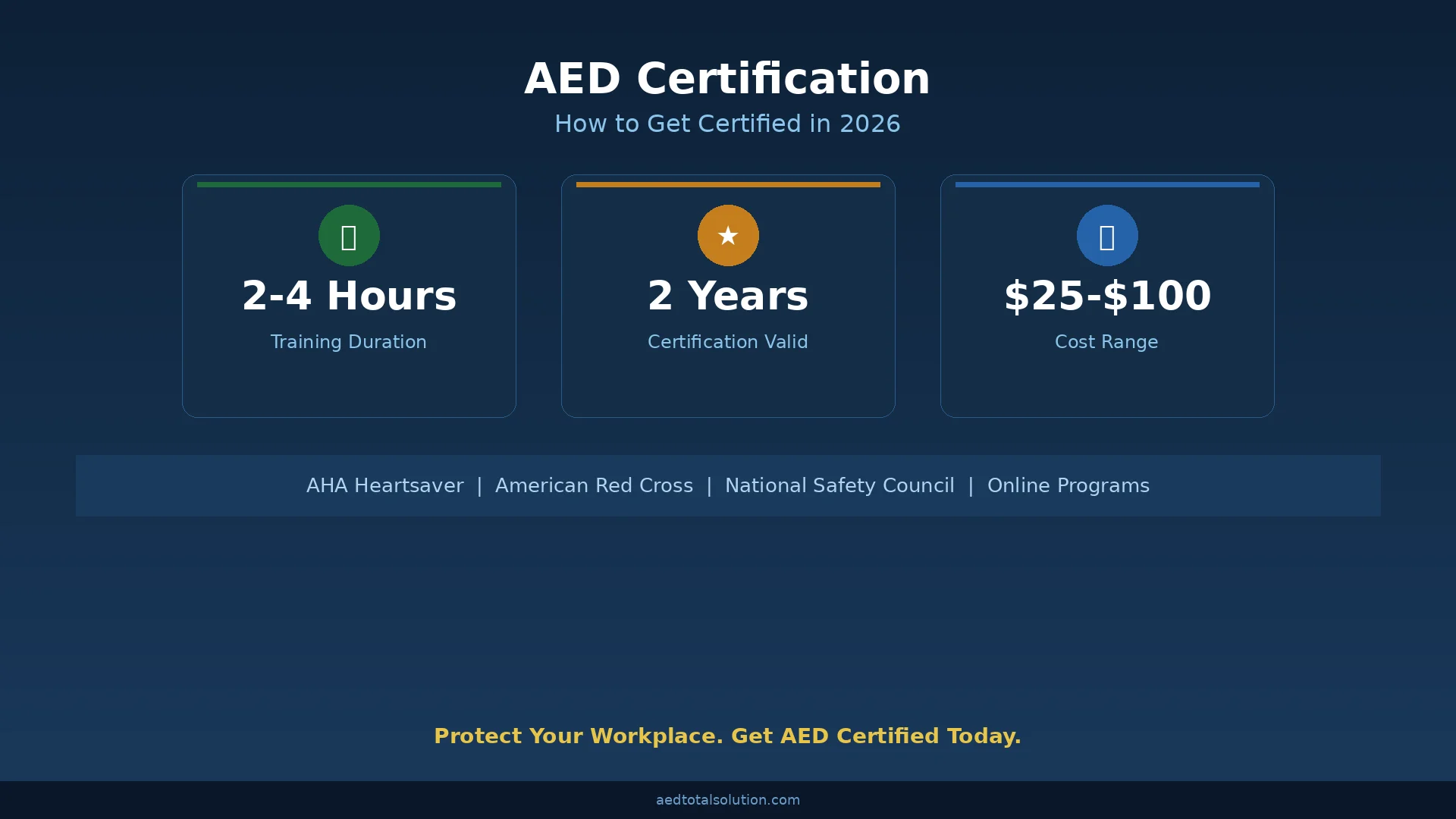
Upon successful completion of a certified course, you receive a course completion card or digital certificate that is typically valid for two years. These credentials are recognized by employers, regulatory agencies, and organizations such as OSHA.
Who Needs AED Certification?
While anyone can benefit from AED certification, certain groups have a professional or regulatory obligation to maintain this credential:
- Designated workplace responders – Employees assigned to emergency response teams, particularly in workplaces that are not within close proximity to a hospital or emergency medical facility (per OSHA guidance)
- Healthcare professionals – Nurses, physicians, EMTs, and other clinical staff (typically through BLS certification)
- Fitness and recreation staff – Gym employees, personal trainers, lifeguards, and coaches
- Childcare providers and educators – Daycare workers, teachers, and school administrators (many states require this)
- Safety officers and facilities managers – Professionals responsible for AED compliance management
- Construction and industrial workers – Employees in high-risk environments where cardiac events are more likely
- Volunteers and community members – Anyone who wants to be prepared to help in a public emergency
If your organization deploys AEDs, having trained staff is not just good practice; it is a critical component of a compliant AED program. Understanding AED requirements for businesses is the first step toward building a comprehensive safety plan.
Types of AED Certification Programs
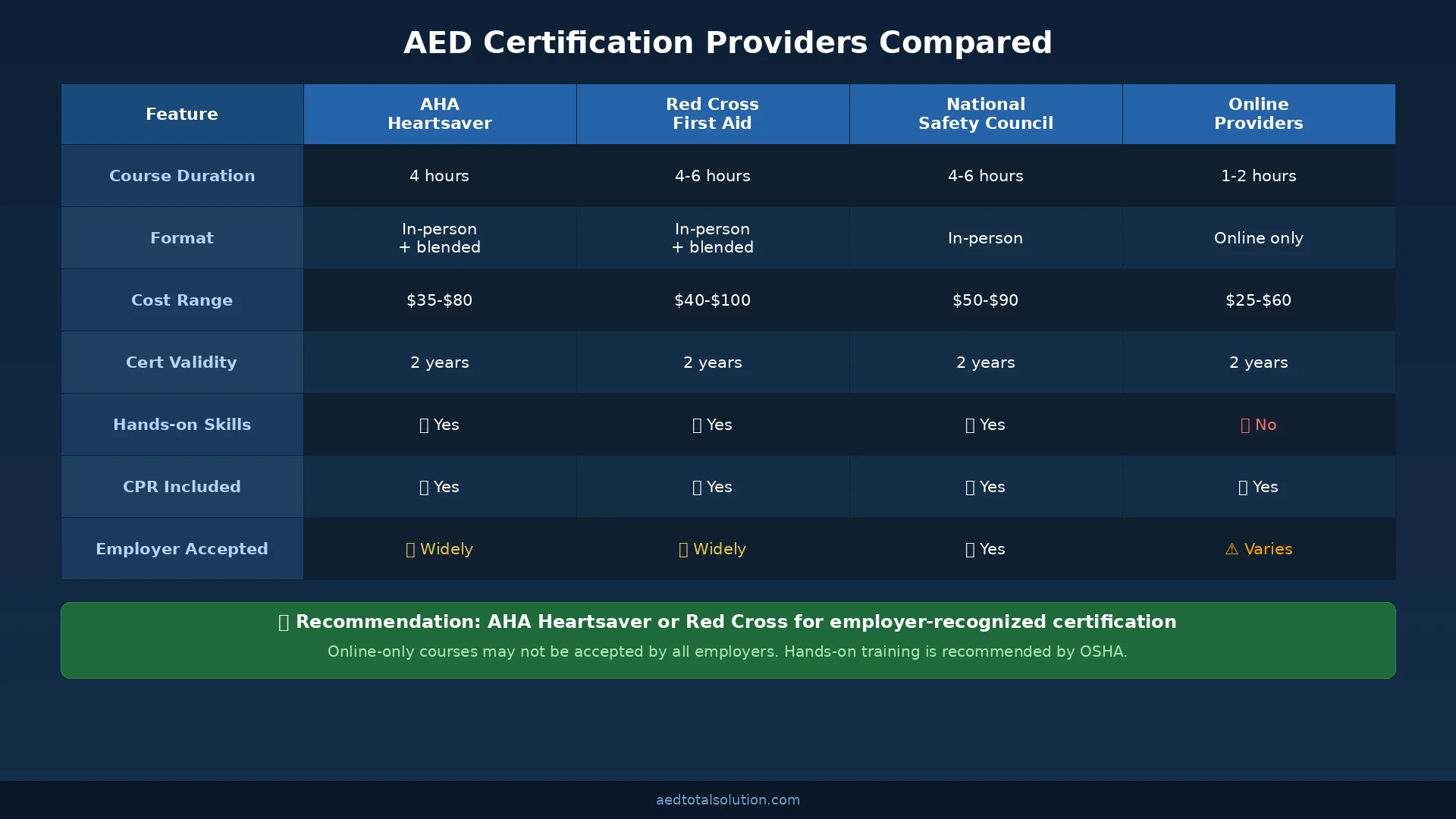
Several nationally recognized organizations offer AED certification. The right program depends on your role, industry requirements, and learning preferences.
American Heart Association (AHA) Heartsaver CPR AED
The AHA Heartsaver CPR AED course is the most widely recognized AED certification for non-healthcare professionals. It is designed for anyone with little or no medical training who needs an OSHA-compliant course completion card.
- What it covers: Adult CPR and AED use, choking relief, plus optional modules for child and infant CPR
- Format options: Classroom (instructor-led), blended learning (online + in-person skills session), or self-guided learning
- Duration: Approximately 2-3 hours for the online component, plus 1-2 hours for the hands-on skills session
- Certification validity: 2 years
- Cost: $35-$80 depending on location and format
The AHA also offers Heartsaver First Aid CPR AED, which adds first aid training to the CPR/AED curriculum and is the most comprehensive option for workplace compliance.
AHA Basic Life Support (BLS)
BLS certification is designed for healthcare professionals and includes more advanced skills:
- What it covers: High-performance team CPR, multi-rescuer scenarios, AED use, bag-mask ventilation, and opioid emergency response
- Format options: Classroom or blended learning
- Duration: Approximately 3-4 hours
- Certification validity: 2 years
- Cost: $50-$100+

American Red Cross First Aid/CPR/AED
The Red Cross offers a comprehensive First Aid/CPR/AED certification that meets OSHA workplace requirements. It is available in both blended learning and fully in-person formats.
- What it covers: First aid for injuries and sudden illness, adult/child/infant CPR, AED use, and choking relief
- Format options: Blended learning (approximately 2.5 hours online + in-person skills session) or fully classroom-based
- Duration: 4-5 hours total
- Certification validity: 2 years
- Cost: $37-$90 depending on format and location
The Red Cross provides digital certificates with a unique ID and QR code that employers can use to verify credentials instantly.
Online AED Certification Providers
Several online platforms offer AED certification courses that can be completed entirely from your computer or mobile device. Providers like ProTrainings, National CPR Foundation, and others offer convenient, self-paced options.
- Cost: $25-$65
- Duration: 1-2 hours
- Format: Fully online with video instruction and written assessment
Important note: Fully online courses typically do not meet OSHA workplace certification requirements because they lack a hands-on skills evaluation component. If you need OSHA-compliant certification, choose a course that includes an in-person skills session with a certified instructor. Online-only courses may be appropriate for general awareness training or for individuals who want foundational knowledge before taking a hands-on course.
How to Get AED Certified: Step by Step
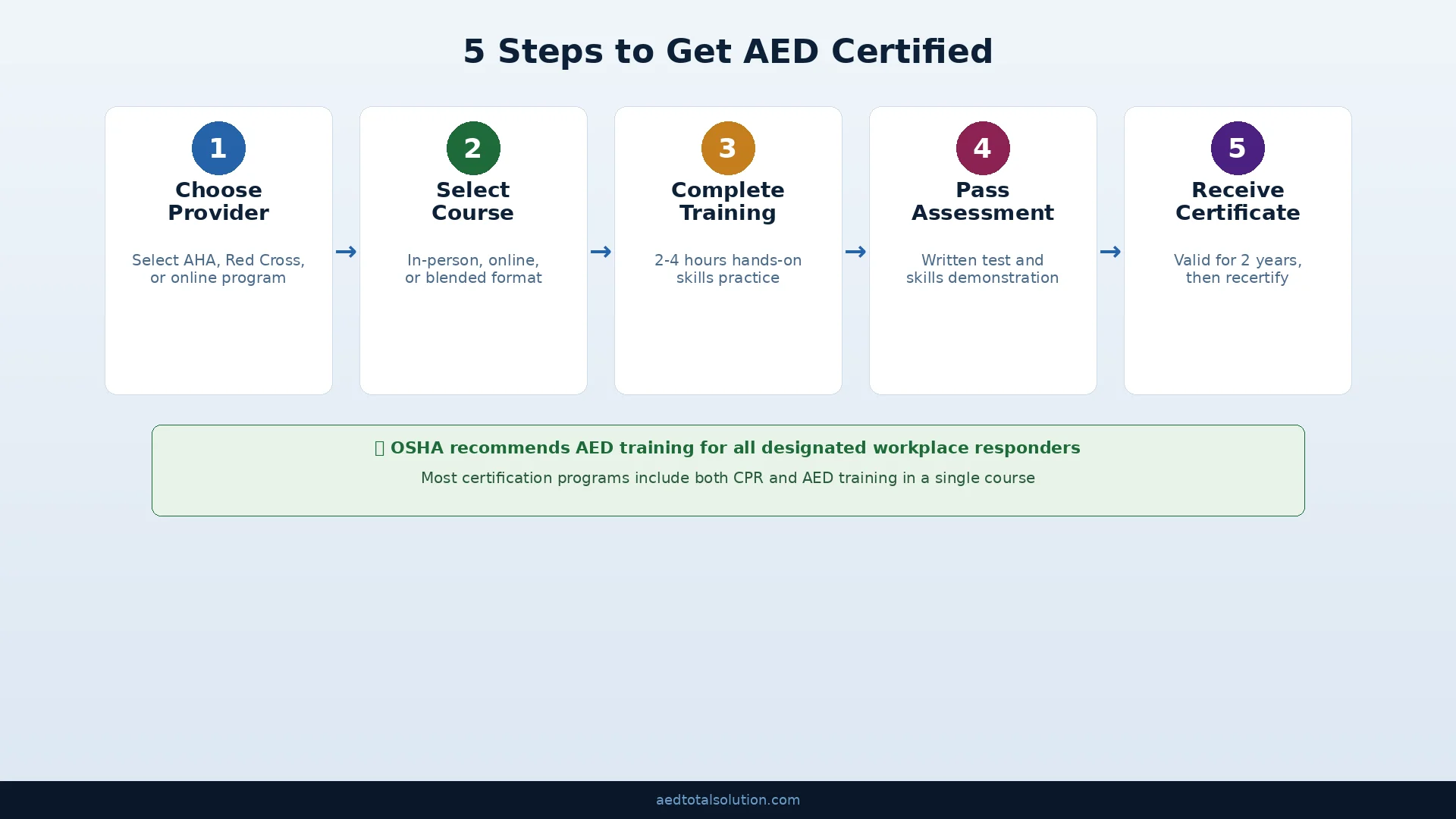
Getting AED certified is straightforward. Follow these steps to earn your credential in 2026:
- Determine your requirements. Are you getting certified for workplace compliance, a professional requirement, or personal preparedness? This determines whether you need an OSHA-compliant course with a hands-on component.
- Choose a certification program. Select from AHA Heartsaver, Red Cross First Aid/CPR/AED, or another accredited provider based on your needs and budget.
- Select your learning format. Decide between fully classroom-based, blended learning (online + in-person skills session), or online-only (if OSHA compliance is not required).
- Complete the online coursework (if taking a blended learning course). This typically takes 1-3 hours and covers theory, protocols, and AED operation through interactive video modules.
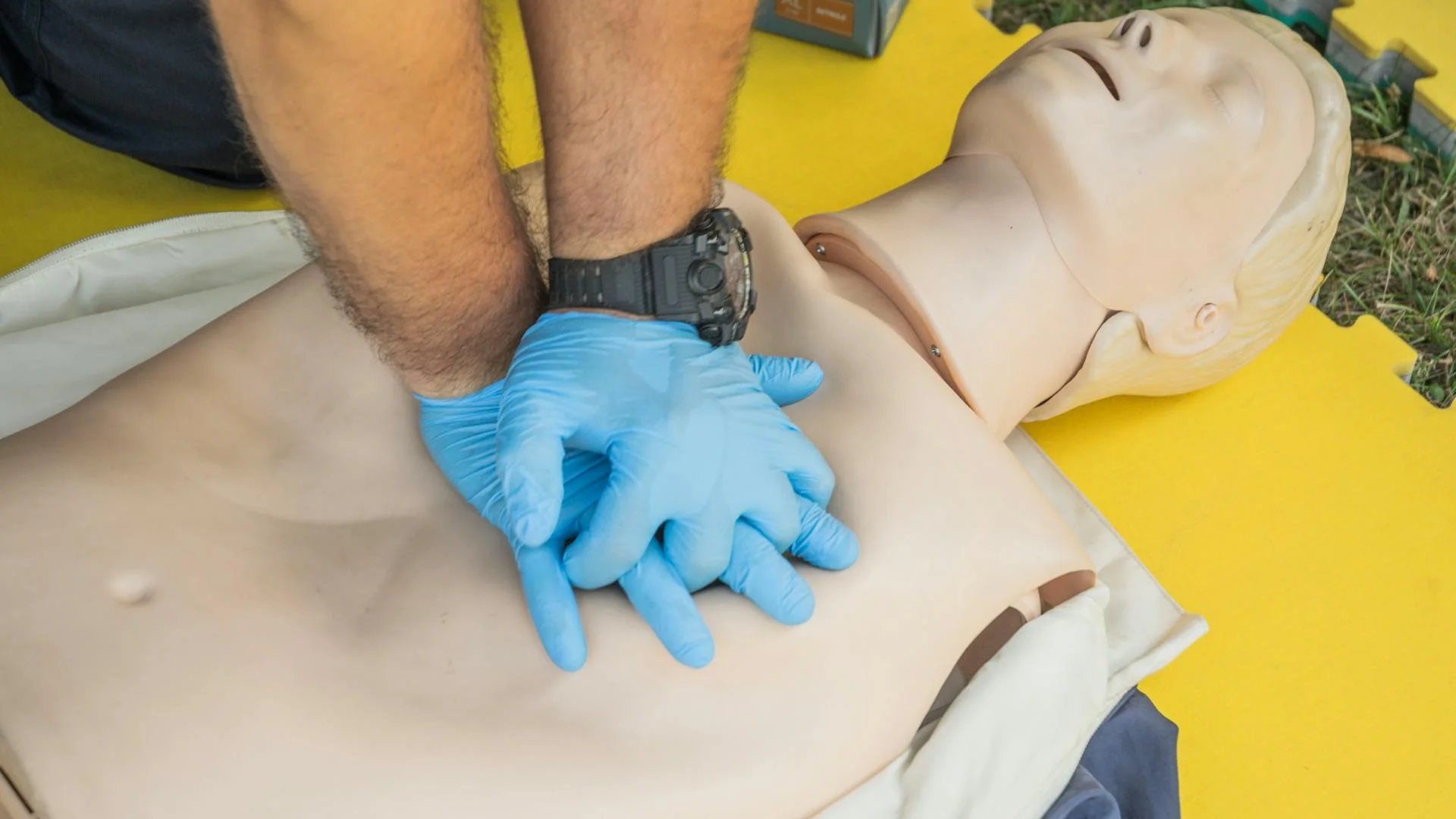
- Attend the in-person skills session. Practice CPR compressions on a mannequin, operate an AED trainer, and demonstrate choking relief techniques. An instructor evaluates your skills.
- Pass the assessment. Complete a written or online knowledge check and demonstrate competency during the skills evaluation.
- Receive your certification. Upon successful completion, you receive a digital certificate or course completion card valid for two years.
Most people complete the entire process in a single day. Blended learning options offer additional flexibility by letting you complete the online portion at your own pace before attending a shorter in-person session.
How Much Does AED Certification Cost?
AED certification costs vary depending on the provider, format, and location. Here is a general breakdown:
| Program | Format | Approximate Cost |
|---|---|---|
| AHA Heartsaver CPR AED | Classroom or Blended | $35 – $80 |
| AHA Heartsaver First Aid CPR AED | Classroom or Blended | $50 – $90 |
| AHA BLS (Healthcare) | Classroom or Blended | $50 – $100+ |
| Red Cross First Aid/CPR/AED | Blended or Classroom | $37 – $90 |
| Red Cross Adult CPR/AED Online | Online Only | $37 |
| Online Providers (ProTrainings, etc.) | Online Only | $25 – $65 |
Many employers cover AED certification costs as part of their workplace safety programs. If your organization is investing in an AED compliance management program, bundling training with device management is a cost-effective approach.
How Long Does AED Certification Last?
AED certification from AHA, Red Cross, and most accredited providers is valid for two years from the date of completion. This two-year validity period applies to:
- AHA Heartsaver CPR AED
- AHA Heartsaver First Aid CPR AED
- AHA BLS
- Red Cross First Aid/CPR/AED
- Most online certification providers
Skills can fade over time, even within the two-year window. OSHA recommends annual CPR refresher training to keep skills sharp. Many organizations schedule annual drills or refresher courses to reinforce emergency response readiness.

How to Recertify Your AED Certification
When your AED certification approaches its two-year expiration, you need to recertify to keep your credentials current. The recertification process is typically shorter and less expensive than the initial certification:
- AHA: Take the current version of the Heartsaver or BLS course. AHA treats recertification as taking the full course again to ensure skills are up to date with the latest guidelines.
- Red Cross: Abbreviated renewal courses are available in person and through blended learning. These are designed specifically for individuals whose certifications are current but near expiration.
- Online providers: Most offer recertification courses at the same or reduced cost.
Pro tip: Do not wait until your certification expires. Begin the renewal process 30-60 days before expiration to avoid any gaps in your credentials. Organizations that manage multiple certified employees should use tracking systems to monitor expiration dates across their team.
Employer Requirements and OSHA Guidance
OSHA does not have a specific federal standard mandating AED certification in every workplace. However, OSHA strongly recommends AED programs and trained responders, and their guidance on AEDs in the workplace makes clear that preparedness saves lives.
Here is what employers should know:
- Near proximity rule: If your workplace is not within close proximity (generally 3-4 minutes) of a hospital, clinic, or emergency medical facility, OSHA requires at least one employee trained in first aid and CPR on-site.
- OSHA-compliant training: Training must include a hands-on skills evaluation. Online-only courses do not satisfy OSHA requirements.
- Industry-specific mandates: Certain industries, including construction, logging, and electric power generation, have explicit OSHA requirements for trained first aid responders.
- AED program best practices: OSHA recommends a written AED program that includes device placement, maintenance protocols, trained responders, and medical oversight.
- State requirements: Many states have their own AED laws that go beyond federal OSHA guidance. Some states require AEDs in gyms, schools, or specific business types. Review AED requirements by state for details.
Organizations that deploy AEDs in business settings should pair device management with a comprehensive training program. This ensures your AED program is not just equipped but truly ready to save a life.
AED Certification vs. CPR Certification: What’s the Difference?
AED certification and CPR certification are closely related but not identical:
- CPR certification focuses on cardiopulmonary resuscitation, the manual technique of chest compressions and rescue breaths used to maintain blood flow when someone’s heart stops.
- AED certification specifically covers the operation of an Automated External Defibrillator, including pad placement, following the device prompts, and integrating AED use with CPR during a cardiac emergency.
In practice, most certification programs combine both skills into a single course. The AHA Heartsaver CPR AED, Red Cross First Aid/CPR/AED, and BLS courses all teach CPR and AED use together because effective cardiac arrest response requires both.
If your certification only covers CPR without AED training, consider upgrading to a combined CPR/AED course. Having an AED available but no one trained to use it defeats the purpose of your investment in emergency preparedness equipment.
Where to Find AED Certification Near You
Finding an AED certification class near you is easier than you might think. Here are the best resources:
- American Heart Association: Use the AHA course finder at cpr.heart.org to search for Heartsaver and BLS classes by location.
- American Red Cross: Visit redcross.org/take-a-class to find classroom and blended learning options in your area.
- Local fire departments and community centers: Many offer periodic CPR/AED classes, sometimes at reduced cost.
- Your employer: Check with your HR department or safety officer. Many organizations coordinate on-site group training.
- Hospitals and healthcare systems: Local hospitals often host community CPR/AED classes.
For organizations that need to certify multiple employees, on-site group training is often the most efficient and cost-effective option. An AHA or Red Cross instructor can come to your workplace and train your entire team in a single session.
How AED Certification Fits Into Your AED Program
AED certification is one piece of a comprehensive AED program. A truly prepared organization also needs:
- Properly maintained AED devices – Routine inspections, battery and pad replacement tracking, and firmware updates
- Compliant AED placement – Devices positioned for access within 3-5 minutes from any point in your facility
- Registration and documentation – AEDs registered with local EMS and the manufacturer
- Medical oversight – A physician medical director overseeing your program
- Audit-ready records – Training logs, inspection records, and compliance documentation
Managing all of these components, especially across multiple locations, is where many organizations struggle. A managed AED compliance program ensures that training, maintenance, and documentation are handled consistently and that your organization is always prepared for an emergency and a regulatory review.
Learn how AED Total Solution’s compliance management program keeps your AED program inspection-ready and response-ready.
Key Takeaways
- AED certification teaches you to use an AED and perform CPR during sudden cardiac arrest. Most courses combine both skills.
- The AHA Heartsaver CPR AED and Red Cross First Aid/CPR/AED are the two most widely recognized programs for non-healthcare professionals.
- Certification costs range from $25 for online-only courses to $100+ for comprehensive in-person programs.
- All major certifications are valid for two years. Plan recertification 30-60 days before expiration.
- OSHA-compliant certification requires a hands-on skills evaluation; online-only courses do not meet this standard.
- AED certification is one component of a complete AED program that includes device maintenance, placement, registration, and documentation.
Frequently Asked Questions
How long does it take to get AED certified?
Most AED certification courses take 2-5 hours to complete, depending on the program and format. Blended learning options split the time between online coursework (1-3 hours) and an in-person skills session (1-2 hours).
Can I get AED certified online?
You can complete the knowledge portion of AED certification online through AHA, Red Cross, and other providers. However, OSHA-compliant certification requires an in-person hands-on skills session. Fully online courses are best suited for general awareness, not workplace compliance.
Is AED certification the same as CPR certification?
Not exactly, but most programs combine them. AED certification specifically covers operating a defibrillator, while CPR certification focuses on chest compressions and rescue breathing. Nearly all modern courses teach both skills together.
Does my employer have to pay for AED certification?
If your employer requires you to be AED/CPR certified as a condition of your role or to meet OSHA requirements, they are generally responsible for providing and paying for the training. Check with your HR department for your company’s specific policy.
What happens if my AED certification expires?
An expired certification means you are no longer recognized as a certified responder. You will need to take the full certification course again. There is no penalty, but any gap in certification could affect workplace compliance. Recertify before your expiration date to maintain continuous coverage.