Key Takeaways
- An AED is designed for anyone to use. The device provides voice prompts and will only deliver a shock if it detects a life-threatening heart rhythm.
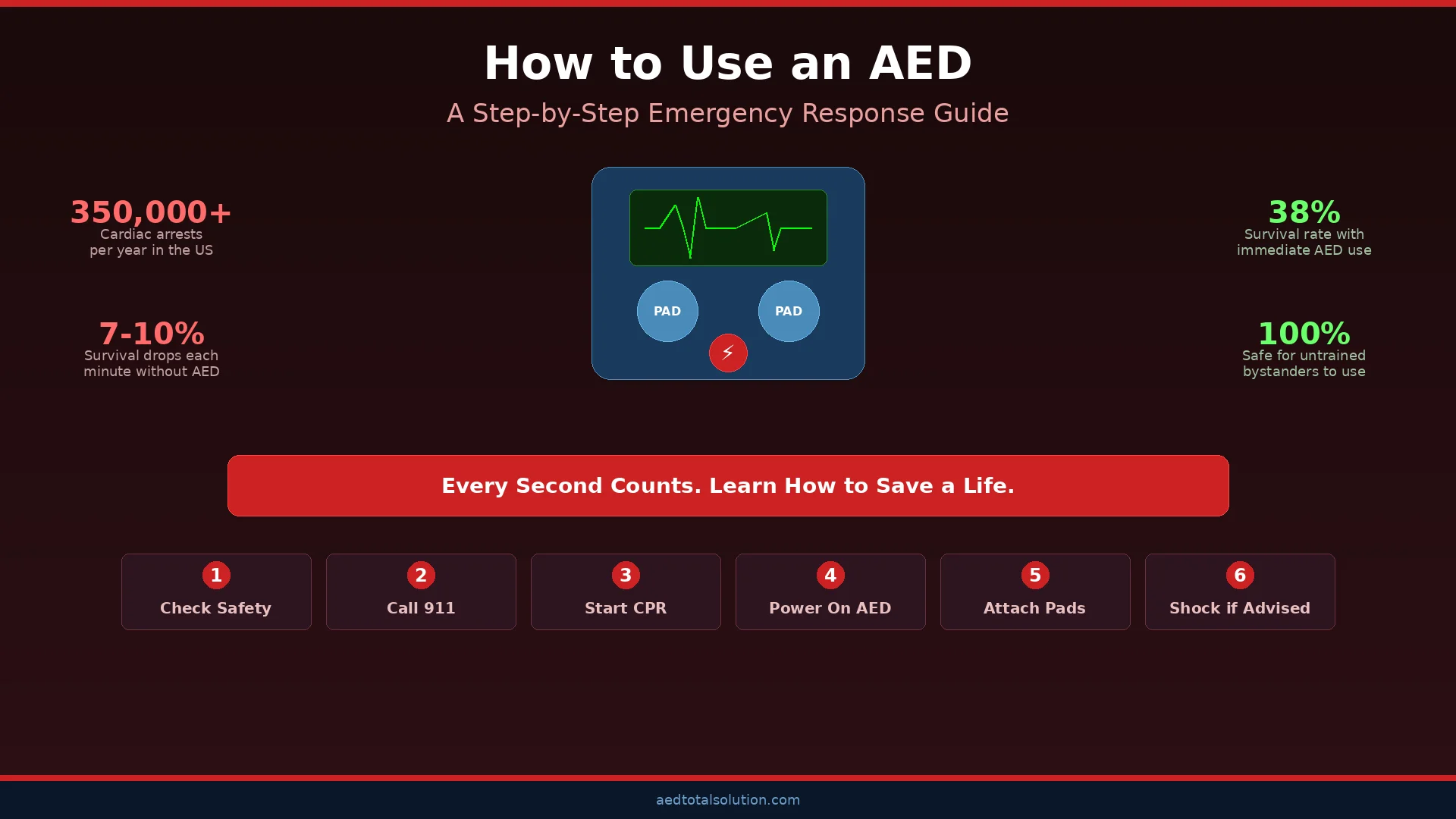
- Time is critical: every minute without defibrillation reduces survival chances by 7 to 10 percent.
- The basic steps are: call 911, start CPR, turn on the AED, attach the pads, and follow the voice prompts.
- Good Samaritan laws in all 50 U.S. states protect bystanders who provide emergency AED assistance in good faith.
What Is an AED and How Does It Work?
An automated external defibrillator (AED) is a portable, battery-powered device that analyzes the heart’s electrical rhythm and delivers a controlled shock to restore a normal heartbeat during sudden cardiac arrest (SCA). Knowing how to use an AED is one of the most important lifesaving skills you can learn.
Sudden cardiac arrest occurs when the heart’s electrical system malfunctions, causing it to quiver instead of pump blood. This is different from a heart attack, which is a circulation problem. SCA can happen to anyone, at any age, often without warning. According to the American Heart Association (AHA), more than 350,000 out-of-hospital cardiac arrests occur each year in the United States.
AEDs are specifically designed for non-medical bystanders. The device uses sensors in the electrode pads to analyze the heart’s rhythm and determine whether a shock, known as defibrillation, is needed. If the AED detects ventricular fibrillation or pulseless ventricular tachycardia, it prompts the user to deliver a shock. If the rhythm does not require a shock, the device will not allow one to be delivered. This built-in safety feature means you cannot accidentally harm someone by using an AED.
Modern AEDs feature clear voice prompts, visual diagrams, and step-by-step instructions that guide you through the entire process. They are now commonly found in offices, schools, airports, gyms, churches, and other public spaces.
Recognizing Sudden Cardiac Arrest
Before you can use a defibrillator, you need to recognize when someone is in cardiac arrest. The signs are unmistakable once you know what to look for:
- Sudden collapse. The person falls to the ground without warning.
- Unresponsiveness. They do not respond when you tap their shoulders and shout, “Are you okay?”
- No normal breathing. They are not breathing at all, or are only gasping (agonal breathing, which is not effective breathing).
- No pulse. If you are trained to check, there is no detectable pulse.
If a person is unresponsive and not breathing normally, assume they are in cardiac arrest and begin the emergency response immediately. Do not waste time second-guessing. Acting quickly is more important than being absolutely certain of the diagnosis.
How to Use an AED: Step-by-Step Instructions
The American Heart Association and American Red Cross both recommend the following sequence when responding to a suspected cardiac arrest. Here is exactly how to use an AED, broken down into clear steps.
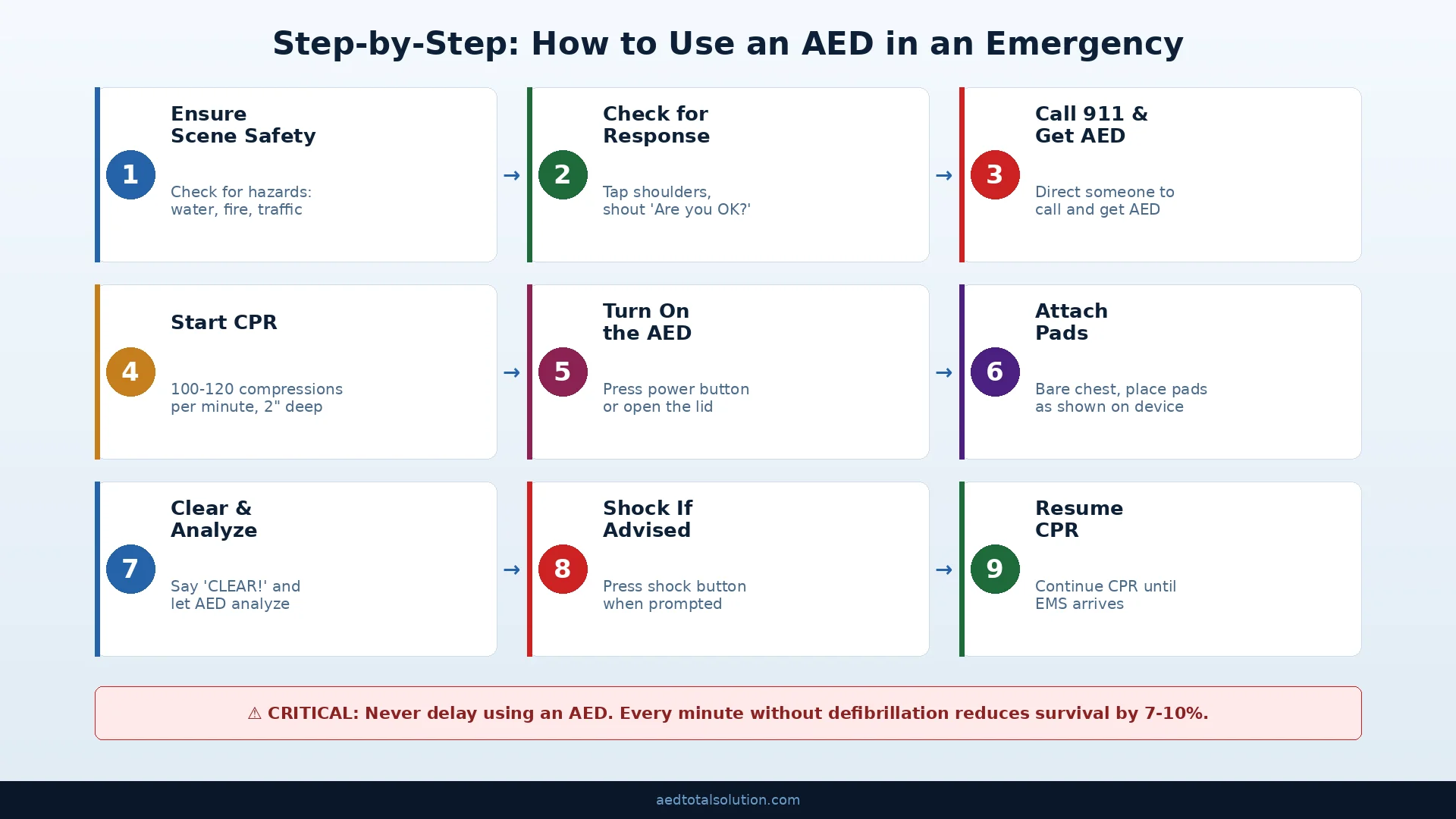
Step 1: Ensure the Scene Is Safe
Before approaching the person, quickly scan the area for hazards such as traffic, water, fire, or electrical dangers. A quick assessment takes only a few seconds but prevents you from becoming a second victim.
Step 2: Check for Responsiveness
Tap the person’s shoulders firmly and shout, “Are you okay?” If they do not respond, they need immediate help.
Step 3: Call 911 and Get the AED
If you are with other people, point to a specific person and say, “You, call 911.” Point to another and say, “You, get the AED.” Being direct eliminates the bystander effect, where everyone assumes someone else will help. If you are alone, call 911 on speaker and retrieve the nearest AED yourself.
Step 4: Start CPR
While waiting for the AED, begin chest compressions immediately. Push hard and fast in the center of the chest at a rate of 100 to 120 compressions per minute, with a depth of at least two inches. Allow the chest to fully recoil between compressions. If you are trained, provide rescue breaths in a 30:2 ratio (30 compressions to 2 breaths). If not, hands-only CPR is effective and recommended by the AHA.
Step 5: Turn On the AED
As soon as the AED arrives, turn it on by pressing the power button or opening the lid (some models activate automatically when opened). The device will immediately begin providing voice prompts.
Step 6: Expose the Chest and Attach the Pads
Remove or cut away all clothing covering the person’s chest. The electrode pads require direct skin contact to work properly. Wipe the chest dry if it is wet.
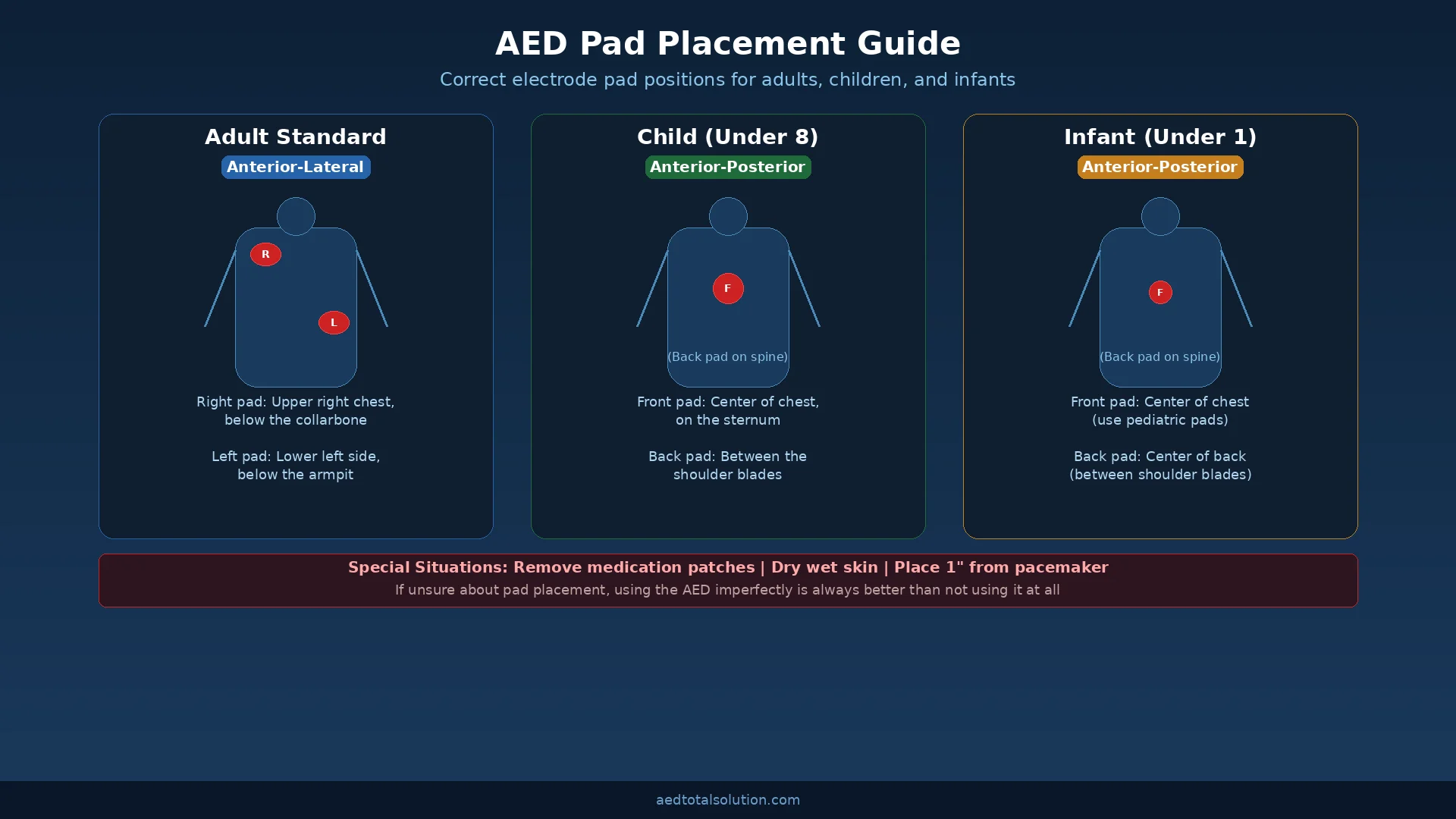
Peel the backing from each pad and place them as shown in the diagrams on the pads:
- Right pad: Upper right chest, just below the collarbone.
- Left pad: Lower left side of the chest, below the armpit.
This is called anterior-lateral placement. It creates a direct electrical pathway through the heart. For more detailed guidance on pad positioning, including special scenarios, see our complete AED pad placement guide.
Step 7: Let the AED Analyze
Once the pads are attached and plugged in (if required by the model), the AED will announce, “Analyzing heart rhythm.” Say “CLEAR!” in a loud, commanding voice and make sure absolutely no one is touching the person. Any movement or contact can interfere with the analysis.
Step 8: Deliver a Shock (If Advised)
If the AED detects a shockable rhythm, it will say, “Shock advised. Press the shock button.” Confirm that no one is touching the person, say “CLEAR!” again, and press the flashing shock button. Some fully automatic AEDs will deliver the shock without requiring you to press a button.
Step 9: Resume CPR Immediately
After the shock is delivered, or if the AED says “No shock advised,” immediately resume CPR starting with chest compressions. The AED will re-analyze the rhythm every two minutes and prompt you if another shock is needed. Continue this cycle of CPR and AED analysis until emergency medical services arrive or the person begins breathing normally.
Using an AED on Children vs. Adults
AEDs can and should be used on children experiencing cardiac arrest. The 2025 AHA guidelines encourage earlier AED use for pediatric patients, including infants. Here are the key differences:
Children Under 8 Years Old (or Under 55 Pounds)
- Use pediatric pads or activate the pediatric mode on the AED, if available. Pediatric pads deliver a lower energy dose appropriate for smaller bodies.
- If pediatric pads are not available, use adult pads. The AHA and Red Cross both confirm that using adult pads on a child is far better than not using an AED at all.
- Because a child’s chest is smaller, the pads may be too close together in standard position. Use anterior-posterior placement instead: one pad on the center of the chest (sternum), one pad on the back between the shoulder blades.
Children Over 8 Years Old (or Over 55 Pounds)
- Use adult pads and follow the standard adult placement.
- Never use pediatric pads on a child over 8 or over 55 pounds, as the reduced energy may not be sufficient.
Infants (Under 1 Year)
- Use pediatric pads if available.
- Always use anterior-posterior placement (front and back).
- If pediatric pads are not available, adult pads are acceptable.
Common Mistakes to Avoid When Using an AED
Even though AEDs are designed to be straightforward, certain mistakes can reduce their effectiveness. Knowing how to use a defibrillator also means knowing what not to do.
1. Delaying Action
The most critical mistake is hesitating. Every minute without defibrillation reduces survival chances by 7 to 10 percent. Do not wait for emergency services to arrive before starting CPR and using the AED.
2. Placing Pads on Wet Skin
Water conducts electricity and can reduce the effectiveness of the shock or cause burns. Quickly wipe the chest dry before applying the pads. If the person is in a puddle, move them to a dry surface first.
3. Placing Pads Over Clothing or Body Hair
Pads must have direct skin contact. Remove all clothing from the chest. If thick body hair prevents good adhesion, use the razor included in many AED kits to shave the pad areas, or press the pads down firmly, rip them off to remove hair, and apply a second set of pads.
4. Placing Pads Over a Pacemaker or Medication Patch
If you see a scar or feel a hard lump under the skin (indicating a pacemaker or implanted defibrillator), place the AED pad at least one inch away from the device. Remove any medication patches from the chest and wipe the area clean before applying AED pads.
5. Touching the Person During Analysis or Shock
Any contact with the person during rhythm analysis or shock delivery can interfere with the reading or put the rescuer at risk. Always ensure everyone is clear before the AED analyzes and before delivering a shock.
6. Stopping CPR for Too Long
Minimize interruptions. The AHA emphasizes that pauses in chest compressions should be as brief as possible. Continue CPR right up until the AED is ready to analyze, and resume immediately after the shock.
What to Do After Using an AED
Your responsibility does not end after the AED delivers a shock. Here is what to do next:
- Continue CPR. Resume compressions immediately after each shock, or if no shock is advised. Follow the AED prompts for re-analysis every two minutes.
- Wait for EMS. Continue the cycle of CPR and AED use until paramedics arrive and take over.
- If the person starts breathing normally, place them in the recovery position (on their side) and monitor them closely. Leave the AED pads attached and the device on.
- Stay with the person. Do not leave until EMS assumes responsibility.
- Report to EMS. When paramedics arrive, tell them what happened, when the event occurred, how many shocks were delivered, and any CPR provided.
After the event, the AED used in an emergency will need to be serviced. The electrode pads are single-use and must be replaced. The device should be inspected to ensure it is ready for the next emergency. Organizations with AED programs should have a process for post-event maintenance. Learn more about keeping your devices response-ready in our AED inspection and maintenance guide.
Good Samaritan Protections for AED Users
One of the biggest reasons people hesitate to use an AED is fear of legal liability. The good news: every U.S. state has Good Samaritan laws that protect bystanders who provide emergency assistance, including using an AED.
Good Samaritan protections generally apply when you:
- Act voluntarily, without expecting compensation
- Act in good faith, genuinely trying to help
- Provide care that a reasonable person with similar training would provide
- Do not act with gross negligence or intentional misconduct
These laws were specifically designed to encourage bystanders to take action during life-threatening emergencies like cardiac arrest. Many states include specific provisions that protect AED users and organizations that maintain AED programs.
In addition, the federal Cardiac Arrest Survival Act provides liability protections for AED users and acquirers in federal buildings and encourages AED programs in all settings. The legal framework is clear: using an AED to help someone in cardiac arrest is both the right thing to do and legally protected.
Why Keeping Your AED Response-Ready Matters
Knowing how to use an AED only matters if the device is ready when you need it. Expired pads, depleted batteries, and missed inspections can render an AED useless in the moment that matters most.
Organizations that deploy AEDs should establish a comprehensive AED program that includes:
- Regular inspections and maintenance tracking
- Automated alerts for pad and battery expiration
- Staff training and refresher courses
- Compliance with state-specific AED requirements
- Post-event device servicing protocols
AED Total Solution provides full-service AED program management that covers every aspect of readiness and compliance. From automated monitoring and inspection tracking to pad and battery replacement alerts, our white-glove approach ensures your AEDs are always prepared for an emergency. Learn about our AED program management services.
Frequently Asked Questions About Using an AED
Can I use an AED if I have no training?
Yes. AEDs are designed for use by anyone, including people with no medical training. The device provides step-by-step voice prompts and will only deliver a shock if it detects a shockable heart rhythm. You cannot accidentally harm someone with an AED.
Can I use an AED on a pregnant person?
Yes. Defibrillation is safe for pregnant individuals. Sudden cardiac arrest is a life-threatening emergency, and using an AED is critical for both the parent and the baby. Follow the same steps as you would for any adult.
What if the AED says “no shock advised”?
This means the AED did not detect a shockable rhythm. Continue CPR immediately. The AED will re-analyze the rhythm every two minutes. “No shock advised” does not mean the person is fine; it means the specific rhythm present does not respond to defibrillation.
Can I use an AED on someone in the water?
Do not use an AED on someone who is in standing water. Move them to a dry surface first, wipe their chest dry, and then apply the pads. Once out of the water, AED use is safe and recommended.
How often should an AED be inspected?
AEDs should be visually inspected at least monthly and fully maintained according to the manufacturer’s schedule. Many organizations use AED management software to automate inspection tracking and compliance reporting. Learn more in our AED inspection guide.
Act Now: Every Second Counts
Sudden cardiac arrest can happen to anyone, anywhere. The combination of early CPR and rapid AED use can more than double a person’s chance of survival. Now that you know how to use an AED, the next step is making sure your organization has a device that is ready when you need it.
Whether you are building a new AED program, upgrading your current devices, or looking for a partner to manage compliance and readiness, AED Total Solution is here to help. Contact us to learn about our full-service AED program management.
This article was reviewed by Prabakar Mahalingam, Managing Partner of AED Total Solution and a nationally recognized provider of safety training, AED products, and proprietary compliance software dedicated to addressing Sudden Cardiac Arrest (SCA).