Placing an AED in the right location can mean the difference between a life saved and a life lost. Sudden cardiac arrest strikes without warning, and for every minute that passes without defibrillation, a victim’s chance of survival drops by approximately 10%. When an AED is positioned too far from the emergency, buried in a back office, or hidden in a closet, those critical minutes slip away.
AED placement is not a guessing game. It requires a systematic approach based on building layout, occupancy patterns, response time targets, and regulatory requirements. This guide covers the principles, best practices, and compliance considerations for placing AEDs in commercial buildings, schools, government facilities, and multi-location organizations.
The 3-Minute Rule: The Foundation of AED Placement
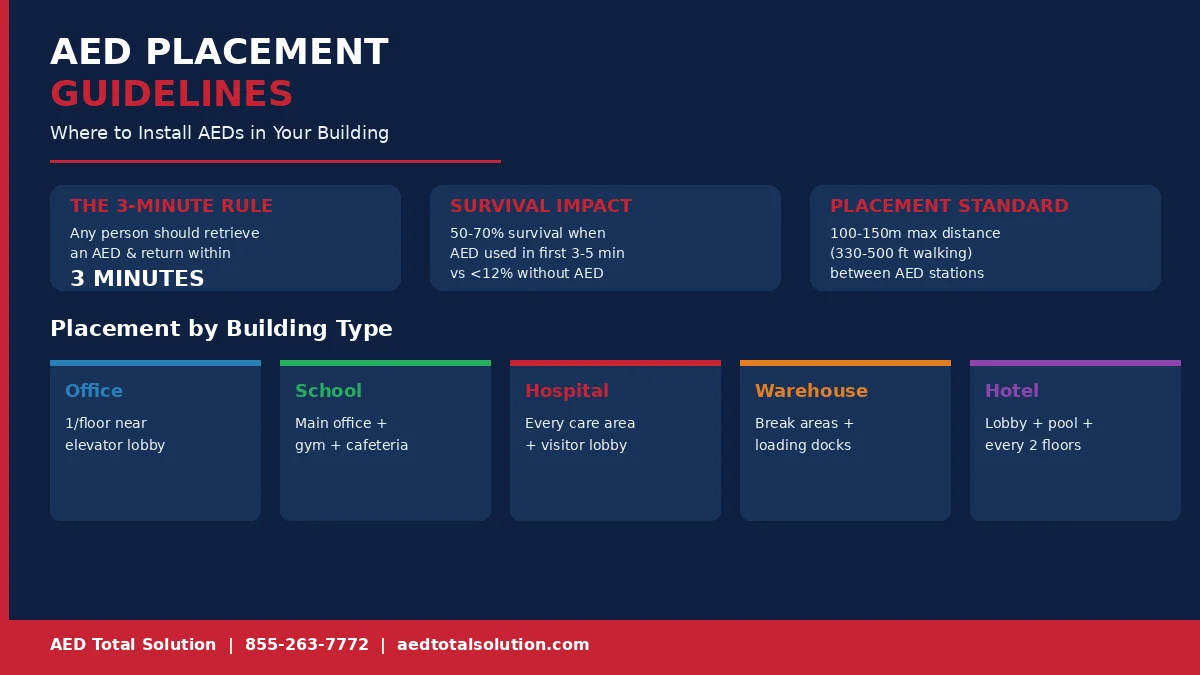
The widely accepted standard for AED placement is the 3-minute rule: any person in a facility should be able to retrieve an AED and return to the victim within three minutes. This benchmark comes from the American Heart Association (AHA) and is referenced by OSHA, state health departments, and emergency medical services organizations nationwide.
Why three minutes? Research shows that when defibrillation occurs within the first three to five minutes of cardiac arrest, survival rates can reach 50% to 70%. After five minutes, survival rates begin to decline sharply. Since the average EMS response time in the United States is 7 to 12 minutes, relying solely on paramedics means the window for effective defibrillation has often already passed.
The 3-minute rule translates to practical placement decisions: an AED should be no more than a 1.5-minute walk from any point in the building. For a typical office building, this means placing devices approximately every 100 to 150 meters (330 to 500 feet) of walking distance.
General AED Placement Principles
Regardless of your building type, the following principles should guide every AED placement decision:
Visibility and Accessibility
- Mount AEDs at eye level in high-traffic areas where they are immediately visible to employees, visitors, and first responders.
- Never place AEDs behind locked doors or in restricted-access areas. The device must be accessible 24/7, especially during off-hours when the building population is smaller.
- Use wall-mounted cabinets with clear window panels. Alarmed cabinets discourage theft and tampering while ensuring the device is accessible in an emergency.
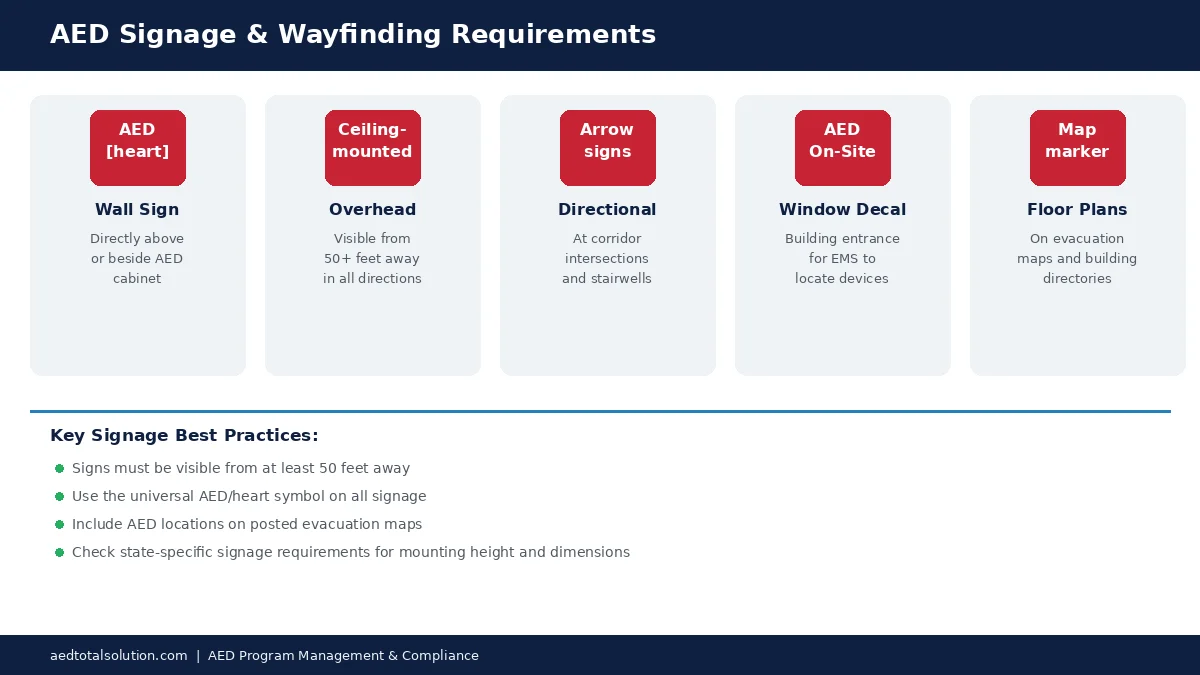
- Install AED signage above and around the device, including overhead markers, wall-mounted directional signs, and window decals. Signs should be visible from at least 50 feet away.
Strategic Location Selection
- High-traffic common areas: Lobbies, reception desks, break rooms, and cafeterias are optimal because they are central and familiar to building occupants.
- Near elevators and stairwells: These are natural gathering points and easy-to-describe locations when directing someone to retrieve an AED.
- Adjacent to high-risk areas: Gyms, fitness centers, loading docks, manufacturing floors, and areas with physically demanding work carry elevated cardiac risk.
- Near existing emergency equipment: Placing AEDs near fire extinguishers, first aid kits, and emergency phones creates a centralized emergency response station.
Environmental Considerations
- Temperature: Most AEDs are rated for operation between 32°F and 122°F (0°C to 50°C). Avoid placing devices in direct sunlight, near heating vents, in uninsulated outdoor locations, or in freezing environments without a heated cabinet.
- Moisture: While many modern AEDs carry IP-rated protection against water and dust, indoor placement is preferred. Outdoor installations should use weather-resistant cabinets.
- Security: In areas with high foot traffic from the public (lobbies, transit stations, arenas), alarmed cabinets help prevent tampering while maintaining rapid access.
AED Placement by Building Type
Different facilities have different risk profiles, occupancy patterns, and regulatory requirements. Here are placement guidelines for the most common building types:
Corporate Offices and Commercial Buildings
| Building Feature | Recommended Placement |
|---|---|
| Single-story office | 1 AED in main lobby or central hallway |
| Multi-story office | 1 AED per floor, near elevator lobby |
| Large floor plates (50,000+ sq ft) | 2 AEDs per floor at opposite ends |
| Fitness center / gym | 1 AED inside the facility, near entrance |
| Cafeteria / break room | 1 AED nearby or within the space |
| Parking garage | 1 AED per level near elevator access |
For corporate environments, place AEDs in locations that employees pass daily so they become familiar with the device’s location without needing a map. A workplace AED emergency response plan should document exact placement locations and include them in employee orientation materials.
Schools and Educational Facilities
Many states mandate AEDs in schools, particularly near athletic facilities. For a complete breakdown, see our guide on AED requirements for schools.
| Area | Recommended Placement |
|---|---|
| Main office / front entrance | 1 AED in the front office, accessible to visitors and staff |
| Gymnasium / athletic fields | 1 AED inside the gym; 1 portable unit for outdoor fields |
| Cafeteria | 1 AED near the entrance |
| Large buildings (multiple wings) | 1 AED per wing or corridor intersection |
| Auditorium / performing arts center | 1 AED near the main entrance |
Schools face unique challenges because of pediatric patients. Ensure that AEDs deployed in schools include pediatric pads or have a pediatric mode, and that staff are trained on proper AED pad placement for children and infants.
Healthcare and Senior Living Facilities
- Place AEDs in every patient/resident care area, even if manual defibrillators are available elsewhere in the building.
- Lobby and visitor areas should have their own AED, separate from clinical equipment.
- Multi-building campuses (assisted living, rehabilitation centers) need AEDs in each building, not just the main facility.
Manufacturing, Warehouses, and Industrial Facilities
- Place AEDs near break areas and shift change stations where workers congregate.
- Loading docks, outdoor work areas, and remote sections of the facility may require portable AEDs or additional wall-mounted units. For guidance specific to temporary and outdoor worksites, see our guide on AEDs for construction sites.
- Consider environmental factors: dust, extreme temperatures, and moisture may require ruggedized cabinets or devices rated for harsh conditions.
Hotels, Hospitality, and Event Venues
- Front desk / lobby is the primary location for guest-accessible AED placement.
- Pool and fitness areas require dedicated AEDs due to elevated risk.
- Convention centers and ballrooms should have AEDs available during large events.
- Multi-story hotels should place AEDs at minimum every other floor, near elevators.
- For temporary events, AED rental programs provide flexible coverage without a permanent purchase AED devices commitment.
AED Signage and Wayfinding Requirements
An AED that people cannot find is an AED that will not be used. Proper signage is as important as proper placement.
Types of AED Signage
- Wall-mounted signs: Place directly above or beside the AED cabinet. Use the universal AED/heart symbol with the text “AED” in large, bold lettering.
- Overhead/ceiling-mounted signs: Visible from a distance and from multiple angles. Essential in large open spaces, corridors, and lobby areas.
- Directional arrows: Guide people from distant areas toward the nearest AED. Place at corridor intersections and stairwell entrances.
- Window decals: “AED On-Site” decals on building entrances help EMS personnel locate devices quickly upon arrival.
- Floor plans: Include AED locations on posted emergency evacuation maps and in building directories.
Many states have specific signage requirements. Check the AED laws in your state for mounting height, sign dimensions, and other compliance requirements.
State Regulations That Affect AED Placement
AED placement requirements vary significantly by state. Some common regulatory patterns include:
- California: Requires AEDs in certain commercial buildings, health clubs, and public assembly facilities. California also mandates biannual testing and 90-day inspection cycles for deployed AEDs.
- New York: Mandates AEDs in facilities with 1,000 or more occupants. Schools, health clubs, and places of public assembly have specific requirements.
- Texas: Requires physician oversight for all AED programs. Monthly inspections with documented checklists are required.
- Illinois: Mandates AEDs in fitness centers with 100 or more active members. Penalties for non-compliance range from $1,500 to $2,000 or more.
- Florida: Encourages AED placement but does not mandate it broadly. Provides unconditional Good Samaritan protection for properly maintained AED programs.
For organizations operating in multiple states, compliance requirements compound. AED Total Solution manages multi-state AED compliance through centralized tracking and state-specific AED program management, ensuring every location meets its regulatory obligations.
How Many AEDs Does Your Facility Need?
Determining the right number of AEDs involves several factors:
| Factor | Impact on AED Quantity |
|---|---|
| Total square footage | Larger buildings need more devices to maintain the 3-minute response window |
| Number of floors | Minimum 1 AED per floor; large floors need 2+ |
| Number of occupants | Higher occupancy increases the statistical probability of a cardiac event |
| Distance from EMS | Remote locations with longer EMS response times need more coverage |
| Building layout complexity | Separated wings, multiple buildings, or restricted-access areas each need dedicated devices |
| High-risk areas | Gyms, industrial floors, and areas with physically demanding work need dedicated AEDs |
A thorough site assessment is the best way to determine exact quantities. AED Total Solution provides placement consulting as part of our AED program management service, including on-site assessments and optimal placement recommendations.
AED Placement for Multi-Location Organizations
Organizations managing AEDs across multiple facilities face additional challenges:
- Standardized placement policies: Create a company-wide placement standard that accounts for building size, occupancy, and regulatory requirements, then adapt it for each location.
- Centralized device tracking: Use a single platform to monitor every AED’s location, status, and maintenance schedule across all sites. Manual tracking across spreadsheets breaks down at scale.
- Consistent signage: Use the same signage standards across all locations so that employees who move between sites can locate an AED intuitively.
- Scalable procurement: As you add locations, coordinate AED purchases to maintain consistency in device models, which simplifies training and supply management.
AED Total Solution has experience managing programs for organizations with over 400 locations nationwide, providing centralized dashboards, automated monitoring, and dedicated program specialists.
Common AED Placement Mistakes to Avoid
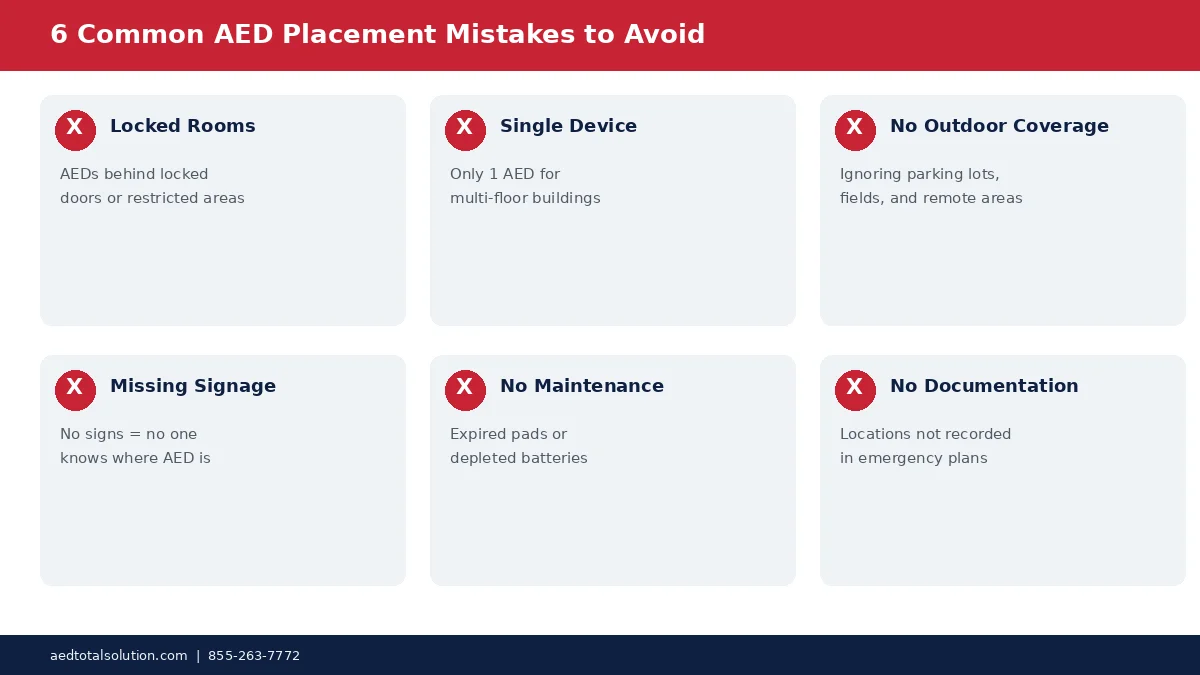
- Placing AEDs in locked offices or storage rooms. The device must be accessible without a key, code, or permission from anyone.
- Relying on a single AED for a multi-floor building. Running up or down stairs to retrieve a device wastes critical minutes.
- Ignoring outdoor and remote areas. Parking lots, playing fields, and construction sites need portable AED solutions.
- Placing AEDs without signage. If people do not know where the device is, it will not be used during an emergency.
- Neglecting maintenance after placement. An AED that is not regularly inspected may have expired pads or a depleted battery. Use the AED maintenance checklist to keep devices rescue-ready.
- Failing to document placement locations. Every AED location should be documented in your AED emergency response plan and posted on building maps.
Frequently Asked Questions
What is the recommended height for mounting an AED on a wall?
AEDs should be mounted at a height that is accessible to most adults, typically between 36 and 48 inches from the floor to the bottom of the cabinet. This ensures the device can be quickly retrieved without bending or reaching. Check your state’s specific requirements, as some states specify mounting heights in their AED regulations.
Can AEDs be placed outdoors?
Yes, AEDs can be placed outdoors using weather-resistant heated cabinets designed for external installation. These cabinets protect the device from temperature extremes, moisture, and vandalism. Outdoor AEDs are common at athletic fields, pools, parks, and construction sites.
How do I know if my building is required to have an AED?
AED requirements depend on your state, building type, and occupancy. Many states mandate AEDs in schools, fitness centers, and large public facilities. Even when not mandated, OSHA recommends AEDs as a best practice for workplace safety. Consult the AED laws for your state for specific requirements.
Should every floor of a building have an AED?
Yes. The standard recommendation is at least one AED per floor in multi-story buildings. Large floor plates (over 50,000 square feet) may require two or more devices per floor to maintain the 3-minute response window. Elevators are not a reliable means of AED transport during emergencies due to wait times.
What is the cost of an AED and installation?
AED device packages typically range from $1,400 to $3,000, depending on the brand and model. This includes the device, carry case, electrode pads, battery, wall cabinet, and signage. For a detailed breakdown, see our AED cost and pricing guide. AED Total Solution also offers AED rental programs for organizations that prefer flexible, lower-upfront-cost options.
Ensure Your AEDs Are in the Right Place at the Right Time
AED placement is a strategic decision that directly impacts survival outcomes during cardiac emergencies. By following the 3-minute rule, selecting high-visibility locations, addressing state-specific requirements, and maintaining proper signage, your organization can ensure that life-saving equipment is always within reach.
AED Total Solution provides end-to-end AED program management, including site assessments, placement consulting, device procurement, installation support, and ongoing maintenance tracking across all your locations.
Contact AED Total Solution at 855-263-7772 or visit our services page to schedule a placement assessment and build a compliant, response-ready AED program for your organization.