Sudden cardiac arrest (SCA) strikes more than 350,000 Americans each year, and fitness facilities present a unique risk environment. Intense physical exertion can trigger fatal cardiac events in individuals with undiagnosed heart conditions, making gyms and fitness centers critical locations for automated external defibrillators (AEDs). Multiple states now mandate that health clubs maintain functional AED programs, and even in states without explicit mandates, having an AED on-site is a recognized industry standard of care.
This guide covers state-by-state AED requirements for gyms and fitness centers, what a compliant program looks like, and how to implement one efficiently.
Why Gyms and Fitness Centers Need AEDs
Exercise-related cardiac events, while relatively rare, are disproportionately fatal without immediate intervention. According to the American Heart Association, survival rates for SCA drop 7% to 10% for every minute defibrillation is delayed. When an AED is used within the first few minutes of cardiac arrest, survival rates can exceed 70%.
Gyms concentrate physical exertion in a single location, often involving individuals who may not be aware of underlying cardiovascular conditions. High-intensity interval training, heavy weightlifting, and vigorous cardio sessions all elevate cardiac stress. For facility operators, this combination of risk factors makes AED readiness both a safety imperative and a legal consideration.
Beyond saving lives, maintaining an AED program demonstrates a commitment to member safety, reduces organizational liability, and may satisfy insurance requirements.
Which States Require AEDs in Gyms and Fitness Centers?
AED requirements for gyms vary significantly by state. Some states have explicit mandates requiring health clubs to maintain functional AED programs, while others strongly encourage AED placement without a legal mandate. Below is an overview of states with specific gym or fitness center AED laws.
States with Mandatory Gym AED Requirements
- California: Health studios must have at least one AED on-site and ensure trained personnel are available during staffed operating hours (California Health & Safety Code § 104113).
- New York: Health clubs must have AEDs on-site and staff trained in AED use and CPR (N.Y. General Business Law § 627-A).
- Illinois: Physical fitness facilities with 100 or more members must have an AED and at least one trained staff member on-site during business hours (410 ILCS 4/15).
- Rhode Island: Health clubs must maintain at least one AED on the premises and ensure employees are trained (R.I. Gen. Laws § 5-50-12).
- Washington: Fitness centers that employ staff must acquire and maintain at least one AED (RCW 70.54.315).
- Arkansas: Health spa facilities are required to have AEDs and trained operators on-site.
- Louisiana: Health clubs must maintain an AED and have at least one staff member trained in its use during operating hours.
- New Jersey: Health clubs and fitness centers are required to maintain AEDs on premises with trained staff present.
States with Strong Recommendations or Partial Requirements
- Florida: While not universally mandated for gyms, Florida provides broad Good Samaritan protections that encourage AED placement in commercial fitness facilities.
- Texas: AEDs are not universally required in gyms, but medical oversight mandates apply when AEDs are deployed, and many municipalities have local ordinances requiring them.
- Oregon: Encourages AED placement in fitness facilities through liability protections for businesses that maintain compliant programs.
- Massachusetts: Recommends AED placement in health clubs, and many cities have local mandates.
- Connecticut: Health clubs with staffed hours are encouraged to maintain AEDs under the state’s general AED legislation.
Even in states without explicit gym mandates, the standard of care in the fitness industry increasingly favors AED availability. A growing number of professional organizations, insurance carriers, and accreditation bodies recommend or require AEDs in fitness facilities.
Key Components of a Compliant Gym AED Program
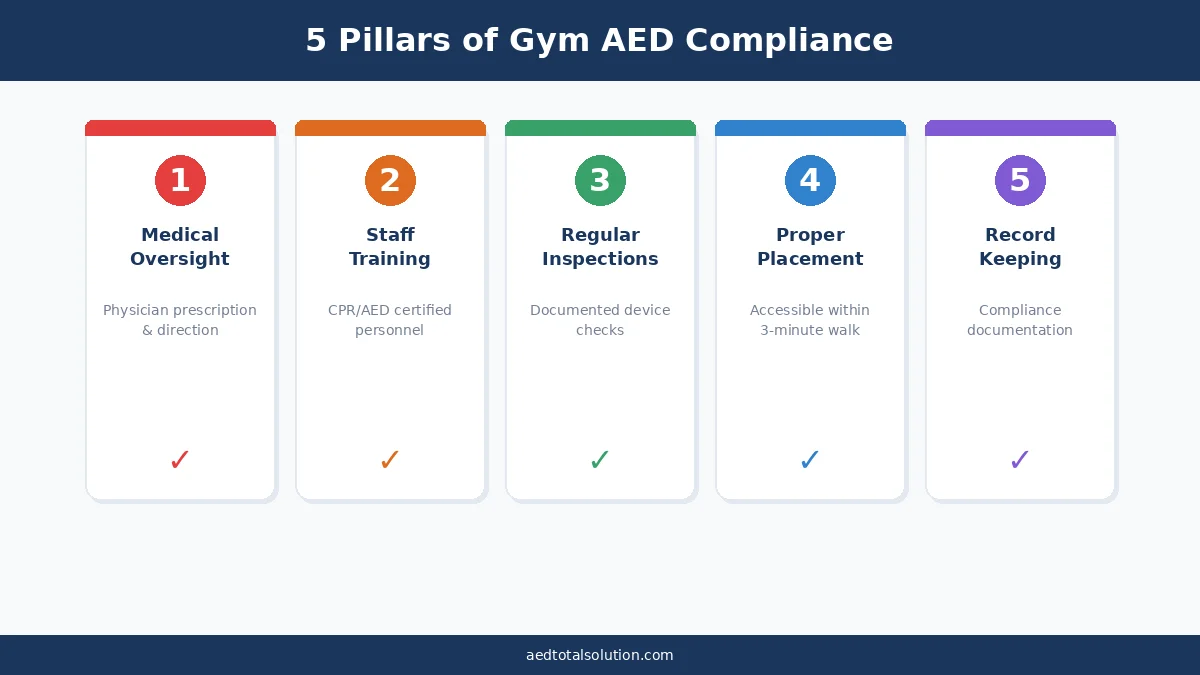
Having an AED on the wall is only the starting point. A truly compliant program includes several ongoing requirements that must be maintained consistently.
Medical Oversight and Physician Prescription
AEDs are FDA-classified Class III medical devices, which means they require a physician prescription for purchase and deployment. Many states also require ongoing medical direction for AED programs, including protocol review and post-event physician oversight. An AED AED program management provider can coordinate this medical oversight on your behalf.
Staff Training and Certification
Most state laws requiring AEDs in gyms also mandate that at least one trained staff member be present during operating hours. Training should cover:
- CPR and AED operation (American Heart Association or American Red Cross certification)
- Recognizing signs of sudden cardiac arrest
- Activating emergency medical services (EMS)
- Proper AED pad placement and use
Certifications typically expire every two years, so tracking and renewing staff training is an ongoing responsibility.
Regular Inspections and Maintenance
AEDs require regular inspections to verify that batteries are charged, electrode pads are not expired, and the device performs self-checks without errors. State requirements vary:
- California mandates biannual testing and 90-day inspection cycles.
- Other states require monthly visual inspections at minimum.
- Manufacturer recall notices must be tracked and addressed promptly.
Failing to maintain inspection records can void Good Samaritan protections and expose your facility to liability.
Proper AED Placement and Signage
AEDs should be placed in visible, easily accessible locations within the facility. Best practices include:
- Mounting the AED within a 3-minute walk from any point in the facility
- Using clear AED signage that meets local code requirements
- Positioning near high-traffic or high-risk areas (cardio floor, weight rooms, group fitness studios)
- Ensuring the AED is not locked behind restricted-access doors
Documentation and Record Keeping
A compliant program requires documentation of:
- Device registration with local or state authorities (where required)
- Inspection logs with dates, inspector names, and device status
- Staff training certifications and renewal dates
- Maintenance activities (pad and battery replacements, recalls)
- Post-event reports if the AED is ever deployed
How to Choose the Right AED for Your Gym
Not all AEDs are created equal, and the best choice for a fitness center depends on your facility’s size, layout, and operational model.
Key selection criteria include:
- Ease of use: Look for models with clear audio and visual prompts that guide untrained bystanders through the rescue process.
- Durability: Gym environments involve temperature fluctuations, humidity, and dust. Choose a device rated for your conditions.
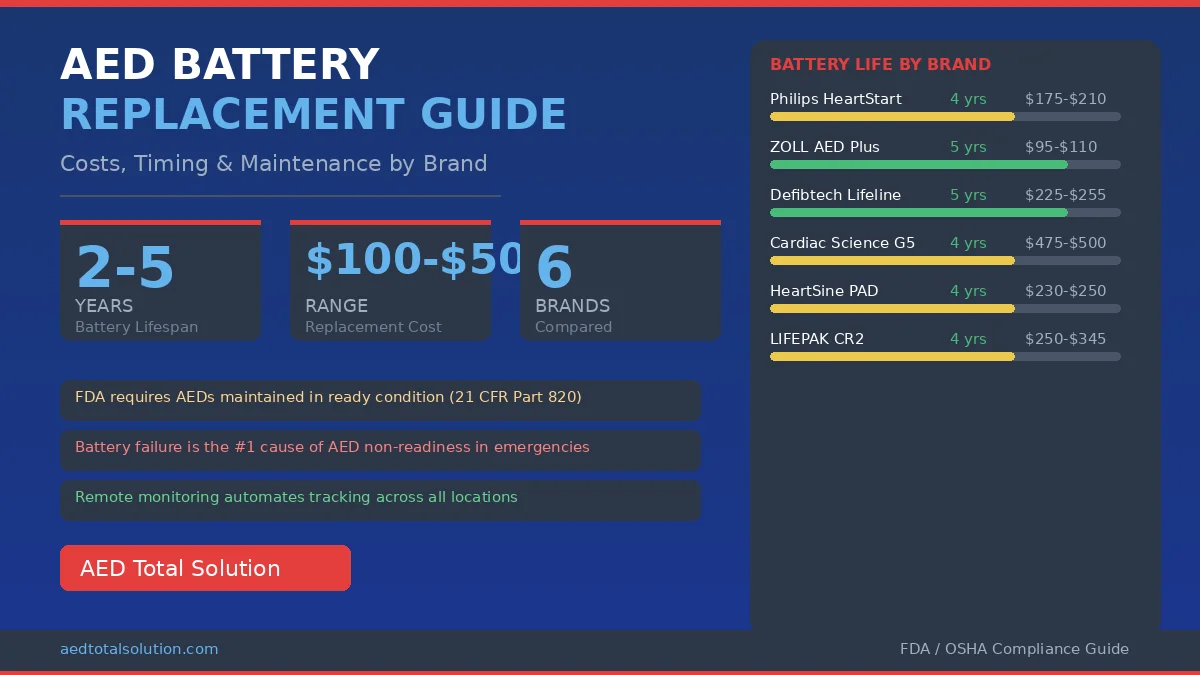
- Pad and battery life: Longer shelf lives reduce replacement frequency and ongoing AED cost informations.
- Connectivity: Some modern AEDs offer Wi-Fi or cellular connectivity for remote monitoring and automatic status alerts.
- Pediatric capability: If your facility serves minors (youth sports programs, family fitness areas), ensure your AED supports pediatric pads or has a pediatric mode.
Popular AED models for fitness centers include the ZOLL AED Plus, Philips HeartStart OnSite, and Defibtech Lifeline VIEW, all of which are available through AED Total Solution.
Common Compliance Mistakes Gym Owners Make
Many fitness facilities purchase an AED but fail to maintain a complete compliance program. These are the most common pitfalls:
- Expired pads or batteries: AED electrode pads and batteries have expiration dates. Using expired components can result in device failure during an emergency.
- No trained staff on duty: Having an AED without trained personnel present during all operating hours leaves the facility exposed to liability.
- Missing inspection records: Without documented inspection histories, facilities cannot prove compliance during audits or legal proceedings.
- No medical oversight: Skipping physician prescription or medical direction requirements can void the legality of your entire AED program.
- Ignoring state registration requirements: Many states require AED registration with local EMS or health departments. Failure to register may void Good Samaritan protections.
Frequently Asked Questions
Are gyms legally required to have AEDs?
It depends on the state. California, New York, Illinois, Washington, Rhode Island, Arkansas, Louisiana, and New Jersey all have laws mandating AEDs in fitness centers. Even in states without explicit mandates, AED placement is considered an industry standard of care and is recommended by professional organizations and insurance carriers.
How many AEDs does a gym need?
The general guideline is to place AEDs so that any person in the facility can reach one within a 3-minute walk. For large, multi-floor, or multi-building fitness facilities, this may require two or more devices. State laws typically require a minimum of one AED per facility. For detailed guidance on placement strategies, device selection, and maintenance specific to fitness environments, see our AED for Gyms and Fitness Centers: Best Practices Guide.
How often do gym AEDs need to be inspected?
Inspection frequency varies by state. California requires 90-day inspections and biannual testing. Most industry best practices recommend monthly visual checks and documented inspections at least quarterly. Your AED program management provider should automate inspection reminders and tracking.
What happens if a gym doesn’t have an AED and someone has cardiac arrest?
In states with AED mandates, non-compliance can result in fines and penalties. More critically, a facility without an AED faces significant legal liability if a member suffers SCA and the absence of an AED contributed to a poor outcome. Courts have increasingly held fitness facilities to a higher standard of care regarding cardiac emergency preparedness.
Can a gym be liable for using an AED incorrectly?
Good Samaritan laws in most states protect individuals and organizations that use AEDs in good faith during cardiac emergencies. However, these protections are often conditional on maintaining a compliant program, including physician oversight, staff training, and regular device maintenance.
How AED Total Solution Simplifies Gym AED Compliance
Managing an AED program across one or multiple fitness locations requires ongoing attention to inspections, training renewals, supply replacements, and regulatory changes. AED Total Solution’s managed AED program eliminates this administrative burden with:
- Physician-provided medical oversight and prescription, included in every plan
- Automated tracking for battery and pad expiration, training certifications, and inspection schedules via a centralized web portal and mobile app
- Automatic supply replacement (Standard Plus plan) so pads and batteries are shipped before they expire
- Multi-location management for gym chains and franchise operations
- Post-event coordination including data download, physician review, and device refurbishment
- State registration assistance and ongoing compliance documentation
With AED Total Solution, your facility stays compliant, your staff stays trained, and your AEDs stay ready, so you can focus on running your business.
Ready to build a compliant AED program for your gym or fitness center? Contact AED Total Solution or call 855-263-7772 to get started.