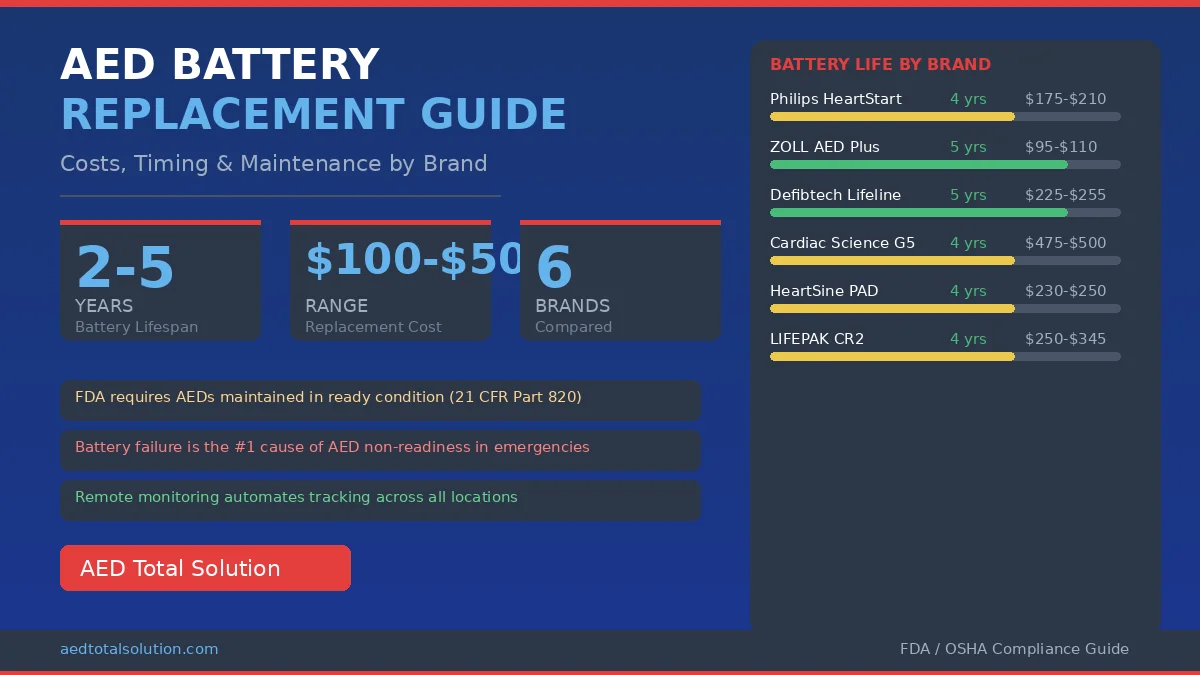
An AED is only as reliable as its battery. If the battery is expired, depleted, or incompatible, the device will not deliver a shock when someone’s life depends on it. Battery failure is the most common reason AEDs are found non-functional during emergencies, making AED battery replacement one of the most critical aspects of any AED program.
This definitive guide covers everything organizations need to know about replacing AED batteries: how long batteries last by brand, the three critical dates on every battery, warning signs that a replacement is needed, step-by-step replacement instructions for every major brand, what replacement costs to expect, FDA maintenance guidelines, proper disposal procedures, pad-and-battery co-replacement strategy, and how managed AED programs take the guesswork out of battery tracking entirely.
Key Takeaways
- Most AED batteries last 2 to 5 years when installed, depending on the brand and model.
- Battery failure is the leading cause of AED non-readiness during cardiac emergencies.
- Every AED battery has three critical dates: manufacture date, install-by date, and expiration date. Tracking all three is essential.
- Replacement costs typically range from $100 to $500, varying by manufacturer and battery type.
- The FDA requires AEDs to be maintained in ready condition, including timely battery replacement.
- Warning signs include beeping, red status indicators, failed self-tests, and expired dates.
- AED pads and batteries often need coordinated replacement to maintain full device readiness.
- A managed AED program with remote monitoring automates battery tracking and ensures replacements happen on schedule.
How Long Do AED Batteries Last? A Brand-by-Brand Breakdown
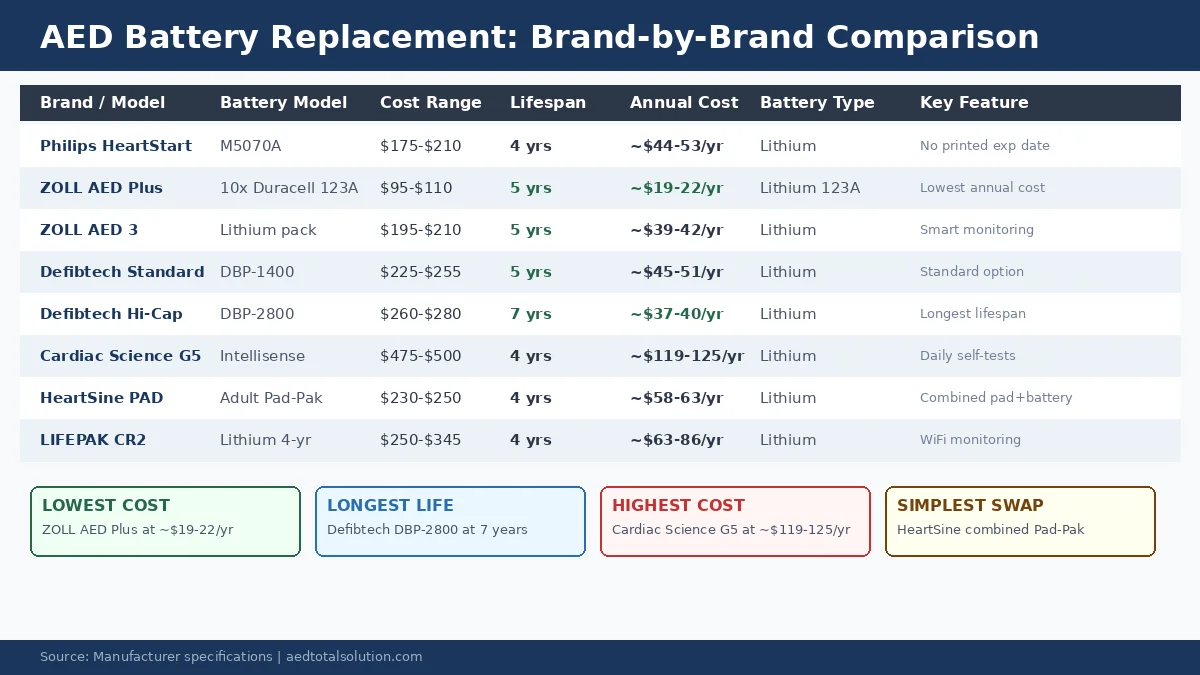
AED battery lifespan varies significantly across manufacturers and models. Most batteries are non-rechargeable lithium packs engineered for long standby periods while maintaining the ability to deliver high-voltage rescue power instantly.
Here is a breakdown of battery life by major AED brand:
Philips HeartStart (OnSite and FRx)
- Installed life: 4 years
- Shelf life (uninstalled): 5 years from manufacture date
- Battery model: M5070A
- Replacement cost: $150 to $250
- Key note: Philips batteries do not display a printed expiration date. The battery life begins from the install date, so organizations must track when the battery was placed into the device. This is a common oversight that leads to expired batteries still in service.
ZOLL AED Plus
- Installed life: 5 years (software version 5.32 or higher) or 3 years (earlier software versions)
- Shelf life (uninstalled): Up to 10 years from manufacture date
- Battery type: Set of 10 Duracell 123A lithium batteries
- Replacement cost: $25 to $40 for the battery set
- Key note: All 10 batteries must be replaced at the same time. Replacing only a few creates a false “Ready” status, which means the device could fail during an actual emergency. Only Duracell-brand batteries are recommended by ZOLL. Never attempt to recharge these non-rechargeable lithium cells, as doing so risks explosion or device damage.
Defibtech Lifeline
- Standard battery (DBP-1400): 5 years installed
- High-capacity battery (DBP-2800): 7 years (uninstalled shelf life) or 5 years installed
- VIEW model battery (DCF-2003): 4 years installed
- Replacement cost: $150 to $350 depending on capacity
- Key note: Defibtech offers both standard and long-life battery options. The high-capacity DBP-2800 is a strong choice for organizations that want to extend the time between replacements.
Cardiac Science Powerheart G5
- Installed life: 4 years
- Shelf life (uninstalled): 5 years
- Replacement cost: $200 to $300
- Key note: The Powerheart G5 features Intellisense technology that performs daily, weekly, and monthly self-tests to verify battery status. Even with automated testing, manual inspections should supplement the device’s self-check cycle.
HeartSine Samaritan PAD (350P, 360P, 450P)
- Installed life: 4 years
- Battery type: Combined Pad-Pak (battery and pads in one cartridge)
- Replacement cost: $200 to $350 (includes pads)
- Key note: HeartSine uses a unique combined battery-and-pad cartridge. When the battery expires, the pads expire at the same time. This simplifies maintenance but means replacement costs include both components.
Stryker/Physio-Control LIFEPAK CR2
- Installed life: 4 years
- Replacement cost: $250 to $400
- Key note: The LIFEPAK CR2 supports WiFi connectivity, enabling remote monitoring of battery status and device readiness. This feature is particularly valuable for multi-location organizations.
The 3 Critical Dates on Every AED Battery
Every AED battery carries multiple dates, and confusing them is one of the most common compliance mistakes organizations make. Understanding the difference between these three dates is essential for maintaining a rescue-ready device.
Manufacture date
This is the date the battery was produced. It appears on the label as a printed or stamped date. The manufacture date starts the clock on the battery’s overall chemical lifespan, regardless of whether it has been installed in a device.
Install-by date (shelf life expiration)
This is the deadline by which the battery must be placed into an AED. If a battery sits on a shelf past this date, its stored energy may have degraded to the point where it cannot reliably power a rescue. For most brands, the install-by window is 2 to 5 years from the manufacture date.
Expiration date (installed life)
Once a battery is installed in an AED, the expiration date is calculated from the installation date, not the manufacture date. This is the most important date for day-to-day compliance. For brands like Philips that do not print an expiration date on the battery itself, organizations must record the installation date manually and calculate the replacement deadline.
Critical point: A battery can pass its install-by date while sitting in a supply closet, making it unreliable even though it has never been used. Always check all three dates before installing a replacement battery.
What Factors Shorten an AED Battery’s Lifespan?
The published lifespan for any AED battery assumes ideal storage and operating conditions. In the real world, several factors can significantly reduce how long a battery actually lasts.
Temperature and environment
AED batteries are designed to operate within a specific temperature range, typically 32°F to 122°F (0°C to 50°C). Storing an AED in a vehicle, outdoor cabinet, or non-climate-controlled warehouse exposes the battery to temperature extremes that accelerate chemical degradation. High heat is especially damaging and can cut battery life by 20% or more.
Self-test frequency
Modern AEDs perform automated self-tests daily, weekly, or monthly depending on the model. Each self-test draws a small amount of power. Devices with more frequent or more comprehensive self-test routines will consume battery energy faster than the published standby lifespan suggests.
Partial use events
If an AED is powered on during a suspected emergency but no shock is delivered, the device still consumes significant battery power during the analysis and charging cycles. After any use event, even a brief one, the battery should be evaluated and potentially replaced to ensure full readiness.
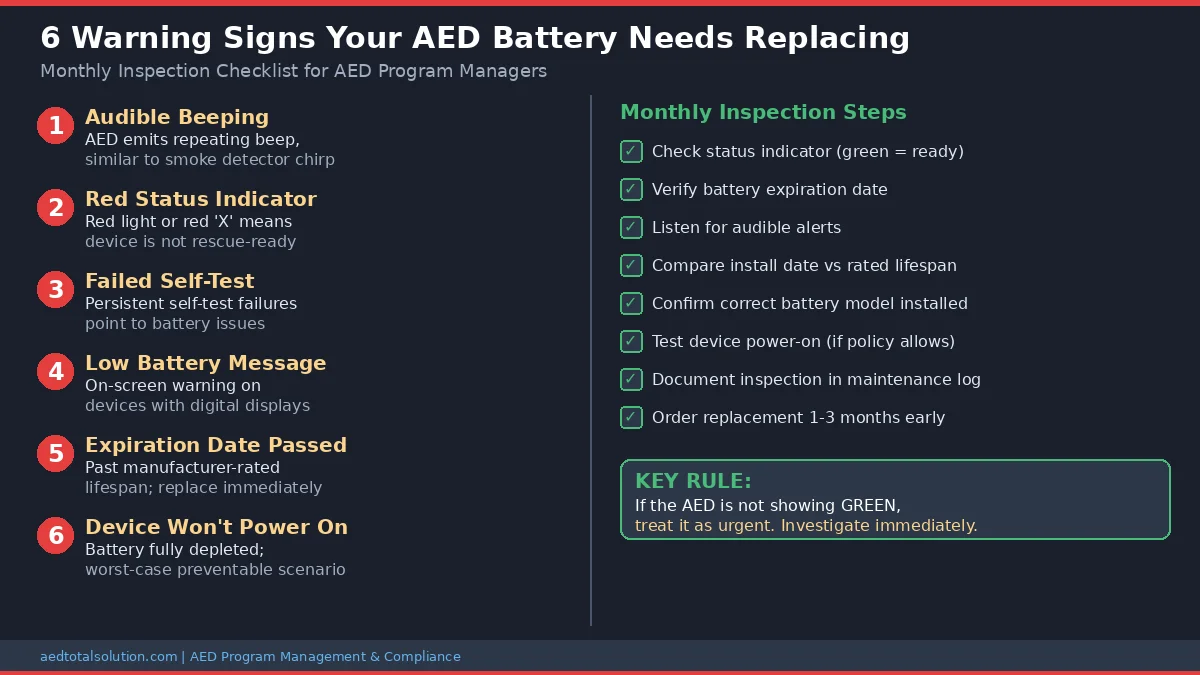
6 Warning Signs Your AED Battery Needs Replacing
Do not wait for a battery to fully fail before acting. These warning signs indicate that an AED battery replacement is needed:
- Audible beeping or chirping. Most AEDs emit a repeating beep when the battery drops below operational thresholds. This sound is similar to a smoke detector’s low-battery chirp and should never be ignored.
- Red status indicator or “X” symbol. A red light or red “X” on the device’s status display means the AED is not rescue-ready. The battery is the most common cause.
- Failed self-test. AEDs perform automated self-tests on a regular schedule. If the device reports a failed test through its indicator or event log, battery failure is a primary suspect.
- Expired date on the battery. If the printed or calculated expiration date has passed, the battery must be replaced immediately, even if the device still shows a green status indicator.
- Physical damage or corrosion. Swelling, leaking, discoloration, or corrosion on battery terminals indicates the battery is compromised and should be removed and replaced immediately.
- Device used in an emergency or training. After any use event, even if only briefly powered on, replace the battery to ensure the AED has full power available for the next emergency.
How to Check Your AED Battery Status
Monthly visual inspection
At minimum, perform a monthly visual check of every AED in your program. Verify the status indicator shows green (or the model-specific “ready” symbol), confirm the battery is seated properly, and check the expiration date. Document the inspection in your AED maintenance log.
Understanding battery dates
Locate the manufacture date and expiration date on the battery label. If the battery is a Philips model without a printed expiration, check your installation records. Compare the current date against the installed life expectancy for your specific model. If the battery is within 60 days of expiration, order a replacement immediately.
Using self-checks and remote monitoring
Many modern AEDs, including the LIFEPAK CR2 and Cardiac Science Powerheart G5, offer automated self-check features that test battery voltage, pad connectivity, and internal circuitry. Some models support WiFi or cellular connectivity that transmits device status to a central dashboard. While these automated checks are valuable, they should supplement, not replace, regular manual inspections.
How to Replace an AED Battery: Step-by-Step Instructions by Brand
Each AED manufacturer has a slightly different battery replacement procedure. Follow the steps below for your specific device. Always have the replacement battery ready before removing the old one.
Philips HeartStart OnSite and FRx
- Press the release tab on the bottom of the device to eject the old battery cartridge.
- Slide the new M5070A battery into the slot until it clicks into place.
- The device will automatically perform a self-test. Wait for the green status indicator to confirm readiness.
- Record the installation date on the battery or in your maintenance log. The 4-year countdown starts now.
ZOLL AED Plus
- Place the AED face-down with the handle pointing away from you.
- Use a coin to turn each of the battery cover screws, then lift the cover to expose the battery compartment.
- Remove all 10 existing Duracell 123A batteries.
- Insert the 10 new batteries starting at the top left, moving down to the bottom, then top right to bottom right, and finally the two center positions last.
- Replace the cover and secure the screws.
- Flip the AED upright. It will begin a self-check and use voice prompts to guide you. Press the blue button when prompted to confirm the replacement.
- Verify the green check mark appears on the status display.
Stryker/Physio-Control LIFEPAK CR2
- Open the battery compartment on the bottom of the device.
- Slide the old battery out and insert the new LIFEPAK CR2 battery pack.
- Close the compartment and ensure it locks securely.
- The device will run an automatic self-test. Confirm the status indicator shows the device is rescue-ready.
Cardiac Science Powerheart G5
- Locate the battery compartment on the bottom of the device.
- Press the release latch and slide the old battery out.
- Insert the new Intellisense battery until it clicks into place.
- The G5 will automatically initiate a self-test. Wait for the green ready indicator.
HeartSine Samaritan PAD (350P, 360P, 450P)
- Open the device and remove the old Pad-Pak cartridge (this contains both the battery and pads).
- Insert the new Pad-Pak, ensuring the connector seats firmly.
- Close the device and confirm the status indicator shows green.
- Note: Because the Pad-Pak includes both battery and pads, this single replacement covers both components.
Defibtech Lifeline
- Locate the battery compartment on the right side of the device.
- Press the release button and slide the old battery out.
- Insert the new battery (DBP-1400, DBP-2800, or DCF-2003 depending on your model) until it clicks.
- Press the reset button inside the battery compartment.
- Wait for the AED to complete its self-check and confirm the green status light is active.
Important for all brands: After replacing the battery, always reset the AED if required by the manufacturer, run a manual self-test, and update your maintenance records with the new installation date and expected expiration date.
AED Pad and Battery Co-Replacement: What You Need to Know
AED pads and batteries are both consumable components with limited lifespans, and their replacement schedules often overlap. A coordinated approach to replacing both components saves time, reduces compliance risk, and ensures complete device readiness.
Why pads and batteries should be tracked together
An AED with a fresh battery but expired pads is just as unreliable as one with a dead battery. Pads lose adhesive effectiveness and electrical conductivity over time. Most AED pads last 2 to 5 years, which closely mirrors battery lifespans. Organizations that track both components on a single maintenance schedule avoid the risk of one component expiring unnoticed.
Brands with combined pad-battery cartridges
HeartSine’s Pad-Pak system combines the battery and electrode pads into a single replaceable cartridge. This eliminates the need to track two separate expiration dates and ensures both components are always replaced simultaneously. While the upfront cost is higher ($200 to $350), the simplified maintenance can reduce total program management costs.
Budgeting for total cost of ownership
When planning your AED program budget, account for the recurring cost of both batteries and pads. For a typical AED with a 4-year battery and 2-year pad lifespan, expect to replace pads twice for every battery replacement. Over a 10-year device lifespan, total consumable costs (batteries plus pads) typically range from $500 to $1,500 per device depending on the brand.
How Much Does AED Battery Replacement Cost?
AED battery replacement costs vary by brand, battery capacity, and where you purchase. Here is a general pricing overview:
- Philips HeartStart M5070A: $150 to $250
- ZOLL AED Plus (10-pack Duracell 123A): $25 to $40
- Defibtech DBP-1400 (standard): $150 to $200
- Defibtech DBP-2800 (high-capacity): $250 to $350
- Cardiac Science Powerheart G5: $200 to $300
- HeartSine Pad-Pak (battery + pads): $200 to $350
- LIFEPAK CR2: $250 to $400
Factors that influence cost
Battery pricing depends on whether you purchase OEM (original equipment manufacturer) or FDA-approved third-party replacements, the quantity ordered, and whether the purchase is part of a managed program subscription. OEM batteries are always recommended to ensure device compatibility and warranty coverage.
Saving money with bulk orders and subscriptions
Organizations managing multiple AEDs can often negotiate volume discounts. Managed AED programs like those offered by AED Total Solution bundle battery replacements into an annual subscription, which spreads costs predictably and ensures replacements arrive before expiration dates.
FDA Requirements for AED Battery Maintenance
Federal requirements
The FDA classifies AEDs as Class III medical devices and requires that they be maintained in a condition that is ready for use. This includes ensuring that batteries are not expired and that the device passes its self-tests. Failure to maintain AEDs in ready condition can result in FDA enforcement action, particularly for organizations subject to federal regulations.
OSHA and workplace requirements
While OSHA does not specifically mandate AEDs in workplaces, organizations that choose to provide them are expected to maintain them in working order. OSHA’s General Duty Clause requires employers to provide a workplace free from recognized hazards, which extends to properly maintaining life-safety equipment once it is deployed.
State-level AED laws
Many states have specific AED maintenance laws that require regular inspections, battery tracking, and documentation. Some states mandate AEDs in certain facility types (schools, gyms, government buildings) and require annual compliance reporting. Check your state’s AED laws for specific requirements.
Documentation and record-keeping
Maintaining detailed records of every battery installation, inspection, and replacement is essential for regulatory compliance. Your documentation should include the battery model, manufacture date, installation date, expected expiration date, and the name of the person who performed the replacement. These records must be readily available for inspection by regulatory authorities.
Proper Disposal of AED Batteries
Disposal guidelines
AED batteries contain lithium and other materials that require special disposal procedures. Never throw AED batteries in regular trash. Follow these steps:
- Check manufacturer guidelines: Some manufacturers offer take-back or recycling programs for used batteries.
- Use a certified recycling facility: Lithium batteries should be taken to a hazardous waste collection site or a battery recycling center. Many home improvement stores and electronics retailers also accept lithium batteries.
- Tape the terminals: Before transporting a used battery, place tape over the terminals to prevent short circuits.
- Keep records: Document the disposal for your compliance files, including the date, method, and facility used.
Managing AED Batteries Across Multiple Locations
Organizations with AEDs in multiple buildings, floors, or cities face unique challenges in battery management. A missed replacement at one location creates a critical gap in the entire safety network.
Create a centralized tracking system
Maintain a master spreadsheet or database that lists every AED by location, including the device model, battery type, installation date, and expiration date. Assign a responsible person at each location to perform monthly visual inspections and report status back to the central coordinator.
Stagger replacement schedules
If all AEDs were deployed at the same time, their batteries will expire simultaneously, creating a large one-time expense and logistical burden. Where possible, stagger deployments so that battery replacements are spread across different months or quarters.
Use remote monitoring where available
Devices like the LIFEPAK CR2 and certain ZOLL models support WiFi or cellular connectivity that reports device status to a central dashboard. For multi-location programs, remote monitoring can dramatically reduce the labor required for manual inspections while providing real-time alerts for battery issues.
How to Choose an AED Battery Replacement Service
For organizations that prefer professional support, an AED battery replacement service handles procurement, installation, testing, and documentation. Here is what to look for when evaluating providers:
Key qualifications
- Authorized dealer status with major AED manufacturers
- Automated expiration tracking and proactive replacement alerts
- Professional installation with post-swap device testing
- Complete documentation and compliance record management
- Support for multiple AED brands and models
OEM vs. third-party batteries
Always insist on OEM batteries or FDA-approved equivalents. Third-party or aftermarket batteries may be less expensive but can void your AED warranty, fail to meet output specifications, and create liability risk if the device fails during an emergency.
Why Managed AED Programs Make Battery Replacement Effortless
How AED Total Solution handles battery replacement
AED Total Solution’s managed program takes the guesswork out of AED battery maintenance entirely. The program includes:
- Automated tracking: Every battery and pad expiration date is monitored in a centralized system with proactive alerts.
- Timely replacements: New batteries are shipped before the current ones expire, so there is never a gap in readiness.
- Professional installation support: Guidance or on-site service for battery installation and post-replacement testing.
- Compliance documentation: All maintenance activities are logged and available for audit, inspection, or regulatory review.
- Remote monitoring integration: For compatible devices, real-time status reporting provides peace of mind across all locations.
The cost of not managing batteries proactively
The consequences of a failed AED during a cardiac emergency go far beyond regulatory penalties. Sudden cardiac arrest kills over 350,000 Americans each year, and every minute without defibrillation reduces survival odds by 7 to 10 percent. An AED with a dead battery is functionally no different from having no AED at all. Proactive battery management is not a maintenance task; it is a life-safety obligation.
Frequently Asked Questions
How often should I replace my AED battery?
Most AED batteries should be replaced every 2 to 5 years, depending on the brand and model. Check your specific device’s manual for the manufacturer’s recommended replacement interval. Always replace the battery immediately after any use event, even if it is within the normal lifespan.
Can I use generic or aftermarket AED batteries?
It is strongly recommended to use only OEM batteries or FDA-approved equivalents. Generic or aftermarket batteries may not meet the voltage and output specifications required for reliable shock delivery, and using them can void your device warranty and create legal liability.
Do AED batteries expire even if the device has never been used?
Yes. AED batteries have a limited chemical lifespan that begins at the manufacture date. Even if the battery has never been installed, it will eventually lose its ability to hold a charge. This is why the install-by date exists: it marks the deadline for placing the battery into service.
What happens if I use an AED with an expired battery?
An expired battery may not deliver sufficient energy for a rescue shock, or the device may fail to power on at all. In a cardiac emergency, this delay can be fatal. Never rely on an AED with an expired battery.
How do I know which battery my AED needs?
Check your AED’s user manual or the label on the existing battery for the part number. You can also look up your device model on the manufacturer’s website or contact AED Total Solution for help identifying the correct replacement.
Is AED battery replacement covered by warranty?
Most AED warranties do not cover battery replacement, as batteries are classified as consumable components. However, if a battery fails prematurely (well before its published lifespan), contact the manufacturer to inquire about a warranty claim.
Can I recharge a non-rechargeable AED battery?
Never attempt to recharge a non-rechargeable AED battery. Doing so can cause the battery to overheat, leak, or explode. Always replace non-rechargeable batteries with new ones when they expire or are depleted.
How should I store spare AED batteries?
Store spare batteries in a cool, dry environment between 59°F and 77°F (15°C to 25°C). Keep them in their original packaging until ready to install. Avoid storing batteries in vehicles, outdoor cabinets, or areas subject to temperature extremes. Always check the install-by date before placing a stored battery into service.
Do I need to replace AED pads when I replace the battery?
Not necessarily at the same time, but both components should be tracked together. If your pads are within 6 months of expiration when you replace the battery, it is more efficient to replace both at once. For HeartSine devices, the Pad-Pak system replaces both components simultaneously.
Take the Guesswork Out of AED Battery Management
Keeping your AEDs rescue-ready should not require a spreadsheet, a calendar full of reminders, and constant manual checks. AED Total Solution’s managed AED program handles battery tracking, proactive replacements, compliance documentation, and device monitoring so your team can focus on what matters: being prepared to save a life.
Contact AED Total Solution today to learn how our program keeps your devices ready and your organization compliant. Call (855) 263-7772 or request a free consultation.