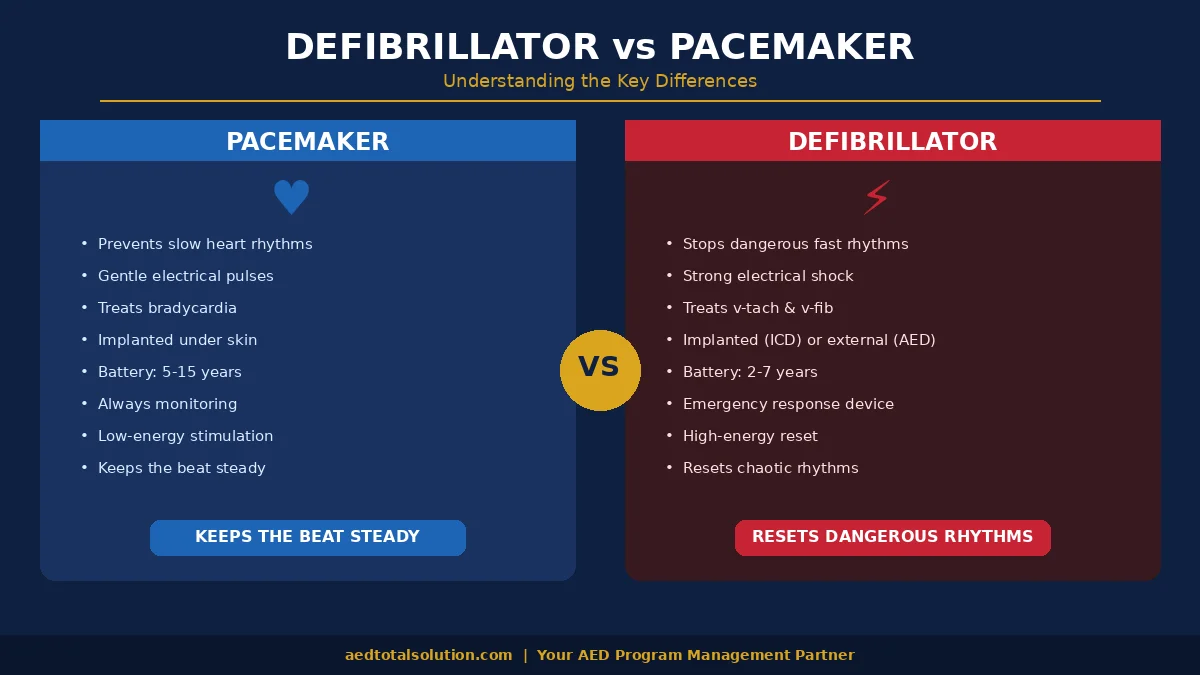
People often confuse defibrillators and pacemakers because both devices help the heart maintain a normal rhythm. However, they serve fundamentally different purposes. A pacemaker sends gentle electrical pulses to prevent the heart from beating too slowly. A defibrillator delivers a stronger shock to reset a dangerously fast or chaotic heart rhythm.
Understanding the difference between a pacemaker and a defibrillator matters beyond the hospital. It shapes how your organization prepares for cardiac emergencies, trains employees, and maintains AED (automated external defibrillator) programs. This guide breaks down how each device works, when each is used, and what it all means for workplace safety.
What Is a Pacemaker?
A pacemaker is a small, battery-powered medical device implanted under the skin near the collarbone. It connects to the heart through thin wires called leads. When the heart beats too slowly or pauses unexpectedly, the pacemaker sends a mild electrical pulse to maintain a steady rhythm.
Pacemakers are primarily used to treat bradycardia, a condition where the heart rate drops below 60 beats per minute and causes symptoms like dizziness, fatigue, or fainting. They are also used for certain types of heart block, where electrical signals between the upper and lower chambers of the heart are delayed or interrupted.
How a Pacemaker Works
The pacemaker continuously monitors the heart’s electrical activity. When it detects a heartbeat that is too slow or irregular, it sends a small electrical impulse through the leads to stimulate the heart muscle. Modern pacemakers are “demand” devices, meaning they only activate when needed and remain silent when the heart beats normally.
Key facts about pacemakers:
- Implanted under the skin near the collarbone during a minor surgical procedure
- Battery life typically ranges from 5 to 15 years
- Monitored remotely by a cardiologist
- Does not deliver high-energy shocks
- Treats slow heart rhythms, not fast ones
What Is a Defibrillator?
The term “defibrillator” covers several types of devices, and this distinction is important for safety managers to understand.
Implantable Cardioverter Defibrillator (ICD)
An ICD is an implanted device similar in size to a pacemaker. It monitors the heart continuously and delivers a controlled electrical shock when it detects a dangerously fast heart rhythm, such as ventricular tachycardia or ventricular fibrillation. Many modern ICDs also include pacemaker functionality, allowing them to treat both slow and fast rhythms.
ICDs are typically recommended for people who have survived sudden cardiac arrest, have certain genetic heart conditions, or have severely reduced heart function that puts them at risk for life-threatening arrhythmias.
Automated External Defibrillator (AED)
An AED is a portable, external device designed for use by bystanders during a sudden cardiac arrest (SCA) emergency. For details, see our guide on sudden cardiac arrest vs heart attack. Unlike an ICD, an AED is not implanted. It uses adhesive electrode pads placed on the chest to analyze the heart’s rhythm and deliver a shock if needed.
AEDs are the devices found in offices, schools, gyms, airports, and other public spaces. They are designed to be used by anyone, even without medical training, thanks to voice prompts and automated rhythm analysis. AEDs are a critical component of workplace emergency preparedness and AED program management.
Defibrillator vs Pacemaker: Key Differences
Understanding the core differences between these devices helps clarify their roles in cardiac care and workplace safety.
| Feature | Pacemaker | Implantable Defibrillator (ICD) | AED (External Defibrillator) |
|---|---|---|---|
| Purpose | Prevents slow heart rhythms | Stops dangerously fast rhythms | Treats sudden cardiac arrest |
| How it works | Gentle electrical pulses | Controlled shock to reset rhythm | External shock via chest pads |
| Location | Implanted under the skin | Implanted under the skin | Portable, kept on-site |
| Who uses it | Patient (automatic) | Patient (automatic) | Bystander or first responder |
| Conditions treated | Bradycardia, heart block | Ventricular tachycardia, ventricular fibrillation | Sudden cardiac arrest (SCA) |
| Shock intensity | Low-energy pulses | High-energy shock | High-energy shock |
| Requires surgery | Yes | Yes | No |
| Battery life | 5-15 years | 5-7 years | 2-5 years (standby) |
The Core Distinction
A pacemaker is like a metronome that keeps the heart beating at a steady pace when it slows down. A defibrillator is like a reset button that restores normal rhythm when the heart spirals into a chaotic or dangerously fast pattern.
Neither device prevents heart disease. They manage rhythm problems that arise from existing cardiac conditions. The pacemaker addresses the “too slow” problem. The defibrillator addresses the “too fast and chaotic” problem.
Is a Defibrillator the Same as a Pacemaker?
No. A defibrillator is not the same as a pacemaker, although some modern implanted devices combine both functions. Here is how they differ:
A pacemaker sends low-energy electrical pulses to prevent the heart from beating too slowly. It does not deliver shocks.
An implantable defibrillator (ICD) monitors the heart for life-threatening fast rhythms and delivers a high-energy shock to reset the heart. Many ICDs also have built-in pacemaker capability to address slow rhythms.
An AED is a completely different category. It is an external, portable device that anyone can use during a cardiac emergency. It is not implanted and not a replacement for either a pacemaker or ICD.
The key takeaway: pacemakers and defibrillators are complementary tools that address different types of cardiac rhythm problems. Some patients may have both an ICD and pacemaker function in a single device, known as a combination device.
Can You Use an AED on Someone With a Pacemaker?
Yes. You can and should use an AED on someone experiencing sudden cardiac arrest, even if they have a pacemaker or ICD. The AED will not damage the implanted device.
However, there are special considerations when using an AED on someone with an implanted cardiac device:
- Avoid placing AED pads directly over the implanted device. You may see or feel a small bump under the skin near the collarbone. Place the AED pad at least one inch away from the device.
- Follow the AED’s voice prompts. The device will analyze the heart’s rhythm and determine whether a shock is needed, regardless of whether the person has an implant.
- Do not delay. An implanted pacemaker or ICD does not eliminate the need for external AED use during sudden cardiac arrest. The implanted device may have failed, or the rhythm may require an external shock.
Learn more about proper electrode positioning in our AED pad placement guide.
When Is Each Device Used?
Pacemaker Use Cases
Pacemakers are prescribed for conditions involving slow or irregular heartbeats:
- Bradycardia: Heart rate consistently below 60 bpm causing symptoms
- Heart block: Delayed or blocked electrical signals between heart chambers
- Sick sinus syndrome: The heart’s natural pacemaker (SA node) malfunctions
- After heart surgery: Some patients need temporary or permanent pacing post-procedure
ICD Use Cases
ICDs are recommended for patients at high risk of sudden cardiac arrest:
- Previous sudden cardiac arrest survivor
- Ventricular tachycardia: Dangerously fast heart rhythm originating in the lower chambers
- Ventricular fibrillation: Chaotic electrical activity causing the heart to quiver instead of pump
- Severe heart failure: Ejection fraction below 35%, indicating high arrhythmia risk
- Genetic heart conditions: Hypertrophic cardiomyopathy, long QT syndrome, Brugada syndrome
AED Use Cases
AEDs are used in emergency situations when someone collapses and shows signs of sudden cardiac arrest:
- Sudden collapse with no pulse
- Unresponsiveness and no normal breathing
- Witnessed or unwitnessed cardiac arrest in any setting
Understanding when to use an AED and recognizing AED shockable rhythms are critical skills for anyone responsible for workplace safety.
What Is the Connection Between SCA, AEDs, and Implanted Devices?
Sudden cardiac arrest (SCA) is the sudden loss of heart function, breathing, and consciousness. It is caused by an electrical malfunction in the heart that produces an abnormal rhythm. SCA can happen to anyone, including people who already have pacemakers or ICDs.
Here is how the devices relate to SCA:
- Pacemakers do not treat SCA. They prevent slow rhythms but cannot deliver the high-energy shock needed to stop ventricular fibrillation.
- ICDs are designed to detect and treat SCA by delivering an internal shock. However, ICDs can fail, or the arrhythmia may overwhelm the device.
- AEDs are the first line of defense in any out-of-hospital SCA event. They work regardless of whether the victim has an implanted device.
This is why every workplace needs accessible, maintained AEDs as part of a comprehensive emergency response plan. Relying solely on implanted devices is not sufficient. According to the American Heart Association, fewer than 12% of out-of-hospital SCA victims survive. Having an AED available and using it within the first few minutes can increase survival rates dramatically. For more information, read our guide on cardiac arrest survival statistics.
Why Workplaces Need AEDs Regardless of Implanted Devices
Some organizations assume that employees with pacemakers or ICDs are “covered” and that AEDs are unnecessary. This is a dangerous misconception.
Here is why every workplace needs an AED program:
- SCA strikes without warning. Most SCA victims have no prior diagnosis of heart disease. You cannot predict who will need an AED.
- Implanted devices can fail. Battery depletion, lead fracture, or device malfunction can prevent an ICD from delivering a needed shock.
- AEDs cover everyone. They work on anyone experiencing a shockable rhythm, whether or not they have an implanted device.
- Response time is everything. For every minute without defibrillation, survival rates drop 7-10%. Waiting for EMS is often too long.
- Regulatory compliance. Many states have AED requirements for certain facility types. OSHA guidance strongly recommends AED programs for workplaces.
AED Total Solution provides comprehensive AED program management that includes device selection, placement guidance, inspection tracking, compliance monitoring, and audit-ready documentation. Whether you are building a new program or upgrading an existing one, our white-glove approach ensures your AEDs are always response-ready.
Combination Devices: Pacemaker and Defibrillator in One
Modern cardiac technology has produced combination devices that integrate both pacemaker and ICD functions into a single implant. These are sometimes called CRT-D (cardiac resynchronization therapy with defibrillator) devices.
Combination devices can:
- Pace the heart when it beats too slowly (pacemaker function)
- Deliver a shock when a life-threatening fast rhythm is detected (ICD function)
- Synchronize the heartbeat in patients with heart failure (CRT function)
These devices are typically recommended for patients with heart failure combined with a high risk of sudden cardiac arrest. They reduce the need for multiple separate devices and simplify ongoing cardiac care.
Even patients with combination devices benefit from having accessible AEDs in their workplace. No implanted device is 100% reliable, and external AED availability provides an essential safety net.
How to Build a Workplace AED Program
Understanding the difference between pacemakers and defibrillators reinforces why external AEDs are non-negotiable for workplace safety. For details, see our guide on what a defibrillator is. Here is how to build an effective program:
- Assess your facility. Determine how many AEDs you need based on building size, occupancy, and response time goals.
- Select the right devices. Choose FDA-approved AEDs from trusted manufacturers. Browse our AED selection.
- Train your team. Ensure designated responders know how to use an AED and hold current AED certification.
- Maintain compliance. Regular inspections, battery and pad tracking, and proper documentation are essential. AED Total Solution handles all of this through our program management services.
- Consider flexible options. For events or temporary sites, explore our AED rental program.
Frequently Asked Questions
What is the main difference between a defibrillator and a pacemaker?
A pacemaker prevents the heart from beating too slowly by sending gentle electrical pulses. A defibrillator detects life-threatening fast heart rhythms and delivers a strong electrical shock to reset the heart. They treat opposite types of rhythm problems.
Is a defibrillator the same as a pacemaker?
No. While both are cardiac devices that address heart rhythm issues, they work differently. Pacemakers treat slow heartbeats. Defibrillators treat dangerously fast or chaotic heartbeats. Some modern implanted devices combine both functions in one unit.
Can someone have both a pacemaker and a defibrillator?
Yes. Combination devices that include both pacemaker and ICD functionality are common. These devices can pace the heart when it beats too slowly and deliver a shock when a dangerous fast rhythm is detected.
Can you use an AED on a person with a pacemaker?
Yes. AEDs are safe to use on people with pacemakers or implanted defibrillators. Place the AED pads at least one inch away from the implanted device and follow the AED’s voice prompts normally.
Do workplaces need AEDs if employees have pacemakers?
Absolutely. Pacemakers do not treat sudden cardiac arrest. AEDs are needed regardless of whether anyone in the workplace has an implanted cardiac device. SCA can strike anyone, and AEDs are the most effective response in the critical first minutes.
What is an ICD vs a pacemaker?
An ICD (implantable cardioverter defibrillator) monitors the heart for dangerous fast rhythms and delivers a shock to restore normal rhythm. A pacemaker monitors for slow rhythms and delivers gentle pulses to maintain a steady heartbeat. ICDs handle emergencies; pacemakers handle ongoing rhythm support.
Written by Prabakar Mahalingam, Managing Partner at AED Total Solution. Prabakar is a nationally recognized provider of safety training, products, and compliance software dedicated to addressing sudden cardiac arrest. With extensive experience in AED program management across North America, he leads AED Total Solution’s mission to ensure every organization is prepared for cardiac emergencies.
Reviewed for medical accuracy. This article is for informational purposes only and does not constitute medical advice. Consult a qualified healthcare provider for questions about cardiac devices or treatment options.
Sources:
– American Heart Association (AHA) – Cardiac Device Guidelines
– OSHA Guidance on Workplace AED Programs
– Cleveland Clinic – Pacemakers vs Defibrillators
– National Heart, Lung, and Blood Institute (NHLBI) – Arrhythmia Treatment
Disclaimer for information purposes only:
The information provided on this website is intended for general educational and informational purposes only. It is not medical advice and should not be used as a substitute for professional diagnosis, treatment, or care. Always consult a qualified healthcare or medical professional regarding any health-related questions or concerns.
While we strive to ensure the information shared is accurate and up to date, no guarantees are made regarding completeness, accuracy, or applicability to any individual situation. Use of this content is at the reader’s sole discretion and risk.
This website is part of the Response Ready family of emergency preparedness and training resources, including CPR & first aid training and compliance services, AED sales and program support, AED program management software, and medical oversight solutions provided through our affiliated platforms:
• CPR1.com
• AEDLeader.com
• ResponseReady.com
• MDSIMedical.com
By accessing or using this website, you agree to release, indemnify, and hold harmless the website owners, authors, contributors, and affiliated entities from any claims, losses, damages, or liabilities arising from the use or reliance on the information presented.