Every AED comes with visual diagrams on the pads and voice prompts to walk you through the process. But in a real emergency, seconds matter, and preparation beats improvisation. Understanding the correct AED pad locations before an emergency gives you the confidence to act immediately when someone’s life is on the line.
This guide covers every AED pad placement scenario you may encounter: standard adult positioning, the front-and-back method for children, and how to handle real-world complications like a wet chest or an implanted pacemaker. By the end, you will know exactly where to place AED pads for any situation.
Key Takeaways
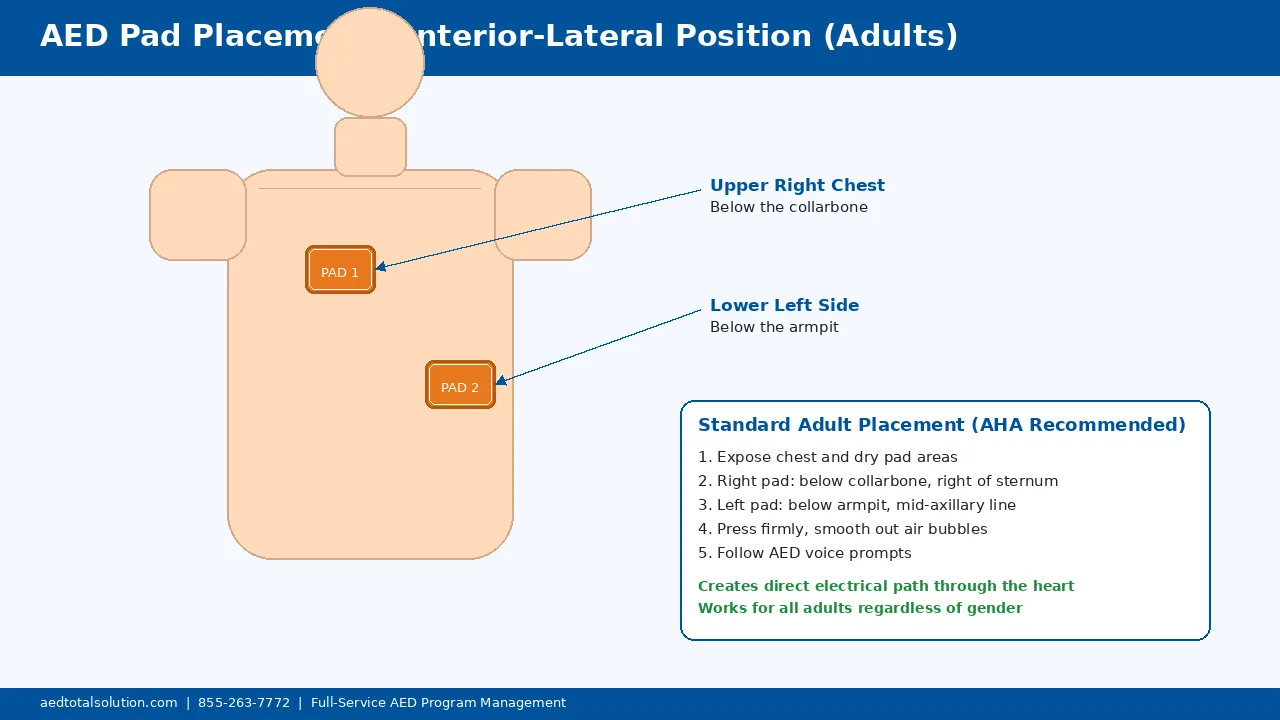
- Standard adult AED pad locations use the anterior-lateral position. Place one pad on the upper right chest just below the collarbone and the second pad on the lower left side of the chest beneath the armpit. This creates a direct electrical pathway through the heart.
- Children and infants require the anterior-posterior method. For patients under 8 years old or weighing less than 55 pounds, place one pad on the center of the chest and one on the back between the shoulder blades to prevent pad overlap.
- Always prepare the chest before placing pads. Expose bare skin, dry any moisture, shave excessive hair from pad areas, remove medication patches, and position pads at least one inch from any implanted device.
Why Correct AED Pad Locations Matter
When someone experiences sudden cardiac arrest, their heart’s electrical system malfunctions. An Automated External Defibrillator (AED) can analyze the heart’s rhythm through its electrode pads and deliver a controlled shock to restore a normal heartbeat. For details, see our guide on what AED stands for. But the device can only work if those pads are positioned correctly.
According to the American Heart Association’s 2025 Guidelines for CPR and Emergency Cardiovascular Care, correct pad positioning maximizes the delivery of transthoracic current, which is the electrical energy that passes through the heart muscle. ZOLL Medical explains that “careful pad placement allows for the most direct and unobstructed path of transthoracic current,” while “improper pad placement and the presence of a variety of substances can create resistance to current flow.”
In practical terms, this means that misplaced pads can weaken or misdirect the shock, reduce the chances of restoring a normal rhythm, and ultimately lower the person’s chance of survival. Getting the placement right is one of the most important things you can do during a rescue.
Standard Adult AED Pad Placement: The Anterior-Lateral Position
The anterior-lateral position is the default method recommended by the AHA for adults and children over 8 years old (or over 55 pounds). “Anterior” means the front of the body, and “lateral” means the side.
Step-by-Step Placement
- Expose the chest. Cut or remove clothing to access bare skin. Every second counts, so do not hesitate to use scissors from the AED kit.
- Dry the skin. If the chest is wet or sweaty, wipe only the areas where the pads will go.
- Place the first pad (right side). Position it on the upper right chest, just below the collarbone (clavicle), to the right of the sternum (breastbone).
- Place the second pad (left side). Position it on the lower left side of the chest, below the armpit along the mid-axillary line. For women, place this pad below and to the side of the left breast. The AHA specifies that electrode pads should not incorporate any breast tissue.
- Press firmly. Smooth each pad from the center outward to eliminate air bubbles and secure the edges. Studies cited by ZOLL Medical recommend applying at least 80 newtons of force when adhering pads for optimal contact.
- Follow the AED prompts. The device will analyze the rhythm and instruct you whether a shock is needed.
Why This Position Works
This arrangement places the heart directly between the two pads. The electrical current travels from the upper right pad down through the cardiac muscle to the lower left pad, depolarizing the maximum amount of heart tissue. This gives the AED the best chance of successfully interrupting a dangerous rhythm like ventricular fibrillation.
Anterior-Posterior AED Pad Placement: The Front-and-Back Method
The anterior-posterior position is an alternative that places one pad on the front of the chest and one on the back. The AHA recognizes both methods as acceptable for adult defibrillation, with research showing comparable outcomes.
When to Use This Method
- The person has an implanted pacemaker or defibrillator near the standard pad location
- A child’s chest is too small for both pads without overlapping
- Medication patches, burns, or trauma block the standard pad sites
- The AED manufacturer’s instructions specifically recommend it
How to Position the Pads
- Front pad: Place it on the center of the chest over the sternum, or over the left side of the chest between the midline and the nipple.
- Back pad: Place it on the upper left side of the back, just below the left shoulder blade (scapula), to the left of the spine.
This positions the heart between the two pads from front to back. The current passes through the full depth of the cardiac muscle, which can be particularly effective for patients with anatomical considerations that make standard placement difficult.
Pediatric AED Pad Locations: Children and Infants
Cardiac arrest in children is less common than in adults, but when it happens, knowing the correct AED pad placement for pediatric patients is critical. The 2025 AHA Pediatric Basic Life Support Guidelines recommend attaching an AED as soon as possible using a pediatric attenuator and pediatric pads if available.
Choosing the Right Pads
- Under 8 years old or under 55 pounds (25 kg): Use pediatric AED pads if your device has them. These deliver a reduced energy level appropriate for a smaller body.
- Over 8 years old or over 55 pounds: Use standard adult pads with standard energy levels.
- No pediatric pads available: Adult pads can be used on children and infants, as long as the pads do not touch or overlap. The American Red Cross confirms: “If pediatric-specific AED pads are unavailable, adult pads may be used for infants and children, provided the pads do not touch each other.”
Important: Never use pediatric pads on a patient older than 8 or heavier than 55 pounds. The reduced energy will not be sufficient to defibrillate effectively.
The Anterior-Posterior Method for Children
Because a child’s or infant’s chest is small, placing both pads on the front often causes them to overlap, which reduces or eliminates shock effectiveness. The recommended approach:
- Front pad: Center of the chest on the sternum.
- Back pad: Between the shoulder blades (scapulae) on the back.
- Verify spacing: Ensure the gel borders of both pads never touch through the torso.
For infants under 1 year old, the Red Cross and AHA guidelines both recommend always using the anterior-posterior position.
Special Scenarios: Adapting AED Pad Placement
Emergencies are unpredictable. Here are the most common real-world complications and how to handle each one quickly.
Wet or Sweaty Chest
Moisture on the skin can interfere with pad adhesion and may divert electrical current away from the heart. The AHA advises:
- Move the person out of standing water if possible
- Dry only the pad placement areas using a towel, cloth, or the gauze in the AED kit
- Do not delay treatment to dry the entire body
- Once pads are firmly applied with good skin contact, proceed with AED use
Excessive Chest Hair
Thick chest hair prevents the electrode pads from making full contact with the skin. The AHA’s Basic Life Support guidelines offer three solutions:
- Shave the pad areas using the disposable razor included in most AED kits
- Press firmly if hair is sparse. The adhesive may compress the hair enough for contact
- Rip-and-replace: If no razor is available, apply pads firmly, rip them off to clear the hair, then apply a fresh set of pads to the cleared skin
Pacemaker or Implantable Cardioverter-Defibrillator (ICD)
Look for a small, firm lump under the skin near the collarbone, usually on the left side, often with a surgical scar. If a pad is placed directly over the device, it can block or redirect the shock.
- Position the nearest AED pad at least one inch (2.5 cm) away from the implanted device
- If the device is near the standard right-side pad location, shift the pad lower or use the anterior-posterior method instead
- Do not delay treatment because of a pacemaker. The AED will still analyze and deliver an appropriate shock if pads are positioned properly
Transdermal Medication Patches
Patches (nitroglycerin, nicotine, fentanyl, hormone patches) can block the electrical current or cause burns under the AED pad.
- Wear gloves to protect yourself from medication absorption
- Remove any patch in or near the pad placement area
- Wipe away residue and dry the skin
- Apply the AED pad to clean, dry skin
Pregnant Patients
AED use is safe during pregnancy. Place the pads in the standard anterior-lateral position, exactly as you would for any adult. The AHA’s 2025 Guidelines specifically address cardiac arrest in pregnancy, emphasizing that prompt defibrillation is critical for both maternal and fetal survival.
Common Pad Placement Mistakes to Avoid
Even trained rescuers can make errors under stress. Watch for these common mistakes:
- Pads placed over clothing or undergarments. Always apply to bare skin.
- Pads too close together. Current may travel across the surface instead of through the heart.
- Overlapping pads on a child. Switch to the anterior-posterior method.
- Pads placed over jewelry or piercings. Remove them from the pad area, or reposition pads.
- Air trapped under pads. Press firmly from center outward to ensure full adhesion.
- Forgetting to check for patches or devices. A quick visual scan of the chest takes only seconds.
Why Training and AED Readiness Go Hand in Hand
Knowing the correct AED pad locations is only part of the equation. Training builds the muscle memory and confidence needed to act decisively in a real emergency, when adrenaline is high and thinking clearly is difficult. For more information, read our guide on AED training.
Equally important is ensuring your AED devices are maintained and ready. For details, see our guide on AED maintenance checklist. Expired pads with dried-out gel will not adhere properly, and dead batteries make the entire device useless. Regular inspections, battery and pad replacement tracking, and compliance documentation are essential to a functional AED program.
For organizations managing AEDs across multiple locations, this oversight becomes even more complex. A professional AED program management service handles every detail: automated expiration alerts, inspection tracking, compliance reporting, supply replenishment, and post-event support. This ensures your devices are not just present, but genuinely ready when someone’s life depends on it.
Frequently Asked Questions
Where do AED pads go on an adult?
Use the anterior-lateral position: one pad on the upper right chest below the collarbone and one pad on the lower left side below the armpit. Follow the visual diagrams printed on the pads for guidance.
Can you place AED pads in the wrong position?
Delivering a shock with imperfect pad placement is always better than not shocking at all. If you realize pads are reversed (left pad on right side, right pad on left), the AED will still function. Do not remove and reapply pads once placed, as this wastes critical time.
What is the difference between anterior-lateral and anterior-posterior placement?
Anterior-lateral places both pads on the front of the chest (upper right and lower left). Anterior-posterior places one pad on the chest and one on the back. Both are effective for adults. Anterior-posterior is preferred for children and infants to prevent pad overlap.
Can I use adult AED pads on a child?
Yes, if pediatric pads are unavailable. Use the anterior-posterior method so the pads do not overlap. Pediatric pads should be the first choice for children under 8 years old or weighing less than 55 pounds.
How often should AED pads be replaced?
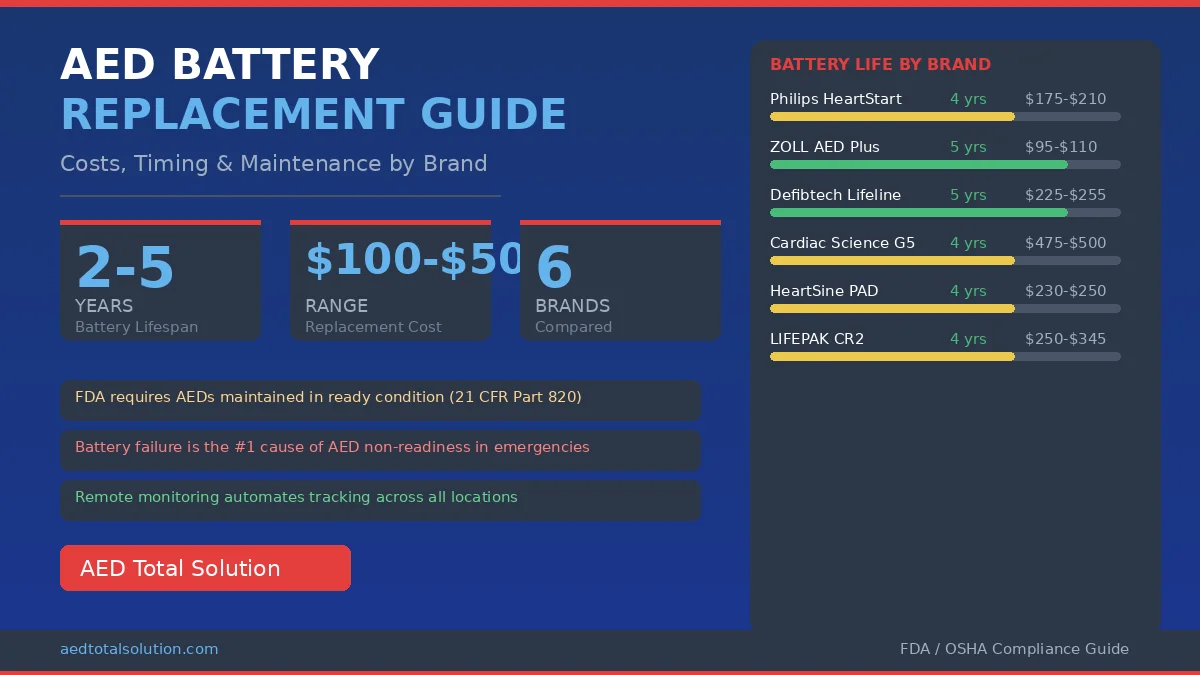
AED pads typically last 2 to 5 years, depending on the manufacturer. Check the expiration date on the packaging and replace them before they expire. Dried-out gel on expired pads prevents proper skin contact and can compromise a rescue. An AED management program automates expiration tracking so nothing is missed.
What should I do if the person has a pacemaker?
Place the AED pads at least one inch away from the implanted device. You can identify a pacemaker by a firm lump under the skin near the collarbone, often with a scar. If the standard pad location is too close, use the anterior-posterior method. Do not delay using the AED because of a pacemaker.
Disclaimer for information purposes only:
The information provided on this website is intended for general educational and informational purposes only. It is not medical advice and should not be used as a substitute for professional diagnosis, treatment, or care. Always consult a qualified healthcare or medical professional regarding any health-related questions or concerns.
While we strive to ensure the information shared is accurate and up to date, no guarantees are made regarding completeness, accuracy, or applicability to any individual situation. Use of this content is at the reader’s sole discretion and risk.
This website is part of the Response Ready family of emergency preparedness and training resources, including CPR & first aid training and compliance services, AED sales and program support, AED program management software, and medical oversight solutions provided through our affiliated platforms:
• CPR1.com
• AEDLeader.com
• ResponseReady.com
• MDSIMedical.com
By accessing or using this website, you agree to release, indemnify, and hold harmless the website owners, authors, contributors, and affiliated entities from any claims, losses, damages, or liabilities arising from the use or reliance on the information presented.