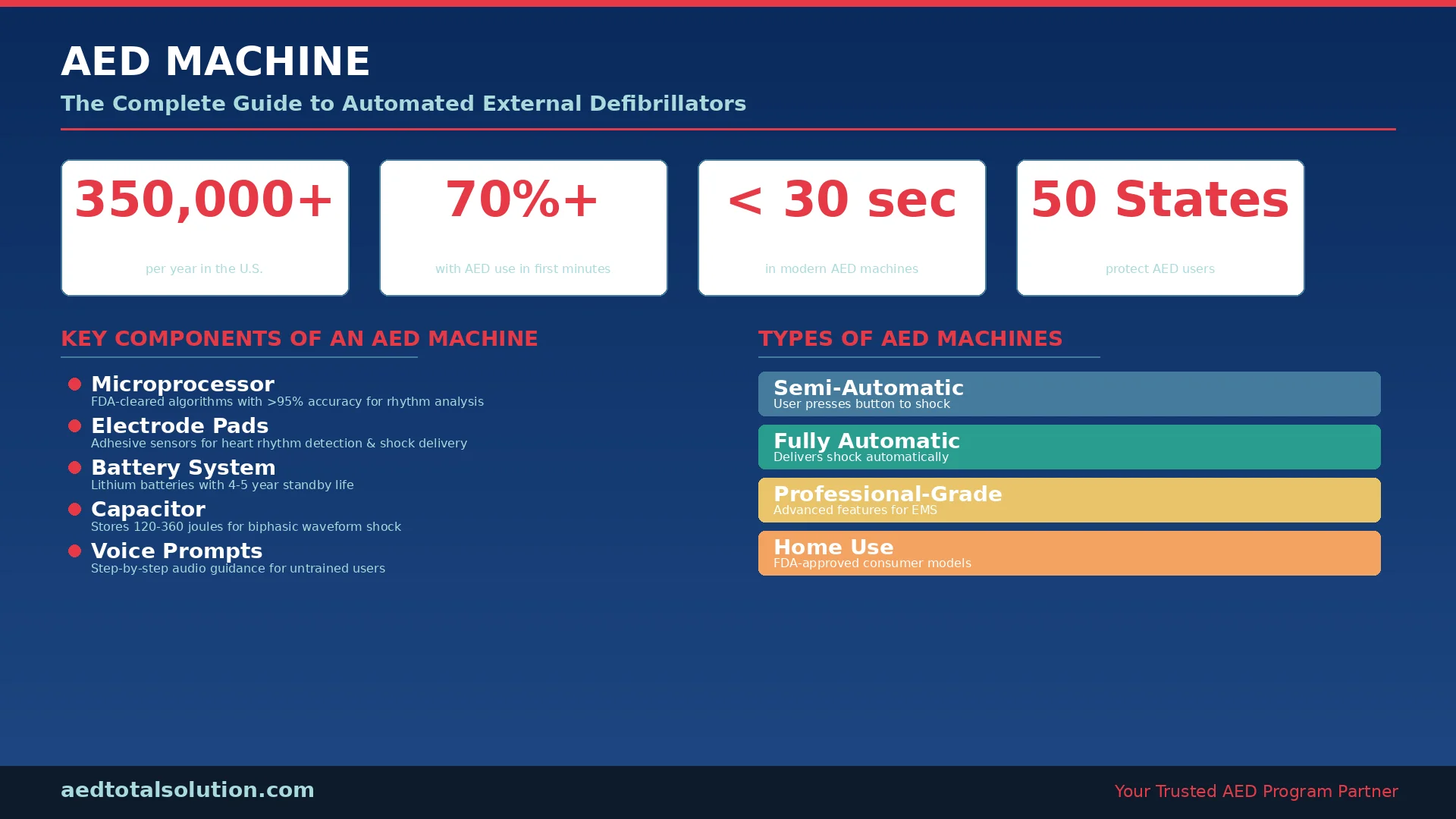
An automated external defibrillator (AED) can increase survival rates during sudden cardiac arrest to as high as 74% when used within the first few minutes. But that life-saving potential depends entirely on one thing: the device being ready when you need it. Research shows that approximately 23% of AED failures are caused by expired batteries, expired pads, or inadequate maintenance. Understanding AED inspection requirements is the foundation of keeping your devices rescue-ready at all times.
As someone who has managed AED programs for organizations across the country, I can tell you that the difference between a device that saves a life and one that fails almost always comes down to a consistent inspection routine. This guide breaks down exactly how often your AED should be inspected, what to check at each interval, and which regulatory standards you need to follow.
Why AED Inspection Requirements Matter
AEDs are not set-it-and-forget-it devices. They sit on walls or in cabinets for months or even years between uses, and during that time, batteries drain, electrode pads dry out, and components can degrade without anyone noticing. For details, see our guide on AED pad placement and condition. For every minute that defibrillation is delayed during a cardiac arrest, the chance of survival drops by 7 to 10 percent. A non-functional AED during an emergency is not just an equipment failure; it can be the difference between life and a preventable tragedy.
Beyond the critical safety concern, AED inspection requirements also carry legal weight. Most states have Good Samaritan protections for organizations with AED programs, but these protections are frequently tied to proper maintenance and documentation. Neglecting your inspection routine could void your legal protections and expose your organization to significant liability.
Regulatory Framework for AED Inspections
AED inspection requirements come from multiple levels of regulation. Understanding where these requirements originate helps you build a compliant program that meets or exceeds every standard.
FDA Classification and Requirements
The FDA classifies AEDs as Class III medical devices under Title 21, Part 870.2250 of the Code of Federal Regulations, the highest level of regulatory control. This classification means AEDs must receive FDA clearance or approval before being marketed in the United States. The FDA requires manufacturers to provide complete documentation on use, installation, operation, training, and maintenance. Organizations should register their AEDs with the manufacturer to receive safety alerts, software updates, and recall notifications.
OSHA Guidelines and the General Duty Clause
While OSHA does not have a specific standard dedicated solely to AEDs, the devices fall under OSHA’s broader workplace safety requirements. OSHA Publication 3185 (2003) encourages employers to install AEDs in workplaces and provides resources for implementation. More importantly, OSHA’s General Duty Clause (Section 5(a)(1) of the OSH Act) requires employers to maintain a workplace free from recognized hazards likely to cause serious harm. A poorly maintained or non-functional AED could be considered a failure to meet this obligation.
OSHA’s guidelines emphasize the importance of a written AED program that includes details on placement, maintenance, training, and medical oversight. Employers should establish a system for regular checks, replacement of expired consumables, and proper documentation of all maintenance activities.
American Heart Association (AHA) Recommendations
The AHA recommends both monthly and annual AED inspections to ensure devices are ready for use. Monthly checks should verify battery charge status, pad expiration dates, and device self-test results. The AHA also emphasizes regular training for designated AED responders, recommending refresher courses at least every two years.
State-Specific AED Requirements
Nearly every state has laws governing AEDs, and the specifics vary widely. For details, see our guide on AED laws and compliance requirements by state. Some states have detailed rules covering device placement, maintenance schedules, required training, and medical oversight. For details, see our guide on comprehensive AED maintenance checklist. For example, California requires AED inspections at least every 90 days and annual notification to building tenants of AED locations. Other states may require AED registration with local emergency services, specific training mandates, or medical director oversight. Because these regulations can change, it is essential to stay current with your state’s specific requirements.

The Three-Tier AED Inspection Schedule
The most effective approach to meeting AED inspection requirements is a multi-layered schedule that combines quick daily checks, detailed monthly inspections, and comprehensive annual reviews. Think of it as a system of checks and balances: daily glances catch immediate problems, monthly reviews confirm supply readiness, and annual servicing handles deeper technical maintenance.
Daily Visual Checks (Under 1 Minute)
A daily visual check is the fastest and simplest part of your inspection routine, but it is also your first line of defense against AED failure. This check should take less than one minute and should be built into your facility’s opening or closing routine.
What to check daily:
- Location and accessibility: Confirm the AED is in its designated spot, clearly visible, and not blocked by furniture, boxes, or other obstructions.
- Status indicator light: Verify the readiness indicator shows a green light, checkmark, or “OK” status, confirming the device passed its most recent self-test. A red indicator or warning chirp means immediate attention is needed.
- Physical condition: Look for any obvious signs of damage, tampering, or displacement of the device or its cabinet.
Most modern AEDs perform automatic self-tests on a regular schedule, checking internal circuitry, battery levels, and pad connections. The status indicator is your window into those self-test results. Making this daily check a habit is the easiest way to ensure your AED remains functional between more thorough inspections.
Monthly Hands-On Inspections (5 to 10 Minutes)
Monthly inspections go beyond the daily visual check and involve a more detailed, hands-on assessment of every critical component. This is where you verify that consumables are current, documentation is up to date, and the device is truly ready for a rescue.
Monthly inspection checklist:
- Status indicator verification: Confirm the readiness light shows the device is operational. Document the result.
- Battery expiration date: Check the date printed on the battery or battery compartment. Most AED batteries last 2 to 5 years depending on the manufacturer and model. Replace proactively before expiration.
- Electrode pad expiration date: Verify that both adult pads (and pediatric pads, if applicable) are sealed in their original packaging and within their expiration date. Pads typically last 2 to 4 years. Never use expired pads, as the adhesive gel degrades over time and may not stick properly during a rescue.
- Physical inspection: Examine the device for cracks, dents, moisture damage, or frayed cables. Check that all ports, connectors, and buttons are functional.
- Rescue accessories: Verify that rescue supplies are present, including gloves, a razor, scissors, a CPR barrier mask, and a towel. Replace any missing or expired items.
- Cabinet and signage: Ensure the AED cabinet opens properly, any alarm system is functional, and directional signage is visible and unobstructed.
- Storage environment: Confirm the AED is stored within its recommended temperature range (typically 32°F to 122°F) and protected from direct sunlight, excessive moisture, and dust.
- Documentation: Record the date, the inspector’s name, all findings, and any corrective actions taken in your inspection log.

Annual Comprehensive Reviews
Once a year, your AED program needs a deeper, more comprehensive evaluation. For details, see our guide on AED program management. This is ideally performed by qualified personnel familiar with your specific AED model, or by a professional AED program management service.
Annual review checklist:
- Professional device testing: Have the AED tested beyond its standard self-test. A professional service inspection includes comprehensive testing of all components and verification that the device meets manufacturer specifications.
- Battery replacement planning: Review battery expiration dates and order replacements with enough lead time to avoid any gap in readiness. Even if the battery indicator shows charge remaining, replace batteries that are approaching their end-of-life date.
- Electrode pad replacement: Replace pads before their expiration date, ideally with several months of buffer. Keep spare pad sets on hand to eliminate downtime.
- Software and firmware updates: Check with the manufacturer for any available updates. Software updates may reflect current resuscitation guidelines from the AHA and can improve device performance.
- Program documentation review: Audit your complete AED program documentation, including inspection logs, training records, and medical director oversight (if required by your state). Update your written AED policy as needed.
- Training and responder certification: Verify that all designated AED responders have current CPR/AED certification. Schedule refresher training if certifications are expiring.
- Regulatory compliance check: Review your state’s current AED laws and confirm your program meets all requirements, including registration, placement, and notification mandates.
Manufacturer-Specific AED Inspection Requirements
While the general inspection framework applies to all AEDs, each manufacturer has specific maintenance requirements that you must follow. Failing to adhere to the manufacturer’s guidelines can void your device warranty and may affect your Good Samaritan protections.
Common Manufacturer Requirements
- Self-test frequency: Most AEDs perform daily, weekly, or monthly automatic self-tests depending on the model. Some models, like the ZOLL AED Plus, run a comprehensive suite of self-tests that check circuitry, battery, and pad integrity.
- Battery replacement intervals: Typically every 2 to 5 years, but this varies by model. Some standby-only batteries last up to 5 years, while batteries in frequently used devices may need earlier replacement.
- Electrode pad replacement: Generally every 2 to 4 years. Some manufacturers require replacement at 2 years, while others allow up to 4 years if the pads remain sealed.
- Device registration: Register your AED with the manufacturer to receive recall notifications, safety alerts, and update reminders. This is a critical step that many organizations overlook.
- Data card or module checks: Some AEDs use internal data cards to store event records. Verify the card is properly installed during monthly inspections, and replace it after any use.
Always consult your AED’s user manual for the specific maintenance schedule and requirements for your model. The manual is the ultimate authority on your device’s maintenance needs.
AED Inspection Documentation Requirements
Proper documentation is just as important as the inspection itself. Without records, you have no way to prove compliance, track expiration dates, or demonstrate due diligence in the event of a legal inquiry.
What to Document
| Documentation Element | Required Information | Frequency |
|---|---|---|
| Device Inspections | Status indicator result, physical condition, location verification | Daily / Monthly |
| Battery Status | Serial number, installation date, expiration date, charge level | Monthly |
| Electrode Pads | Lot numbers, installation date, expiration date, condition | Monthly |
| Cleaning Activities | Date, method, responsible staff member | Monthly |
| Software Updates | Version number, installation date, confirmation | As needed |
| Training Records | Responder names, certification dates, expiration dates | Annually |
| Corrective Actions | Issue identified, action taken, date resolved | As needed |
Using a digital tracking system or an AED program management service can simplify documentation significantly. Automated reminders eliminate the risk of forgotten inspections, and centralized dashboards give you instant visibility into the compliance status of every device across all your locations.
Common AED Inspection Failures and How to Prevent Them
Understanding the most common points of failure helps you focus your inspection efforts where they matter most.
- Expired batteries: This is the number one cause of AED failure. Set calendar reminders well in advance of expiration dates and keep replacement batteries on hand.
- Expired electrode pads: Pads are the second most common failure point. The adhesive gel degrades over time, even in sealed packaging. Track expiration dates and order replacements proactively.
- Missed inspections: Busy teams skip inspections, especially when the process is manual. Automate reminders and designate backup inspectors for vacations and absences.
- Improper storage: AEDs stored in extreme temperatures, direct sunlight, or high-humidity environments can suffer accelerated component degradation. Ensure your storage location meets manufacturer specifications.
- Lack of documentation: Even if inspections are performed, a lack of records can create legal risk and make it impossible to track trends or identify recurring issues.
How a Managed AED Program Simplifies Inspection Compliance
For organizations managing multiple AEDs across one or more locations, maintaining a consistent inspection routine can be challenging. Staff turnover, competing priorities, and the sheer volume of tracking requirements can lead to gaps in your program.
A full-service AED program management solution takes the burden off your team by handling every aspect of AED compliance. This includes automated inspection reminders and scheduling, centralized dashboards with real-time device status, proactive supply replenishment for batteries and pads, audit-ready documentation and reporting, and expert oversight from dedicated program managers.
Instead of relying on manual checklists and spreadsheets, a managed service ensures that nothing falls through the cracks. Your organization stays compliant with federal guidelines, state laws, and manufacturer requirements without the administrative overhead.
Conclusion: Build an Inspection Routine That Protects Lives
Meeting AED inspection requirements is not optional. It is a responsibility that comes with owning a life-saving device. The good news is that the process is straightforward when you break it into daily, monthly, and annual tasks. A quick daily glance at the status indicator, a thorough monthly review of all components and expiration dates, and a comprehensive annual evaluation keep your AED rescue-ready 365 days a year.
The stakes are too high to leave AED readiness to chance. Whether you manage one device or hundreds, a consistent, documented inspection program is the foundation of a responsible AED program. If managing these requirements internally feels overwhelming, partnering with an AED program management provider can give you confidence that every device is compliant, functional, and ready to save a life when seconds matter most.